Iran's Hormuz Strikes Shift Gulf Alliances
Iran's missile strikes reshape Gulf security dynamics.
Model Diplomat9 min readMiddle East
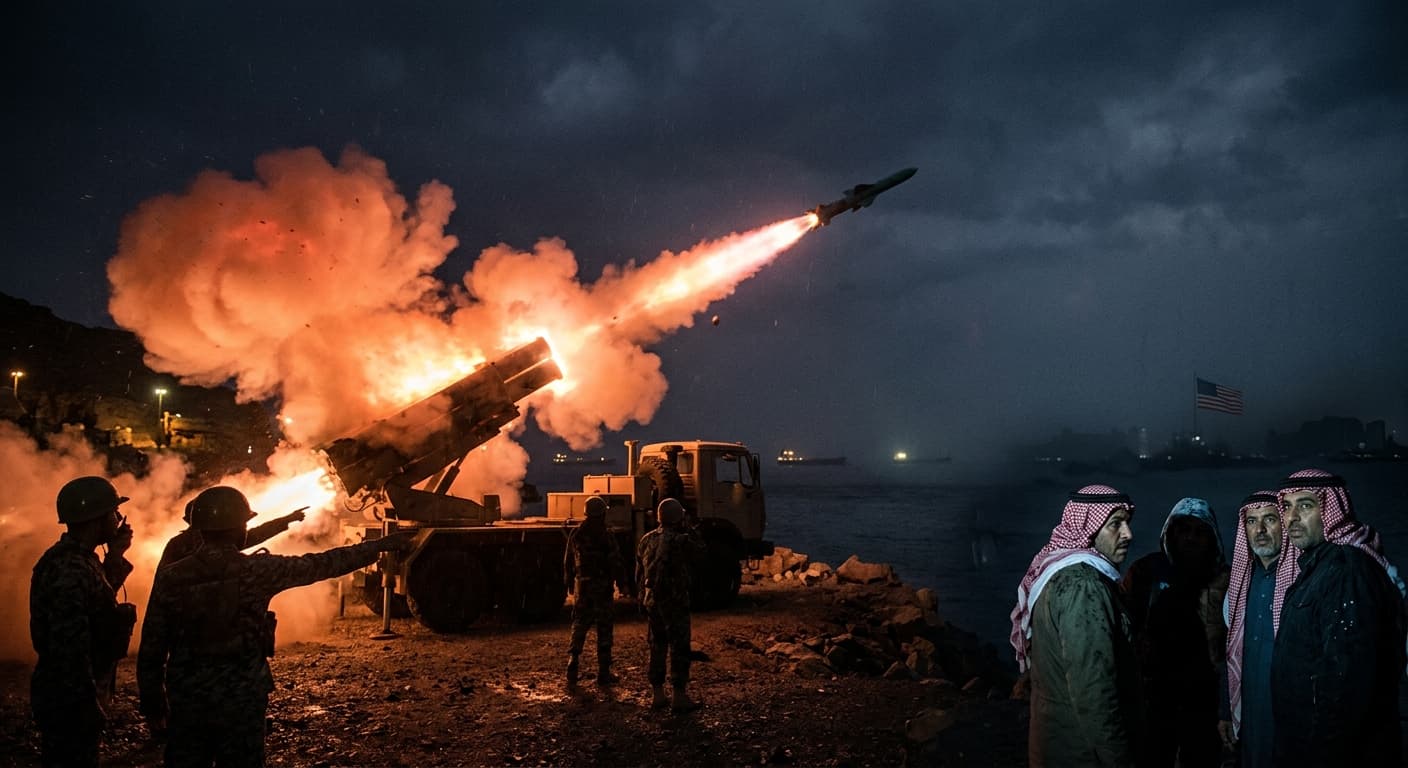
Iran's Hormuz missile strikes push Gulf states off the US line
Iran's July 7 strikes on two ships in the Strait of Hormuz have shattered Trump's 60-day truce — and the biggest strategic winner is Paris and London, not Washington.
Iran's Islamic Revolutionary Guard Corps fired at least two missiles at commercial vessels in the Strait of Hormuz in the early hours of July 7, 2026, hitting an LNG carrier reportedly linked to Qatar's Nakilat fleet east of the Omani village of Limah. The strikes are the first inside the strait since Presidents Donald Trump and Masoud Pezeshkian signed the Islamabad Memorandum of Understanding on June 17, and they come three days after London, Paris and Muscat announced a Franco-British "Multinational Military Mission" to escort shipping — without Washington. The real story is not another tanker on fire; it is that the Gulf's post-war security architecture is now being drafted in Europe and Oman, over Washington's objections, with China quietly the biggest structural beneficiary.
Axios first reported the strikes citing US and British briefings, with no casualties but "significant damage" to two ships, according to The Straits Times. The UK Maritime Trade Operations centre confirmed a tanker "set ablaze after being struck by a projectile" near Limah at first light, per the
Globe and Mail wire report. Iranian state television said the LNG carrier had "ignored warnings" from IRGC controllers, according to
The Hindu's live tracker of Khamenei-funeral-week events. This is Iran's fifth attack on commercial shipping since the June 17 MoU; MarineTraffic has now recorded at least 49 attacks on commercial vessels since February 28, most claimed by or attributed to Iranian forces.
What Iran is actually doing
Read narrowly, this is one more escalation on a graph line that has trended up since Ayatollah Ali Khamenei was killed on February 28 in a US airstrike on Tehran. Read strategically, it is Tehran's answer to a specific US demand — that the strait revert to being a toll-free international waterway managed by no one.
The MoU's Point 5 is unambiguous on the transition, and clumsy on the endgame. It commits Iran to "best efforts for the safe passage of commercial vessels with no charge for 60 days" and asks Tehran to "conduct dialog with the Sultanate of Oman to define the future administration and maritime services in the Strait of Hormuz," per the full text published by the BBC. Iran's chief negotiator Mohammad Bagher Ghalibaf said the same week that the strait "will not return to pre-war conditions" and that Iran would "receive a fee for services," according to
Al Jazeera. That is the whole quarrel.
Tehran wants to convert de facto wartime control into a permanent tolling regime through the Persian Gulf Strait Authority — an IRGC-controlled body already sanctioned by the US, EU and UK. Ships wanting transit must email the IRGC, answer more than 40 questions on origin, cargo, crew nationality and vessel value, and pay for a "passage permit," per NPR's reporting on the mechanics. Auxilium Worldwide's Ian Ralby told NPR any such payment would "potentially be considered funding of terrorism" under existing sanctions on the IRGC — meaning even shipowners who want to comply risk secondary sanctions on their whole fleet. Secretary of State Marco Rubio flatly rejected the arrangement on a June 24 UAE visit: "It's an international waterway. No country is allowed to charge tolls or fees on an international waterway,"
Al Jazeera reported.
Today's strikes are Tehran's costliest signal so far that the tolling question is not negotiable. The IRGC — now firmly under Mojtaba Khamenei, whom the Assembly of Experts confirmed as supreme leader on March 8 — is enforcing the permit regime by making non-compliance visibly dangerous. Mojtaba lost his father, mother, wife and a son in the February 28 strike, and the BBC has noted analysts do not expect him to bow to Western pressure. Alan Eyre, a former senior US diplomat, told
Al Jazeera that the MoU "was a one-pager with a lot of things left to be filled in later" — a text vague enough for both sides to declare victory and fight over the details in fire.
The Europe move Washington did not want
The most consequential document of the past week was not filed in Tehran or Washington. On July 3, 2026, Downing Street published a joint statement from Prime Minister Keir Starmer and President Emmanuel Macron declaring that Oman had "agreed to work with the United Kingdom and France to ensure that its sovereign territorial waters are safe for navigation," and that the two governments "stand ready to deploy the wider Multinational Military Mission to support freedom of navigation in the Strait of Hormuz," according to the primary text on GOV.UK.
The United States is not a party. That is not an accident. ISPI's Eleonora Ardemagni had already noted in April that Saudi Arabia, Qatar and Kuwait joined the Franco-British "coalition of the willing for Hormuz" at ministerial level while "the US didn't send representatives at the conference," per ISPI. At the UN Security Council on July 2, UK ambassador James Kariuki formally endorsed the parallel track, saying London supports the International Maritime Organization's evacuation of stranded vessels and calling for transit rights "in accordance with international law, as reflected in the United Nations Convention on the Law of the Sea," per the transcript on
GOV.UK.
Four months into the war, the GCC has split three ways. The UAE and Bahrain want the US and Israel to finish Iran off — Abu Dhabi was the first to brand IRGC behaviour "economic terrorism," and Manama drafted a UNSC text demanding reopening "by all necessary means" that Russia and China vetoed, per ISPI. Qatar and Oman, whose economies were disproportionately damaged — QatarEnergy declared force majeure after Iranian missiles caused what its foreign ministry called "significant damage" at Ras Laffan on March 18, per
Al Jazeera — want to talk. Saudi Arabia and Kuwait oscillate. What unites five of the six — everyone but the UAE — is discomfort with an American solution that treats the Gulf as a US theatre.
That discomfort is now doctrinal, not situational. Annelle Sheline of the Quincy Institute told Al Jazeera that US bases "actually" produced "the opposite of a deterrent effect. These military bases became targets." Carnegie's assessment is harsher still: "A substantial US and Israeli air campaign was unable to eliminate Iran's will or capability to exert power in the Gulf," and the GCC "has no seat at the table, despite its entreaties, for negotiations that will shape the bloc's economic and security environment for years to come," per
Carnegie Endowment.
What the July 3 statement does, in effect, is give Oman a way to sign a bilateral transit-management deal with Tehran under a European security umbrella — one that finesses the "tolls versus service fees" quarrel by letting Muscat, not the IRGC, collect and administer any charges. That is precisely the outcome the US delegation warned against in a background briefing after signing the MoU, telling reporters via the BBC that "Gulf states would never accept a future in which there is a tolling system in place." Except three of them just did — under a European flag, without Washington in the room.
The oil market has already voted
Markets have priced in the shift more quickly than diplomats. Brent crude, which topped $126 a barrel on April 30, closed at $70.82 on July 2, below its pre-war level of $72.48, according to Al Jazeera. OPEC+ announced on July 6 that seven producers — Saudi Arabia, Russia, Iraq, Kuwait, Kazakhstan, Algeria and Oman — will add 188,000 barrels per day from August, the fifth consecutive monthly increase, per
Al Jazeera.
That is a producer cartel betting that the strait stays operationally open even as it becomes politically contested. Iran has pushed close to 50 million barrels of previously blockaded crude to market since June 17, Sparta Commodities' Kang Wu Yip told Al Jazeera, and Saudi Arabia has more than doubled shipping volumes over the prior three months combined. Roughly 40 vessels crossed the strait on July 1, versus 130 daily pre-war and single digits at the wartime nadir. The International Energy Agency's record 400-million-barrel emergency release announced on March 11 — nearly double the 2022 post-Ukraine release, per
Al Jazeera — served its purpose: it capped the risk premium long enough for pipelines through Saudi Arabia's East-West line, the UAE's Abu Dhabi Crude Oil Pipeline, and the Iraq-Türkiye line to absorb some traffic.
But those bypasses cover only a fraction of the roughly 20 million barrels a day that traversed the strait pre-war. Sparta's June Goh told Al Jazeera that the war has locked in a "sustained push by energy producers and consumers alike to reduce their reliance on the strait" — new pipelines for producers, larger strategic petroleum reserves for buyers. Today's strikes will accelerate every one of those decisions.
The historical parallel — and the beneficiary nobody names
Look for the analogue and it is not the 1988 Tanker War, when US Navy convoys reflagged Kuwaiti tankers under Operation Earnest Will and confronted Iran directly. It is closer to 1971, when Britain withdrew "east of Suez" and the Gulf's security guarantor changed. Except this time the direction is reversed: a US withdrawal in effect, if not in name, with European navies and Omani administration filling the void.
That is where Beijing wins without spending a bullet. China brokered the Saudi-Iran normalisation of March 2023 and has consistently opposed Iran charging tolls — the White House's readout of a Trump-Xi meeting explicitly said Xi opposed the fee regime, per NPR — but Beijing has also, alongside Russia, vetoed the US-backed Chapter VII resolution that would have authorised force to reopen the strait, per
Al Jazeera. China gets a strait that stays open enough for Iranian crude to flow to Chinese refiners under the eased sanctions regime —
BBC Verify reported that at least 30 Iranian-linked tankers moved oil out of the Gulf in the week after the MoU — while the US absorbs the diplomatic cost of every incident like today's.
The GCC is drawing its own conclusions. Al Jazeera has documented conversations between Emirati and Iranian officials, including IRGC representatives, on "various types of economic incentives" to make Iran investable, per Al Jazeera. Even the UAE — the most hawkish GCC state — is quietly hedging. Saudi Arabia signed a mutual-defence agreement with Pakistan last September that treats an attack on one as an attack on both, and Riyadh is now discussing an expanded "quad" with Türkiye, Egypt and Islamabad. None of these arrangements require Washington's permission.
What to watch
- August 16, 2026 — the 60-day MoU deadline. If Iran resumes formal tolling on August 17, expect either a US military response or a tacit acceptance that Omani administration is the workaround. The strikes today make the latter marginally more likely by demonstrating what enforcement looks like.
- August 2, 2026 — the next OPEC+ meeting. Whether Saudi Arabia keeps unwinding cuts is a real-time referendum on whether Riyadh believes the strait stays open.
- The next incident. The IRGC's tempo has been roughly one major strike per week since June 17. The question is not whether but where — and whether the Franco-British mission's rules of engagement, still undisclosed, permit escort within Iranian territorial waters.
Diplomat View
The forecast: within 90 days, Oman will announce a "maritime services" framework co-signed with Iran, blessed by the UK and France, quietly tolerated by Saudi Arabia and Qatar, and formally rejected by Washington and the UAE. Ships will pay Muscat, not the IRGC. The US will not go to war to stop it, because it has already discovered that a "substantial" air campaign — the Carnegie phrase — could neither reopen the strait nor bring Tehran to heel. Trump will claim victory on the toll-free letter of the MoU while a service-fee regime operates in practice. This forecast would revise if: (a) Iran targets a US-flagged or US-crewed vessel, forcing direct escalation; (b) Mojtaba Khamenei is killed, as Israel's defence minister has publicly threatened, opening a succession vacuum Rand's analysts warn could collapse into a "quasi-military junta"; or (c) the UAE persuades Saudi Arabia to reunify the GCC around the American position — a scenario Riyadh's oscillating diplomacy makes unlikely before year-end.
The Bottom Line
The July 7 strikes did not break the MoU; they revealed that it was already broken by design — a one-page truce that let each side define the strait as it chose. The winner is not Iran, which will remain sanctioned and isolated, but the coalition of European and Gulf states now building a security order that treats Washington as a customer rather than a manager. If that architecture holds, Hormuz will be the first chokepoint of the century where the United States sets neither the rules nor the price.
Discover more
US Politics
House Ethics Committee Pushes Sexual Miscond.
The House Ethics Committee has shifted responsibility for sexual harassment settlement records to the Office of Congressional Workplace Rights, complicating disclosure efforts.
US Politics
SNAP Food Assistance Faces Legal Challenges
In 2026, SNAP faces stricter eligibility rules and mounting legal challenges, threatening food assistance for the millions of Americans who rely on the program.

India
Delhi CM Rekha Gupta Blasts Opposition's Delm
Delhi CM Rekha Gupta's remarks on women's quota defeat reveal BJP's strategy for the 2029 Lok Sabha elections, focusing on delimitation.

Conflict & Security
Drone Warfare Killing Aid Workers at Unprec
Over 1,000 humanitarian workers killed in three years as cheap armed drones collapse legal protections. Gaza, Sudan, Ukraine, and DRC see deliberate targeting of aid convoys and hospitals with zero prosecutions.

