Iran's Hormuz Missile Strikes: A Toll Booth
Tehran's missile attack reveals new maritime control tactics.
Model Diplomat8 min readMiddle East
Iran's Hormuz Missile Strikes Turn a Ceasefire Into a Toll Booth
Iran's July 7 missile attack on a Qatari-linked gas tanker near Oman shows Tehran is using the Strait of Hormuz as coercive leverage — and the Gulf states, not the US, are paying the bill.
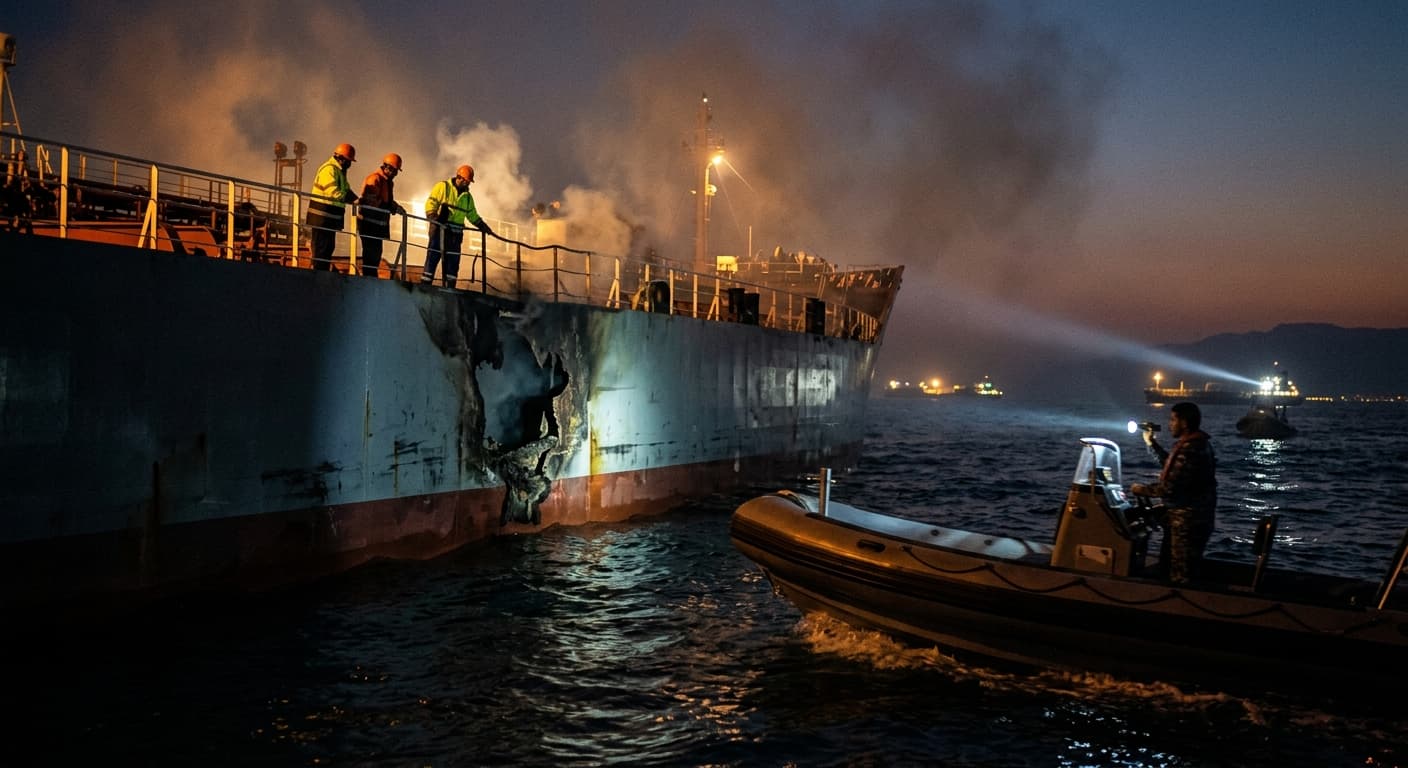
Iran fired at least two missiles at commercial ships transiting the Strait of Hormuz on the early hours of July 7, 2026, damaging vessels including what appears to be the Qatari gas tanker Al Rekayyat and setting an engine room ablaze eight nautical miles east of Oman's Limah, according to a US official cited by The Jerusalem Post. The attack is not a ceasefire wobble; it is Tehran cashing in the strategic asset it has spent four months building. Iran is converting the Strait of Hormuz from an international waterway into a permission-based regime in which the Islamic Revolutionary Guard Corps, not maritime law, decides who passes — and the Gulf Cooperation Council states, not Washington, are the ones being coerced into legitimising it.
What happened at Limah, and why the target matters
The UK Maritime Trade Operations (UKMTO) reported a tanker was struck by an "unknown projectile" and caught fire; a Wall Street Journal recording captured a crew message from the Al Rekayyat saying it had been hit on the port side, "engine room fire and full of smoke," with the crew mustered safely on the starboard rail, according to reporting relayed by The Jerusalem Post. Over the weekend, the IRGC broadcast to commercial ships in the strait: "Our missiles and drones are ready to fire at you" if they used the US-recommended southern corridor near Oman rather than Tehran's designated northern route.
The choice of target is the story. If Al Rekayyat is confirmed as the vessel struck, Iran has attacked a Qatari-linked LNG carrier — the same Qatar that mediated the June 17 ceasefire and whose gas exports were shut in for months by Tehran's closure of the strait. Doha's ports were forced to halt some energy shipments during the war because they, unlike Saudi Arabia and the UAE, have no pipeline bypass, as Al Jazeera noted when Gulf states began drafting their second UN resolution. Firing on Qatari cargo is Iran telling every GCC capital that mediation buys you nothing if you also lend your airspace or ports to the American side.
The June 17 memorandum is the crime scene
The trigger for today's incident sits in Article 5 of the US–Iran Memorandum of Understanding, signed at the G7 in Evian-les-Bains on June 17, 2026. That clause commits Iran to make "arrangements using its best efforts for the safe passage of commercial vessels with no charge, for 60 days only," and to "conduct dialog with the Sultanate of Oman to define the future administration and maritime services in the Strait of Hormuz." The words "best efforts" and "future administration" are load-bearing. They contain no mechanism to enforce passage, no cap on post-60-day fees, and — crucially — no rejection of Iranian claims to sovereign administration of the waterway.
Iran read Article 5 the way its drafters intended it to read: as a concession. On June 20, Iran's Persian Gulf Strait Authority (PGSA), a body created by Tehran's Supreme National Security Council to formalise its control, published transit terms declaring that "no vessel is permitted to pass through the Strait of Hormuz without a valid passage permit issued by the PGSA," per BBC News. Ali Vaez, Iran project director at the International Crisis Group, warned that while the interim rerouting was expected, "the important thing now is that the Iranians do not start taking fees or other tolls, because that is not provided for in the memorandum of understanding," speaking to
Al Jazeera.
The July 7 attack is the third documented strike on commercial shipping in the 20 days since that memorandum was signed — after the June 25 hit on the Singapore-flagged Ever Lovely and a June 27 UKMTO-reported bridge strike on a tanker whose origin was not disclosed. Each attack has come against ships using the Joint Maritime Information Center's Oman-hugging southern route, the one Tehran does not control.
The real fight is over who administers the strait — not tolls
Washington's public framing is freedom of navigation. That is not what the fight is about. The dispute is over administration, not tolls — whether the post-war Hormuz regime is defined by Iran, by Oman, or by the multinational mission the UK and France are assembling.
A UK–France joint statement on July 3, 2026, made explicit what the memorandum left ambiguous: "The Sultanate of Oman has agreed to work with the United Kingdom and France to ensure that its sovereign territorial waters are safe for navigation," and both governments stand ready to deploy "the wider Multinational Military Mission to support freedom of navigation in the Strait of Hormuz," per the UK Government. Speaking at the UN Security Council on July 2, UK envoy James Kariuki condemned "Iran's reckless attacks against Bahrain and Kuwait, and on international shipping in the Strait of Hormuz," invoking
Resolution 2817, the March 2026 measure that condemned Iran's attacks on seven neighbouring states and was co-sponsored by a record 136 states.
Resolution 2817 is the primary document worth reading closely. It affirmed the "inherent right of individual or collective self-defence" under Article 51 of the UN Charter in response to Iranian attacks, and was adopted 13-2-0 with China and Russia abstaining — the highest co-sponsorship in Security Council history, according to a policy brief from the Observer Research Foundation. But a follow-on Bahraini resolution in April, which would have authorised defensive escorts, was vetoed by Moscow and Beijing, as
Al Jazeera reported. That veto is why the strait's future is being written now in bilateral deals with Oman, not at Turtle Bay — and it is why Iran believes it can extract a permanent administrative role.
Who wins, who loses
Follow the money and the mission risk. Iran's Persian Gulf Strait Authority, per the Fars-attributed Iranian estimate, could generate over $10 billion annually in maritime service fees if it were widely accepted, per Al Jazeera. US Treasury has responded by threatening any shipper paying those tolls with sanctions exposure under existing IRGC designations, according to a June OFAC alert reported by
BBC News. Treasury Secretary Scott Bessent went further on May 28, warning that "Oman, in particular, should know that the US Treasury will aggressively target any actors involved — directly or indirectly — in facilitating tolls," per
Al Jazeera.
The losers are visible. Qatar, if the July 7 attack on Al Rekayyat is confirmed, becomes the second GCC state after Bahrain to see its assets struck since the ceasefire. Bahrain's Interior Ministry reported an 11-year-old girl injured, vehicles burned and homes damaged by shrapnel from intercepted Iranian drones on June 10. Oman — a US treaty partner threatened with sanctions by its own ally and with missile fire by its neighbour — is the diplomat caught in the middle: Foreign Minister Badr Albusaidi has publicly insisted "future arrangements related to the strait do not involve imposing any transit fees," per Al Jazeera. Muscat's leverage is that both sides need it; its exposure is that both sides can hurt it.
The winners are more subtle. Saudi Arabia and the UAE, which invested in the East–West and Abu Dhabi Crude Oil pipelines that bypass the strait, have expanded market share as buyers price in Hormuz risk. Saudi shipping volumes have more than doubled since June 17 compared with the prior three months combined, according to Sparta Commodities analyst June Yip, cited by Al Jazeera. OPEC+ announced on July 6 that seven members — including Saudi Arabia, Iraq, Kuwait, Kazakhstan, Algeria, Russia and Oman — would add 188,000 barrels per day from August, taking advantage of prices that Brent stabilized near $72 despite continued attacks.
The historical parallel that reframes everything
American policymakers keep referring to the Tanker War of 1984–1988 as the template. It is the wrong reference. The closer parallel is Turkey's 1936 Montreux Convention, which took a strait — the Bosporus — that international law had treated as free and vested its administration in the coastal state, subject to conditions. Iran does not need to close Hormuz to win. It only needs the world to accept, through habit and small concessions, that transit requires PGSA coordination. The IRGC's June 25 statement — "The only authorised transit routes through the Strait of Hormuz are those designated by the Islamic Republic of Iran" — is Montreux language in Farsi.
That is why the American Enterprise Institute's Brian Carter and Nicholas Carl argue Iran is "positioning itself to emerge from the war in a stronger strategic position, with veto power over who can access one of the most critical maritime chokepoints in the world," in an analysis for AEI. The new Iranian supreme leader Mojtaba Khamenei — appointed by the Assembly of Experts on March 8, 2026, after his father's killing in the opening US–Israeli strikes, per
BBC News — has staked his opening bid on precisely this leverage. His father's body arrived in Qom on July 6 en route to burial in Mashhad on July 9; the missile strike on July 7 lands inside the funeral week, a deliberate signal that the succession has not weakened Tehran's Hormuz posture.
Diplomat View
The July 7 strike is a stress test of a memorandum that was designed to be ambiguous, and Iran is passing the test on its own terms. The 60-day window from the June 17 signing expires on August 16. Between now and then, expect Tehran to keep the tempo of small, deniable strikes on ships using the Omani corridor while its diplomats in Geneva insist the ceasefire holds. The forecast: barring a decisive US kinetic response before August 16, the final deal — if one is signed — will contain some formula that acknowledges an Iranian or joint Iran–Oman administrative role in the strait, dressed up as "services" rather than tolls. That would be Tehran's largest strategic gain from the war.
The forecast would be wrong if any of three things happen: Trump orders a sustained CENTCOM campaign against IRGC naval assets on the scale of the 96 Bandar Abbas strikes documented by ACLED between February 28 and April 8; Oman publicly rejects the joint-administration framework in writing; or a Chinese-flagged vessel is hit, forcing Beijing off its abstention posture at the Security Council. Absent one of those, the toll booth is going up.
What to watch next
- July 9, 2026: Khamenei's burial in Mashhad. Watch whether Mojtaba Khamenei finally appears in public — his first substantive act as supreme leader would signal how far he will push the Hormuz posture.
- August 16, 2026: The 60-day negotiating window under the US–Iran MoU expires. Any extension, or lack of one, defines whether the PGSA fee regime is activated.
- UN Security Council: Watch for a third Bahraini resolution attempt after the July 7 attack and whether Russia and China again veto — the diplomatic ceiling on any US-led escort mission depends on it.
The Bottom Line
The bottom line: Iran's July 7 missile strike is not a ceasefire violation — it is the ceasefire, executed as designed. Tehran has spent four months converting the Strait of Hormuz into the Islamic Republic's most durable strategic asset, and the June 17 memorandum quietly gave it the diplomatic scaffolding to lock that gain in. Unless Washington or Muscat forces a break in the next six weeks, the post-war Hormuz will be administered from Tehran in all but name.
Discover more
Global Politics
Xi Jinping Calls China-Russia Ties 'Precious'
Xi Jinping's description of China-Russia ties as 'precious' reflects a strategic imbalance, with Beijing dictating terms in the partnership.
US Politics
SNAP Food Assistance Faces Legal Challenges
In 2026, SNAP faces stricter eligibility rules and mounting legal challenges, threatening food assistance for the millions of Americans who rely on the program.
US Politics
House Ethics Committee Pushes Sexual Miscond.
The House Ethics Committee has shifted responsibility for sexual harassment settlement records to the Office of Congressional Workplace Rights, complicating disclosure efforts.
Conflict & Security
Guatemala: El Niño 2026–27 becomes regional security test
UNICEF: 25.8M children face El Niño risks in Latin America; Guatemala maps 188 municipalities for drought and food insecurity amid regional security test.