Iran's Hormuz Gambit Tests Trump's Strategy
Iran's actions challenge U.S. control over the Strait of Hormuz.
Model Diplomat9 min readMiddle East
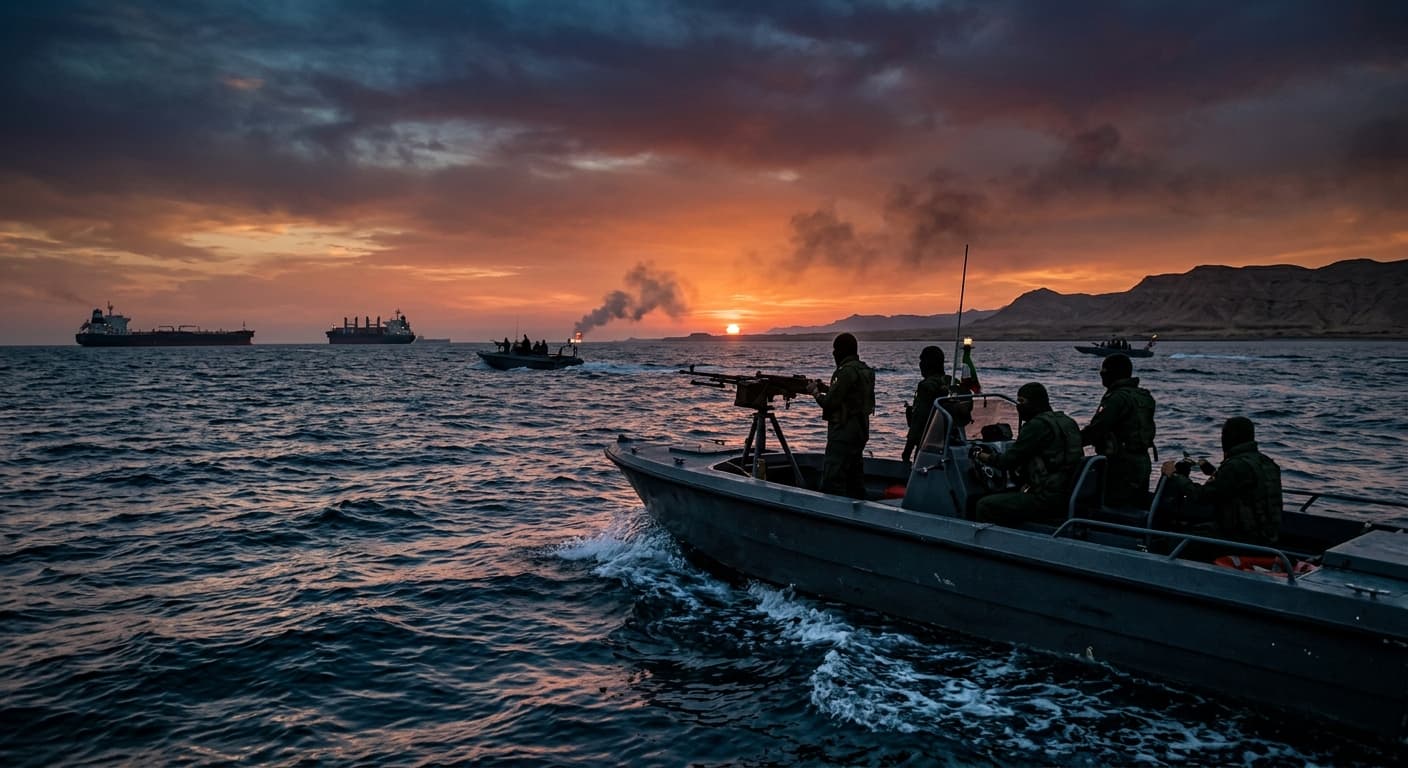
Iran's Hormuz Gambit Bypasses the Gulf — and Tests Trump
Iran's July 7 attacks on Saudi and Qatari tankers and Trump's revocation of the oil waiver show Tehran will risk war to lock in control of the Strait of Hormuz.
Iran is willing to accept a second round of large-scale war with the United States rather than surrender its veto over who transits the Strait of Hormuz — and the July 7, 2026 exchange, in which U.S. Central Command struck more than 80 targets after Iranian projectiles hit Qatari and Saudi tankers, has confirmed that the strait, not the nuclear file, is now the war's real prize. The Institute for the Study of War concluded in its July 8 special report that Tehran "values control over the strait more than avoiding renewed escalation with the United States." That single sentence upends the working assumption in Washington and Riyadh that Iran's economy would force it to trade Hormuz leverage for sanctions relief. It did not. And with the Treasury's revocation of Iran's 60-day oil waiver on July 7, the only tangible benefit Tehran had extracted from the June memorandum is gone — leaving coercion of the Gulf as its remaining play.
What actually happened on July 7
The sequence is now settled. On the night of July 6–7, the IRGC hit three commercial vessels transiting the Omani side of the strait — including the Qatari LNG carrier Al-Rekayyat and the Saudi-flagged crude tanker Wedyan operated by Bahri, according to BBC News. Both Doha and Riyadh publicly held Iran "fully responsible." Within hours, the U.S. Navy–led Joint Maritime Information Center raised the transit threat level to "severe," its first such designation since June 15, per
Al Jazeera.
CENTCOM then launched what its release called "powerful strikes" against 80-plus targets — coastal radars, anti-ship missile batteries, drone launch sites, command nodes, and more than 60 IRGC fast attack craft, according to the ISW-CTP update. Iran responded by attacking U.S. bases in Bahrain and Kuwait; no American casualties were reported. From the NATO summit in Ankara, Donald Trump told reporters the memorandum of understanding was "over" and called Iran's leaders "sick" and "scum," as
Al Jazeera reported. Brent crude jumped 4.2% to $77.24 a barrel on his remarks, the highest close in two weeks.
The economic knife arrived first. Late on July 7, the U.S. Treasury canceled the general license issued in June that had allowed Iran to sell crude and petrochemicals through August 21. New sales after July 7 are sanctioned; proceeds from already-loaded cargoes are diverted to a "blocked, interest-bearing account," per Al Jazeera's read-out of the Treasury notice. That waiver, alongside the lifted naval blockade, was the MoU's only immediate deliverable for Tehran.
The Clause 5 fight is the war
Everything now turns on one paragraph — Article 5 of the 14-point MoU Trump signed at the G7 in Evian on June 17. Its operative text, reproduced by the BBC, reads:
"Upon the signing of this MoU, the Islamic Republic of Iran will make arrangements using its best efforts for the safe passage of commercial vessels with no charge for 60 days, only from the Persian Gulf to the Sea of Oman and vice versa. … The Islamic Republic of Iran will conduct dialog with the Sultanate of Oman to define the future administration and maritime services in the Strait of Hormuz, in discussion with other Persian Gulf littoral states in line with the applicable international law and the sovereign rights of coastal states of the Strait of Hormuz."
Two readings of that clause are irreconcilable. Iran treats it as recognition of authority — the "new and Iranian order in the Strait of Hormuz," in the words of Ebrahim Azizi, spokesman for the Iranian parliament's national security commission, cited by Al Jazeera. Secretary of State Marco Rubio has said the article merely requires Iran not to impede transit, and that tolling international waters is illegal under the UN Convention on the Law of the Sea. Administration officials told the
BBC they inserted the Gulf-state consultation language expressly because they believed Riyadh, Abu Dhabi, and Doha "would never" accept a tolling system and would therefore moderate Iranian ambitions.
That is the machinery Iran is now trying to smash. ISW-CTP's July 8 assessment is blunt: Tehran is "attempting to circumvent the intent of Clause 5" by coercing Gulf capitals directly rather than accepting the multilateral dialogue the clause envisions. Majid Shakeri, an adviser to chief negotiator Mohammad Bagher Ghalibaf, told Iranian state television on July 7 that Oman must submit to Iranian inspection rights inside its own territorial waters — a demand that would gut UNCLOS transit passage. "Either we hold on to this strait, or we go and become martyrs for it one by one," Shakeri said, adding that "revenue is subordinate to control."
Why the strikes are not changing Iran's calculus
CENTCOM's 80-target package was designed to degrade exactly the capabilities Iran uses to close the strait — coastal radars, anti-ship missiles, mine-layers, and IRGC fast boats. It has not worked, and ISW-CTP flags why. Iran's strategy relies on firing "small numbers of projectiles" at individual ships, not saturation attacks. That posture is cheap, distributed, and hard to attrit. Traffic data confirms the intimidation is working: Kpler recorded only 31 verified crossings on July 5, 34 on July 4, and 43 on July 3, per Al Jazeera — a fraction of the 120–140 daily transits before the war.
The other constraint sits in Washington. According to reporting summarized by ISW, Trump has told advisers he will not "resume the war" unless Iran kills U.S. servicemembers. Iran's July 7 salvos into Bahrain and Kuwait killed no one — a calibration, not an accident. The message from Tehran is that it can bleed Gulf shipping and hit U.S. bases below the red line the president himself has drawn.
That gap between American red lines and Iranian tactics is the war's operating logic. Iran does not need to close the strait. It needs to keep the option credible enough that insurers, shipowners, and Gulf sovereign-wealth managers behave as if it can — and the Joint Maritime Information Center's "severe" threat rating does that work.
Who wins and who loses
The Gulf capitals are the losers of the past week. Their strategy since April has been to bind the strait's fate to a multilateral instrument — a Chapter VII UN Security Council resolution co-sponsored by Qatar, the UAE, Bahrain, Saudi Arabia, Kuwait, and the United States, tabled in early May and killed by Russian and Chinese vetoes. A prior Bahraini draft died the same way in April. With multilateralism blocked at Turtle Bay and Clause 5 hollowed out by Iranian coercion, the GCC is being pushed into precisely the bilateral bargaining position it spent three months trying to avoid.
The exposure is not symmetric. Saudi Arabia can push roughly 5 million barrels per day through its East–West pipeline to Yanbu; the UAE can move about 1.5 mbpd via the Habshan–Fujairah line to the Gulf of Oman, as Al Jazeera analyst Abdulla Banndar Al-Etaibi noted in his July 8 column. Qatar has no bypass — its entire LNG book depends on Hormuz, which is why Doha is hosting the U.S.–Iran talks and pressing hardest for a settlement, even at the cost of Iranian face-saving language. Oman, drawn into Iran's condominium fantasy as the strait's other littoral state, is a UNCLOS signatory that publicly rejects tolls but faces daily Iranian pressure and Omani commercial equities that favor a deal.
The quiet winners are less obvious. China is one: Beijing's veto on May 7 preserved Iran as a strategic buffer, and the reimposition of U.S. oil sanctions will push discounted Iranian barrels back toward Chinese teapot refiners even as Brent rises for the rest of the world. Turkey is another; Iraq is "quietly exploring" a Ceyhan route north, according to the Al Jazeera opinion piece, and Ankara this week secured Trump's promise to lift its own sanctions and "consider" F-35 sales, per Al Jazeera — a side deal that could not have happened without Iran making itself indispensable as a problem.
The primary documents behind the fight
Two U.S. government texts anchor how far this has come. The president's February 28 War Powers notification to Speaker Mike Johnson framed the original strike package as necessary to ensure "the free flow of maritime commerce through the Strait of Hormuz." His
April 7 ceasefire statement made the strait explicit again: cessation was "subject to the Islamic Republic of Iran agreeing to the COMPLETE, IMMEDIATE, and SAFE OPENING of the Strait of Hormuz." The
May 13 Congressional Research Service Insight documents what happened next: Iran began collecting tolls reportedly as high as $2 million per ship, and the United States responded with a full blockade — CENTCOM at one point had "redirected 67 commercial vessels and 'disabled' 4 Iranian-flagged ships" attempting to cross its line.
That record matters for two reasons. First, it establishes that the White House has, in three separate documents in three months, committed itself in writing to keeping Hormuz open. Backing away now carries a domestic political cost the Iranian regime is testing. Second, it shows the sequence Tehran believes it can repeat: escalate, force a Trump climbdown into a bilateral framework, then use the sanctions-relief carrot as leverage over Gulf capitals it wants to divide from Washington.
What to watch
- July 15–16, Rome. Lebanese Prime Minister Nawaf Salam's government announced on July 8 that it will join U.S. and Israeli negotiators in Rome on southern Lebanon "pilot zones," per ISW-CTP. This is the first regional negotiation since Trump declared the MoU dead, and Lebanon's insistence on linking talks to an Israeli withdrawal will test whether any part of the 14-point framework can survive in isolation.
- The oil-waiver grace period. Treasury's revocation takes effect July 7 for new sales, with a grace window on cargoes already at sea. If Iran responds by cutting sales to Chinese buyers rather than absorbing the discount, Brent has room to run above $80; if not, the sanctions bite quietly and Tehran's economic runway shortens.
- Kharg Island. Trump publicly floated that U.S. forces "may take over" Iran's main export terminal, an operation that would require ground troops. Any move on Kharg would end the ceasefire fiction entirely and put roughly 90% of Iranian oil exports at immediate risk.
- Gulf UNSC re-file. Watch whether Qatar and the UAE table a third resolution stripping out Chapter VII authorization language to secure Russian and Chinese abstention. Failure a third time will effectively concede the strait to bilateral bargaining.
Diplomat View
The consensus this week has framed July 7 as an escalation. That reading is too small. What actually happened is that Iran demonstrated it can hit named Qatari and Saudi tankers, absorb an 80-target CENTCOM response, and still hold Trump below his own red line — all while the Treasury withdrew the only economic sweetener the MoU delivered to Tehran. The signal to the Gulf is unambiguous: multilateral cover through the UN has failed, U.S. deterrence is capped at American casualties, and the strait's "future administration" will be negotiated on Iranian terms unless someone raises the ceiling.
Our forecast: within 60 days, either the Gulf states quietly begin a direct dialogue with Tehran on a "services fee" framework dressed up to satisfy UNCLOS, or the war resumes at a scale that puts Kharg Island and Iranian power generation on the target list. The middle path — the current pattern of tit-for-tat strikes plus MoU life support — is not stable. We would revise this call if (a) Iran kills U.S. personnel, which would collapse Trump's ceiling and force full re-engagement, (b) Beijing publicly backs the Gulf position at the UNSC, which it will not, or (c) Riyadh signals it will let U.S. forces stage offensive operations from Saudi soil. Absent one of those triggers, the leverage sits with Tehran, and the Gulf capitals know it.
The Bottom Line
The bottom line: Iran's July 7 gambit was not a lapse in the ceasefire — it was the ceasefire's stress test, and Tehran passed it. By hitting Gulf-flagged tankers, absorbing an 80-target U.S. response, and keeping American casualties at zero, Iran proved it can rewrite Article 5 of the MoU through coercion faster than the United Nations, the Gulf Cooperation Council, or CENTCOM can defend the original text. Whoever ends up managing the Global Politics of the Strait of Hormuz in 2027 will negotiate from a map Iran redrew this week.
Discover more
India
Congress Accuses Modi of Stalling Women's Law
Congress accuses Modi of stalling women's reservation law by linking it to delimitation, revealing a deeper electoral strategy.
US Politics
SNAP Food Assistance Faces Legal Challenges
In 2026, SNAP faces stricter eligibility rules and mounting legal challenges, threatening food assistance for the millions of Americans who rely on the program.
India
Women’s Reservation Bill 2026
The Constitution (131st Amendment) Bill, 2026 was defeated in Lok Sabha, revealing deeper political conflicts over women's reservation and delimitation.

Conflict & Security
Drone Warfare Killing Aid Workers at Unprec
Over 1,000 humanitarian workers killed in three years as cheap armed drones collapse legal protections. Gaza, Sudan, Ukraine, and DRC see deliberate targeting of aid convoys and hospitals with zero prosecutions.