Iran's Gulf Gambit: Strikes to Save MoU
Tehran's missile strikes aim to leverage Gulf diplomacy.
Model Diplomat9 min readMiddle East
Iran's Gulf Gambit: Why Tehran Is Hitting Its Neighbors to Save the MoU
Iran's July 9 strikes on US bases in Kuwait, Bahrain, Qatar and Jordan aren't a war expansion — they are a bid to weaponize Gulf diplomacy to force Washington back to the negotiating table before August 21.
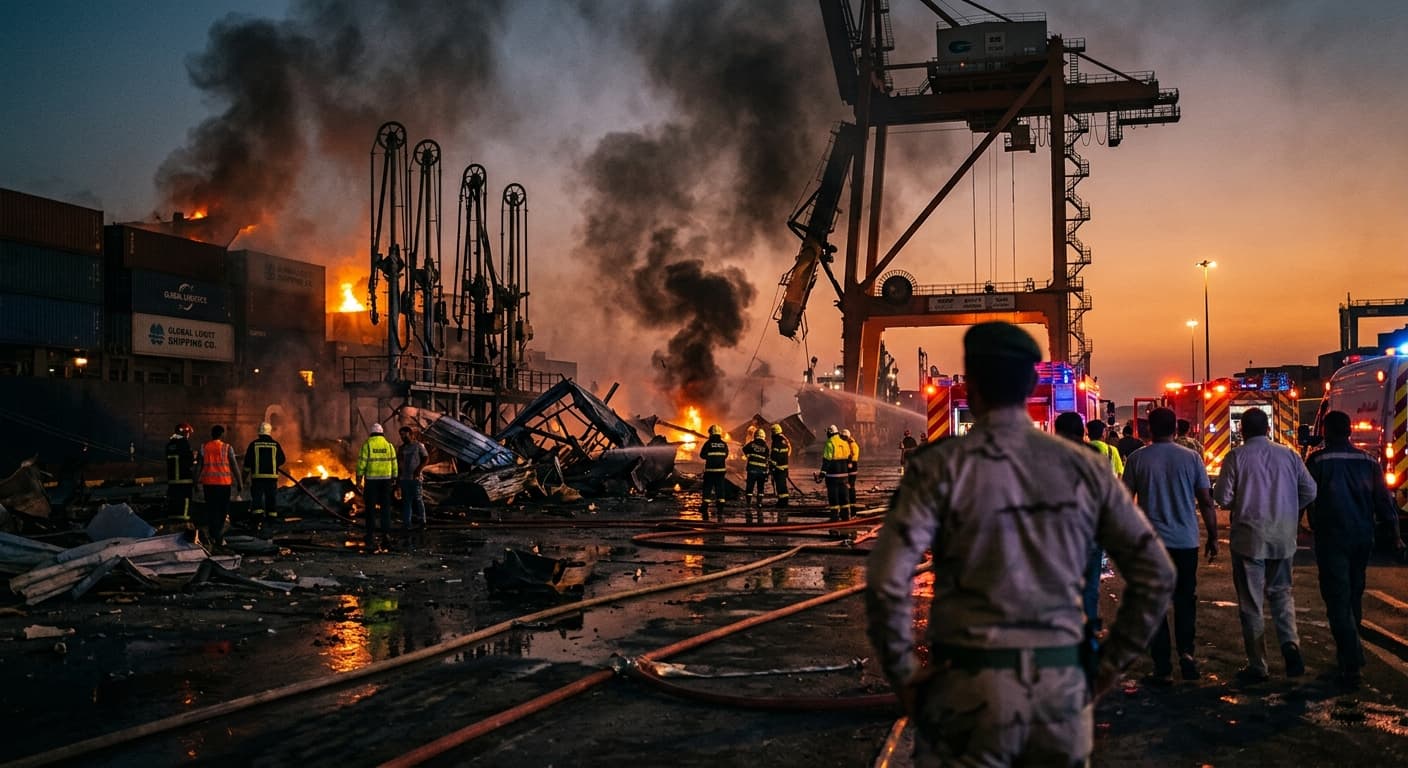
Iran fired at least three ballistic missiles, one cruise missile and 10 drones at US installations across four Gulf Arab states in the early hours of July 9, 2026 — and the deliberate breadth of the target list is the story. Tehran's escalation, hours after CENTCOM hit some 90 Iranian coastal targets and a day after Donald Trump pronounced the Islamabad memorandum "over," is not a slide into open war. It is a calculated attempt to make Gulf capitals — Doha, Kuwait City, Manama, Riyadh — costly enough to Washington that they push the White House back inside the 60-day framework that expires August 21. The Gulf, not Tehran, is now the pressure point Iran is squeezing.
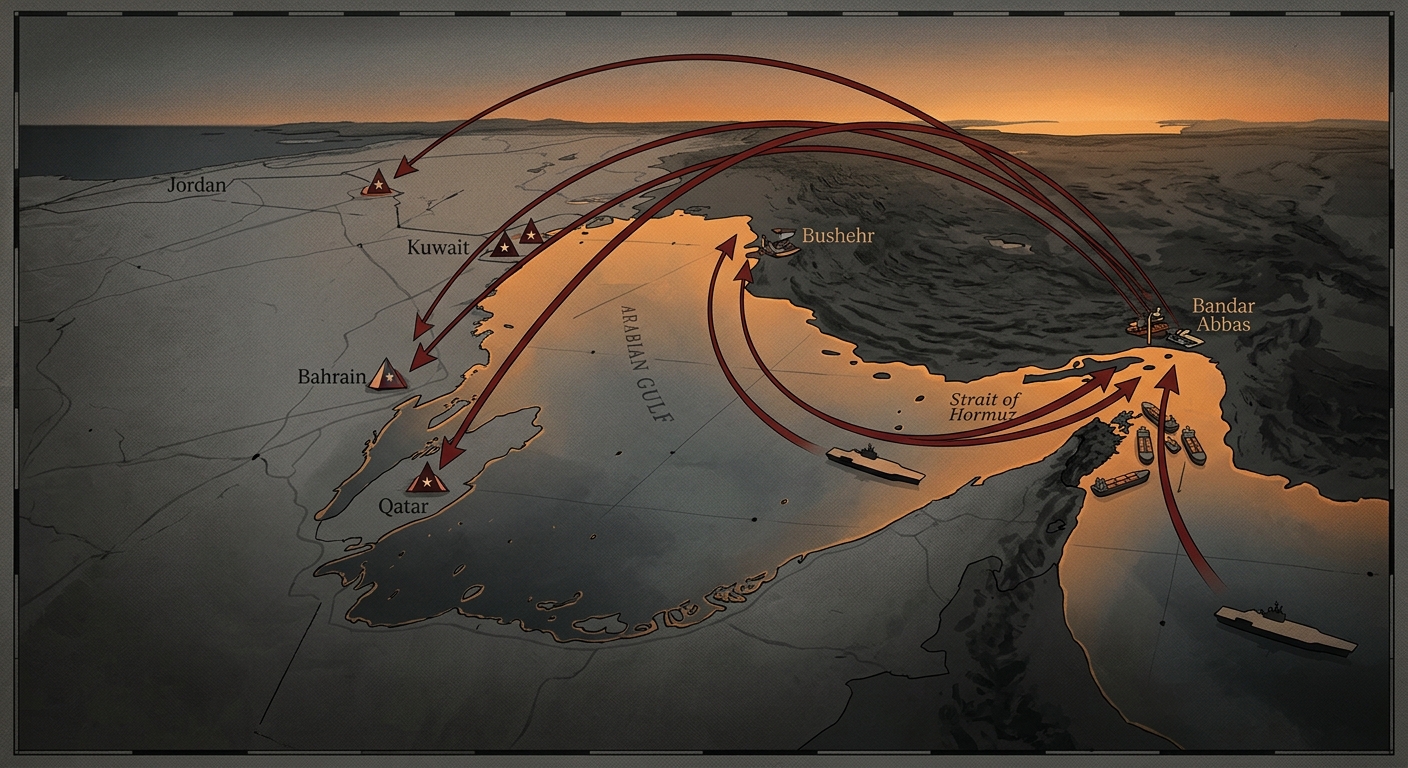
The immediate facts are stark. U.S. Central Command said it struck more than 170 Iranian military targets across two nights along the coast near the Strait of Hormuz — about 14 times the tempo of the June flare-up, according to Al Jazeera's live coverage citing CENTCOM figures. Iran's Islamic Revolutionary Guard Corps responded by hitting US bases at Camp Arifjan and Ali Al Salem in Kuwait, Juffair (home of the US Fifth Fleet) and Sheikh Isa in Bahrain, a satellite antenna site in Qatar and a base in Jordan, per
Al Jazeera. Kuwait's Ministry of Defence reported one person injured by falling debris after intercepts of three ballistic missiles, a cruise missile and 10 drones,
NPR reported. At least 14 Iranians have been killed in the US strikes; eight Iranian service members died in the first wave alone, according to state news agency IRNA.
Why hitting the Gulf is the point
Read the target set. Iran chose the four Arab states most exposed to US basing — and pointedly hit none of them hard enough to trigger a coalition war. In Qatar, the "elevated security threat" was lifted within hours. In Kuwait, air defenses shot down every incoming munition but one. In Bahrain, home to the US Navy's 5th Fleet, sirens sounded three times but there was no confirmed damage. This is signaling, not warfighting.
The reasoning is on the record. Ali Vaez–style analysis is echoed in Tehran itself: "They're lashing out to punish the regional countries and get them to urge the US to implement the agreement," Sina Azodi told Al Jazeera. Reporting from Doha, Al Jazeera's Malik Traina noted that Gulf officials expect "a diplomatic push from across the Gulf to bring Iran and the US back to the negotiating table. Nobody wants to see a breakdown of this ceasefire, or the MoU."
That push materialized within hours. Qatari Prime Minister Sheikh Mohammed bin Abdulrahman Al Thani called Iranian Foreign Minister Abbas Araghchi on July 9, insisting both sides "commit to diplomacy" and implement the June 17 MoU. Pakistan's foreign ministry — the co-guarantor of the deal — said flatly that "a renewed conflict is in no one's interest," urging both sides to honor what Islamabad now calls the "Islamabad Memorandum of Understanding," per Al Jazeera's Islamabad bureau. The mediators are doing exactly what Iran needs them to do.
Former US ambassador Joey Hood put the counter-view plainly to Al Jazeera: by attacking Gulf infrastructure and commercial shipping, "Iran has taken the opportunity of this new regime to launch a war that they hope will give them custodianship over the Gulf economies and, therefore, a lot of influence." Whether coercion or custodianship is the correct label, both readings agree on the mechanism: Iran is instrumentalizing the Gulf's fear of war to reshape the diplomatic geometry.
The MoU trap: Article 5 was always the fuse
The document Tehran and Washington signed electronically on June 17 — read into the record by a senior US official and published in full by the BBC — never actually resolved the question that is now killing it. Point 5 states that Iran "will make arrangements using its best efforts for the safe passage of commercial vessels with no charge for 60 days only, from the Persian Gulf to the Sea of Oman, and vice versa," and directs Tehran to "conduct dialogue with the Sultanate of Oman to define the future administration and maritime services in the Strait of Hormuz."
That single paragraph contains the entire war.
Tehran reads the clause as an acknowledgment of Iranian managerial authority over the strait — the basis for its self-declared "Persian Gulf Strait Authority" and for a future toll regime. Washington reads it as a duty not to impede navigation, with no veto over routes. Ebrahim Azizi, spokesman for Iran's parliamentary security commission, put the maximalist position on X: "Recognise the new and Iranian order in the Strait of Hormuz." The US Treasury put the opposite view into policy on July 7, when the Office of Foreign Assets Control published its "Sanctions Risks of Iranian Demands for Strait of Hormuz Passage" alert and rescinded the 60-day oil waiver that was Iran's only tangible material win from the deal.
The waiver, per Al Jazeera, had been set to expire August 21 alongside the negotiating window; its early revocation removes Iran's near-term economic incentive to comply. Iran's Foreign Ministry cited breaches of MoU Articles 1 and 5 and called the US strikes "a grave war crime." Parliament Speaker and chief negotiator Mohammad Bagher Ghalibaf — a hardliner installed after the February decapitation of the leadership — posted on X: "America still hasn't learned that bullying and breaking promises are no longer cost-free. Let me put it plainly: If you strike, you'll get hit."
The Gulf's calculus: everyone loses if Hormuz shuts again
For the Gulf states, the reason to hold their nose and press for the MoU is not solidarity with Tehran — it is the economics of the strait. UN Trade and Development (UNCTAD) data logged on the European Commission's Knowledge for Policy portal show that when the war shut Hormuz between February and April, daily transits dropped from 129 ships to four — a 97% collapse. In the last week before the war, the strait carried 38% of global seaborne crude, 29% of LPG, 19% of LNG and roughly a third of world seaborne fertilizer trade.
A Congressional Research Service report to Congress, CRS R45281, estimates that in a normal year approximately 20 million barrels per day — 27% of global maritime oil trade and one-fifth of world petroleum liquids consumption — move through Hormuz. Brookings' post-war assessment concluded that from March through May 2026, the closure produced what the
International Energy Agency called "the largest supply disruption in the history of the global oil market" — 14 million barrels per day of lost output, cushioned only by the largest coordinated reserve release ever, 400 million barrels.
The IRGC on July 9 claimed strait traffic had been restored only to 50% of pre-war levels, blaming "American adventurism." Brent crude, which had drifted back toward pre-war ranges after the MoU, jumped more than 6% on Trump's NATO-summit remarks to hit a two-week high around $78, Al Jazeera reported. Saudi Arabia's East-West pipeline and the UAE's Habshan-Fujairah line are already at full utilization; Riyadh and Abu Dhabi have exhausted their bypass options.
That is why the GCC's public messaging on July 9 was, on close reading, tactically asymmetric. GCC Secretary-General Jasem Mohamed AlBudaiwi condemned Iran's strikes on Bahrain and Kuwait as a "flagrant violation" and cited UN Security Council Resolution 2817 (2026) — the Bahrain-drafted resolution adopted 13-0-2 (China, Russia abstaining) on March 11 condemning Iran's "egregious attacks" on Gulf neighbors. UAE presidential adviser Anwar Gargash accused Iran of "wavering between the logic of escalation and the path of rationality." Yet in the same breath, Qatar's foreign ministry stressed "the need to continue the path of dialogue and diplomacy" and to protect "progress previously made under existing agreements." Oman condemned both the Iranian strikes and — implicitly — the American ones that provoked them. The Gulf is publicly aligning with Washington on norms while privately telling both parties to sit back down.
The Mojtaba factor: a leadership that hasn't tested war
The domestic Iranian variable is a new supreme leader who has not been seen in public since taking office. Mojtaba Khamenei, 56, appointed by the Assembly of Experts on March 8 after his father's killing, was reportedly wounded in the same February 28 strike. He communicates only in writing and has been notably absent from a week of processions for his father, whose burial in Mashhad took place on July 9. The BBC's Middle East desk noted that his three brothers — Masoud, Mostafa and Meysam — attended the Tehran services; Mojtaba did not.
Analysts describe a leadership less cautious than the elder Khamenei's "no war, no peace" doctrine. As one Tehran expert told the BBC, "An 86-year-old is no longer guiding the ship of the Islamic Republic. The big handbrake on evolution of the system was Ali Khamenei." The consequence — as NPR observed — is a real fracture in Iran's negotiating posture: hardliners centered on the IRGC and Ghalibaf want lasting control over Hormuz as leverage; pragmatists around President Masoud Pezeshkian and Foreign Minister Araghchi want sanctions relief and the promised $300 billion reconstruction fund embedded in MoU Point 6.
That $300 billion is the number few outside the region are pricing in. The 14-point memorandum commits the US to organize "regional partners" — meaning primarily the Gulf — to fund Iranian reconstruction. Saudi Arabia and the UAE, the presumed underwriters, are not going to move money into Tehran while Iran is bombing Al-Udeid–adjacent sites. Iran's coercion of Gulf capitals into pressuring Washington is therefore a self-defeating instrument on the economic track even as it may work on the security track.
What to watch next
- August 21: the MoU's 60-day negotiating window formally expires unless extended by mutual consent under Point 3. Trump has hinted at both continuation and abandonment inside 24 hours; the operative signal will be whether special envoy Steve Witkoff and Jared Kushner re-engage Araghchi within the week. Trump publicly named them on July 9 as the channel he might still authorize.
- Kharg Island: Trump's Truth Social post threatened seizure of the island through which 90% of Iranian crude exports pass, some 950 million barrels a year, per
Al Jazeera's explainer. Any US move against Kharg — as opposed to coastal military infrastructure — crosses from coercion into regime-change signaling and would end the MoU beyond diplomatic recovery.
- Oman track: MoU Point 5 tasks Muscat with brokering the strait's "future administration." Sultan Haitham's ministry has condemned both the Iranian and — implicitly — the US strikes. If Oman formally suspends its mediation, the deal has no technical implementer.
- Bahrain and Kuwait sovereignty response: Kuwait's Foreign Ministry has already invoked Resolution 2817 by name. A second GCC-drafted UNSC resolution — with Russian and Chinese abstention rather than veto — remains the most likely next diplomatic escalation.
Diplomat View
Iran is not trying to reopen the war; it is trying to save the MoU on its own terms by making Gulf neutrality unbearable for Washington. The wager is that Doha, Riyadh and Abu Dhabi — none of which can afford a second closure of Hormuz — will drag Trump back inside the 60-day frame before it expires. That call is defensible for the next 14 days; it becomes reckless the moment the White House decides that hitting Kharg costs less than being seen to accept Iranian tolls on the strait. The forecast: an extended, ugly ceasefire holds through August, with sporadic tit-for-tat strikes but no full war, provided three conditions obtain — Qatar's mediation channel stays open, the US does not target Kharg or Iranian civilian infrastructure, and Mojtaba Khamenei does not personally intervene to override Ghalibaf. Revise this view downward the day any one of those fails; revise it sharply downward if two do.
The Bottom Line
The bottom line: Iran's July 9 strikes on four Gulf Arab states are not the opening of a new front but a coercive diplomatic instrument aimed squarely at Washington through its regional clients. If the MoU survives to August 21, it will be because Doha and Islamabad successfully translated Iranian threats into American restraint — a Gulf-mediated peace preserved precisely by Iran's willingness to violate Gulf sovereignty.
Discover more
India
Congress Accuses Modi of Stalling Women's Law
Congress accuses Modi of stalling women's reservation law by linking it to delimitation, revealing a deeper electoral strategy.

US Politics
House Ethics Committee Pushes Sexual Miscond.
The House Ethics Committee has shifted responsibility for sexual harassment settlement records to the Office of Congressional Workplace Rights, complicating disclosure efforts.

US Politics
SNAP Food Assistance Faces Legal Challenges
In 2026, SNAP faces stricter eligibility rules and mounting legal challenges, threatening food assistance for the millions of Americans who rely on the program.

Conflict & Security
Drone Warfare Killing Aid Workers at Unprec
Over 1,000 humanitarian workers killed in three years as cheap armed drones collapse legal protections. Gaza, Sudan, Ukraine, and DRC see deliberate targeting of aid convoys and hospitals with zero prosecutions.