Iran's $6 Billion Oil Surge During US Truce
How a 27-day truce turned into a $6 billion oil surge for Tehran
Model Diplomat8 min readMiddle East
Iran's 27-Day, $6 Billion Blitz: How the Truce That Was Supposed to End a War Instead Refueled One
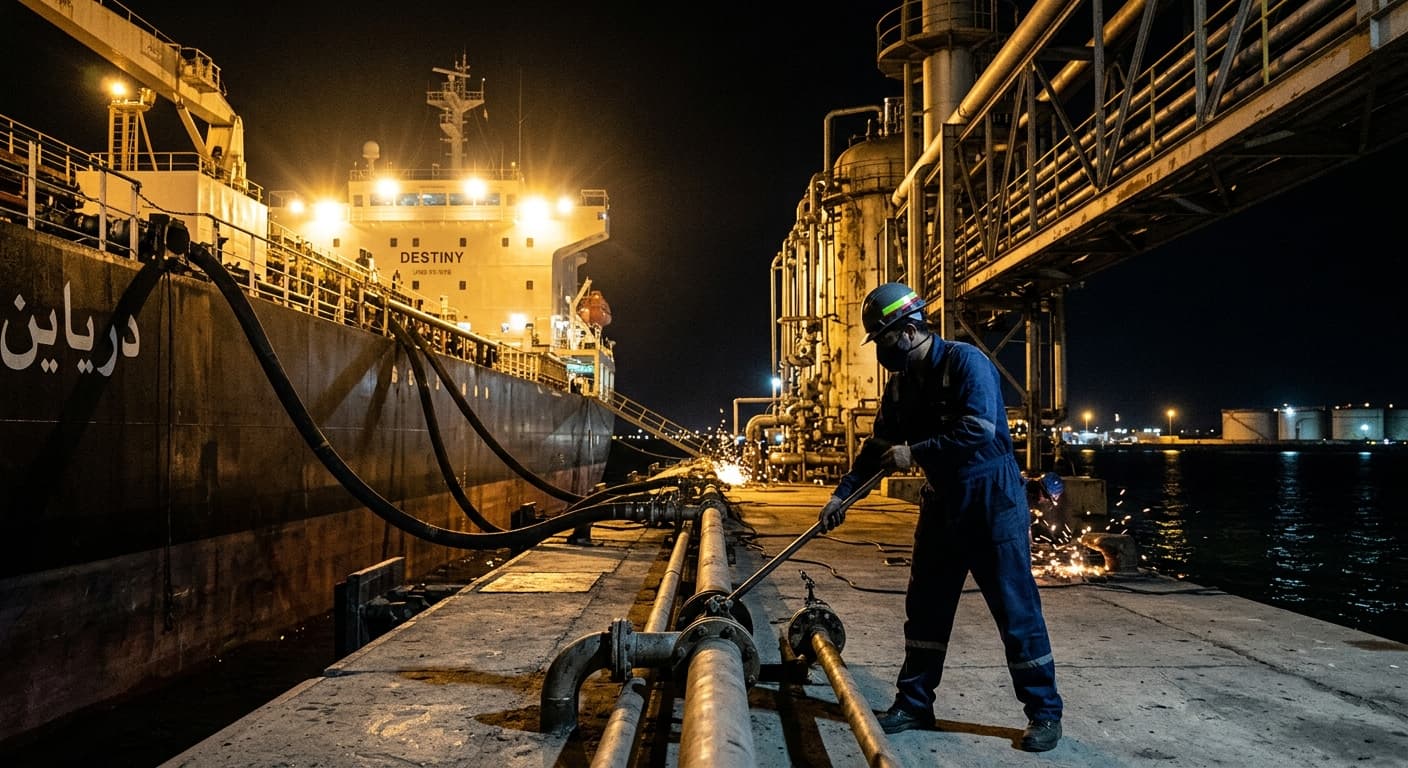
Iran shipped 70 million barrels of oil worth up to $6 billion during a brief US truce — exceeding its own pre-war revenue forecasts and turning a diplomatic off-ramp into the most concentrated oil-export surge in the country's recent history.
Iran entered June 2026 with its oil exports cratering to a five-year low and the rial trading at nearly 1.9 million to the dollar. It exits July with a replenished war chest, a restored revenue pipeline, and a structural lesson delivered: the blockade-truce-blockade cycle does not strangle the Islamic Republic — it fuels it. The central beneficiary of the June 17 memorandum of understanding between Washington and Tehran was not peace, but Tehran's treasury.
The core finding in the Wall Street Journal report, published July 19, is that Iran exported roughly 70 million barrels of crude during the truce window — 50 million of them in the second half of June alone, according to estimates compiled by United Against Nuclear Iran, a US-based advocacy group The Jerusalem Post. At prevailing prices, the windfall amounts to between $5 billion and $6 billion.
That is more than Iran's own pre-war budget forecast. An Iranian budget bill issued in late 2025 projected oil revenues of about $35.5 billion for the 2026 calendar year, or roughly $17.75 billion for the first six months — assuming exports of 1.77 million barrels per day at $55 per barrel. In reality, according to Brett Erickson of Obsidian Risk Advisors, Tehran generated more than $23 billion from oil sales in the first half of 2026 — exceeding its own projections by approximately 30% ABC News Australia.
The Anatomy of a Surge
The sequence that produced this outcome was compressed into 27 days.
On June 17, US President Donald Trump and Iranian negotiators signed a 14-point memorandum of understanding in Versailles, halting hostilities and lifting the CENTCOM naval blockade that had kept Iranian tankers bottled up since April 13 AP News. Five days later, the US Treasury's Office of Foreign Assets Control issued General License X, "Authorizing the Production, Delivery and Sale of Crude Oil, Petrochemical Products, and Petroleum Products of Iranian-Origin through August 21, 2026" — a sweeping waiver that permitted dollar-denominated sales for the first time in years
OFAC.
The effect was immediate. Tankers that had been idling as floating storage — estimates put the volume at more than 180 million barrels by early May — began moving. Among the first to reach waters off Malaysia's east coast were the Diona, the Hero II, and the Sonia 1. The Stream arrived on July 13. All were using ship-to-ship transfers outside Malaysia's territorial waters to obscure origins and funnel crude toward Chinese teapot refineries The Jerusalem Post.
The surge was both a response to and an exploitation of the diplomatic process. "If they had left the blockade on, the pinch would likely have hit about now," Charlie Brown, a Singapore-based analyst with United Against Nuclear Iran, told the Journal. Instead, Iran "quickly surged more oil… so there is a big buffer again" The Jerusalem Post.
The license was revoked on July 7 — just 16 days after issuance — following Iranian attacks on three commercial tankers in the Strait of Hormuz OFAC. A wind-down license, General License X1, permitted completion of in-process transactions through July 17, but prohibited any new purchases or loading
OFAC General License X1. By July 14, CENTCOM had restored the full naval blockade, disabling the Curacao-flagged tanker Belma with Hellfire missiles when it attempted to approach Kharg Island
BBC News.
By then, the 70 million barrels were already en route.
China's Teapots: The Indispensable Enabler
None of this would function without the unique architecture of Chinese demand. Iran exports approximately 90% of its crude to China, and the mechanism is well-established: a "shadow fleet" of aging, often uninsured tankers with opaque ownership conducts ship-to-ship transfers off Malaysia, relabels the crude as Malaysian or Omani, and delivers it to small private refineries — known as teapots — in Shandong province NPR.
These facilities are the structural backbone of sanctions evasion. They operate largely outside the US financial system, pay for barrels in renminbi through China's Cross-border Interbank Payment System rather than SWIFT, and represent just over 20% of China's total refining capacity Bruegel. State-owned Chinese refiners avoid Iranian crude to insulate themselves from secondary sanctions, but Beijing has never shut down the teapots — creating a two-tier system that lets the state benefit from discounted oil while maintaining deniability.
In 2025, China imported approximately 1.4 million barrels per day from Iran, representing 13% of its total crude imports and roughly 80-90% of Tehran's total oil exports Bruegel. The discount has been significant. Before the war, Iran was selling at roughly $53 per barrel — approximately $8-10 below benchmark
ABC News Australia. As the war created scarcity conditions and pushed global prices upward, Iran was able to sell stored crude at prices as high as $117 per barrel during the truce window. The price of oil had more than doubled, and Iran captured the spread.
The False Premise of the Blockade
What the June-July surge exposes is a structural flaw in the blockade strategy itself. The US approach assumes a binary — either exports flow or they do not — but the real dynamic operates in pulses. Iran accumulated oil at sea during the blockade, preserved production by storing rather than shutting wells, and then monetized the inventory as soon as constraints lifted.
Between March and May 2026, Iranian exports had already shown this pulse pattern. In March, with the Strait of Hormuz disrupted but no blockade in place, Iran exported 1.84 million barrels per day and earned an estimated $5.13 billion — more than in any comparable peacetime month because global prices were elevated Al Jazeera. By May, under the full CENTCOM blockade, exports collapsed to roughly 300,000 barrels per day, generating about $837 million — an 84% decline from March levels
Al Jazeera.
Then the truce opened the valve again. TankerTrackers.com identified Iran's "first crude oil exports in two months" on June 17, as the Diona and Hero II exited the blockade line carrying 3.8 million barrels Al Jazeera. By June 23, daily exports had rebounded to about 565,000 barrels per day — still far below pre-war levels but accelerating rapidly
The National.
The reality is that a temporary blockade does not destroy an oil industry — it warehouses it. Iran's onshore storage of roughly 50-55 million barrels was already about 60% full before the blockade. Had the truce not materialized, that storage would have filled within weeks, forcing production shutdowns that could permanently damage wells through water coning — potentially destroying up to 500,000 barrels per day of production capacity, or billions in annual revenue Foreign Affairs.
The truce prevented exactly that outcome. It converted a structural vulnerability into a liquidity event.
Who Wins, Who Loses
The winners from the June-July surge are concentrated and identifiable.
Tehran's war cabinet secured the most immediate benefit: an estimated $5-6 billion in revenue that will continue flowing over the coming months as delivered cargoes are paid for, even as the renewed blockade halts new shipments. "Iran's economy is in its worst shape since the revolution, so every dollar of revenue matters," Jonathan Panikoff of the Atlantic Council told the Journal, adding that Tehran would likely prioritize the funds for its "strategic objectives, particularly its ongoing confrontation with the US" The Jerusalem Post.
Chinese teapot refineries captured discounted crude during a window when global prices were elevated — the ideal arbitrage. They remain the only significant customer for Iranian barrels and will continue absorbing whatever Tehran can ship through the shadow fleet. China's broader strategic petroleum reserve, estimated at roughly 1.2 billion barrels by early 2026 — approximately 109 days of seaborne import cover — means Beijing has ample buffer regardless of short-term disruptions US House Select Committee on China, cited by Al Jazeera.
Russia gains indirectly. As Iranian and Venezuelan supplies to China were disrupted by US military action, Russia redirected oil exports toward China, increasing shipments by roughly 300,000 barrels per day in early 2026 Carnegie Endowment. Moscow is the quiet beneficiary of every US-Iran escalation that destabilizes competing suppliers.
The unambiguous loser is the credibility of the blockade strategy itself. The US redirected more than 140 vessels and disabled nine ships during the April-June blockade period — and still could not prevent a 16-day window from generating revenue equivalent to roughly four months of Iran's pre-war budgeted oil income CBS News.
The Iranian rial also lost ground. The currency changed hands for over 1.93 million against the dollar in Tehran's open market on July 18, recording a new all-time low as the renewed conflict triggered capital flight Al Jazeera. The oil revenue may be flowing into state coffers, but ordinary Iranians are absorbing the inflationary consequences of a collapsing currency.
The Second-Order Problem: The Cycle Hardens the Regime
The deeper implication is that the blockade-truce-blockade sequence entrenches the very behavior it is meant to deter. Every temporary opening teaches Tehran that the storage-and-surge playbook works, and that the US will eventually need a diplomatic off-ramp — which means another window.
This is not a theoretical concern. In the first round of the war, Iran used the period between the Strait of Hormuz closure and the April blockade to export at elevated volumes while global prices spiked. In the second round — the June-July truce — it converted stored oil into hard revenue at the fastest rate in its history. The expectation of a third round is now priced into the regime's planning.
The blockade's design assumes the US can sustain economic pressure longer than Iran can absorb it. As one analyst put it: "The question is whether the United States can sustain the broader economic consequences long enough for that pressure to have its intended effect" Al Jazeera. The June-July surge suggests the answer is no — at least not on a timeline that prevents Iran from periodically refilling its coffers.
The Diplomat View
The 70-million-barrel surge is not a footnote to the failed June MOU — it is the most important data point from it. Iran demonstrated that it can convert a temporary diplomatic concession into a multibillion-dollar cash injection in under three weeks. The US granted the license as a good-faith gesture to enable negotiations; Iran used it as a strategic resupply operation and then attacked shipping in the Strait of Hormuz within 14 days of the license taking effect.
Forecast: The current blockade will degrade Iran's export capacity over 4-6 weeks — Kpler data already shows Strait of Hormuz transits collapsing to as few as six vessels on July 12, compared to a pre-war average of 138 per day BBC News. But the $5-6 billion already in the pipeline gives Tehran a financial horizon extending through at least September-October 2026, consuming roughly the window that the US political calendar can allocate to sustained military pressure before midterm elections in November.
What would change the forecast: (1) Direct strikes on Kharg Island — Iran's primary export terminal — would degrade the storage-and-surge playbook by damaging infrastructure rather than merely interdicting ships. (2) A meaningful shift in China's teapot enforcement — Beijing has never fully shut the teapots, and until it does, the pipeline remains open at a discount. (3) A deal architecture that does not include an oil-export grace period as a upfront concession — the June MOU's fatal flaw was granting the revenue before extracting verifiable compliance.
The bottom line: Iran turned a peace gesture into a $6 billion refueling operation, and the US strategy has no answer for the storage-and-surge dynamic that makes every truce a windfall. As long as the shadow fleet can sit at anchor waiting for the next window, the blockade is not a siege — it is an interval.
Discover more
India
Romanian Coalition Party Demands PM Resign
Romania's Social Democrats withdrew from coalition, joining far-right AUR to topple PM Bolojan, risking €10 billion in EU funds by August 2026.

US Politics
House Ethics Committee Pushes Sexual Miscond.
The House Ethics Committee has shifted responsibility for sexual harassment settlement records to the Office of Congressional Workplace Rights, complicating disclosure efforts.
India
700 Activists Accuse PM Modi of MCC Breach
Over 700 activists allege PM Modi breached election code with a televised address attacking opposition parties just before state elections.

Conflict & Security
Drone Warfare Killing Aid Workers at Unprec
Over 1,000 humanitarian workers killed in three years as cheap armed drones collapse legal protections. Gaza, Sudan, Ukraine, and DRC see deliberate targeting of aid convoys and hospitals with zero prosecutions.