Iran War Rewrote the Economics of US Gas
How the Iran war locked in a decade of US LNG approvals
Model Diplomat7 min readMiddle East
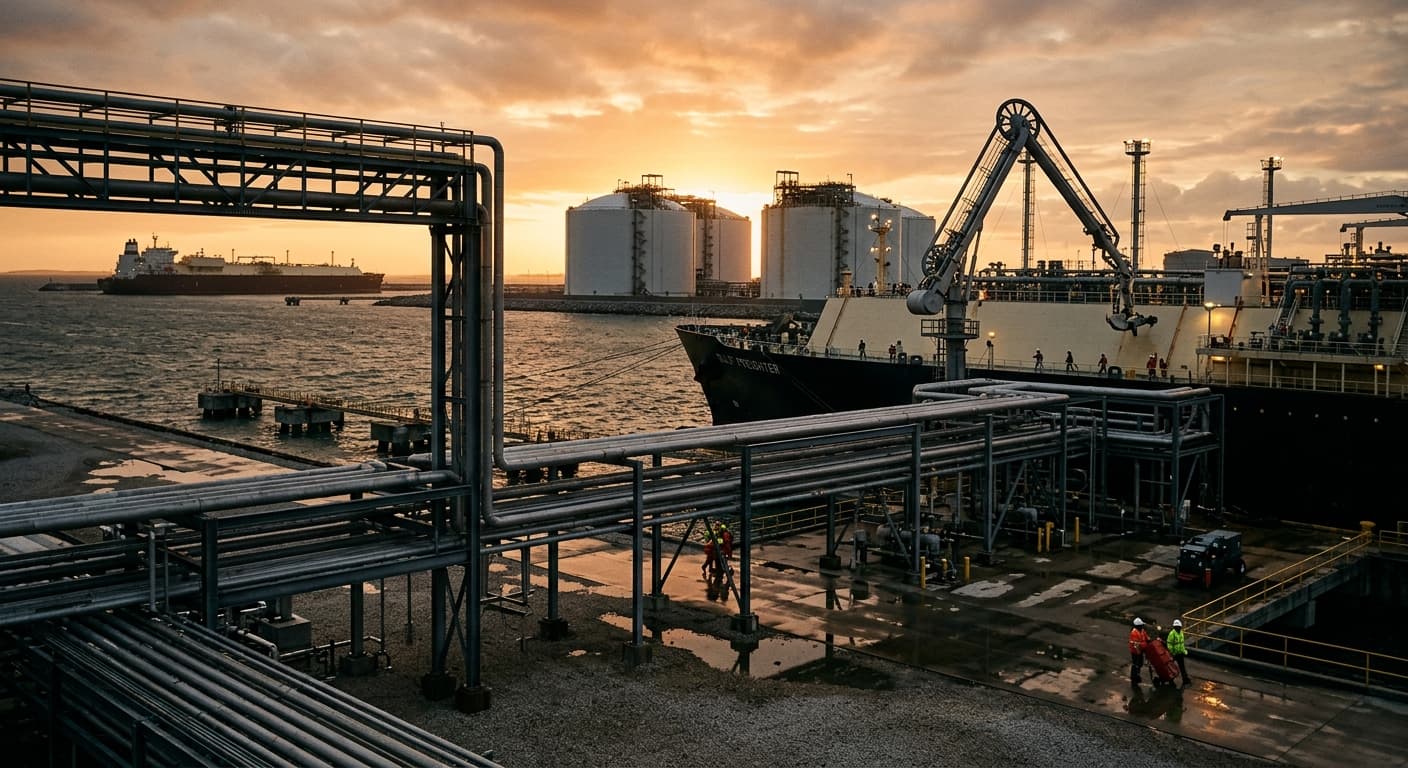
Iran War Rewrote the Economics of US Gas — and Locked In a Decade of LNG Approvals
The US-Iran conflict closed the Strait of Hormuz, knocked out 17% of Qatar's LNG capacity, and handed American exporters a $3-to-$20 price arbitrage that turned deregulation into record export approvals, a structural shift that will outlast the war.
The US-Iran war that began on February 28, 2026, did something that two years of lobbying could not: it converted the Strait of Hormuz from a trade route into a liability, and in doing so, gave American LNG producers both the cash and the political cover to lock in the fastest expansion of US gas export capacity in history. On July 15, 2026, S&P Global reported that Middle East conflict had driven record US LNG export approvals, with Vice Chairman Daniel Yergin declaring "really quite strong momentum to US LNG" and predicting buyers would look "even more strongly at US LNG as a form of diversification" away from chokepoint-dependent supplies (Briefs). The number that matters is not the approvals count but the price spread that made them bankable: US producers bought feedgas at roughly $3 per million British thermal units while selling cargoes into Asia and Europe at approximately $20. That margin financed new terminals and made the regulatory case for approving them unanswerable (
NPR).
The chokepoint that rewired the market
Iran's closure of the Strait of Hormuz after US-Israeli strikes began on February 28 shut down the passage through which roughly one-fifth of the world's LNG transits. The blow fell hardest on Qatar, the world's largest LNG producer, which accounts for about 20% of global supply. Iranian missiles and drones struck the Ras Laffan complex, the largest LNG facility on the planet, damaging two of its 14 liquefaction trains and one gas-to-liquids plant. QatarEnergy declared force majeure on contracts to Italy, Belgium, South Korea, and China on March 2, sidelining 12.8 million tonnes of annual production for three to five years at an estimated $20 billion in lost revenue (Al Jazeera). UNCTAD, the UN trade body, reported that daily transits through the strait dropped from an average of 103 vessels in late February to single digits within weeks, effectively bringing flows to a standstill (
UNCTAD). The World Bank's natural gas price index rose 24% in March alone, with the Asian LNG benchmark spiking about 94% and Europe's climbing roughly 59% (
World Bank). The US benchmark, insulated by abundant domestic production, fell 3% the same month.
That divergence, Asian gas near $20 while US gas stayed near $3, is the arbitrage that bankrolled the approval surge. Ira Joseph, an international gas expert at Columbia University, told NPR the spread "provides a huge influx of cash for all of these companies," giving them leverage when approaching banks to finance expansion. Venture Global, which saw its stock rise about 30% since the war began, closed on $8.6 billion in financing for phase two of its Louisiana LNG project in the weeks after the conflict erupted (NPR). Cheniere Energy's stock rose about 10%; Australia's Woodside Energy, which has US LNG holdings, gained about 20%.
From Biden's pause to Trump's pipeline
The record approvals did not emerge from a vacuum. They capped an 18-month regulatory reversal. In January 2024, the Biden administration paused new Department of Energy authorizations for LNG exports to non-FTA countries, pending a climate and economic review. Sixteen Republican-led states sued; on July 1, 2024, US District Judge James Cain Jr. granted a preliminary injunction, finding the states likely to succeed on the merits (NPR). On January 20, 2025, Inauguration Day, President Trump signed Executive Order 14154, "Unleashing American Energy," directing agencies to lift burdens on natural gas development (
Congressional Research Service). Two months later, on April 2, 2025, DOE rescinded the 2023 policy statement that had restricted extensions of export commencement deadlines, reverting to a case-by-case approach (
Federal Register).
The Federal Register has since logged a steady pipeline of new and amended authorizations. In December 2025, Plaquemines Expansion filed for long-term authorization to export roughly 1,624 billion cubic feet per year from its Louisiana terminal (Federal Register). Cheniere followed in March 2026, with its Corpus Christi complex seeking authorization for an additional 251 Bcf/yr from its Midscale project and citing refined production capacity data (
Federal Register). In June 2026, Rio Grande LNG Train 6 applied to export approximately 312 Bcf/yr from a sixth train at its Cameron County, Texas, facility (
Federal Register). According to CSIS, the US has more than 70 million tonnes per annum of baseload export capacity under construction, with projects reaching final investment decision last year attracting $40 billion in debt and equity financing; by 2028, capacity is slated to exceed 160 mmtpa — more than double Qatar's current output (
CSIS).
S&P Global projects that gas feeding LNG facilities, largely on the Gulf Coast, will double over the coming five years, with US LNG supply forecast to grow about 84% in that window (Briefs). Energy Secretary Chris Wright framed the calculus plainly at CERAWeek in Houston: "We have a shortage of natural gas. Where is that natural gas gonna come from? It's gonna come from continued ramps, continued investments to grow United States LNG exports" (
NPR). Anatol Feygin, Cheniere's chief commercial officer, called the sudden loss of Hormuz LNG a "guillotine issue."
Who benefits, who pays
The beneficiaries are concentrated and named. Cheniere, the largest US exporter, gains from both volume and the Corpus Christi expansion. Venture Global, already capitalized for phase two at Plaquemines, is positioned to capture spot-market premiums. ExxonMobil and Shell, which hold joint-venture stakes in Qatar's damaged trains, face losses on the Gulf side but gain on the US side where their LNG portfolios are anchored — a hedge that Qatar's pure-play national champion cannot match (Brookings). Gulf-state investors, anticipating prolonged regional instability, are accelerating capital flows into US projects, a trend S&P Global's Yergin said existed before the conflict but is now expected to speed up (
Briefs).
The losers are also specific. Asian buyers — Bangladesh, India, Pakistan — absorb the sharpest price shock because 90% of Hormuz LNG flows east, and most have only 20 to 50 days of reserves, according to research cited by the Council on Foreign Relations (CFR). Europe, which imports only about 10% of its LNG from the Gulf, nonetheless paid an additional €24 billion for fossil fuel imports since the war began because it competes with Asia for the same non-Qatari cargoes (
Chatham House). The European Commission responded with its AccelerateEU package, mixing short-term gas coordination with long-term electrification incentives. The developing-country toll is steepest: UNCTAD warned that the oil import bill for vulnerable economies could rise by $20 billion annually, costing some more than 5% of GDP (
UNCTAD).
The environmental counter and its limits
The approval surge faces a legal counteroffensive, but its leverage is narrowing. Environmental groups, including the Sierra Club and Earthjustice, have a long record of challenging FERC approvals under the National Environmental Policy Act, arguing that upstream production impacts and lifecycle emissions must be weighed. The D.C. Circuit ruled in 2016 that FERC is not required to review upstream impacts, shifting that burden to DOE (StateImpact NPR). The Biden-era DOE study, released December 2024, found that unfettered exports could raise domestic energy bills and increase emissions, giving advocates ammunition for litigation (
NPR). But the Trump administration's February 2026 repeal of the 2009 endangerment finding — the legal foundation for greenhouse gas regulation — stripped a key tool from challengers, prompting lawsuits from 23 states and numerous cities (
BBC). An industry-funded S&P Global study released in March 2025 argued that continued US LNG expansion would result in 324 to 780 million tonnes of lower global emissions through 2040, because US gas displaces higher-intensity fossil alternatives — a claim environmental groups contest (
S&P Global).
Diplomat View
The Iran war did not create the US LNG boom — it accelerated and entrenched it. The structural shift is this: the Strait of Hormuz, once a reliable artery, is now priced as a persistent risk, and that risk premium is being capitalized into a decade of US export capacity that will outlast any ceasefire. Even with the interim US-Iran peace agreement and QatarEnergy's phased restart toward 80% capacity, buyers are locking in long-term US contracts rather than betting on a Gulf return — because Iran can close the strait at any time, and renewed attacks in July 2026 have already demonstrated that fragility (UN News;
CFR). The CSIS projects US contracted volumes to Europe growing from 31 bcm in 2026 to 52 bcm by 2030, with US capacity more than doubling to 300 bcm by 2029 (
CSIS).
This forecast would revise downward on two conditions: a durable, verified Hormuz reopening that restores Qatari volumes to near-full capacity and collapses the Asia-US arbitrage below the threshold that finances new terminals; or a successful legal challenge that reinstates stringent public-interest review at DOE, slowing the authorization pipeline. Neither is imminent. The more probable risk is the opposite: a simultaneous Houthi closure of the Bab al-Mandeb, which would trap Saudi Arabia's East-West Pipeline bypass and block roughly 25% of global oil and gas, deepening US LNG's structural advantage further (Al Jazeera).
What to watch:
- QatarEnergy's restart timeline and whether it reaches the targeted 80% capacity within two months of the June 16 peace agreement — slippage extends the arbitrage window.
- DOE rulings on pending Plaquemines Expansion (1,624 Bcf/yr) and Rio Grande Train 6 (312 Bcf/yr) applications — the next approval batch tests whether the pace holds post-ceasefire.
- The D.C. Circuit's handling of state lawsuits challenging the endangerment finding repeal — a ruling reinstating EPA authority would reopen a litigation path against new LNG authorizations.
- Houthi activity around the Bab al-Mandeb Strait — a second chokepoint closure would structurally entrench, not threaten, the US LNG advantage.
Discover more
US Politics
House Ethics Committee Pushes Sexual Miscond.
The House Ethics Committee has shifted responsibility for sexual harassment settlement records to the Office of Congressional Workplace Rights, complicating disclosure efforts.

India
Delhi CM Rekha Gupta Blasts Opposition's Delm
Delhi CM Rekha Gupta's remarks on women's quota defeat reveal BJP's strategy for the 2029 Lok Sabha elections, focusing on delimitation.
India
Congress Accuses Modi of Stalling Women's Law
Congress accuses Modi of stalling women's reservation law by linking it to delimitation, revealing a deeper electoral strategy.

Conflict & Security
Drone Warfare Killing Aid Workers at Unprec
Over 1,000 humanitarian workers killed in three years as cheap armed drones collapse legal protections. Gaza, Sudan, Ukraine, and DRC see deliberate targeting of aid convoys and hospitals with zero prosecutions.