Iran War Made US the Indispensable Gas Suppli
Hormuz closure turbocharged US LNG dominance through 2030
Model Diplomat4 min readMiddle East
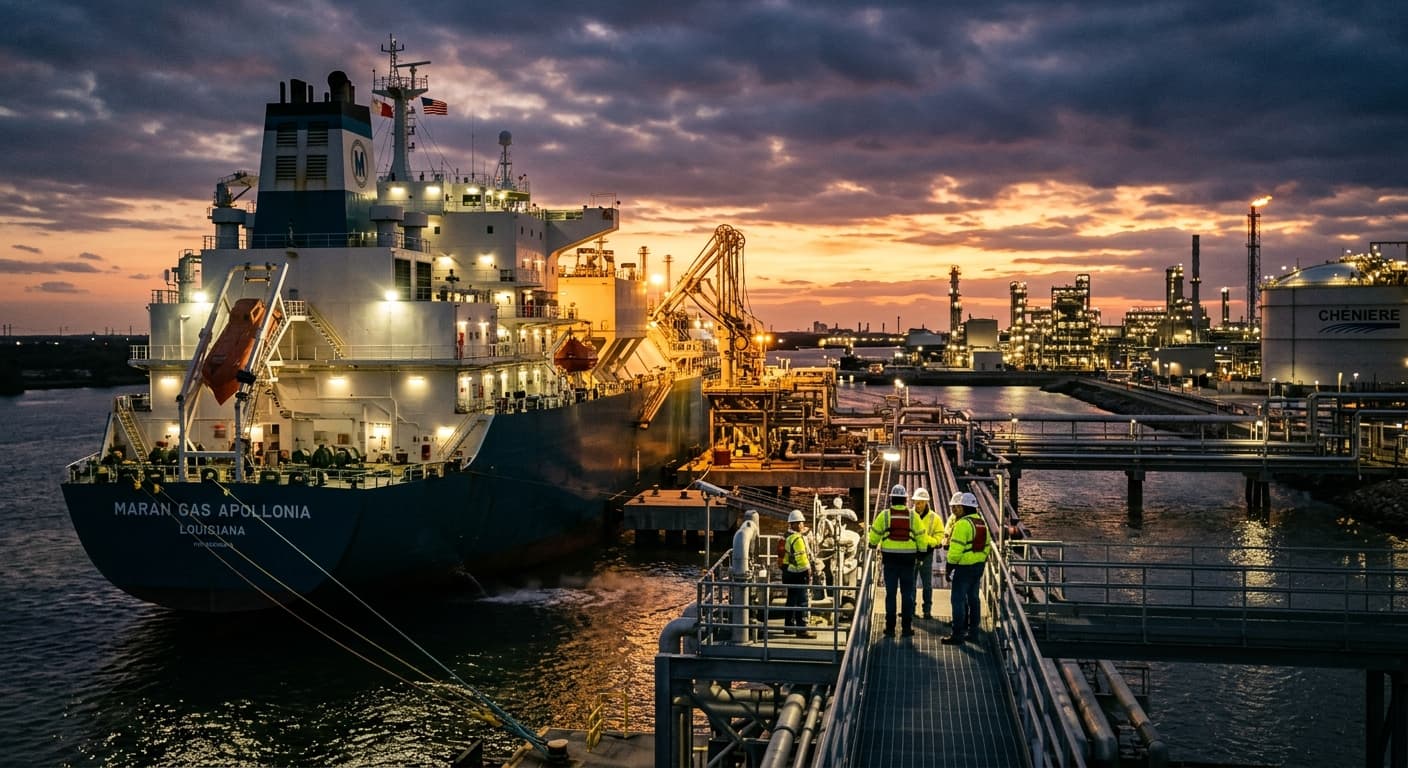
Iran War Quietly Made the US the World's Indispensable Gas Supplier
The February 2026 Hormuz closure didn't just spike prices. It turbocharged a US LNG permitting wave that locks in American gas dominance through 2030 and redirects Gulf-state capital into Gulf Coast terminals as a hedge against the very chokepoint that made it possible.
S&P Global reported on July 15, 2026 that the Iran war has driven record U.S. LNG export approvals and channeled fresh investment into American terminals, as buyers worldwide scramble for alternatives to the Strait of Hormuz — the chokepoint through which roughly one-fifth of global liquefied natural gas normally transits, according to Al Jazeera. The real story is not the windfall itself. It is that a 100-day shipping blockade, layered onto a 2025 policy reversal that lifted the Biden-era permitting pause, has structurally pulled forward a decade of U.S. LNG capacity. The blockade has cemented American dominance of a market Qatar once expected to lead and turned the U.S. Gulf Coast into the hedge of choice for the very Gulf-state capital now fleeing the Gulf.
The Hormuz Shock and the Windfall Economics
The U.S.-Israeli war on Iran began on February 28, 2026. Within days, Iran had effectively shuttered the Strait of Hormuz — the largest energy supply disruption in history, according to the International Energy Agency. On March 2, Iranian drones struck QatarEnergy's Ras Laffan LNG complex. On March 18, a second strike destroyed two of the facility's 14 liquefaction trains, knocking out roughly 17% of Qatari export capacity and about 3% of global LNG trade, per
EIA analysis. QatarEnergy declared force majeure. QatarEnergy estimates repairs on the two destroyed trains could take up to five years, as
Brookings confirmed — a timeline that effectively removes a major supplier from the market through 2031.
The price consequences were immediate and brutal for importers. The World Bank reported its natural gas price index rose 24% in March, with the Asian LNG benchmark spiking 94% and Europe's climbing 59%. For U.S. producers, the arithmetic was stark. Columbia University's Ira Joseph told
NPR that exporters were buying feed gas at around $3 per million British thermal units and selling cargoes into Asia and Europe at roughly $20. "That spread provides a huge influx of cash for all of these companies," he said. Venture Global's stock rose about 30% after the war began; Cheniere's rose about 10%; Woodside Energy, about 20%.
The U.S. benchmark, insulated by abundant shale supply, actually fell 3% in March before rebounding modestly. That divergence, flat Henry Hub against soaring Asian and European spot prices, is the single most important fact underpinning the approval surge. It means U.S. exports impose what S&P Global calls a "negligible" cost on American households while generating extraordinary margins abroad. The World Bank projects European gas prices jumping 25% in 2026 even as the U.S. benchmark stays flat — a wedge that makes American LNG the cheapest reliable molecule on the planet.
From Pause to Acceleration
The windfall landed on a permitting regime that had just reopened. On January 20, 2025, President Trump signed Executive Order 14154, "Unleashing American Energy," lifting the Biden administration's January 2024 pause on non-FTA LNG export authorizations, as documented by the Congressional Research Service. The pause had frozen 17 pending projects. A Louisiana federal judge had already stayed it in July 2024, but the executive order formalized the reversal and directed DOE to weigh "domestic economic and employment effects, and the security of U.S. allies and partners" in public-interest reviews.
Under the Natural Gas Act, Section 3(a), the DOE must authorize LNG exports to non-FTA countries unless it finds the exports inconsistent with the public interest — a presumption favoring approval. As of June 30, 2025, the DOE had issued 42 long-term LNG export authorizations totaling 55.3 billion cubic feet per day (Bcf/d), up from 41 authorizations and 49.8 Bcf/d in April 2023, per the
DOE Office of Fossil Energy. Current U.S. peak export capacity stands at 18.3 Bcf/d, with over 28 Bcf/d in operation or under construction.
The war turned that reopened pipeline into a torrent. DOE approved Commonwealth LNG's 9.5 mtpa Cameron Parish facility — the first authorization after the pause, per Oil & Gas Journal — and in March and April 2026 increased permitted exports for Plaquemines LNG (0.5 Bcf/d) and Elba Island (0.1 Bcf/d). Daniel Yergin, vice chairman of S&P Global, framed the moment bluntly to
Briefs: "There's been really quite strong momentum to US LNG. There's going to be a further focus on energy security, further focus on having alternatives to choke points." The war didn't just make American gas indispensable. It made the Gulf Coast the place where Gulf money hides from the Gulf.
Discover more

US Politics
Virginia's Redistricting Referendum
Virginia's redistricting referendum is drawing a flood of dark money, shaping future elections and the fight for congressional control amid party stakes.

Global Politics
Xi Jinping Calls China-Russia Ties 'Precious'
Xi Jinping's description of China-Russia ties as 'precious' reflects a strategic imbalance, with Beijing dictating terms in the partnership.
Global Politics
US-Iran Tensions Rise
Tensions escalate in the Strait of Hormuz as Iran and the US clash over maritime control, with a ceasefire hinging on a contested MoU paragraph.

Conflict & Security
Drone Warfare Killing Aid Workers at Unprec
Over 1,000 humanitarian workers killed in three years as cheap armed drones collapse legal protections. Gaza, Sudan, Ukraine, and DRC see deliberate targeting of aid convoys and hospitals with zero prosecutions.