Iran-U.S. Strikes: Ceasefire Collapse
Ceasefire breakdown empowers Iran's hardliners
Model Diplomat9 min readMiddle East
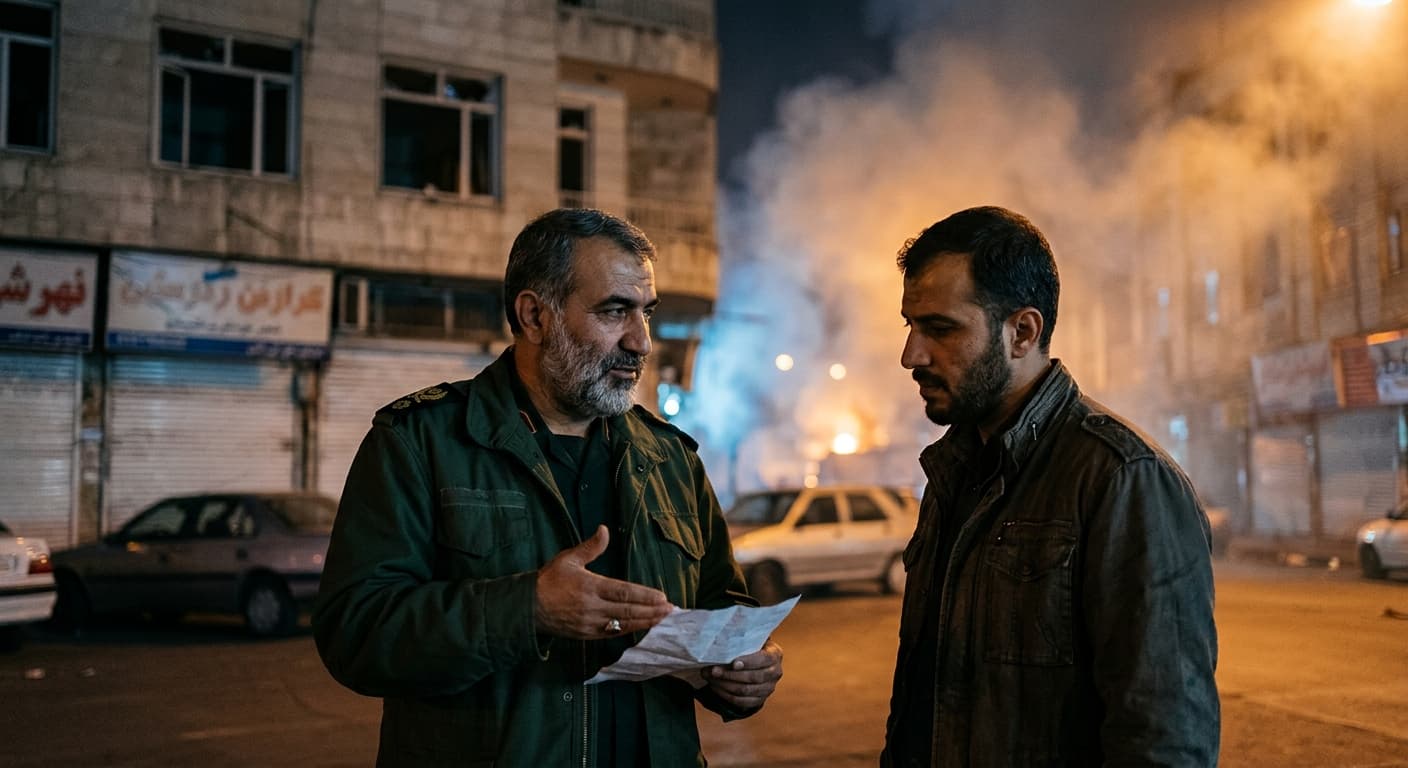
Iran-U.S. strikes: ceasefire collapse hands leverage to the IRGC
U.S. hits about 90 Iranian targets on July 9, 2026 as Iran strikes Gulf bases. The June 17 MoU is unravelling — and hardliners in Tehran are the beneficiaries.
The second round of American airstrikes in as many nights — some 90 Iranian military targets hit on July 9, 2026, met by Iranian missile salvoes against U.S. facilities in Kuwait, Bahrain and Qatar — has done more than fracture the three-week-old ceasefire between Washington and Tehran. It has vindicated the wager the Islamic Revolutionary Guard Corps made when it signed the June 17 memorandum of understanding: that turning the Strait of Hormuz into a permanent bargaining chip would extract concessions no Iranian negotiator could win at the table. The MoU is failing on exactly the point the IRGC wanted it to fail on — control of the strait — and the political price is being paid inside Iran by anyone who argued for a diplomatic exit.
What happened, in order
U.S. Central Command said it hit "approximately 90" targets late on July 8, including missile and drone storage, coastal radar, maritime traffic-control nodes and logistics infrastructure along Iran's southern coast, according to Al Jazeera's reporting of the CENTCOM statement. The
BBC reported strikes on Bandar Abbas, Sirik, Jask and the perimeter of the Bushehr nuclear complex, and additional hits on a railway bridge in northeastern Iran.
Iran's health ministry, cited by public-relations chief Hossein Kermanpour, reported at least 14 killed and 78 wounded across five provinces on July 8–9, with 47 still in hospital. Iran's Islamic Revolutionary Guard Corps said it had targeted U.S. bases in Kuwait and Bahrain overnight as the "first phase of the punitive response against the American treaty-breakers," and Iranian state-linked media later reported further strikes on U.S. assets in Jordan and Iraq.
Speaking at the NATO summit in Ankara on July 8, U.S. President Donald Trump said the memorandum of understanding was "over" and called Iran's leadership "scum," per Al Jazeera. He nonetheless left negotiators in place and told reporters on Air Force One that Iran had "called a little while ago" seeking a deal — a signalling pattern that mirrors his April 7 ultimatum, when a threat of civilisational destruction was followed within hours by a Pakistan-brokered truce that
the BBC reported took effect immediately.
Iranian Foreign Minister Abbas Araghchi replied on X: "We do not answer vulgarity with vulgarity, but with action: fearlessly and with great valour."
The Hormuz leverage the MoU never resolved
The MoU's fatal ambiguity was written into point five. Iran committed to using "its best efforts for the safe passage of commercial vessels with no charge for 60 days" and to "conduct dialogue with the Sultanate of Oman to define the future administration and maritime services in the Strait of Hormuz," per the US-read text of the agreement. Iran's chief negotiator Mohammad Bagher Ghalibaf immediately told Fars, per
Al Jazeera, that the strait "will not return to pre-war conditions" and Iran will "receive a fee for services." Washington had publicly pledged the waterway would be "permanently toll-free."
Twenty-two days later, that gap is the shooting war. After the MoU was signed, the Joint Maritime Information Center recommended vessels take a southern route through Omani waters. Iran replied on June 25 and June 27 by hitting two ships transiting there, then attacked three more tankers — a Qatari-owned LNG carrier, a Saudi-owned crude tanker and a Liberia-flagged crude tanker — on July 6–7. Only 23 tankers and cargo ships crossed the strait on July 8, down from 47 a week earlier and from a post-MoU peak of 72 on June 24, the BBC reported, citing Kpler data; zero vessels used the US-recommended Omani route that day.
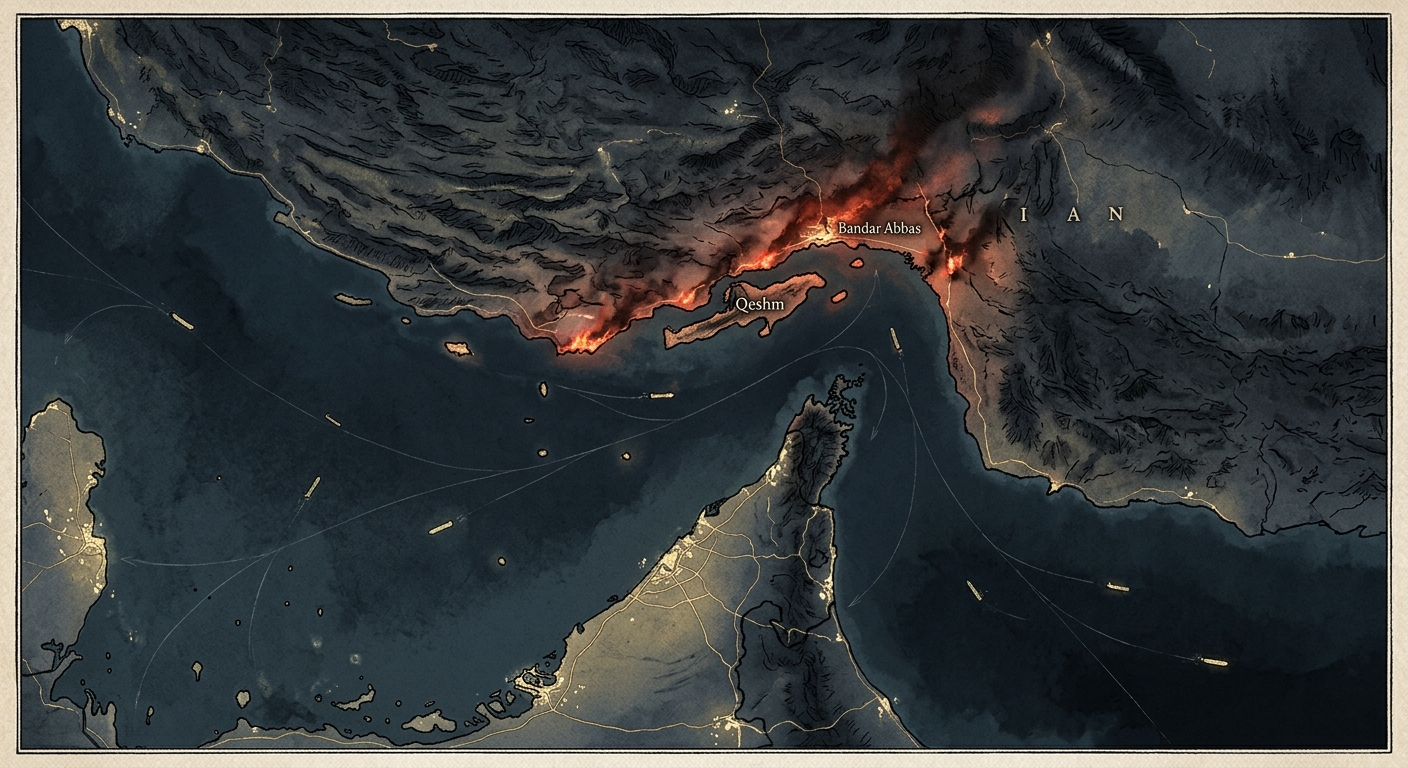
Washington's second lever — sanctions relief — has already been withdrawn. The U.S. Treasury revoked the waiver that had temporarily eased sanctions on Iranian oil exports on July 7, before CENTCOM's strikes, according to the BBC. Iran's parliamentary speaker Ghalibaf called that a breach of the MoU on oil sales, together with the strikes in southern Iran and what he termed "violating Iranian adjustments in the Strait." Both sides now claim the other broke first — legally and strategically a wash, which is precisely the ambiguity the IRGC needs.
Who benefits: the IRGC, the arms industry, and Moscow
Inside Iran, decapitation has centralised rather than dispersed power. The Gulf International Forum's analysis of post-succession Tehran argues that Mojtaba Khamenei's elevation as Supreme Leader "was reportedly pushed by the IRGC and hardline power centres that viewed him as a pliable and reliable figure," and that "the biggest winner of this new phase is not Mojtaba Khamenei, but the IRGC — the institution without which the current order becomes untenable." An Israeli think-tank assessment, from the
Jerusalem Institute for Strategy and Security, goes further: with Mojtaba absent from public life since March, "the IRGC controls the regime" through a security apparatus surrounding him, and its collective decision-making "precludes any compromise or de-escalation."
That reading explains what looks from the outside like Iranian self-sabotage. Every tanker strike hardens the case in Tehran that only Guard-controlled escalation extracts anything from Washington — and simultaneously discredits President Masoud Pezeshkian and Foreign Minister Araghchi, who staked their political capital on the Islamabad process. The Stimson Center noted that Mojtaba "will presumably look toward Russia and China to help Iran recover, both militarily and economically" — and each day the MoU's $300 billion reconstruction fund stays notional, that pivot deepens.
The second beneficiary is the U.S. defence and oil sectors, whose earnings the Financial Times reports are set to book "bumper profits driven by the war in Iran." Brent crude, which had drifted back toward pre-war levels through late June, surged past $80 a barrel on July 7 before easing below $78 the next day — a two-week high that arrived just as major producers prepared quarterly results.
The losers are visible and specific: Qatar and Saudi Arabia, whose flagged tankers were hit and whose territories now host retaliatory Iranian drone strikes; Oman, whose recommended southern shipping lane has been rendered unusable; and the international negotiating framework Pakistan brokered in April and June. Pakistan's foreign ministry called the renewed conflict "in no one's interest" and urged both sides to honour "the Islamabad Memorandum of Understanding," Al Jazeera reported. Qatari Prime Minister Sheikh Mohammed bin Abdulrahman Al Thani spent July 9 telephoning Araghchi to plead for implementation of the June deal, even as Qatar itself condemned an Iranian drone attack on its territory.
The historical parallel that reframes this
The reflex comparison is to 2019–2020: the Soleimani strike, tanker seizures, tit-for-tat missile exchanges. It is the wrong template. The closer parallel is the collapse of the 1975 Algiers Accord between Iran and Iraq, which resolved a Shatt al-Arab waterway dispute on paper while leaving sovereign control unresolved — and which Saddam Hussein tore up five years later to start an eight-year war. The Islamabad MoU has the same structural flaw: it papers over sovereignty of a strategic waterway with a 60-day "best efforts" clause and a promise of future "dialogue." Whoever controls Hormuz controls the deal. Iran's public position — reiterated by Khatam al-Anbiya Central Headquarters that "the only safe route" is one it determines — is a claim of sovereignty dressed as a safety notice.
The RAND Corporation's March scenario mapping flagged a "suppression and succession" pathway in which "the regime becomes more reliant on the Islamic Revolutionary Guard Corps to brutally reassert its authority," producing "a quasi-military junta emerging with weaker clerical legitimacy" that "doubles down on resisting U.S. and Israeli pressure." That is the Tehran now firing on Gulf bases as Ali Khamenei is buried in Mashhad.
The economic second-order effect
The IMF made the fiscal cost explicit the same day Trump declared the ceasefire over. In its July 8 WEO update, the Fund cut its 2026 global growth forecast to 3.0 percent, revising down from 3.1 percent in
its April 2026 baseline, which itself had already priced in "the global economy in the shadow of war." UN Secretary-General António Guterres, whose spokesperson briefed reporters on July 8, warned that "a return to full-scale hostilities would have catastrophic consequences for the peoples of the region, for international peace and security, and for the global economy as a whole," per the
UN's daily press briefing. The Security Council held an emergency session on July 2 at Bahrain's request; its meeting record (
SC/16405) urged parties to "implement peace deal now" as confrontation resumed.
The IMF projection assumes Hormuz remains at least partially open. It does not. On July 9 the marine director of Intertanko, Phil Belcher, told the BBC that traffic through the southern route was "in single figures" — a de facto closure of the corridor that carries roughly a fifth of the world's daily oil and LNG.
"The US had clearly hoped that the generous, some would argue overly generous, financial incentives in the deal would discourage Iran from using shipping in the Strait of Hormuz as leverage. It will now need to rethink that approach. Neither the promise of economic relief nor the threat of military punishment has, so far, changed Iran's behaviour." — Jane Parker, quoted in the
BBC, July 9, 2026.
Why Trump's off-ramp is narrower than April's
The April 7 ceasefire worked because Iran needed to reopen the strait and Trump needed a "win" before his rhetorical threats — a "whole civilisation will die tonight," as the BBC quoted him — became actionable. The June 17 MoU worked because Iran's newly installed leadership needed sanctions relief and the $300 billion reconstruction fund promised in point six of
the text, and Trump could sign a document at Versailles that let him claim war termination.
Both incentives are now degraded. The sanctions waiver is gone, Iranian assets remain frozen, and the reconstruction fund — which the White House told reporters requires "not a cent" from the U.S. Treasury — was always contingent on Gulf partners whose airbases are now under Iranian fire. Trump's hint that the U.S. "may take over" Kharg Island, as Al Jazeera reported, would require ground forces the administration has neither authorised nor requested from Congress; NATO Secretary-General Mark Rutte called the strikes "absolutely necessary" but stopped short of endorsing escalation.
The Trump administration's own read of the leverage, offered anonymously to Al Jazeera by former CIA officer Scott Uehlinger, is that hitting Iran's maritime traffic-control infrastructure will force Tehran "to return to the MoU." The IRGC's reading is the opposite: each strike on Iranian coastal command nodes makes free passage under U.S.-recommended routes more dangerous, not less, because the Guard's calibrated deniability is preserved while Iran's official channels are degraded.
What to watch
- The 60-day clock: point three of the MoU set a deadline of roughly August 16, 2026, for a final deal. Trump has called further talks "a waste of time" but has not formally withdrawn negotiators. The date remains the legal trigger for MoU collapse.
- Kharg Island: any U.S. move against Iran's principal oil export terminal would cross a threshold the April and June ceasefires deliberately avoided. Watch CENTCOM taskings and B-2 movements out of Whiteman AFB.
- Iranian retaliation geography: strikes have already expanded from Kuwait and Bahrain to Qatar, Iraq and Jordan. Extension to Saudi oil infrastructure or U.S. assets in the UAE would mark a qualitative escalation and put GCC states — not Washington — at the front line.
- The next UN Security Council session: the July 2 meeting produced a call to "implement the peace deal now" but no resolution. A binding UNSC resolution was written into point 14 of the MoU as the endorsement mechanism for any final deal; without it, the framework has no legal ceiling.
- The IRGC succession signal: whether Mojtaba Khamenei appears in person at his father's burial rites, or the IRGC's Supreme National Security Council chief Mohammad Baqer Zolghadr speaks in his stead, will indicate who is authorised to accept — or refuse — the next off-ramp.
The Bottom Line
The July 8–9 exchanges are not a rupture of the Islamabad MoU so much as a stress test it has now failed. The deal traded ambiguity on Hormuz sovereignty for a 60-day negotiating window; the IRGC has used that ambiguity to keep the strait a live weapon, and each strike-and-counterstrike cycle transfers domestic Iranian authority further from the negotiators who signed the document to the security apparatus that never wanted it. Whoever controls the Strait of Hormuz controls the deal — and on July 9, 2026, that is not Washington.
Discover more
US Politics
House Ethics Committee Pushes Sexual Miscond.
The House Ethics Committee has shifted responsibility for sexual harassment settlement records to the Office of Congressional Workplace Rights, complicating disclosure efforts.
India
Congress Accuses Modi of Stalling Women's Law
Congress accuses Modi of stalling women's reservation law by linking it to delimitation, revealing a deeper electoral strategy.

India
India-South Korea $50B Trade Expansion Plan
India and South Korea target $50 billion in bilateral trade by 2030, focusing on industrial cooperation and strategic alignment amid US pressures.

Conflict & Security
Drone Warfare Killing Aid Workers at Unprec
Over 1,000 humanitarian workers killed in three years as cheap armed drones collapse legal protections. Gaza, Sudan, Ukraine, and DRC see deliberate targeting of aid convoys and hospitals with zero prosecutions.