Iran Strikes Bahrain and Kuwait Amid US Ties
Iran retaliates after US revokes oil sales license.
Model Diplomat8 min readMiddle East
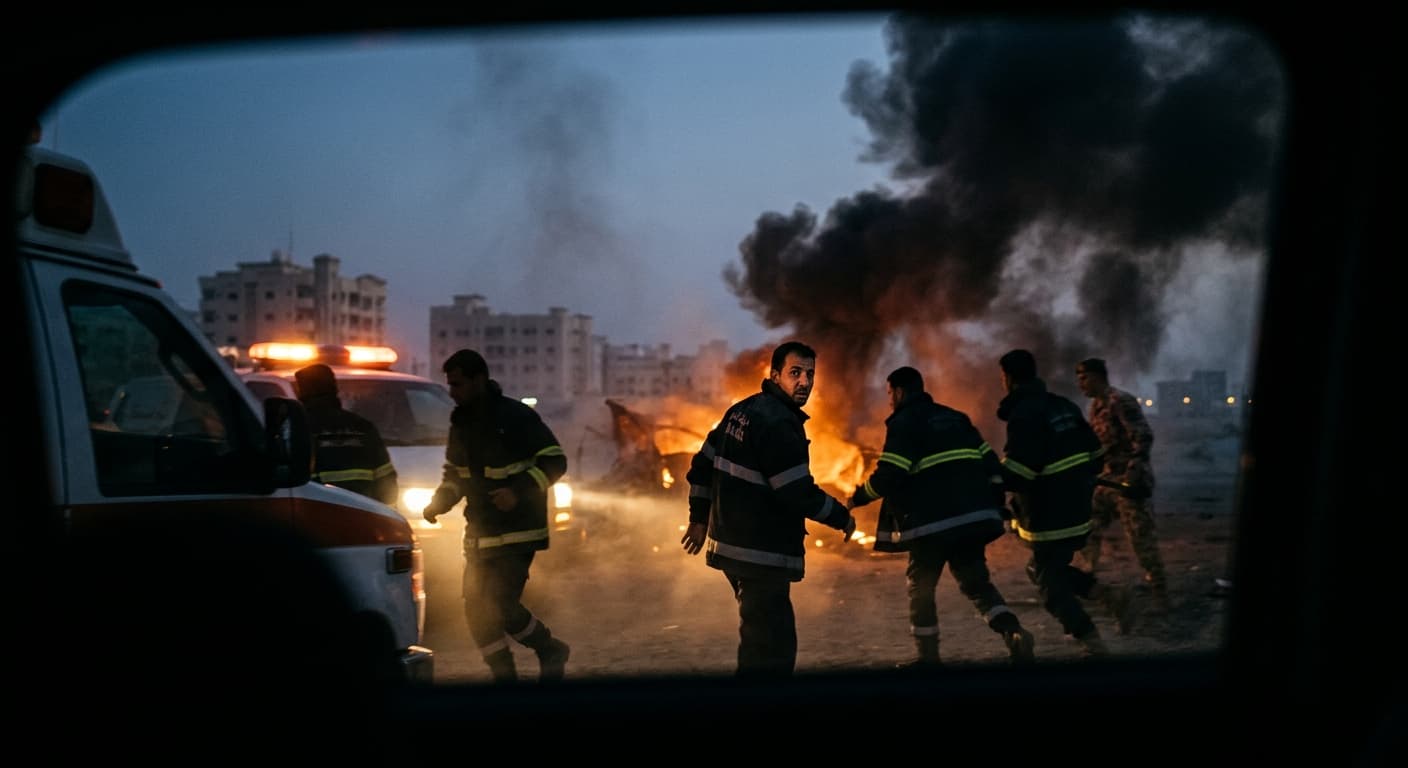
Iran Strikes Bahrain and Kuwait as US Kills Oil Waiver
Iran's IRGC claims strikes on 85 US sites in Bahrain and Kuwait after Washington revokes an Iranian oil license and bombs Iranian air defenses.
Iran's July 8, 2026 strikes on Bahrain and Kuwait are not retaliation for US bombs — they are Tehran's answer to the revocation of its oil-sales license, and they are aimed less at American bases than at the Gulf rulers who host them. Within 24 hours of the US Treasury pulling General License X1, the only door through which Iran could sell crude openly in dollars, the Islamic Revolutionary Guard Corps claimed missile and drone attacks on "85 US military facilities" in the two smallest Gulf monarchies. The message is that any Gulf state complicit in choking Iran's oil revenue will pay in air-raid sirens. That reframes the Strait of Hormuz standoff from a US-Iran contest into a coercion campaign against Manama, Kuwait City, Doha and Riyadh — the countries whose next moves will decide whether the June 17 ceasefire survives July.
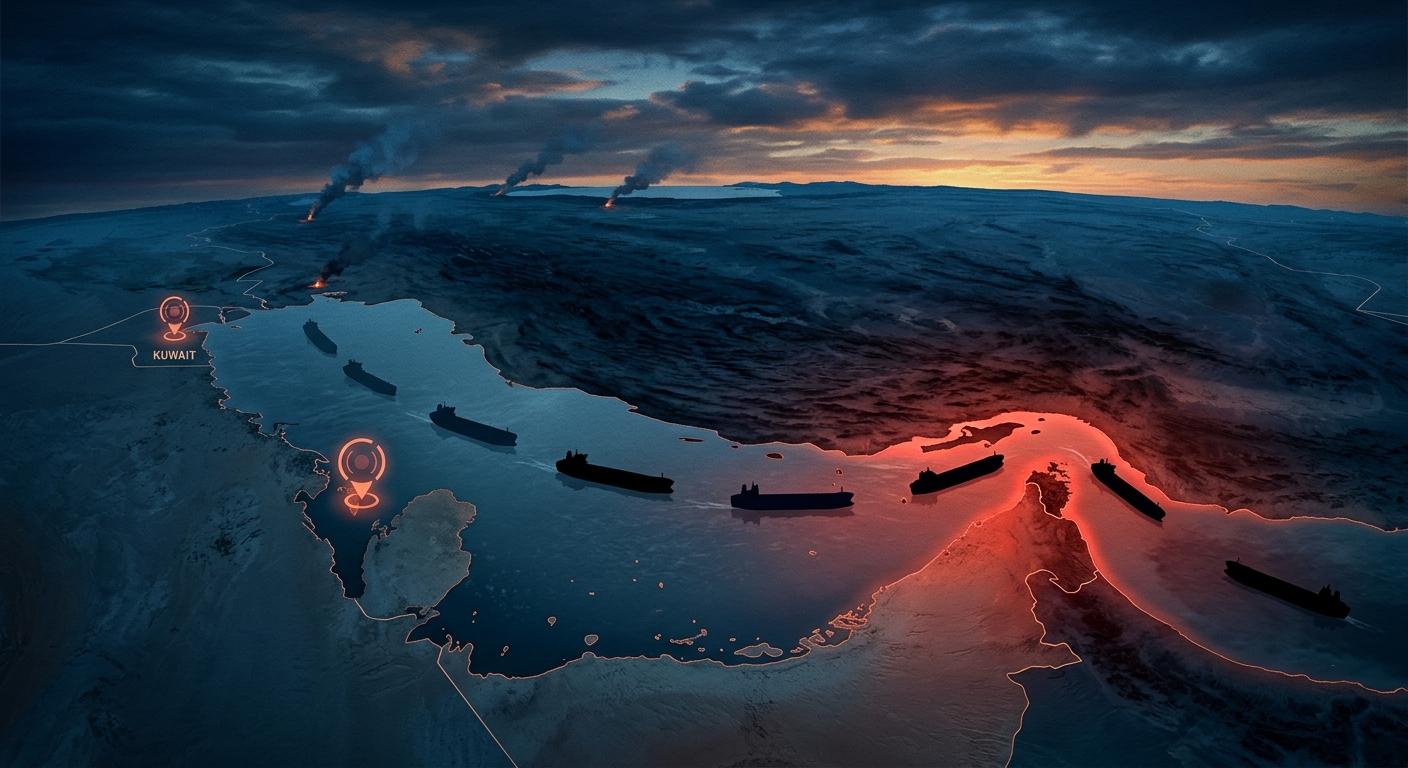
What happened, in order
The trigger was maritime, not political. On July 6, three commercial tankers — the Qatari LNG carrier Al Rekayyat, the Saudi supertanker Wedyan and a third vessel — were struck off the coast of Oman while transiting the southern route through the Strait of Hormuz that the US Navy protects and Iran does not authorize. UK Maritime Trade Operations reported the Al Rekayyat was hit on its port side near Limah and caught fire, according to Al Jazeera. Iranian state television said the tanker had "ignored warnings" but Tehran did not directly claim the strike.
Washington moved on two tracks. First, the Treasury Department revoked the 60-day sanctions waiver it had granted Iran on June 20, cancelling General License X1 with a wind-down cutoff of 04:01 GMT on July 17, per Al Jazeera's summary of the Treasury notice. That license, listed on the
OFAC website, had, for the first time since the 1979 revolution, allowed the production, sale and delivery of Iranian crude in US dollars through August 21.
Second, US Central Command launched what it called "a series of powerful strikes" on more than 80 targets across southern Iran — air defense systems, coastal radars, surface-to-air missiles, drone launchers and 60-plus IRGC fast boats at Sirik, Qeshm Island, Bandar Abbas and Bandar Mahshahr, per NPR and
BBC News. Iran's Fars news agency reported two military bases hit in Bushehr province; the IRGC reported one fighter killed.
Iran's response, hours later, was engineered for maximum political effect. The IRGC statement announced strikes on "85 key US military facilities" in Bahrain and Kuwait, singling out a US Navy headquarters — an unambiguous reference to the 5th Fleet in Manama — and an air base in Kuwait, likely Ali Al-Salem, which was struck in the June 10 round, Al Jazeera reported. Bahrain's air-raid sirens went off four times before dawn, according to the media adviser to the Bahraini king. Kuwait's foreign ministry called it "a flagrant violation of its sovereignty" and invoked
UN Security Council Resolution 2817 (2026), which was adopted 13–0–2 in March to condemn Iran's earlier attacks on seven neighbours.
Why the oil license is the story
Wire coverage is leading with the missiles. It should be leading with the license. The revocation of General License X1 is a bigger blow to Tehran than any of the CENTCOM strikes, and Iranian officials said as much within hours. Deputy Foreign Minister Kazem Gharibabadi called the revocation a "blatant violation" of the MoU and pledged "decisive actions," per Al Jazeera. Chief negotiator Mohammed Bagher Ghalibaf named the sanctions reinstatement as the "major MoU violation," ahead of the airstrikes.
The reason is arithmetic. For most of the past five years, Iran has moved 80–90% of its exported crude to independent Chinese refiners — Shandong "teapots" — at steep discounts. Kpler data cited by Reuters via OilPrice put the Chinese share at roughly 80% of Iranian exports in 2025. That trade never stopped, but it never grew either. The June 20 waiver was Iran's first real chance in a generation to sell openly to state majors, in dollars, at benchmark prices — the difference between $2m-per-cargo dark-fleet trades and normal-book revenue. Pulling the license does not just cost Iran a month of legal sales; it kills the political premise that the war ended in a soft-landing for the Iranian economy.
That is why the IRGC is hitting Bahrain and Kuwait, not Al-Udeid. Qatar and the UAE control the mediation channel; Bahrain and Kuwait are the softer flanks. Tehran is trying to make US basing so politically toxic that the Gulf lobbies Washington to restore the waiver. It has worked before: the March 2026 attacks on Gulf desalination plants and airports triggered the emergency GCC session that pushed the US toward the June ceasefire, BBC reporting at the time made clear.
The Gulf response is hardening, not folding
This is where Iran's playbook is misfiring. The public statements out of Manama, Kuwait City, Doha, Riyadh, Abu Dhabi and Cairo on July 8 read as coordination, not panic. Kuwait invoked Resolution 2817 by number. Qatar's foreign ministry called the strikes on Bahrain and Kuwait "a blatant violation" — notable given Qatar is Iran's most sympathetic Gulf interlocutor and shares the world's largest gas field with it. The UAE's Anwar Gargash said Iran "remains incapable of committing to the requirements of de-escalation," per the Al Jazeera live blog.
Bahrain and the United States are now floating a follow-on Security Council resolution that would, according to the UN readout, demand Iran cease "all attacks and threats against merchant and commercial vessels" and address mining and "illegal tolling" in the strait. It builds directly on Resolution 2817, which condemned Iranian strikes on Bahrain, Kuwait, Oman, Qatar, Saudi Arabia and two others in the "strongest terms." Iran's ambassador Amir Saeid Iravani called the draft "deeply flawed."
The GCC has been here for four months. Secretary-General Jassim al-Budaiwi went to the Security Council in April to demand "all necessary means" to protect Gulf waterways, per Al Jazeera. The BBC's diplomatic reporting suggests Gulf capitals have refused to let US aircraft use their airspace for offensive strikes on Iran — but that red line is now thinner than at any point since the war began in late February.
What the oil market is pricing
Brent crude for September settled at $76.07 a barrel in early Wednesday trading, its highest since June 23, on the strike-and-revocation news, Al Jazeera reported. That is a controlled reaction, not a panic — up roughly 3–5%, well below the wartime spikes that pushed crude past $100 in March. The reason: the Strait of Hormuz is already flowing at a fraction of pre-war volume, so the shock is incremental. The US Navy-led Joint Maritime Information Center raised the transit threat level to "severe" — its top rung — for the first time since June 15, according to Al Jazeera's tanker coverage.
Saul Kavonic, head of energy research at MST Marquee, told Al Jazeera he expects passage through the strait to stay "below 50 percent of pre-war levels for many months with periodic flare-ups." That is the base case now: not closure, not reopening, but a managed chokehold that Iran uses to bleed Gulf revenue and Gulf political will. The pre-war baseline, per UKMTO figures cited by Al Jazeera, was 120–140 vessels per day carrying about 20 million barrels — a fifth of world traded oil and gas.
The historical parallel that reframes this
The closest analogue is not the 2019 Abqaiq strike or the 2020 Soleimani cycle. It is the 1987–88 "Tanker War," when Iran attacked Kuwaiti-flagged vessels to punish Kuwait for financing Iraq's war effort — and Kuwait responded by reflagging its tankers under the US flag, dragging Washington into direct combat with Iran's Revolutionary Guard. That episode ended with Operation Praying Mantis, the largest US surface engagement since World War II, and it destroyed a strategic pillar of the Iranian navy.
The parallel now is exact in structure: Iran punishing Gulf hosts to shape US behavior, and Gulf hosts responding by tightening — not loosening — their embrace of Washington. The critical difference is that the US and Iran are still nominally inside a signed MoU, and Trump publicly said on July 8, per Al Jazeera's live blog, that the MoU is "over" — a statement his own Treasury Department's wind-down schedule to July 17 does not yet ratify. That gap is where the next 10 days will be fought.
What to watch next
- July 17, 04:01 GMT — the hard cutoff for OFAC's wind-down of Iran General License X1. If Iran launches a large strike between now and then, expect Congress to press for Executive Order-level sanctions that cannot be reversed by a stroke-of-pen waiver.
- UN Security Council vote on the Bahrain-US draft resolution on Strait of Hormuz shipping. Russia and China abstained on Resolution 2817; a veto here would tell you Beijing is willing to publicly protect Iranian coercion of the Gulf.
- Trump's return from the NATO summit in Turkey. He was in Ankara when the strikes hit. His first substantive statement on whether the MoU is dead — or merely "on pause" — will drive oil markets and the Gulf's diplomatic posture.
- Gulf airspace access. If Saudi Arabia or the UAE quietly opens airspace to US offensive sorties, the war has re-started in all but name.
Diplomat View
The forecast is that Iran has just made the strategic error of the campaign. The June 17 MoU gave Tehran its single most valuable win of the war — an open, dollar-denominated oil license — and the IRGC has burned it in three weeks by targeting the Gulf capitals whose lobbying secured it. The revoked license is not coming back before the August 21 deadline, and probably not this year: no US Treasury will re-authorize sales while Iranian drones are hitting Manama.
The falsifiable call: by August 21, 2026, either (a) Iran quietly halts strikes on Gulf soil and Washington issues a face-saving new short-term license, keeping the MoU alive on life support, or (b) the Gulf grants the US expanded airspace and basing rights, and the "12-day war" of 2025 gets a sequel of its own. The revision trigger is Chinese behavior. If Beijing signals — through MOFCOM's Blocking Rules, already invoked in May per OilPrice reporting, or through a new dollar-alternative payment channel — that it will absorb Iranian crude at pre-waiver volumes regardless of sanctions, Tehran can survive without General License X1 and the coercion campaign will continue. If China does not, the IRGC's July 8 barrage will be remembered as the moment Iran spent its last card to make a point that Gulf capitals were never going to accept.
Discover more
US Politics
House Ethics Committee Pushes Sexual Miscond.
The House Ethics Committee has shifted responsibility for sexual harassment settlement records to the Office of Congressional Workplace Rights, complicating disclosure efforts.
US Politics
SNAP Food Assistance Faces Legal Challenges
In 2026, SNAP faces stricter eligibility rules and mounting legal challenges, threatening food assistance for the millions of Americans who rely on the program.
India
700 Activists Accuse PM Modi of MCC Breach
Over 700 activists allege PM Modi breached election code with a televised address attacking opposition parties just before state elections.

Economics
Fed's Amex AML order puts correspondent banking on notice
Federal Reserve's Amex AML order requires board-level controls and a 90-day plan; OCC fined the bank $350 million over enterprise-wide deficiencies.