Iran Oil Sanctions Reinstated After Attacks
US revokes sanctions relief amid tanker strikes.
Model Diplomat7 min readMiddle East
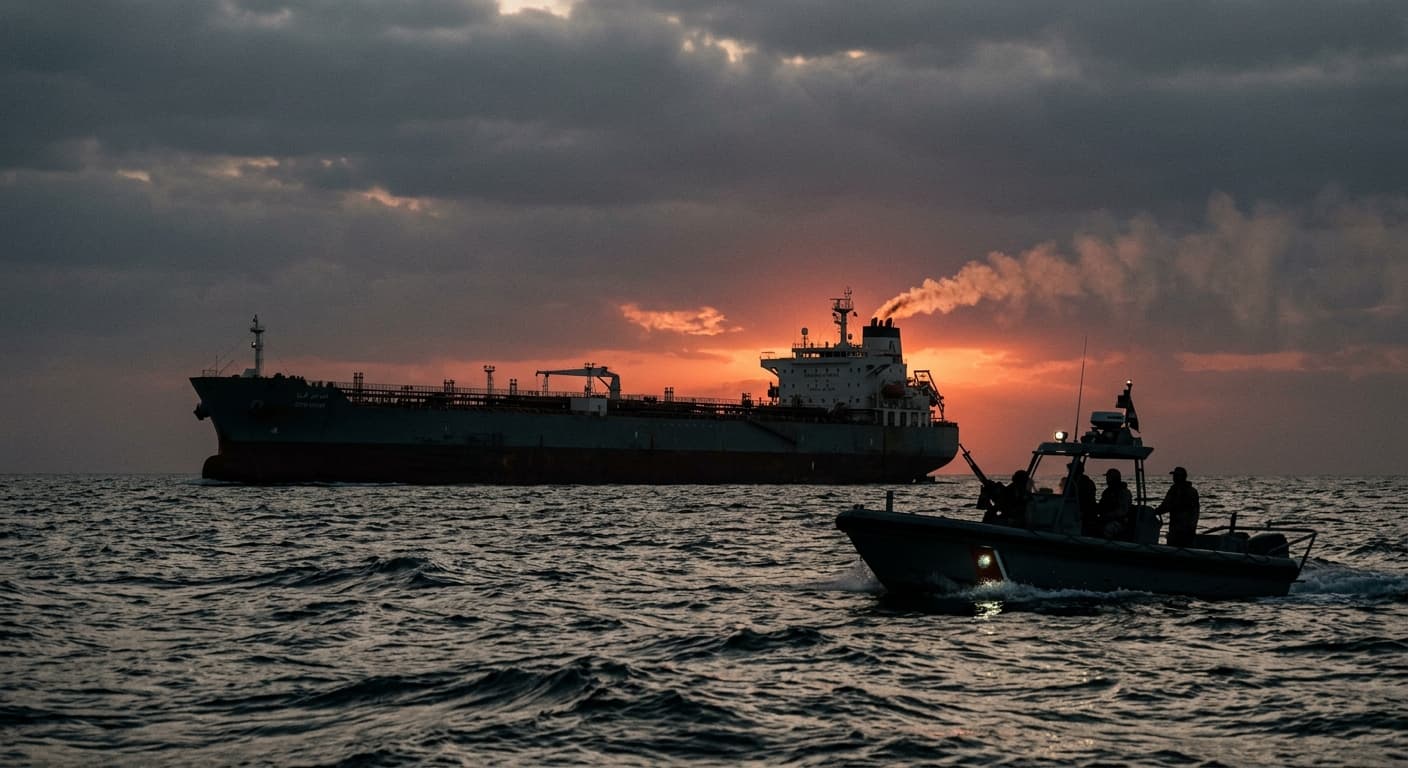
OFAC Reinstates Iran Oil Sanctions After Hormuz Tanker Strikes
Treasury revoked General License X on July 7, 2026 and issued a 10-day wind-down under GL X1 — the tangible collapse of the June US-Iran deal. Here is what breaks, and who gains.
The 20-day experiment in sanctions relief for Iranian crude is over. On July 7, 2026 — hours after Iran's Islamic Revolutionary Guard Corps hit three tankers in the Strait of Hormuz — the Treasury's Office of Foreign Assets Control revoked General License X, the broadest authorization for Iranian oil trade since the 1970s, and replaced it with a narrow wind-down license, GL X1, expiring at 12:01 a.m. EDT on July 17. The consequence is not just a pricing event; it is the physical unwinding of the Trump-Pezeshkian Memorandum of Understanding, which now leaves Beijing as the single price-setter for Iranian barrels and Tehran with roughly 63 million barrels floating without a lawful buyer. Brent jumped above $78 a barrel on the news, but the harder story is who captures the sanctions premium on the way down.
What OFAC actually did
The mechanics are narrow and deliberately punitive. GL X1, as Baker McKenzie's sanctions team laid out, authorizes only activities "ordinarily incident and necessary to the wind down" of transactions already underway under GL X. It bars any new purchases or loadings on or after July 7, 2026, and — a critical detail — requires that payments to blocked persons be deposited into interest-bearing accounts inside the United States. That converts what would have been Iranian sales revenue into US-controlled escrow, functionally identical to the frozen-assets architecture the MoU had promised to unwind. Treasury's
Selected General Licenses page already lists GL X1 as "Revocation and Wind Down of June 21, 2026 Authorization."
The trigger was operational, not diplomatic. According to CENTCOM statements reported by Al Jazeera, IRGC drones struck the Marshall Islands-flagged M/T Al Rekayyat, the Saudi-flagged M/T Wedyan and the Liberian-flagged M/T Cyprus Prosperity on July 6 for refusing to sail Iran's designated "safe route," which cuts close to the Iranian coast and marks a swath of Omani waters as a restricted zone. US strikes on more than 80 Iranian targets followed within hours; a second wave hit 90 more on the night of July 7, per the
BBC.
The MoU was always a Hormuz deal disguised as a nuclear deal
Read the 14 points and the giveaway is in Article 5. As reported by Al Jazeera from the US read-out of the text, the memorandum committed Iran to make "best efforts for the safe passage of commercial vessels, with no charge for 60 days only." Tehran read that as an acknowledgment of Iranian sovereignty over the strait; Washington read it as a transit guarantee. The
Council on Foreign Relations put the point bluntly: "The MOU is thus best understood less as a deal that addresses Iran's nuclear ambitions or military capabilities than as a Hormuz deal: the United States agreed to provide Iran with sanctions relief in exchange for Iran allowing commercial vessels safe passage through the strait."
That framing explains the speed of the reversal. The MoU's only immediate deliverable for Iran was oil revenue and unfrozen assets, secured through GL X. Once IRGC boats began enforcing Iranian transit rules against Gulf-flagged tankers, the exchange collapsed in real time. Iranian parliamentary speaker Mohammad Bagher Ghalibaf — Tehran's chief negotiator — accused Washington of breaching the MoU on sanctions and told reporters that the strait "will only open with 'Iranian arrangements,' not American threats," according to the BBC. Trump, at a NATO summit in Ankara, called Iranian officials "scum" and declared the ceasefire "over."
The 63 million-barrel problem
The sanctions snapback catches Iran mid-shipment. OilPrice.com, citing Bloomberg tanker-tracking data compiled from Vortexa, put roughly 63 million barrels of Iranian crude in transit or idling in tankers between the Persian Gulf and the Strait of Malacca when GL X was pulled. TankerTrackers.com estimated Iran had moved 60 million barrels out of the Gulf since mid-June — a compressed export sprint that only makes commercial sense if you assume the waiver window is fragile.
Which it obviously was. Iranian exports had already collapsed. An Al Jazeera opinion analysis reported Iranian crude was selling at a 20% discount to Brent — up from a $3-a-barrel gap before the war — and volumes fell more than 90% in May under US naval enforcement. The
Financial Times had earlier estimated the pre-war windfall at roughly $140 million a day of revenue, based on a $10 discount to Brent. That windfall is gone.
For context, Kpler data reported in 2025 showed Iran exporting 1.66 million barrels per day of crude and condensate — the highest since 2018 — almost entirely to Chinese independent refiners, the "teapots," via the dark fleet.
The unlikely winner: Chinese teapots
If the MoU briefly threatened Chinese buyers' comparative advantage in Iranian crude — Bloomberg reported that Chinese state majors were reconsidering purchases after the March waiver was issued — the GL X1 snapback restores it. Sanctioned barrels move only through discount channels. Shandong teapots, whose margins are compressed under normal pricing, buy what state refiners won't touch. As Energy Intelligence has
documented for years, they have been "the buyer of last resort for Iran's oil exports" since 2018 — and the buyer of first resort when Washington re-imposes penalties.
The immediate second-order winner is the enforcement infrastructure itself. The Treasury's April 15, 2026 designation of the Shamkhani network — the UAE-based shipping empire run by the son of a deceased Iranian security official — is now the operative template. Secretary Scott Bessent framed the action under National Security Presidential Memorandum 2, which the department says has generated more than 1,000 sanctions actions since President Trump revived "maximum pressure." Every dark-fleet operator that survived those designations now recaptures a widened sanctions premium on shipping, insurance, and ship-to-ship transfer fees. The people who lose are the Iranian state and the Iranian population — not the intermediaries.
What breaks in global markets
The macro shock is smaller than the June scare but real. Brent rose about 6% to $78 following Trump's Ankara comments, per Al Jazeera's markets desk, reversing a slide back toward pre-war levels. European equities fell 1.6%; the dollar strengthened; travel stocks led losers with United Airlines down 3%.
The underlying vulnerability is structural. CFR estimates roughly 20% of the world's oil and LNG transits the Strait of Hormuz, and the 100-day war shut in the equivalent of more than 10 million barrels per day. Bypass options exist — the Saudi East-West pipeline at roughly 7 million barrels a day of design capacity, the Emirati Habshan-Fujairah line under 1.8 million — but they cannot substitute at scale. Both have already been targeted: Iranian strikes reduced East-West throughput by an estimated 700,000 bpd in April, and drones hit Fujairah loading.
Japan, which sources 70% of its Middle Eastern crude via Hormuz, is already tapping strategic reserves. China imports about 40% of its crude through the strait and buys upwards of 80% of Iran's exports — a dependency that gives Beijing simultaneous exposure and leverage no other capital can match.
The unresolved primary document
There is one legal artefact worth flagging: neither Washington nor Tehran has released a physical, signed copy of the MoU. The public text is the verbatim US read-out to reporters on June 17, 2026, reproduced by Al Jazeera and
the BBC. Iran calls it the "Islamabad Memorandum of Understanding" and has not confirmed the US version. That ambiguity now matters: both sides claim the other breached first, and neither has a document a third party can adjudicate. The most authoritative primary artifact governing Iran oil trade today is not the MoU but
GL X1 itself — a Treasury document issued unilaterally, without Iranian counter-signature.
Diplomat View
The GL X1 revocation is not a return to pre-war "maximum pressure." It is worse for Iran and better for the enforcement bureaucracy, because the June waiver stripped out any remaining ambiguity about what the US will and will not tolerate on Hormuz. Tehran learned that sanctions relief is conditional on unfettered transit — and revealed, in the same 20 days, that its parliament and IRGC will not accept unfettered transit. The MoU cannot be resurrected on its original terms.
The base case for the next four weeks: continued tit-for-tat strikes below the threshold of a naval blockade, quiet Chinese absorption of stranded barrels at a widened 20–25% discount to Brent, and Gulf capitals — Saudi Arabia, the UAE, Oman — pressing Washington and Beijing in parallel to prevent a full reclosure of the strait. Brent trades in a $75–$85 range unless a second closure event occurs.
What would falsify this view: a formal reimposition of the US naval blockade (Trump has explicitly threatened it, per Al Jazeera); a Chinese state-refiner boycott of Iranian barrels (highly unlikely absent a UN Security Council reactivation of snapback, which occurred in September 2025 per Treasury's
February 25, 2026 designation memo but has not been enforced against Beijing); or a physical strike on Kharg Island loading infrastructure, which Trump floated at Ankara. Any of the three moves Brent into triple digits within a week.
Forward catalysts to watch:
- July 17, 2026, 12:01 a.m. EDT — GL X1 wind-down expiry. Cargoes not offloaded by this cut-off route revenue into US-blocked accounts, creating a compliance test for every buyer's bank.
- August 17, 2026 — 60-day MoU negotiation window closes. Absent extension, the sole remaining framework for a nuclear settlement lapses.
- August 21, 2026 — Original GL X expiry, now the notional deadline by which the White House had planned to have a final deal in hand.
The Bottom Line
The revocation of General License X is the moment the US-Iran MoU stopped being a peace deal and became a policing arrangement — and the arrangement is failing on Iran's terms, not Washington's. The immediate beneficiaries are Chinese teapot refiners and the UAE-based sanctions-evasion networks Treasury spent April 2026 designating; the immediate losers are Iranian oil revenue, European insurers, and the credibility of any future waiver-for-transit trade. Watch July 17, not August 21: that is when the blocked-account mechanism starts converting Iranian sales into US-controlled escrow, and Tehran finds out whether the maximum-pressure architecture ever really left.
Discover more

Economics
US Sanctions Iran's Nobitex Crypto Exchange
US Treasury sanctions Nobitex, Iran's largest crypto exchange, for processing billions in stablecoins for the central bank and IRGC, extending secondary sanctions risk to foreign platforms.

Economics
Russia's Crypto Law: Sanctions-Evasion by Law
Russia's State Duma passes a comprehensive crypto law legalizing digital currency for all foreign trade settlements, transforming sanctions-evasion workarounds into state-backed financial infrastructure.
Economics
1260H List: Pentagon's Chinese Military Ban
The US DoD's 1260H list of Chinese military companies triggers a direct procurement ban in June 2026 and an indirect ban in 2027, while China retaliates with export controls and anti-sanctions decrees, creating a compliance dilemma for defense contractors.
Global
Turkey's S-400 gambit to rejoin the F-35
Turkey proposes transferring its Russian S-400 to the UAE, aiming to remove the main obstacle to its return to the F-35 program amid a Gulf interceptor shortage.