Indonesian Lawmakers Investigate Timber Firm
Probe into PT Mayawana Persada's alleged rights abuses
Model Diplomat8 min readSoutheast Asia
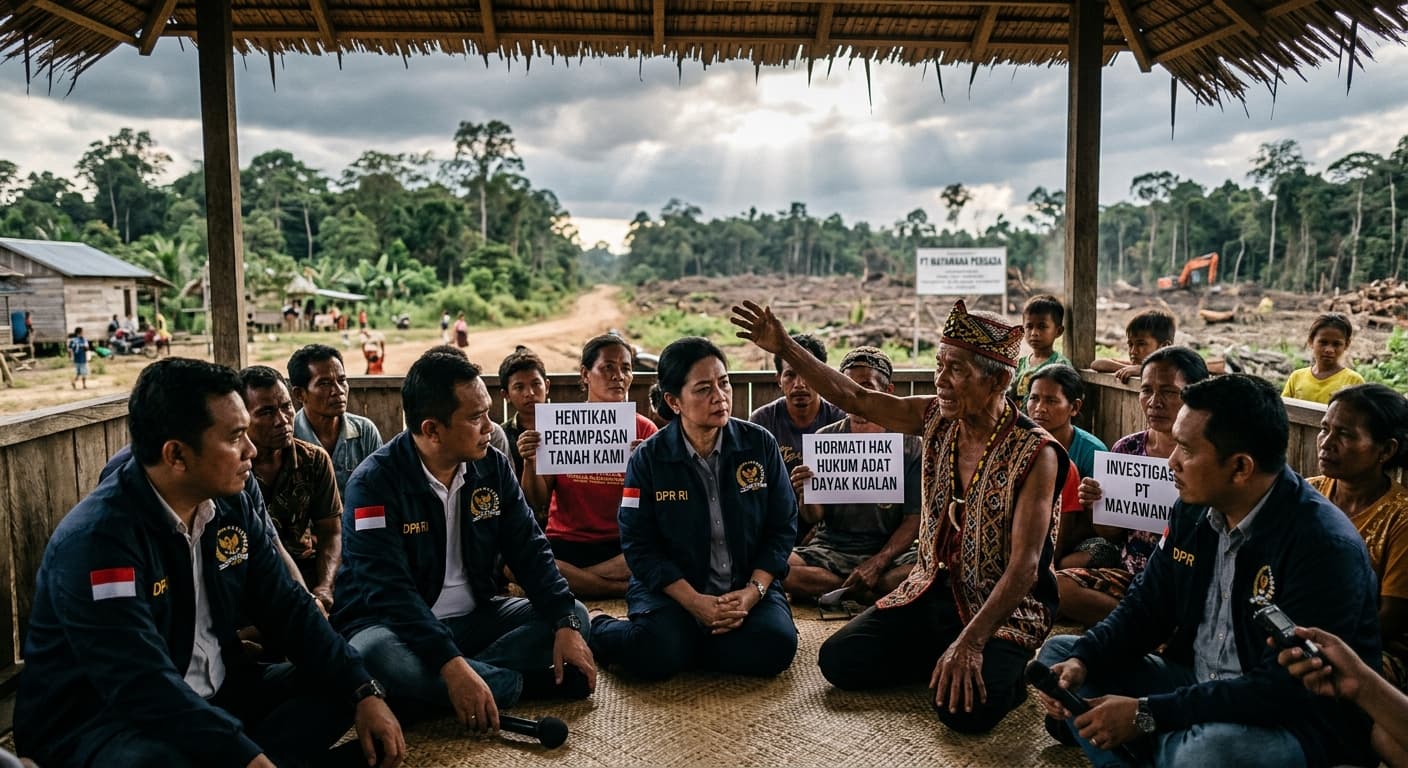
Indonesian Lawmakers Probe Rights Abuses at RGE-Linked Timber Firm
Indonesia's parliament and Human Rights Ministry are investigating alleged abuses of the Dayak Kualan by PT Mayawana Persada, six months before EU deforestation rules bite.
On June 30, 2026, Indonesia's House of Representatives (DPR) closed a hearing by formally requesting a state fact-finding probe into alleged "structural and systematic" human rights violations tied to PT Mayawana Persada, a West Kalimantan timber concessionaire linked through corporate filings and supply-chain data to the Royal Golden Eagle (RGE) conglomerate. The timing is the story: the probe lands six months before the EU Deforestation Regulation (EUDR) starts applying on December 30, 2026, and any state finding of Indigenous-rights violations will hand European operators sourcing RGE fibre a hard, primary document that triggers the regulation's Article 31 "substantiated concerns" mechanism. That would turn a Ketapang land dispute into a chokepoint on a supply chain that reaches viscose mills in China and fashion labels in Europe.
The Ministry of Human Rights, led by Natalius Pigai, told the hearing it would carry out field monitoring and inter-agency coordination, according to Mongabay. Commission XIII of the DPR, which oversees human rights, also urged police to halt criminal proceedings against community members and to review Mayawana's operating permit. Commission member Franciscus Sibarani told
Zona Kalbar that "the state cannot stay silent" and, if violations are proven, the government "must revoke PT Mayawana Persada's permit."
What the Dayak Kualan allege
Mayawana holds an industrial-plantation concession covering roughly 136,710 hectares in Ketapang and Kayong Utara regencies, according to a civil-society coalition briefing reported by Suara. Land clearing began in earnest in 2019 despite permits dating from 2011, LinkAR Borneo's Ahmad Syukri told the same briefing: "Although they had held a permit since 2010, there were many obstacles. But since 2019 the land clearing has been massive."
Two sacred sites anchor the community's complaint. Mayawana bulldozed the Kek Juing ancestral cemetery in 2020, and cleared parts of Bukit Sabar Bubu — a 1,200-hectare hill used for customary ceremonies — between June 2020 and May 2023, according to community documentation reviewed by Mongabay. Tarsisius Fendy Sesupi, customary chief of Lelayang hamlet, told a Jakarta press conference that "the company never sought the community's agreement. It simply moved in and cleared everything." Where households did relinquish land, they were paid 1.5 million rupiah (about $83) per hectare irrespective of standing rubber, orchards or sacred value, LinkAR Borneo's Syukri said in the same account.
That figure is not incidental. Human Rights Watch's 2019 investigation into PT Ledo Lestari's Iban Dayak counterparties in neighbouring Bengkayang documented monetary payouts of "between 1 and 2 million Indonesian rupiah (IDR) (US$70 to 140) per hectare" that "did not account for loss of the community's adat forest," in near-identical language to the Mayawana case, according to Human Rights Watch. Seven years later, in a different regency and a different sector — pulp instead of palm — the same compensation floor prevails. The methodology of dispossession has not changed.
The criminal-charges pattern is the second grievance. Daniel Arianto, son of a Dayak Kualan customary leader, was jailed in 2021 after uprooting acacia seedlings on land his family claims as inherited territory, Suara reported. Between 2022 and 2025 additional residents were reported to police on similar charges. On December 9, 2025 — the eve of International Human Rights Day — West Kalimantan police attempted to detain Fendy Sesupi himself on trespass and threat allegations, and pulled back only after regional legislators intervened, according to the
Environmental Paper Network. Mayawana's public summary states it is "committed to protecting human rights" and seeks to "minimize conflict," according to
Mongabay; the company did not respond to that outlet's requests for comment.
The hidden lever: who really owns Mayawana
Mayawana is formally held through a chain of shell companies registered in the British Virgin Islands and Samoa — jurisdictions that do not require public disclosure of shareholders. But corporate documents, operational management overlaps and pulpwood supply-chain data indicate the concession is linked to RGE, the conglomerate founded by Sukanto Tanoto and parent of APRIL, Asia Symbol, Sateri and Apical, according to the Environmental Paper Network. RGE announced a group-wide "zero deforestation" policy in 2015; APRIL later moved the cut-off date for permissible clearing from 2015 to end-2020 in its Sustainable Forest Management Policy 2.0, precisely the window during which the Dayak Kualan say Bukit Sabar Bubu and Kek Juing were razed.
The pre-history is layered. A 2013 Japan International Cooperation Agency feasibility study describes Mayawana as an Alas Kusuma Group vehicle that obtained its industrial-plantation right in 2011, with Sumitomo Forestry planned as a joint-venture partner alongside two sister concessions (WSL and MTI), according to JICA. The tangled ownership — Alas Kusuma on paper, RGE via operational and supply-chain links, offshore holding companies on top — is exactly the "complex supply chain" the EUDR flags as elevated risk.
Global buyers noticed years ago. Canada-based forest NGO Canopy already rates APRIL and its sister mill Toba Pulp Lestari as "high risk" for viscose producers, and more than 500 fashion brands have committed to removing deforestation-linked viscose from their supply chains, according to Al Jazeera. APRIL told the same outlet it "does not sell DWP to any companies in Xinjiang," subjects fibre suppliers to "strict due diligence standards, regular compliance monitoring and annual third-party audit," and operates "in line with the principle of Free, Prior and Informed Consent." The Mayawana case is a stress test of every one of those claims.
Why the EUDR trigger reframes the story
Regulation (EU) 2023/1115 requires any operator placing wood, pulp, paper or derived products on the EU market from December 30, 2026 to submit a due-diligence statement proving the goods are deforestation-free (post-31 December 2020 cut-off) and produced in accordance with the laws of the country of origin — including laws protecting Indigenous peoples' rights, per EUR-Lex. The regulation's Article 10(2) explicitly lists "the presence of forests and indigenous peoples," "concerns in relation to the country of production… including levels of corruption, prevalence of document falsification, lack of law enforcement," and "the complexity of the relevant supply chain" as risk factors that operators must weigh, according to European Commission
guidance. The December 2025 simplification package, Regulation (EU)
2025/2650, reduced paperwork for downstream SMEs but preserved core traceability, geolocation and the Article 31 concerns mechanism.
Article 31 is the pressure point. Any natural or legal person may submit "substantiated concerns" to a Member State competent authority, which must then investigate — and can block placement of the product on the EU market. Until now, the evidence base for such a submission on Indonesian pulp has been NGO reports and Canopy risk ratings. A finding by Indonesia's own Ministry of Human Rights that Mayawana violated customary land rights would supply European regulators with a state document, converting an activist claim into a legal predicate. That is the mechanism the DPR probe activates, whether or not lawmakers intended it.
The second-order effect runs the other way through the ownership diagram. APRIL's own suppliers cannot pass EUDR due diligence if a company operationally linked to APRIL is under an active Indonesian government human-rights investigation. RGE's downstream customers — the fashion, tissue and personal-care brands that Canopy tracks — will read regulatory risk faster than they read Indonesian parliamentary transcripts. Even if Jakarta's probe concludes softly, the reputational damage priced into a Sateri or an APRIL supply-chain audit is now larger than it was on June 29.
What the DPR probe will and will not do
Whether Pigai's ministry will deliver a finding sharp enough to bite is an open question. The minister told BBC News Indonesia in April 2025 that his ministry's "Prisma" corporate-audit instrument was scheduled for 2026-2027 rollout — "after all the rules and socialization to companies have been running" — and sidestepped Indigenous communities' requests to admit UN special rapporteurs to a separate Merauke case. On that Merauke file, nine UN special rapporteurs had written to the Indonesian government on March 7, 2025, and Jakarta replied through its Geneva mission on May 6, 2025 without committing to an in-country visit. The precedent is unhelpful for Ketapang.
Two features of the Mayawana case still cut differently. First, the DPR itself has taken jurisdiction, and Commission XIII chair Willy Aditya has publicly clashed with Pigai on rights-defender protection, according to BBC News Indonesia — meaning legislative pressure is unlikely to fade quietly. Second, prior comparable cases in the same forestry sector went nowhere: Sorbatua Siallagan, a customary leader in North Sumatra, was sentenced to two years in prison in August 2024 for "occupying" land inside PT Toba Pulp Lestari's 184,486-hectare concession, according to
BBC News Indonesia. His conviction is now a data point in every EUDR risk file on Indonesian pulp, and Mayawana will inherit that baseline of scepticism whatever the ministry reports.
The Ombudsman Republik Indonesia counted 163 palm-oil-related land conflicts in 2017 alone, and land-related complaints against companies exceeded 1,000 in 2018, according to Human Rights Watch's 2021 report. The Dayak Kualan file is not exceptional in Indonesia. It is exceptional only in that it collides with the EUDR at the moment the regulation comes online — and that collision is what turns a routine DPR fact-finding request into a genuine policy event.
What to watch
- Next arrest date. The deferred arrest of Fendy Sesupi was rescheduled for December 15, 2025 by West Kalimantan police, per the
Environmental Paper Network; any renewed police action against community leaders during the probe would signal that Commission XIII's request for a criminal-proceedings freeze has been ignored.
- Ministry of Human Rights field-monitoring report. Pigai's ministry has committed to inter-agency review; the concrete test is whether it produces a written finding on FPIC compliance before December 30, 2026.
- APRIL supplier-list disclosure. APRIL's Sustainability Dashboard publishes concession maps and supplier lists; whether Mayawana is added, removed, or renamed in the run-up to EUDR go-live is the single clearest signal of how RGE reads the regulatory risk.
- First Article 31 submission. Watch for any European civil-society or competent-authority filing citing the DPR hearing as evidence — that is the moment the Indonesian probe crosses into EU enforcement.
The Bottom Line
The DPR's June 30 request for a rights probe into PT Mayawana Persada is not a domestic land-conflict story; it is the first sovereign-level input into the EU Deforestation Regulation's Indonesian pulp file, arriving six months before the regulation applies. If Indonesia's Ministry of Human Rights confirms customary-rights violations at Mayawana, RGE's downstream supply chain — APRIL, Sateri, Asia Symbol — becomes hard to defend under Article 10 due-diligence rules, regardless of what offshore holding companies say about ownership. The losers are the Alas Kusuma-RGE nexus and the European brands still buying from it; the winner, for the first time in this sector, is a state-level Indigenous-rights record that Brussels can actually cite.
Discover more

Global
World Normalises Taliban as Afghan Women Eras
UN data shows Afghan women erased from public life as Russia recognises the Taliban, EU hosts officials in Brussels, and ICC warrants for gender persecution go unenforced.
Human Rights
ECHR Rules Crimea Land Seizures Void
ECHR rules Russia's land seizures in occupied Crimea void under international law, affirming pre-2014 Ukrainian owners' rights and strengthening enforcement of arbitration awards against Moscow.
Human Rights
UN Exposes EU-Funded Trafficking Pipeline
UN experts document 7,400+ migrants detained, expelled, and trafficked at the Tunisia-Libya border since June 2023, a system funded by the EU's billion-euro migration pact with Tunisia.

Global
Trump ICC Sanctions Face Fourth Legal Free-Sp
A fourth lawsuit challenges Trump's ICC sanctions as two federal courts rule the order likely violates the First Amendment, raising questions about presidential power to criminalize speech to an international tribunal.