India's 'Well-Calibrated' AI Law Builds a
India's AI law borrows from Brussels and Washington but copies neither.
Model Diplomat8 min readSouth Asia
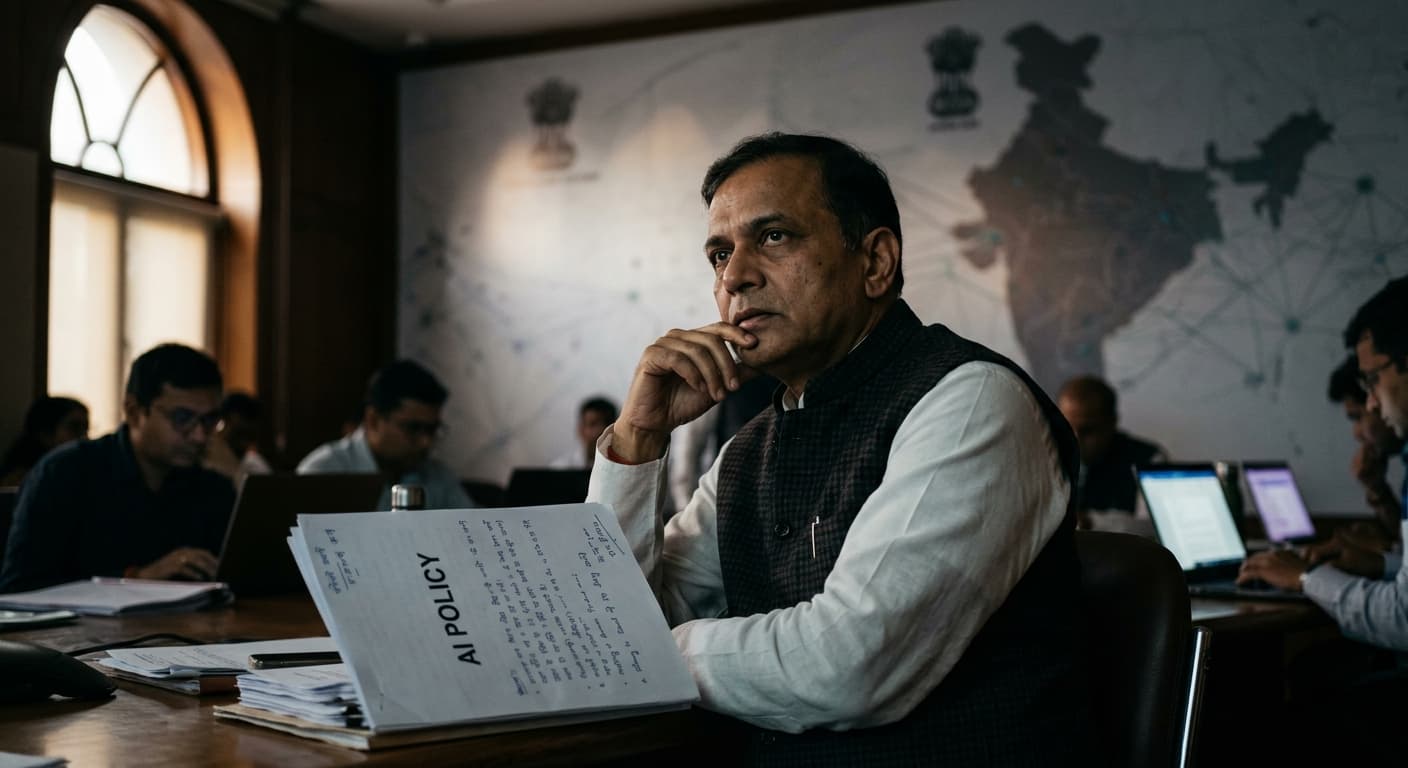
India's 'Well-Calibrated' AI Law Is Quietly Building a Third Way — and the Global South Is Watching
India is crafting an AI law that borrows from Brussels and Washington without copying either. The real prize isn't regulation — it's the normative architecture for a Global South that neither trusts American Big Tech nor Chinese state surveillance.
On July 18, 2026, MeitY Secretary S. Krishnan told an industry gathering in New Delhi what India's technology policy establishment has been signaling for over a year: the government is drafting a "well-calibrated" artificial intelligence law, studying both the European Union's highly prescriptive AI Act and the deregulatory posture of the United States — and intends to replicate neither. The announcement, reported by NDTV Profit, confirms a strategic trajectory that positions India not as a regulatory follower but as a normative entrepreneur for a growing bloc of countries dissatisfied with the binary choice between Brussels and Washington.
The law itself is a secondary event. The primary story is that India is constructing a third regulatory identity at the precise moment when the global AI governance architecture is fragmenting — and the leverage that comes with being the country that 91 nations chose to follow in signing the Delhi Declaration at the February 2026 AI Impact Summit. The question is whether India can maintain the credibility of that role given its own increasingly muscular digital censorship apparatus.
The Third Way, in Practice
Krishnan's formulation — "well-calibrated" — is more than rhetorical branding. It operationalizes a governing philosophy that MeitY has articulated consistently since late 2025: regulate only where existing law cannot reach, and do so through a techno-legal framework that embeds compliance into system design rather than imposing retrospective penalties.
In a December 2025 fireside chat hosted by the Center for Strategic and International Studies, Krishnan was explicit: "We don't want to rush headlong into any tight regulation on AI. I think there's a lot of room for innovation. What the report emphasizes is that there are many existing frameworks, legal frameworks, which can be adapted to regulate AI." He cited the Information Technology Act, the Digital Personal Data Protection Act (DPDP Act), and sectoral regulations as existing tools that already cover misrepresentation, deepfakes, and data privacy. "Therefore, we need not legislate fresh in those areas."
That philosophy was codified in the India AI Governance Guidelines, released by MeitY in February 2026. The guidelines, anchored in seven guiding "sutras" — Trust is the Foundation, People First, Innovation over Restraint, Fairness and Equity, Accountability, Understandable by Design, and Safety, Resilience and Sustainability — adopt a principle-based, techno-legal approach that integrates legal safeguards, technical controls, and institutional mechanisms, as detailed in the Press Information Bureau release.
The institutional architecture is equally telling. Rather than creating a single omnibus regulator, India is establishing a coordinated whole-of-government model: an AI Governance Group for strategic coordination, a Technology and Policy Expert Committee for advisory functions, and an AI Safety Institute for technical validation and safety research, with sectoral regulators retaining domain-specific enforcement authority. This is neither the centralized EU AI Office model nor the fragmented US agency-by-agency approach. It is a calibrated hybrid — and it is explicitly designed to be exportable.
The Office of the Principal Scientific Adviser reinforced this direction with a white paper on Strengthening AI Governance Through Techno-Legal Framework, which defines the techno-legal approach as "a practical and ecosystem-wide model that embeds governance directly into the design and operation of AI systems by default." The language is not coincidentally drawn from India's success with Digital Public Infrastructure — UPI, Aadhaar, and the India Stack — where architecture, not after-the-fact regulation, produced both scale and trust.
The Strategic Calculus: Sovereignty as a Service
Why does this matter beyond India's borders? Because India is not merely regulating its domestic market. It is positioning itself as the normative pole for a Global South that has watched the great powers instrumentalize AI governance for competitive advantage — and found neither model adequate.
At the India AI Impact Summit in February 2026, Prime Minister Narendra Modi articulated a human-centric vision — encapsulated in the acronym M.A.N.A.V. — that framed AI as "an extension of human aspirations, ethics, and dignity" rather than a product of data and algorithms alone, according to a government publication on the summit. The summit's outcome, the Delhi Declaration, was signed by 91 countries and international organizations, including the United States, China, all G7 nations, and the European Union. As the
Brookings Institution noted, "U.S. endorsement is noteworthy considering that it did not join the statement emerging from last year's AI summit in Paris."
The strategic gain is clear. India has converted a series of AI safety summits — Bletchley Park, Seoul, Paris — from which it could have been a spectator into a platform where it sets the agenda. The shift from "safety" to "impact" was deliberate: Krishnan told CSIS that the transition reflected a Global South demand to focus on "concrete action" rather than abstract safety principles that often serve as barriers to diffusion.
The sovereignty dimension is equally critical. The IndiaAI Mission, approved with an outlay of over ₹10,300 crore (approximately $1.25 billion), funds domestic compute capacity, indigenous datasets, and model development explicitly designed to reduce dependency on US Big Tech. As the Council on Foreign Relations observed, India's AI governance philosophy reflects "New Delhi's deeper concern that new technologies are being deployed to freeze the current geopolitical order and deny it and other rising powers space to grow."
The Observer Research Foundation, in an analysis of the "Mumbai and Tel Aviv Effect," argues that India and Israel are jointly constructing an alternative regulatory pole — one that prioritizes innovation-friendly, sector-specific oversight over the EU's horizontal prescriptiveness and the US's laissez-faire federal vacuum. The ORF piece notes that India's approach "draws on domestic DPI architecture rather than importing a foreign model," making it inherently more replicable for countries that lack the EU's institutional depth or the US's market scale.
This is the second-order effect: India is selling a governance stack, not just a product. The countries that adopt India's AI regulatory framework are likely to adopt its DPI architecture — UPI, Aadhaar, DigiLocker — as complementary infrastructure, creating a de facto technology bloc that operates on Indian-designed rails.
Winners and Losers
The calculus of winners and losers is not evenly distributed.
Domestic startups and the Indian AI industry gain. The voluntary-compliance-first approach, which Krishnan emphasized at CSIS — "there's also a lot of emphasis on voluntary compliance" — avoids the compliance costs that the EU AI Act imposes, which the Observer Research Foundation notes have raised concerns about "the impact on firms' global competitiveness and productivity levels." For Indian AI firms competing with well-capitalized US and Chinese rivals, a lighter domestic regime that still offers legal certainty is a competitive advantage.
Global South governments gain a usable template. The Delhi Declaration's 91 signatories include dozens of developing nations that neither have the capacity to replicate the EU AI Act's regulatory machinery nor the desire to subordinate their data sovereignty to US platform companies. India's techno-legal model, built on DPI principles of interoperability and auditability by design, offers a ready-made governance architecture that does not require massive institutional investment.
US Big Tech faces strategic friction, not existential threat. The Trump administration has been explicit about its deregulatory approach: the December 2025 executive order on "Removing Barriers to American Leadership in Artificial Intelligence" revoked Biden-era safety frameworks and sought to preempt state-level AI laws. As the Brookings Institution documented, "the U.S. attorney general is directed to challenge state laws deemed to impede AI leadership, and federal infrastructure funds may be withheld from states that fail to comply." But this leaves a regulatory vacuum that India's calibrated framework can fill, particularly in markets where the US wants to export its AI stack. If Indian law imposes requirements — even voluntary ones — that differ from US expectations, companies like OpenAI, Google, and Meta will need to maintain parallel compliance systems, a cost that advantages domestic competitors.
The biggest loser may be the credibility of India's democratic tech power narrative. The same MeitY that promises a "well-calibrated" innovation-friendly AI law is simultaneously tightening its grip on digital speech. In early 2026, the government amended the IT Rules to reduce the compliance window for content takedown orders from 36 hours to three hours, according to the BBC. The Sahyog portal — a centralized mechanism through which any government department can issue takedown notices to platforms — operates without judicial review, a parallel censorship architecture that X sued over in the Karnataka High Court,
Al Jazeera reported.
The digital rights activist Nikhil Pahwa described the amendments as strengthening the government's "infrastructure for mass censorship," the BBC report noted. If India's eventual AI law extends Sahyog-style mechanisms to AI-generated content — and there is nothing in MeitY's current posture that precludes it — then the "well-calibrated" framework becomes a vehicle for speech control, not safety. That would fatally undermine India's claim to be a democratic alternative to Chinese surveillance and a normative partner for the EU.
Diplomat View
India will not enact a comprehensive, standalone AI Act before mid-2027. What emerges will instead be a framework law — likely an amendment to or replacement of the Information Technology Act — that codifies the techno-legal principles already articulated in the AI Governance Guidelines, delegates enforcement to sectoral regulators, and establishes the AI Safety Institute on a statutory footing. The calibrated gradualism that Krishnan describes is real: India has too much to gain from AI-driven productivity growth and too much to lose from a premature legislative misstep that either chokes innovation or invites US retaliation.
The critical variable is whether India can maintain the separation between its AI innovation agenda and its increasingly muscular content regulation apparatus. If the eventual AI law includes provisions that empower the Sahyog portal or similar mechanisms to police AI-generated content, the Global South narrative collapses — India will be seen as exporting a censorship toolkit alongside a governance model. If, instead, New Delhi builds genuinely multi-stakeholder institutions with transparent oversight, it gains durable soft power as the normative pole for countries unwilling to choose between Brussels, Washington, and Beijing.
What to watch next:
- July 2026 — UN Global Forum on AI. India will have an opportunity to showcase its techno-legal framework on the multilateral stage. The reception among Global South delegates will be an early indicator of whether the model has traction.
- Winter session of Parliament (November–December 2026). A draft AI bill tabled during this session would signal acceleration and invite line-by-line scrutiny of where the censorship boundary lies.
- The DPDP Act rollout over the next 18 months. As India's data protection framework comes fully into force, it will provide the legal plumbing for AI governance — and expose whether the government can implement rights-respecting regulation at scale.
The bottom line: India's "well-calibrated" AI law is not about regulating technology — it is about constructing a regulatory identity that neither Brussels nor Washington controls, and exporting it to a Global South hungry for alternatives. Whether that identity survives contact with India's own authoritarian digital impulses is the question that will determine whether New Delhi leads a democratic tech coalition or merely a more polite version of state-managed surveillance.
Discover more

India
Delhi CM Rekha Gupta Blasts Opposition's Delm
Delhi CM Rekha Gupta's remarks on women's quota defeat reveal BJP's strategy for the 2029 Lok Sabha elections, focusing on delimitation.
India
Congress Accuses Modi of Stalling Women's Law
Congress accuses Modi of stalling women's reservation law by linking it to delimitation, revealing a deeper electoral strategy.

US Politics
SNAP Food Assistance Faces Legal Challenges
In 2026, SNAP faces stricter eligibility rules and mounting legal challenges, threatening food assistance for the millions of Americans who rely on the program.

Conflict & Security
Drone Warfare Killing Aid Workers at Unprec
Over 1,000 humanitarian workers killed in three years as cheap armed drones collapse legal protections. Gaza, Sudan, Ukraine, and DRC see deliberate targeting of aid convoys and hospitals with zero prosecutions.