India's Response to USTR's 12.5% Tariff
India's strategic objection to USTR's proposed tariff on goods.
Model Diplomat7 min readAsia
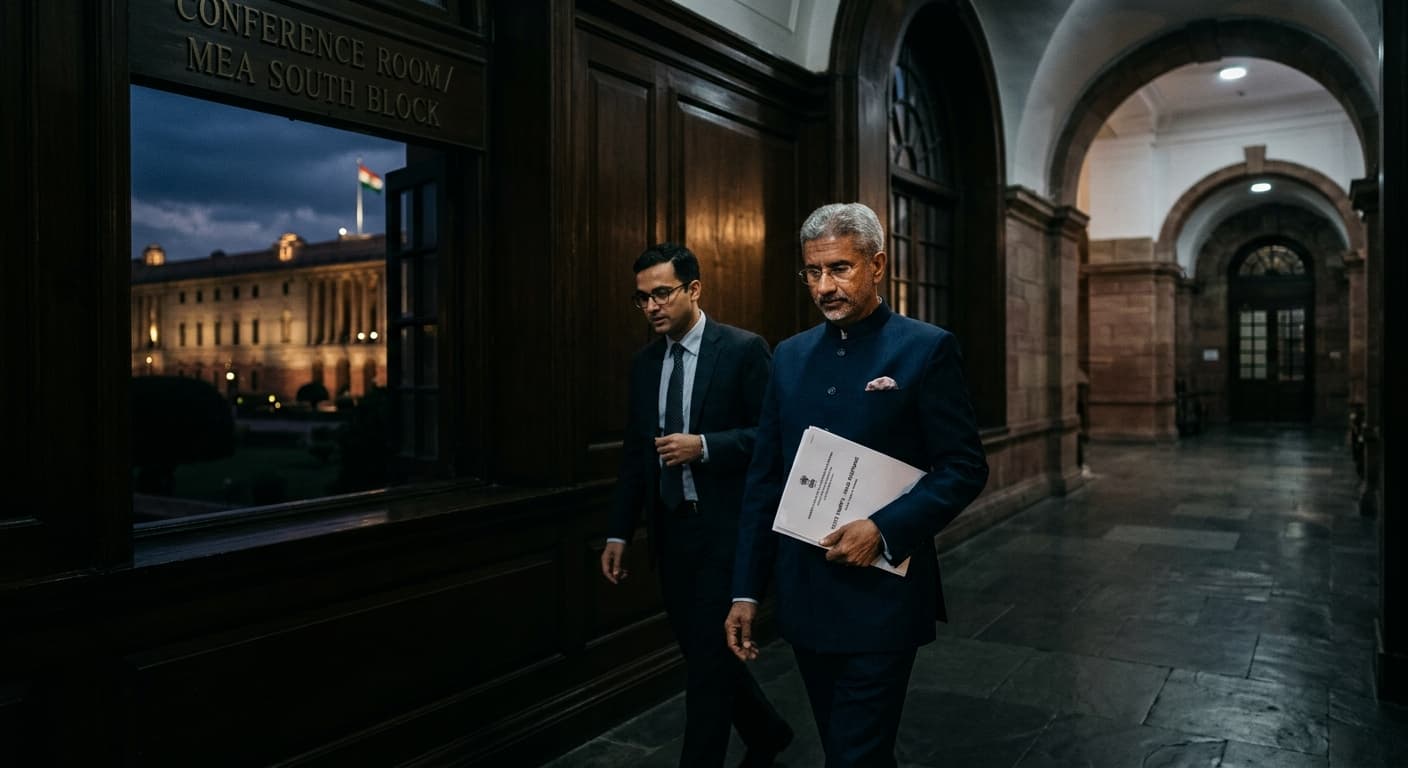
India's calculated shrug at the USTR's 12.5% forced-labor tariff
India filed a formal objection on July 6, 2026, urging the USTR to withdraw a proposed 12.5% Section 301 tariff — but New Delhi's real fight is over the 18% reciprocal rate it locked in five months earlier.
India's Ministry of Commerce told the Office of the US Trade Representative on July 6, 2026, that a proposed 12.5% Section 301 tariff on Indian goods rests on findings that are "insufficient" and "sweeping," and asked Washington to reconsider — a demand notable less for its content than for its restraint. The real story is what New Delhi is not doing: it is not walking away from the February 2026 framework that cut its reciprocal tariff from 50% to 18%, it is not escalating rhetorically, and it is not treating the forced-labor probe as a stand-alone dispute. That is because the Section 301 forced-labor action, as Congressional Research Service analysts have flagged, is Washington's post-IEEPA legal scaffolding for a country-specific tariff wall — and India's leverage lies in bargaining over the base rate, not the 12.5% surcharge that sits on top of it.
What USTR actually proposed
On June 2, 2026, USTR issued findings in 60 parallel Section 301 investigations opened in March, concluding that every one of the 60 economies had "failed to impose and effectively enforce" an import prohibition on goods produced with forced labor. The USTR press release proposed a two-tier remedy: 10% additional duties on 14 economies USTR credited with a partial regime — Canada, the EU, the United Kingdom, Mexico, Indonesia, Pakistan, Argentina, Bangladesh, Cambodia, El Salvador, Guatemala, Malaysia, Taiwan and Ecuador — and 12.5% on the remaining 45, including India, China, Japan, South Korea, Vietnam, Australia and New Zealand. USTR opened written comments through July 6 and began public hearings on July 7, per its
Federal Register notice.
India's submission attacks the record, not the premise. Its written response, first reported by The Economic Times, argues that USTR "has neither identified nor engaged with the discrete elements of Section 301" that would qualify India's practices as "unreasonable" under the statute — the operative legal test in 19 U.S.C. §2411. New Delhi's core complaint is procedural: USTR did not perform economy-specific analysis, did not connect the alleged absence of a forced-labor import ban to any documented distortion of US market conditions, and produced no evidence linking Indian export sectors to forced-labor inputs.
That argument mirrors what independent trade lawyers have said in public. CSIS trade analyst William Reinsch, reviewing the 98-page USTR report, wrote that "the findings with respect to each of the 60 countries are two or three paragraphs each, simply asserting that the country in question 'failed to impose and effectively enforce a forced labor import prohibition.'" No underlying evidence is presented for the country-specific conclusions, Reinsch noted — a defect he called litigation bait.
India's primary-law rebuttal
New Delhi has statute on its side. Article 23 of the Constitution prohibits "begar" and forced labor, and the Bonded Labour System (Abolition) Act, 1976 criminalizes both bonded labor and any advance made under it, with implementation delegated to district magistrates and vigilance committees. Whether enforcement is uniformly effective is a separate matter — Human Rights Watch and the ILO have long argued it is not — but the USTR's operative claim that India has no comparable statutory prohibition is legally shaky. Professor James J. Nedumpara of India's Centre for Trade and Investment Law, who led India's delegation at the
April 28–29 USTR hearings, pressed exactly this point in Washington in April, and India's July 6 filing effectively repackages that testimony as a due-process objection.
The gap USTR needs to close is not about labor law in the abstract; it is about the causal chain Section 301 requires. As the underlying statutory framework laid out in the CRS explainer makes clear, the USTR must find that a foreign practice is "unreasonable or discriminatory" and "burdens or restricts" US commerce. India's filing argues that the report skipped the second half.
Why Goyal is calm — and what that reveals
Commerce Minister Piyush Goyal's public posture is the tell. Days before the filing, Goyal told reporters in New Delhi that "they are trying to create a competitive edge for India" and that he did "not think we need to worry about Section 301," according to The Eastern Herald. He did not contest the underlying forced-labor allegation on the merits. That is the diplomatic equivalent of an unhurried shrug — and it makes sense only when the tariff is read against the bigger deal.
On February 9, 2026, the White House joint statement confirmed that Washington would apply a reciprocal tariff of 18% on Indian goods under Executive Order 14257, down from a punitive 50%, in exchange for India eliminating or reducing tariffs on US industrial and agricultural goods and pledging to purchase over $500 billion of US energy, ICT, coal and other products. The
Press Information Bureau valued the tariff cut at $30.94 billion of exports moving from 50% to 18%, with a further $10.03 billion moving to zero — a differential Indian textiles, gems and jewellery cannot afford to relitigate over a 12.5% surcharge that is still notional.
The arithmetic explains the restraint. India shipped $86.5 billion of goods to the United States in 2025, according to the Observer Research Foundation, concentrated in electronics ($15.9 billion), gems and precious stones ($10.0 billion), pharmaceuticals ($9.8 billion) and machinery ($6.7 billion). A 12.5% stack on an 18% base would push effective rates to roughly 30.5% — punishing, but not the 50% wall that briefly closed Tiruppur's knitwear order books in the third quarter of 2025, when 50% duties triggered widespread order cancellations, as
Al Jazeera documented at the time.
The Section 122 clock is the real deadline
The forced-labor tariff cannot be understood outside the post-IEEPA scramble. When the Supreme Court struck down the Trump administration's IEEPA tariff authority on February 20, 2026, the White House invoked Section 122 of the Trade Act of 1974 to impose a temporary 10% across-the-board tariff — a statute the Peterson Institute noted was "arcane and inapplicable" and legally capped at 150 days. That clock runs out around July 24, 2026. USTR is racing to finalize the Section 301 forced-labor and excess-capacity tariffs before the Section 122 bridge collapses.
That is why the timing matters. The Atlantic Council has estimated that the Section 301 architecture could generate up to $169 billion annually — enough to replace the $166 billion IEEPA regime — with roughly $13 billion of that coming from the ~40 economies in the 12.5% tier that have not negotiated separate reciprocal deals. India, with its February framework, is arguably one of those already inside the tent, which is why Goyal treats the 12.5% as leverage against a subset of Asian competitors, not an attack on India. Malaysia, which declared its US tariff agreement "null and void" after the IEEPA ruling per
BBC News reporting, offers the counter-example New Delhi is quietly avoiding.
Who benefits, who loses
The immediate winners are the countries that struck early deals. Because reciprocal-deal signatories retain lower base rates, the 12.5% surcharge falls hardest on economies that walked away — or waited. Vietnam and Thailand, which have not ratified their frameworks, and India's Asian textile competitors Bangladesh and Cambodia (both at 10%), sit in awkward positions. India's differential — 18% base plus a possible 12.5% stack — still undercuts Vietnam's likely combined burden if Hanoi's parallel IP-related Section 301 lands as Brookings has forecast.
The clear losers are Indian MSMEs in textiles, gems and engineering goods, where margins are thin and hedging is expensive. The Observer Research Foundation warned that MSMEs "with limited financial buffers" are "poorly positioned to absorb tariff shocks." Tiruppur's knitwear cluster, which accounts for 68% of India's knitwear exports and shed orders under the August 2025 50% duty, is the canary. Gems and jewellery — where the US absorbs over a third of India's polished-diamond exports — is the second.
The quieter beneficiary is Washington's tariff architecture itself. By framing the tariff around forced labor rather than balance-of-payments or emergency powers, USTR shifts the legal terrain from IEEPA (invalidated) to Section 301 (litigation-tested since 2018). The Peterson Institute has argued the administration is likely using the 150-day Section 122 window explicitly to "lay the procedural groundwork" for tariffs under sturdier statutes.
Diplomat View
India's July 6 filing is not a serious attempt to defeat the 12.5% tariff. It is a paper trail — a record for the WTO complaint India may file later, and a signal to Washington that New Delhi will play the procedural game rather than upend the February deal. Goyal's calculation is that the US needs a functioning India relationship — for Indo-Pacific hardware alignment, for the $500 billion purchase pledge, and as a China+1 destination — more than USTR needs to enforce a forced-labor finding that, on the CSIS reading, would not survive judicial review. The forecast: the 12.5% will be finalized in some form before the Section 122 tariff expires, but India will secure carve-outs on textiles, pharma and gems in the Bilateral Trade Agreement track that USTR Jamieson Greer's expected visit to Delhi will accelerate. What would change this call: if the Section 301 excess-capacity findings, expected imminently, add a second surcharge on Indian steel or electronics, the stack becomes unmanageable and Goyal's shrug converts into the same "null and void" language Malaysia used.
What to watch
- July 7–9, 2026: USTR's three-day public hearings on proposed remedies; India's industry bodies (APEDA, FICCI, CII, ACMA) testify.
- On or before July 24, 2026: Section 122 tariff expires; USTR aims to finalize the Section 301 forced-labor and excess-capacity tariffs before then, per CRS.
- Mid-July: USTR Greer's expected visit to New Delhi for the BTA round; the substantive test of whether the 12.5% is a negotiating chip or a fixed cost.
The Bottom Line
India's decision to file a legally precise, diplomatically muted objection to the USTR's proposed 12.5% forced-labor tariff is not weakness — it is a bet that the February 2026 framework is worth more than the fight. If Goyal is right, the 12.5% becomes a bargaining unit inside the Bilateral Trade Agreement. If he is wrong, and USTR stacks the forced-labor surcharge on top of a forthcoming excess-capacity finding, India will be forced to choose between litigation, retaliation, or the same walk-away Malaysia has already modelled.
Discover more
Global Politics
US-Iran Tensions Rise
Tensions escalate in the Strait of Hormuz as Iran and the US clash over maritime control, with a ceasefire hinging on a contested MoU paragraph.
Global Politics
U.S. Maritime Pressure on Iran
Washington escalates maritime security operations and sanctions on Iran, disrupting Gulf shipping and reshaping global energy flows in a major strategy shift.

US Politics
White House Pressures Congress for Crypto Leg
The Trump administration's push for the CLARITY Act aims to reshape crypto regulation, impacting trillions in market value and the Trump family's wealth.

Conflict & Security
Drone Warfare Killing Aid Workers at Unprec
Over 1,000 humanitarian workers killed in three years as cheap armed drones collapse legal protections. Gaza, Sudan, Ukraine, and DRC see deliberate targeting of aid convoys and hospitals with zero prosecutions.