India's Graphite Gambit: Mining Arunachal
Exploring Arunachal's graphite to reduce reliance on China
Model Diplomat8 min readAsia
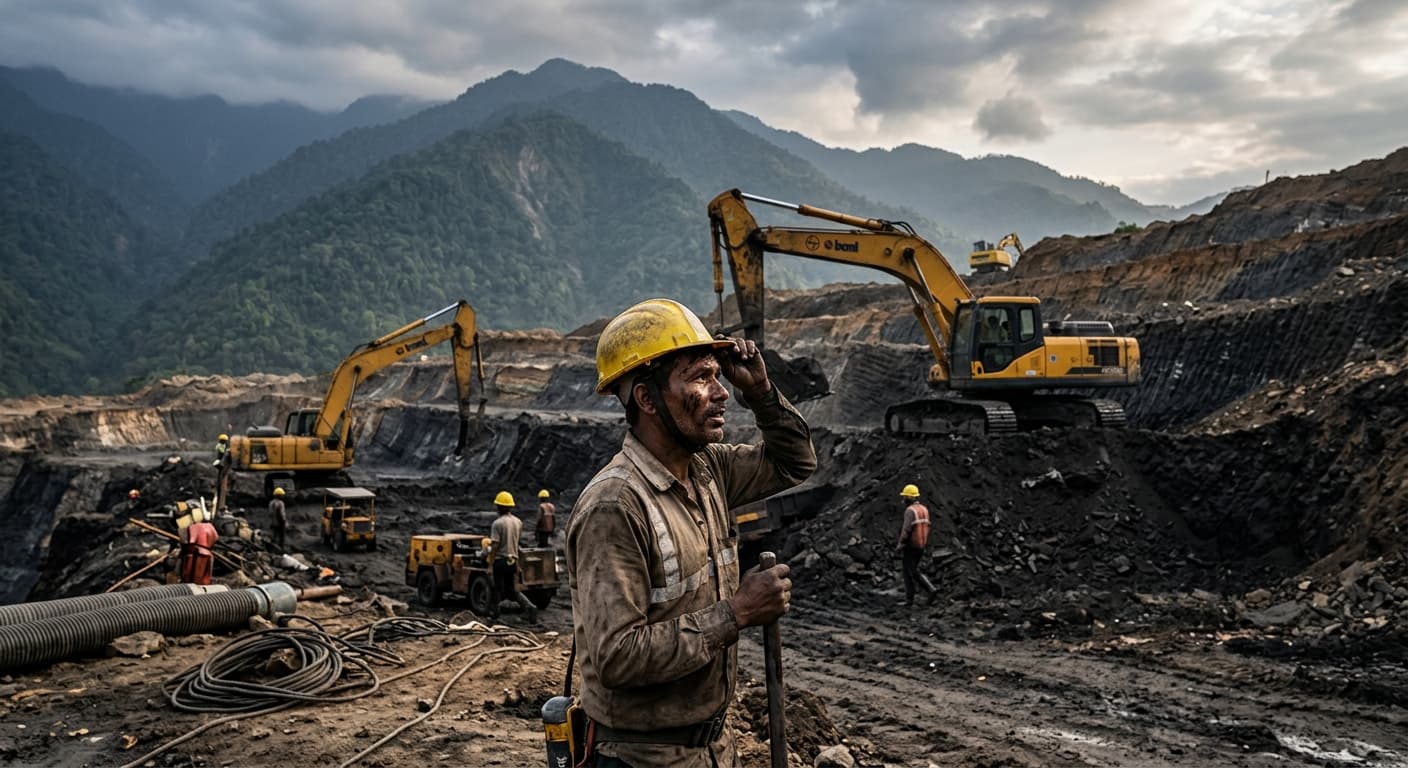
India's Graphite Gambit: Mining Arunachal to Break China's Grip
India is opening graphite reserves in a Chinese-claimed border state to muscle into the battery supply chain — a bet on geology, geopolitics and 60% import dependence.
India is trying to convert a decades-old border dispute into a critical minerals moat. State-owned Oil India Limited is exploring graphite and vanadium in Arunachal Pradesh — the northeastern state Beijing calls "Zangnan" and claims in full — while New Delhi races to shrink a 60% import dependence on the mineral that makes up nearly half of every lithium-ion battery anode. The thesis is straightforward: New Delhi is fusing energy-security policy with contested-territory geopolitics, using clean-energy demand to justify a build-out in the exact borderland where China is constructing hundreds of dual-use villages. Whether Indian graphite ever reaches battery grade at scale is secondary; the strategic prize is being counted as an alternative to China in every diversification framework the West is now writing.
The mineral nobody talked about until Beijing weaponised it
Graphite spent the clean-energy debate as an afterthought behind lithium, cobalt and nickel. That ended on October 20, 2023, when China's Ministry of Commerce imposed export permit requirements on high-purity synthetic and natural flake graphite — three days after Washington tightened AI chip controls. The Center for Strategic and International Studies documented that China then produced 79% of the world's natural graphite and refined more than 90% of it. The Peterson Institute
calculated that Chinese graphite exports collapsed 93% by volume in a single month; shipments to the United States and Japan hit zero.
Beijing escalated on December 3, 2024, banning gallium, germanium and antimony to the United States outright and subjecting graphite to what CSIS called "stricter end-use review." A further tightening
followed in October 2025, formalising rules that require foreign buyers to obtain Chinese approval even for products containing small amounts of rare earths and — again — graphite. An average electric car contains about 60 kg of graphite anode material, according to the International Energy Agency, and Nature Reviews Materials
describes natural graphite supply as "geographically concentrated with sluggish mining scalability."
That is the door Indian planners walked through.
An 18-month sprint from paper to policy
India's National Critical Mineral Mission — approved by the Union Cabinet on January 29, 2025, with an outlay of Rs 34,300 crore ($4 billion) through 2030–31 — is the operating document. The Prime Minister's Office confirms the mission covers the full value chain: exploration, mining, beneficiation, processing and recycling. The Geological Survey of India will run 1,200 exploration projects by 2030–31, per a Ministry of Mines
briefing.
The specific push on graphite is more granular. In a separate Cabinet decision, New Delhi shifted graphite royalties from a per-tonne basis to ad valorem, and — critically — disclosed that India imports 60% of its graphite requirement despite hosting nine working mines, according to the PMO. Twenty-seven blocks have already been auctioned; another 20 have been handed over by GSI and MECL; 26 are in exploration. A Sixth Tranche auction notice on September 16, 2025, put five more graphite blocks on the block.
The demand side is the pressure. India sold more than two million electric vehicles in 2024, a 27% jump on 2023, and is targeting 30% EV penetration by 2030 — a battery market NITI Aayog values near $300 billion. In its February 2026 assessment, the government think tank projects cumulative Indian graphite demand to surpass 14 million tonnes by 2050 under a net-zero pathway. That is roughly twice the reserves USGS currently attributes to China.
Why Arunachal, and why now
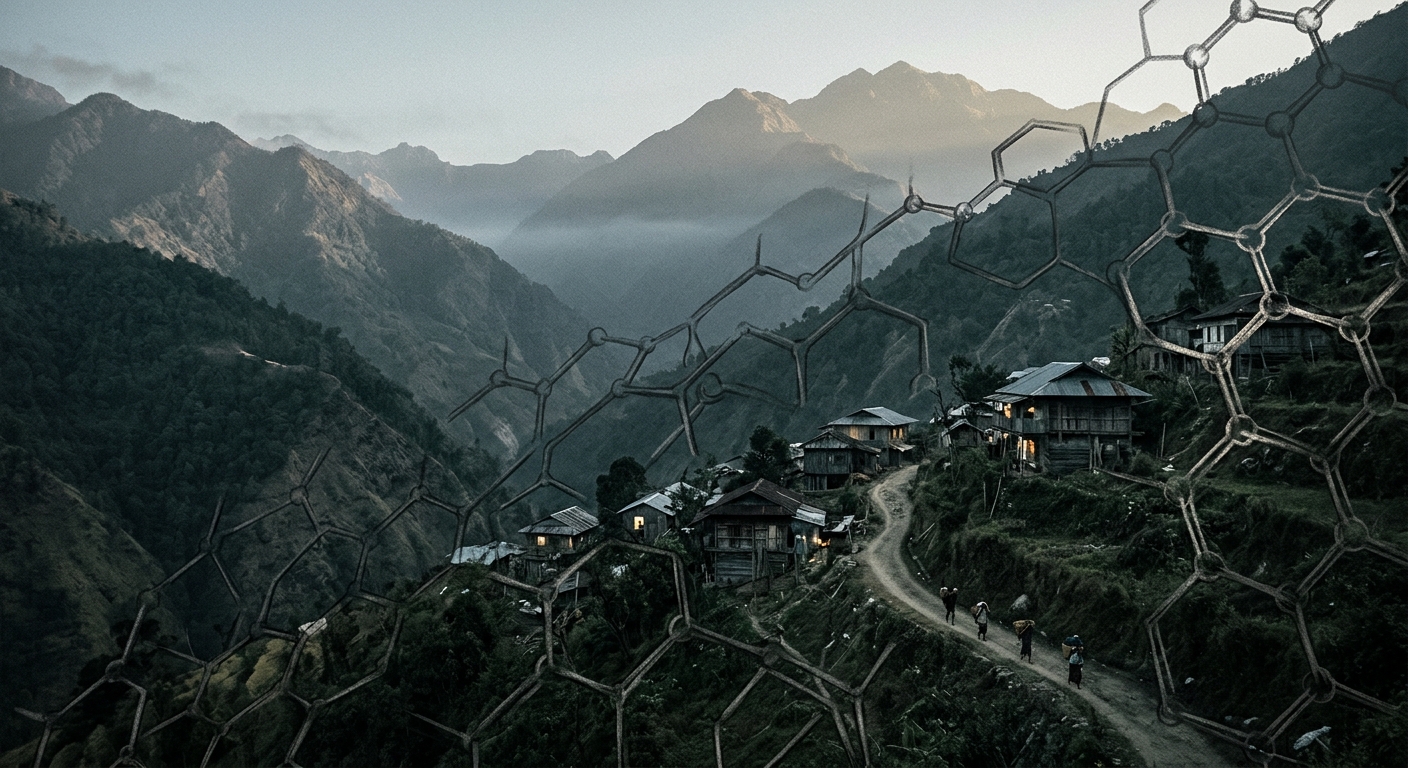
The choice of Arunachal Pradesh is not incidental. Climate Home News reports that the state holds more than one-third of India's graphite reserves and is the subject of an active sovereignty dispute with China. In a November 2025 flare-up, Beijing's foreign ministry insisted "Zangnan is China's territory," a claim India's MEA dismissed as "self-evident" nonsense,
per Al Jazeera. NPR's satellite
analysis counted more than 600 Chinese "xiaokang" border villages, at least 10 in disputed areas; CSIS's ChinaPower project has
tracked their steady dual-use build-up along the eastern Line of Actual Control.
An Indian PSU running exploration crews through Arunachal villages — meeting local youth associations like the one in Phop that spoke to Climate Home News — is therefore also a demographic and administrative fact on the ground. Oil India Limited itself is diversifying: on September 19, 2025, it signed an MoU with Hindustan Copper Limited for joint work on copper and associated critical minerals, according to the Press Information Bureau. The company's decades of upstream infrastructure in Assam and Arunachal — pipelines, roads, camps — is what makes graphite exploration in this specific terrain operationally cheap.
The diversification premium: what Delhi is really selling
India's graphite geology is not the story. Aditya Ramji of UC Davis' Global South Clean Transportation Centre told Climate Home News bluntly: "We are not a big player in the market and have missed the bus." Indian ore is largely lower-grade, making battery-anode conversion harder. USGS' 2025 Mineral Commodity Summaries place India outside the top three producers; the US International Trade Administration
notes India currently produces just four critical minerals at commercial scale — copper, graphite, phosphorous and titanium — for lack of processing infrastructure.
What India is selling is the diversification premium. Sitting outside China's supply chain and inside the Quad's is worth a price the underlying rock does not command:
- January 2026: Germany signed a critical minerals partnership agreement with India — the highest-value European alignment on the sector to date, coinciding with the EU–India trade deal Ursula von der Leyen
called "the mother of all deals."
- February 21, 2026: India and Brazil signed a critical minerals and rare earths MoU during President Lula's Delhi visit,
per Al Jazeera.
- May 26, 2026: External Affairs Minister S. Jaishankar and US Secretary of State Marco Rubio
- July 7, 2026: New Delhi
confirmed partnerships spanning 35 countries.
The Ministry of External Affairs framework text is explicit that Quad governments will "engage in international efforts to protect sensitive supply chains from coercive market practices and reduce our collective vulnerability to single-source monopolies" — a passage Washington's embassy quoted verbatim and one that maps neatly onto Beijing's graphite regime.
Named benefits, named losers
The primary winner is Oil India Limited and its state-PSU peers. OIL, HCL, NALCO and Mineral Exploration Corporation Ltd. — via the KABIL joint venture that acquired 15,703 hectares in Argentina's Catamarca for lithium — now sit at the centre of an industrial policy the private sector is largely watching from the sidelines. The Ministry of Mines' 2025 briefing designated IIT Bombay, IIT Hyderabad, IIT (ISM) Dhanbad, IIT Roorkee, CSIR-IMMT Bhubaneswar, CSIR-NML Jamshedpur and NFTDC Hyderabad as Centres of Excellence, cementing a state-anchored R&D architecture.
Secondary beneficiaries are foreign processors with capital. Kaira Rakheja of IEEFA told Climate Home News that "these exploration and extraction projects have a long gestation period. So even if discussions on processing start now, it will still take a while" — the reason foreign partners in refining are being actively courted. Titan Mining, which began shipping US flake graphite in March 2026 with EXIM co-funding, is a template.
The losers are Chinese anode makers. They still supply South Korea, Japan, India and — under IRA carve-outs until 2027, per Peterson — the United States. Every framework India signs erodes their pricing power, especially if Vance's proposed price-floor mechanism materialises.
The hurdles Delhi is not yet solving
Three problems remain unaddressed at scale:
- Grade. Indian graphite is lower-grade; battery-grade anode conversion requires spherical purification technology dominated by Chinese firms.
- Community consent in a militarised borderland. The Arunachal exploration sits inside Vibrant Villages Programme geography where NPR reported schools without teachers and roads without upkeep. Overlaying graphite mines on that ecosystem, in a zone claimed by China, invites both local resistance and Chinese propaganda leverage.
- Rare earths as the harder problem. The BBC
What to watch next
- Q4 2026: First feasibility outputs from OIL's Arunachal graphite blocks; whether foreign processing partners (Germany, France, Japan) commit capital.
- Late 2026: Formal signing of the EU–India FTA by member states — the vehicle for supply-chain integration language that would bind European battery makers to Indian offtake.
- February 2027 (indicative): Second Critical Minerals Ministerial in Washington and expected roll-out of the US price-floor mechanism; India's positioning inside vs. outside the proposed trading bloc is the decisive question.
- Ongoing: Any Chinese response — visa denials, further export tightening, or infrastructure moves along the eastern LAC that materially raise the risk premium on Arunachal mining.
Diplomat View
India will not break China's graphite monopoly this decade — the grade problem and the twenty-year mining gestation guarantee that. But that is the wrong yardstick. The strategic prize is being priced into every Western diversification deal as the largest democratic alternative to Chinese supply, and Arunachal Pradesh is the geological asset that makes the claim credible. The forecast: by end-2027, at least two of Germany, France, Japan, South Korea and the United States will have signed graphite-specific processing agreements with Indian PSUs, and OIL will have commissioned at least one Arunachal graphite pilot. The forecast breaks if a Sino-Indian border incident forces exploration crews out of the eastern LAC states, if China loosens graphite export controls to reset the diversification calculus, or if the Trump administration's tariff wall makes IRA-linked offtake commercially unworkable for Indian producers. The base case is that graphite becomes the file where India finally proves it can convert geological endowment into geopolitical leverage — quietly, from a border its neighbour still refuses to recognise.
The Bottom Line
India's graphite push is not really about graphite. It is about pricing itself into the Quad, EU and US diversification frameworks as the indispensable non-China node — and doing so in Arunachal Pradesh, the very state Beijing claims. If OIL's exploration converts to production, the deeper story will be that clean-energy demand handed New Delhi an economic reason to industrialise its most contested border, and the West a strategic reason to pay for it.
Discover more
US Politics
House Ethics Committee Pushes Sexual Miscond.
The House Ethics Committee has shifted responsibility for sexual harassment settlement records to the Office of Congressional Workplace Rights, complicating disclosure efforts.
India
BJP's Misunderstanding of Women's Quota Needs
The BJP's linking of the Women Reservation Bill to delimitation risks delaying women's empowerment in India, misreading the aspirations of female voters.
India
Congress Accuses Modi of Stalling Women's Law
Congress accuses Modi of stalling women's reservation law by linking it to delimitation, revealing a deeper electoral strategy.

Economics
Fed's Amex AML order puts correspondent banking on notice
Federal Reserve's Amex AML order requires board-level controls and a 90-day plan; OCC fined the bank $350 million over enterprise-wide deficiencies.