India's Graphite Gambit Against China
India races to mine graphite in Arunachal Pradesh.
Model Diplomat7 min readAsia
India's Graphite Gambit: Arunachal Bets Against China's Anode Monopoly
India is racing to mine graphite in a China-claimed corner of the Himalayas to break Beijing's 90% grip on battery anode refining — the sharpest energy-security shift of 2026.
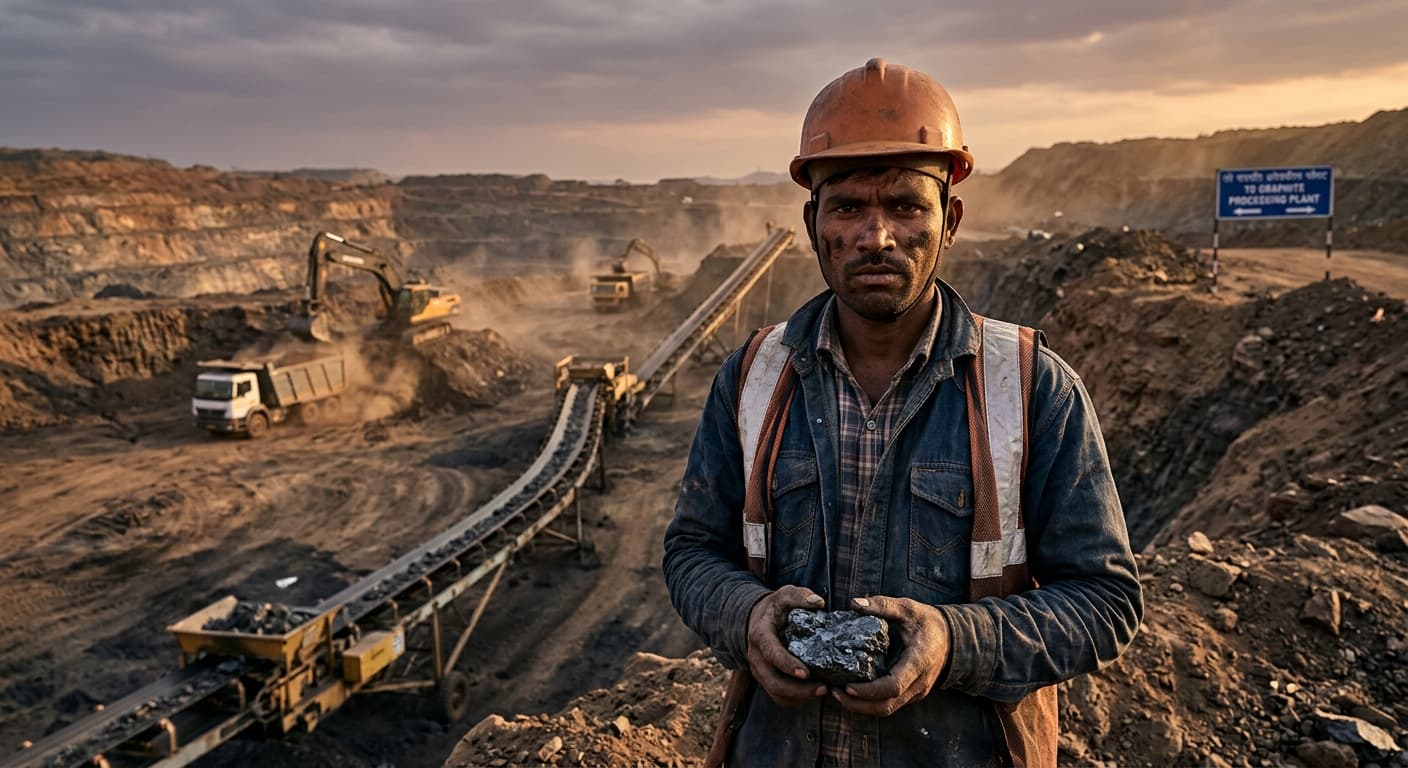
State-owned Oil India Limited is drilling for graphite in Arunachal Pradesh, the Himalayan state China calls "Zangnan," in a bet that New Delhi can convert a disputed frontier into the world's next battery-mineral supply node — and, in the process, blunt the leverage Beijing has demonstrated since it imposed export controls on natural and synthetic graphite on October 20, 2023. The wager is late, geologically awkward and politically explosive. It is also the clearest signal yet that India intends to treat critical minerals the way it once treated nuclear fuel: as a sovereignty issue rather than a commodities question. According to Climate Home News, the villages being sounded out by Oil India sit atop more than a third of India's known graphite reserves — in the very state Beijing insists is not India's to mine.
Why graphite, why now
Graphite is the workhorse the clean-energy conversation forgets. An average electric vehicle contains roughly 60 kilograms of graphite anode material, more than any other single battery input by mass. China produces about 77% of the world's natural graphite and refines close to 90% of it globally, according to the U.S. Geological Survey's 2025 Mineral Commodity Summaries and the
Center for Strategic and International Studies. No other single-choke-point in the energy transition is as tightly held.
On October 20, 2023, Beijing turned that dominance into a policy weapon, folding "high-purity, high-hardness, high-intensity" synthetic graphite and natural flake into its dual-use export control list. India felt it immediately. According to a 2025 study by the Swedish Institute of International Affairs, Chinese exports of natural graphite to India — historically one of Beijing's largest customers — "completely ceased" after the December 2023 implementation date, even as flows to Japan, Germany and South Korea continued.
That was the moment India's minerals policy stopped being a paper exercise. The Union Cabinet approved the National Critical Mineral Mission on January 29, 2025, with an outlay of ₹16,300 crore and expected public-sector investment of ₹18,000 crore. The Prime Minister's Office framed it as a bid for "self-reliance"; the
Ministry of Mines briefing put graphite explicitly on the mission's 30-mineral list. NITI Aayog's February 2026 assessment goes further, projecting that India's cumulative graphite demand will surpass 14 million tonnes by 2050 under a net-zero scenario — 51% above current-policy demand.
The Arunachal calculation
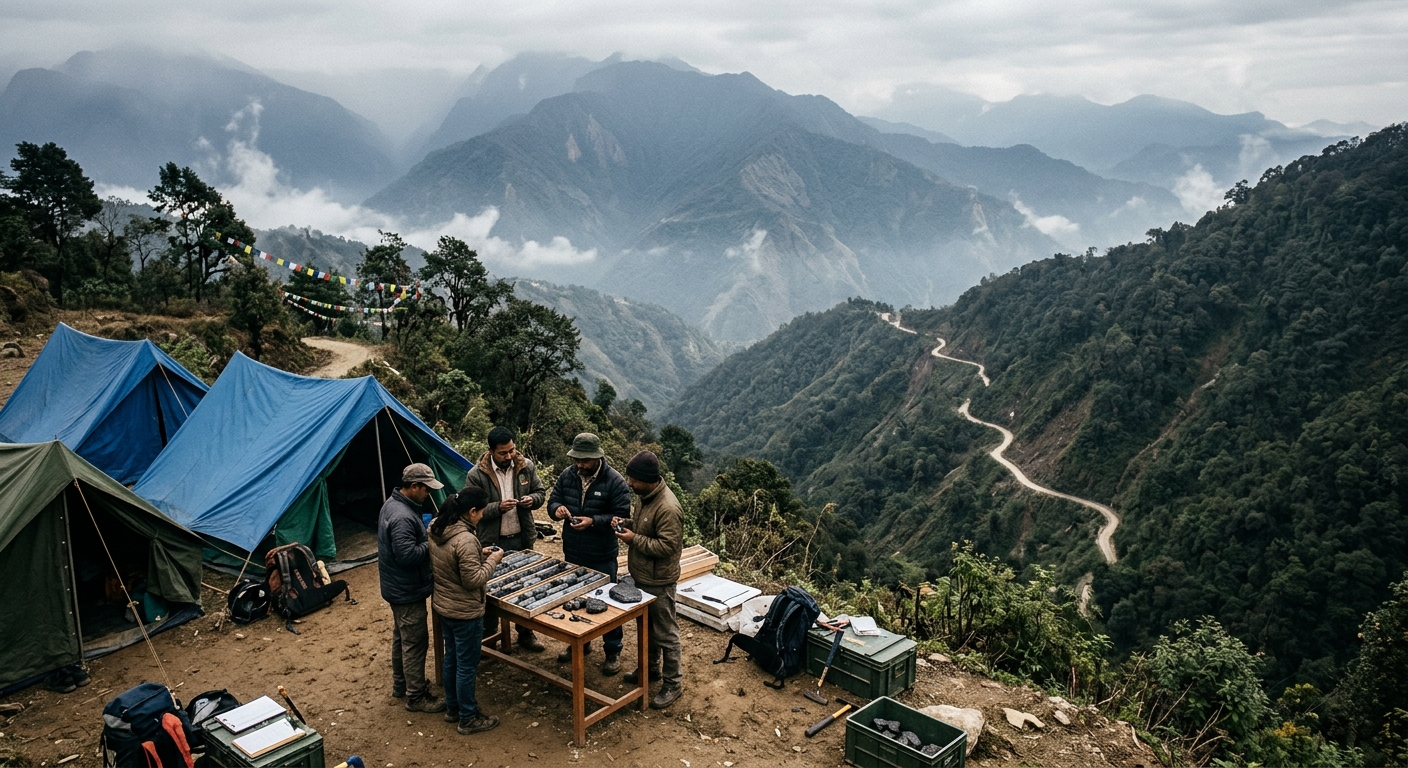
Oil India Limited's presence in Phop village and adjacent tracts is not an accident of geology alone. Arunachal Pradesh is a border state that China's Ministry of Foreign Affairs continues to call "an integral part of Chinese territory," most recently in November 2025 during a diplomatic row reported by Al Jazeera. Any large-scale extractive project there hardens Indian administrative presence in the very valleys Beijing disputes.
That is a feature, not a bug, of New Delhi's calculation. As Carnegie's July 2026 analysis of India's China policy documents, Beijing weaponised its April 2025 rare-earth magnet controls specifically against Indian buyers: 51 applications from Indian automakers sat pending in Chinese ministries while German and American subsidiaries of the same firms received their shipments. Supply resumed only in late October 2025 — and only with conditions barring re-export to the United States or military use.
The strategic logic is not that India will out-produce China on graphite. It cannot. Indian reserves are lower-grade than Mozambican or Chinese flake, and, as Aditya Ramji of UC Davis told Climate Home News, "we are not a big player in the market and have missed the bus." The logic is that even a modest domestic anode chain removes the possibility that Beijing can do to Indian EV makers what it did to Indian magnet importers.
Germany, the EU and the unexpected beneficiary
The most consequential piece of the story is the one buried in the source pack. On January 12–13, 2026, German Chancellor Friedrich Merz — on his first Indo-Pacific trip as head of government — signed a Joint Declaration of Intent on Critical Minerals with Prime Minister Narendra Modi, alongside 26 other bilateral outcomes. According to the OSW Centre for Eastern Studies, the visit was explicitly framed as "a signal to Beijing." Two weeks later, the EU and India endorsed a 2030 Strategic Agenda at the 16th EU-India Summit in New Delhi. That document, in the
European Commission's own text, commits both sides to:
"Cooperate with the aim of developing resilient, secure and diversified critical minerals supply chains for energy transition and sustainable industrial ecosystems."
Read that alongside the India-EU Trade and Technology Council work described by ORF and a picture forms: Europe, hit hard by China's 2023 graphite curbs and its 2025 rare-earth restrictions, has decided India is the least-bad partner for de-risking its anode supply. Germany is not signing minerals declarations in Delhi because it loves Indian graphite — it is signing them because Berlin's automakers cannot afford a repeat of the April 2025 magnet freeze, and because Africa's mines remain difficult to underwrite at scale.
That is where the unexpected beneficiary emerges. Germany's ammonia and semiconductor deals with India — 500,000 tonnes of green ammonia from AM Green to Uniper, semiconductor training tie-ups between Infineon and India's electronics ministry — are the visible tips. The invisible tip is that a Berlin desperate for anode-grade material has a plausible interest in bankrolling Indian processing that Indian firms cannot yet finance alone. The IEEFA's Kaira Rakheja told Climate Home News that "even if discussions on processing start now, it will still take a while." A German or EU-backed offtake agreement is precisely what would shorten that timeline.
The hard part is not the mine
India's own numbers are candid about the gap. Government data cited by the Observer Research Foundation put India's critical-minerals import bill at $8.01 billion in 2023–24, up from $3.03 billion three years earlier, while critical-minerals exports fell to $3.99 billion. India imports about 60% of its natural graphite demand and the "overwhelming majority" of its battery-grade graphite from China. The
February 2026 NITI Aayog assessment lists graphite among the minerals where "India is highly import-dependent with exposure to geopolitically sensitive or single-supplier sources."
Domestic ore is only half the problem. India currently produces around 89,000 tonnes of natural graphite a year, largely from Tamil Nadu and Odisha, but has no commercial-scale spherical or coated-spherical graphite refinery — the two intermediate products that actually go into anodes. As ORF's midstream analysis concludes, "without the ability to convert raw ores into battery-grade or high-purity chemicals, India will remain dependent on single-source suppliers." The NCMM allocates ₹500 crore for mineral-processing parks and ₹1,500 crore for recycling incentives — meaningful sums for scoping studies, small change relative to what a single Chinese graphite refinery costs to replicate.
The Arunachal reserves also happen to be, by international standards, lower-grade amorphous rather than the flake material that anodes prefer. That means more beneficiation, higher energy inputs, and — under the EU's Carbon Border Adjustment Mechanism — a real risk that finished Indian anode material carries embedded-carbon penalties when it lands in Europe. This is the point where Merz's ₹1.24 billion tranche of green-development finance and Germany's green-hydrogen roadmap stop being climate diplomacy and start being industrial policy for the anode chain.
Diplomat View
India's graphite play will not break China's anode monopoly this decade — probably not this decade at all. But it does not need to. If Oil India converts even a fraction of the Arunachal resource into a functioning mine-to-anode chain with German or EU offtake by 2030, Beijing loses something more valuable than market share: the ability to credibly threaten Indian EV makers with export licences. That is the real prize — deterrence, not tonnage.
Our call: the deal that matters is not the Arunachal mine but the first India-Germany processing joint venture, likely to surface within the next 12–18 months as the follow-through to the January 2026 JDI. Watch for a Tata, Vedanta or Hindalco name paired with a German mid-cap chemicals firm. What would revise this forecast: a fresh India-China border incident in Arunachal that spooks foreign investors out of the eastern belt, or a Chinese decision to formally lift the 2023 graphite controls in exchange for Indian trade concessions. The first would delay the timeline by years; the second would gut the political rationale.
What to watch next
- August 2026, Berlin: India-Germany intergovernmental consultations — the first test of whether the January JDIs produce named projects or remain paper.
- Q4 2026, Delhi: Ministry of Mines is expected to notify guidelines for the ₹500-crore mineral-processing park scheme; graphite anode is among the shortlisted priority chains.
- November 10, 2026: China's suspended controls on artificial graphite anode materials and lithium batteries expire. If Beijing lets them lapse, the pressure to build Indian midstream capacity eases; if it does not, the Arunachal calculus hardens.
The Bottom Line
India's graphite gambit is not a bid to displace China — it is a bid to make Beijing's export-control weapon less usable. By pushing Oil India into a Chinese-claimed border state and pairing that push with a German-and-EU processing partnership, New Delhi is quietly rewriting the Indo-Pacific mineral geometry: the country with the third-largest graphite resource base is trading its unused reserves for the security guarantees, capital and technology it lacks. If the first India-Germany anode processing venture is announced by end-2026, the India story becomes the template every non-Chinese battery producer copies next.
Discover more
US Politics
House Ethics Committee Pushes Sexual Miscond.
The House Ethics Committee has shifted responsibility for sexual harassment settlement records to the Office of Congressional Workplace Rights, complicating disclosure efforts.
India
Romanian Coalition Party Demands PM Resign
Romania's Social Democrats withdrew from coalition, joining far-right AUR to topple PM Bolojan, risking €10 billion in EU funds by August 2026.
India
Congress Accuses Modi of Stalling Women's Law
Congress accuses Modi of stalling women's reservation law by linking it to delimitation, revealing a deeper electoral strategy.

Economics
Fed's Amex AML order puts correspondent banking on notice
Federal Reserve's Amex AML order requires board-level controls and a 90-day plan; OCC fined the bank $350 million over enterprise-wide deficiencies.