Now I have everything I need. Let me write the full feature story.
India's Delimitation Bill Died in Parliament. The North-South Fault Line It Exposed Won't.
On April 17, the Modi government's most audacious electoral gambit — rewriting India's parliamentary map and women's quota in one move — fell 54 votes short. What comes next is a reckoning decades in the making.
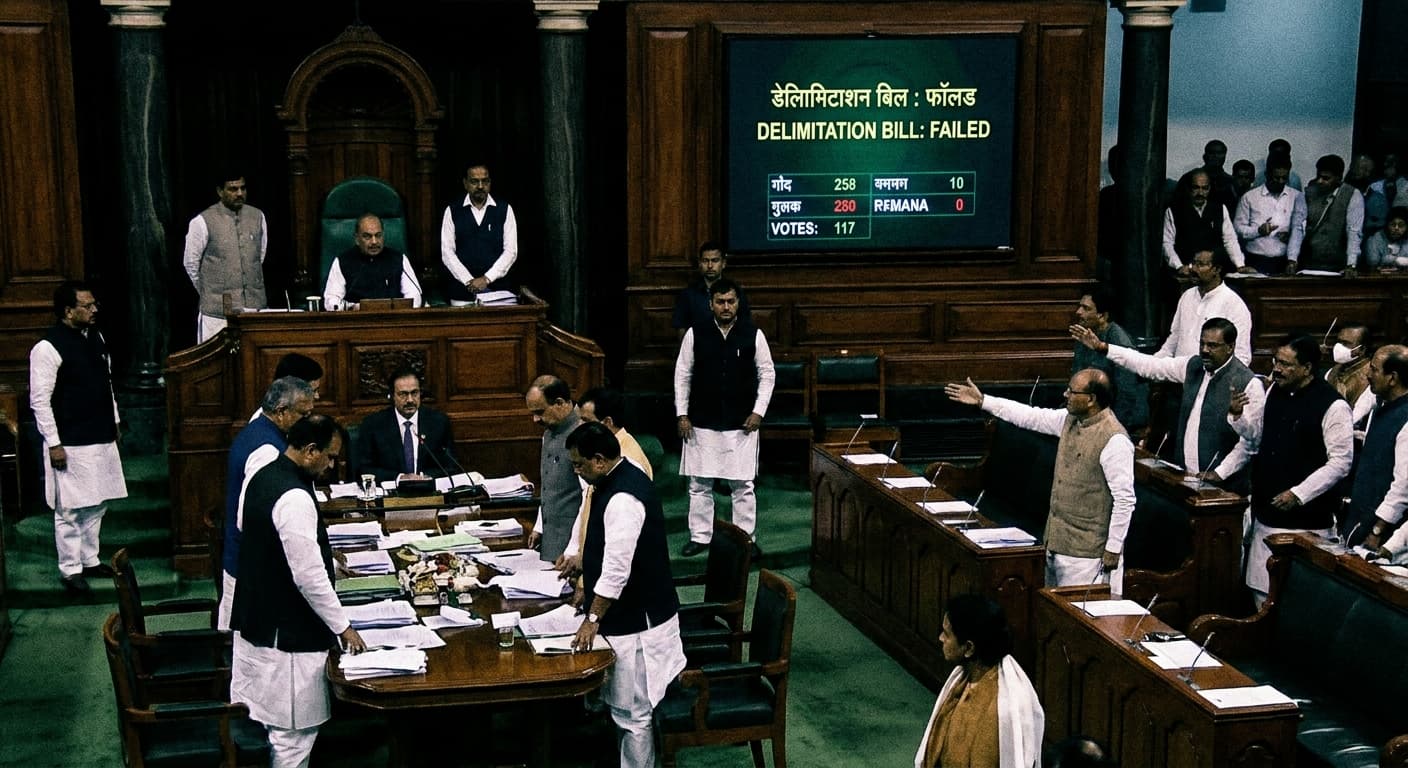
A dramatic editorial illustration of the Indian Parliament building (Sansad Bhavan) at night, split diagonally — the northern half bathed in warm orange light, the southern half in cool blue light, symbolizing the deep political divide between Hindi-belt states and South India over parliamentary seat delimitation. In the foreground, a cracked constitutional document with voting numbers "298 vs 230" partially visible. Dark storm clouds above, with the Indian tricolor visible at the top of the dome.
The numbers on the Lok Sabha tally board on the evening of April 17 told a clean story: 298 in favour, 230 against, 528 members present. The Constitution (131st Amendment) Bill, 2026 needed 352 votes — a two-thirds majority — to pass. It was short by 54. Within hours, the government withdrew two companion bills: the Delimitation Bill, 2026 and the Union Territories Laws (Amendment) Bill, 2026. The entire package was dead.
BJP president Nitin Nabin announced the party would take to the streets to "expose the anti-woman mindset" of the opposition. Home Minister Amit Shah called it a "black day." NDA women MPs staged protests outside Parliament with placards. DMK chief M.K. Stalin, 1,800 kilometres south in Chennai, called it a victory for democracy. Congress president Mallikarjun Kharge framed it as a defence of federalism.
Everyone was right about what they won or lost. Almost no one is talking about what happens next.
The Trap Hidden Inside a Women's Quota Bill
To understand why this fight was so explosive, you need to understand the architecture of the bill — and the sleight of hand at its centre.
The 131st Amendment was ostensibly about implementing the Women's Reservation Act of 2023, which had promised 33% of Lok Sabha and assembly seats to women. That law passed in a blaze of political consensus — but contained a catch. Implementation was tied to a future census and a future delimitation exercise. Critics called it a promise deferred by design: by anchoring reservations to delimitation, the government effectively pushed women's representation past 2034 under normal constitutional timelines.
The 2026 amendment was sold as the fix — a way to fast-track both delimitation and women's reservation using the already-completed 2011 Census data, expanding the Lok Sabha from 543 to approximately 816 seats, with 273 reserved for women, ahead of the 2029 elections. On its face, a historic reform.
But the bill's actual text did something else. By using 2011 Census data as the baseline for seat allocation, it would have redistributed parliamentary weight based on where India's population had grown most since the last major realignment — which meant north and central India, not the south. Congress's Jairam Ramesh spelled out the arithmetic bluntly: under the plan, Uttar Pradesh's Lok Sabha advantage over Tamil Nadu would grow from 60 seats to roughly 90. The south would get more seats in absolute numbers — but a smaller share of a larger parliament. Influence, not just headcount, is what matters when governments are formed.
The bitterness here runs deep — back to 1976, when Indira Gandhi's government froze constituency boundaries in place using the 1971 Census as the permanent baseline, through the 42nd Constitutional Amendment. The freeze was extended through 2026 via the 84th Amendment in 2001. The stated logic was to avoid punishing states that had successfully reduced population growth — a tacit acknowledgement that southern states had invested in family planning, education, and women's health, and shouldn't lose parliamentary seats as a reward.
That bargain held for fifty years. The 131st Amendment was, in effect, a proposal to tear it up.
The irony is genuine: states like Tamil Nadu, Kerala, Karnataka, and Andhra Pradesh did everything the Indian developmental consensus asked of them. Fertility rates dropped. Literacy climbed. Per capita income outpaced the national average. And precisely because of that — because their populations grew more slowly — they were facing the prospect of reduced national influence under any strictly population-weighted delimitation. Tamil Nadu's MK Stalin called it a punishment for governance. He had a point.
The Vote That Reveals the Real Coalition Map
Here is the detail that most commentary has glossed over: two NDA allies — the Telugu Desam Party (TDP) and the AIADMK — voted in favour of the bill, despite modelling by their own state analysts showing it would likely reduce their states' relative parliamentary weight. TDP's Chandrababu Naidu and AIADMK's Edappadi Palaniswami accepted verbal assurances from the BJP leadership. The bill's actual text contradicted those assurances.
What that tells you is that the calculus for regional parties inside the NDA was never purely about delimitation. It was about survival inside a coalition with a party that commands over 240 Lok Sabha seats of its own. Naidu needs the Centre for Andhra Pradesh's reconstruction funds. Palaniswami needs BJP's organisational muscle for the Tamil Nadu assembly election, which is happening right now, with vote-counting scheduled for May 4. You don't pick a fight with your national patron three weeks before a crucial state election, whatever the bill's fine print says.
The result: those parties took a reputational hit with their own electorates for backing a bill that every opposition leader in the south framed as an existential threat to regional representation — and they still didn't get the bill passed. It's a uniquely uncomfortable position to be in.
Meanwhile, the INDIA bloc executed a rare feat of disciplined coordination. Rahul Gandhi's framing — that this was "not about women's reservation, but about reshaping the electoral map" — held firm across parties that don't always agree on much. The Trinamool Congress, the DMK, the Samajwadi Party, the Left — all voted as one. That cohesion itself is the news.
What Happens Now — And Why It's More Complicated Than "BJP Lost"
The BJP's immediate play is transparent: frame the opposition as having betrayed Indian women, take the argument to the streets, and run a counter-narrative into the Tamil Nadu election cycle and beyond. BJP leaders are already using the defeat as campaign fuel, particularly in states where women's reservation is a popular demand.
It may work. The Women's Reservation Act was genuinely popular when passed in 2023. Polling on the issue is favourable. And by bundling delimitation into the women's quota bill, the government created a situation where voting against the package could be — and now is being — characterised as voting against women in Parliament.
But the BJP has a deeper problem. The 2026-27 Census is still ongoing. Until it is complete, any new delimitation attempt faces the same constitutional hurdles. The Vidhi Centre for Legal Policy has documented how complex the legal scaffolding around delimitation actually is — this isn't something that can be reintroduced in the next session by swapping out a few clauses. A genuine consensus process, involving a Delimitation Commission, parliamentary committees, and inter-state consultations, could take years.
That means the Women's Reservation Act remains in a constitutional limbo the government itself created. The Act was notified in the Gazette on April 16, 2026 — one day before the vote that killed its implementation vehicle — a timing that felt, to critics, like a political manoeuvre designed to claim credit without delivering change.
The deeper implication is the one that will outlast this session: India is heading toward the 2029 general election with an unresolved question at the heart of its federal architecture. Once the Census concludes, delimitation becomes legally mandatory — it cannot be deferred indefinitely. When it comes back, all of today's tensions come back with it, plus three more years of accumulated grievance. The INDIA bloc's victory on April 17 was real. But "we stopped it this time" is not a constitutional settlement.
Sonia Gandhi put it plainly in an op-ed last month: delimitation, not women's reservation, is the core issue affecting India's polity. She was right then. She's right now. The south knows it. The Hindi belt knows it. And after April 17, the rest of the country does too.
The bill is dead. The question it asked — whose vote counts more? — is very much alive.