India's Critical Mineral Pledge vs China's G
Vedanta's 50% self-sufficiency forecast faces processing and auction hurdles
Model Diplomat8 min readSouth Asia
India's 50% Critical Mineral Pledge Hides a Deeper Race Against China's Processing Monopoly
A Vedanta executive's July 14 forecast that India can halve its critical mineral import dependency in a decade rests on a policy scaffold already in place — but the bottleneck is processing technology, exploration depth, and auction participation, not legislative intent.
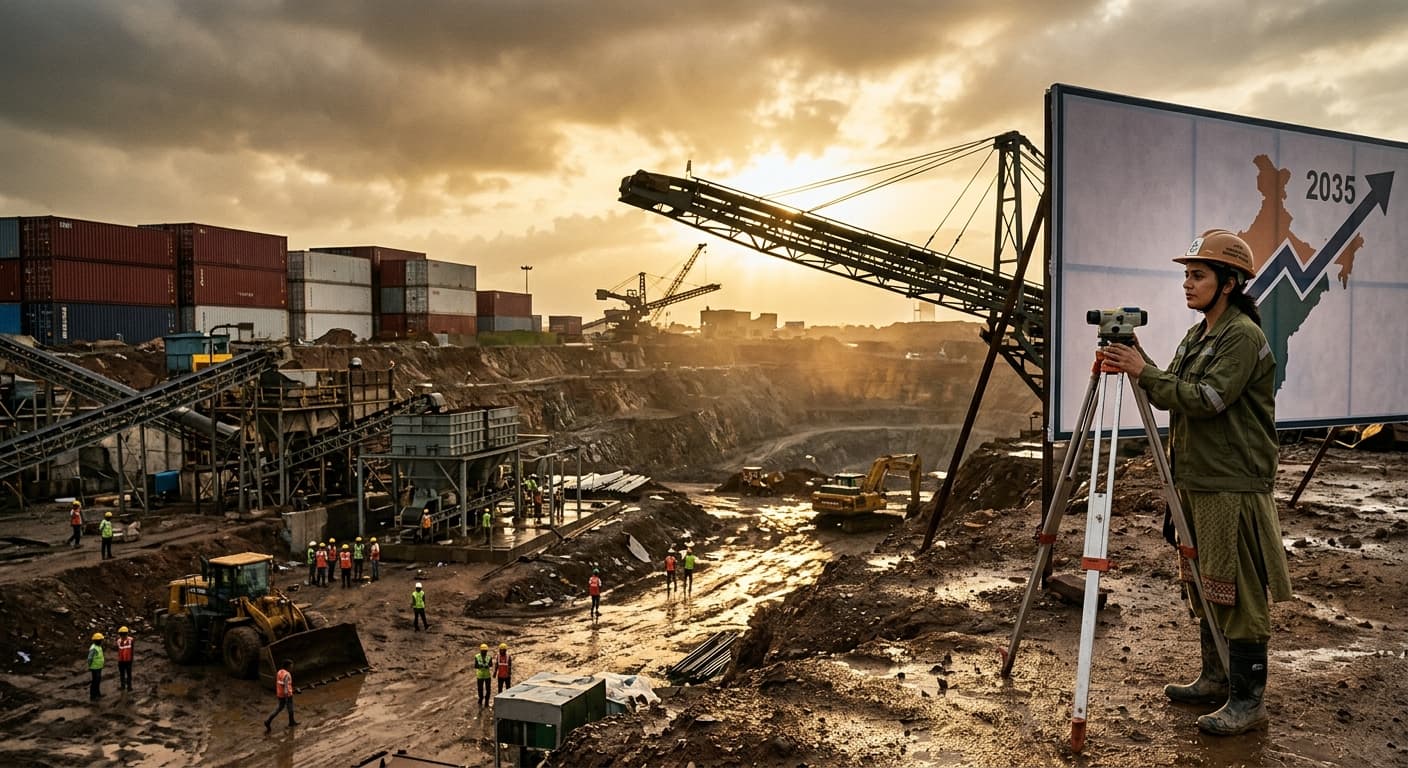
Gouranga Sen, Group Head for Economic and Policy Analysis at Vedanta, told a CII mining summit on July 14, 2026, that India could reach "at least 50 per cent self-sufficient in the critical minerals" within five to ten years. The claim is not a government target — it is an industry wager that the National Critical Mineral Mission, auction reforms, and Vedanta's own block wins will compound fast enough to offset a structural vulnerability: India is 100% import-dependent for 10 of the 30 minerals its own Mines Ministry has classified as critical, and China is the dominant supplier for most of them. The forecast's credibility hinges not on geological potential but on whether India can build processing capacity and exploration depth at a pace no auction has yet demonstrated.
The Policy Scaffold Is Already Standing
India's critical mineral architecture was built in three rapid layers. In June 2023, the Ministry of Mines published its first list of 30 critical minerals and flagged that 10 — including lithium, cobalt, nickel, vanadium, niobium, germanium, rhenium, beryllium, tantalum, and strontium — faced total import dependency, according to the Ministry of Mines report. Three months later, the MMDR Amendment Act of August 17, 2023, introduced an Exploration Licence regime that opened 29 critical and deep-seated minerals to private prospecting for the first time, as detailed in a
PIB release. On January 29, 2025, the Union Cabinet approved the
National Critical Mineral Mission, with Rs 16,300 crore in direct expenditure and an expected Rs 18,000 crore from public sector undertakings, running through 2030-31.
The NCMM is not a mining programme. It is a supply-chain blueprint. Its targets include 1,200 domestic exploration projects by 2030-31, acquisition of stakes in 50 overseas critical mineral mines, 400 kilotonnes of recycling capacity, four mineral processing parks, and 1,000 patents across the critical mineral value chain, according to the NCMM official document. The Geological Survey of India has already taken up 195 exploration projects in the 2024-25 field season, including 35 in Rajasthan, and more than 100 critical mineral blocks are slated for auction. Overseas, Khanij Bidesh India Ltd. (KABIL), a joint venture of NALCO, Hindustan Copper, and MECL, signed an agreement with Argentina's CAMYEN on January 15, 2024, for five lithium brine blocks spanning 15,703 hectares in Catamarca province, as confirmed by a
PIB document. By December 2024, the central government had successfully auctioned 24 critical mineral blocks across four tranches, covering lithium, rare earth elements, graphite, vanadium, nickel, chromium, cobalt, manganese, and tungsten.
Vedanta is one of the private companies moving on these blocks. Sen said the company has already won blocks containing tungsten and lithium, with exploration underway for nickel, cobalt, and rare earths, according to ANI reporting carried by New Kerala. Rare earth projects remain at the exploration stage. "At the end of this exploration process, we will start mining," Sen said.
The Numbers Behind the Vulnerability
The scale of what India is trying to escape is quantifiable. Between 2019 and 2024, China accounted for 82% of India's lithium imports, 85.6% of bismuth, 76% of silicon, 50.6% of titanium, 48.8% of tellurium, and 42.4% of graphite, according to a Takshashila Institution analysis. China processes 68% of the world's nickel, 59% of lithium, 73% of cobalt, and 85% of rare earth elements, according to data cited by the
Observer Research Foundation and corroborated by the
Congressional Research Service. The concentration is not just in mining — it is in the midstream. China controls more than half of global processing capacity for aluminium, indium, lithium, silicon, and rare earth elements, according to an
LSE academic study.
India's demand trajectory makes the vulnerability acute. A February 2026 NITI Aayog report projected cumulative critical energy transition mineral demand of approximately 169 million tonnes under a Net Zero Scenario — 51% higher than the Current Policy Scenario. Over 66% of that demand materialises after 2050, creating what the report calls "urgency to de-risk supply now." Copper requirements alone exceed 20 million tonnes by 2050, and graphite surpasses 14 million tonnes. EV batteries account for roughly 55% of total CETM demand, followed by solar technologies at about 30%.
The Bottleneck Is Not Policy — It Is Execution
Here the forecast frays. Successive auctions of critical mineral blocks since 2023 have been cancelled due to lack of bids or qualified bidders, according to ORF analysis. Only one lithium block has been auctioned so far, and it attracted no participation from major mining companies. The Jammu and Kashmir lithium deposit — 5.9 million tonnes of inferred resources announced in February 2023 — saw two failed auctions, with the most recent not eliciting a single bid, according to the
Peterson Institute for International Economics. Lithium prices had fallen nearly 60% from their peak by the time of the first auction, making higher-cost deposits unattractive.
The deeper problem is exploration maturity. Only one lithium block and two nickel-cobalt blocks in India have been explored to G2/G3 levels, while most critical mineral blocks remain at the preliminary G4 stage, according to ORF. Without deeper geological data, investors cannot price risk, and without pricing, auctions stall. The Exploration Licence regime, designed to bring private prospectors into the field, awards licences through reverse auctioning of revenue share — with earnings deferred until blocks are auctioned in the distant future. That structure leaves explorers with tight cash flows and little incentive to participate.
Processing technology is the second gap. India may have geological resources for copper and graphite with moderate import dependence, but it remains almost fully reliant on imported polysilicon despite low overall silicon import dependence, as the NITI Aayog overview report notes — pointing to gaps in processing and refining capacity rather than geological scarcity. For minerals like lithium, nickel, cobalt, and rare earth elements, India faces near-total import dependence due to the absence of domestic reserves, the report adds. The
ORF has argued that unless the government focuses on acquiring processing technologies or companies invest in R&D to establish their own refining facilities, "the creation of a domestic critical mineral supply chain will take time."
Who Benefits, Who Loses
The winners under the current framework are companies that already have balance-sheet depth and a metals portfolio to cross-subsidise early-stage exploration. Vedanta fits that profile. Its mining and metals businesses — zinc, aluminium, copper — generate cash flow that can absorb the long lead times between exploration and production. The company is also procuring renewable power and setting up solar plants at its facilities, positioning itself for any domestic carbon market that emerges. Sen noted that aluminium and copper produced by Vedanta are "widely used in renewable energy infrastructure," as ANI reported.
Public sector companies are the other beneficiaries. KABIL has a government mandate and sovereign backing to acquire overseas assets — something private firms cannot easily replicate. Hindustan Copper Limited, India's only vertically integrated copper producer, is positioned to extend its mandate into critical minerals, as noted in an arXiv working paper. The Rs 7,280 crore Rare Earth Permanent Magnet Manufacturing Scheme approved on November 26, 2025, targets five beneficiaries through sales-linked incentives of Rs 6,450 crore plus Rs 750 crore in capital subsidy, according to a
PIB document. India imported 60–80% of permanent magnets by value and 85–90% by quantity from China between 2022 and 2025; the scheme is designed to build 6,000 MTPA of integrated capacity from rare-earth oxides to finished magnets.
The losers are smaller mining firms without processing capability, and the consumers — Indian EV manufacturers, solar panel assemblers, and defence contractors — who will pay a premium for non-Chinese supply until domestic processing scales. China's October 2024 rare earth regulation tightened state control over the sector, with fines of 5–10 times illegal gains for violations, according to RSIS Nanyang. That will tighten supply and raise prices for import-dependent countries, increasing the cost of the very transition India is trying to accelerate.
The Historical Parallel
India's critical mineral push mirrors its earlier attempt to build domestic semiconductor capability through production-linked incentives. Both sectors share the same structural challenge: the bottleneck is not demand or capital — it is specialised technical capability and ecosystem depth that takes a decade to build. The semiconductor PLI scheme attracted commitments but has struggled to translate them into functioning fabs on the timeline initially promised. The critical mineral mission faces the same risk: auctions and incentives can attract bids, but turning a G4-stage exploration block into a producing mine with an attached processing plant takes 7–12 years under optimistic assumptions.
Recycling offers a faster lane. The NCMM's Rs 1,500 crore recycling incentive aims to build 270 kilotonnes of annual recycling capacity, producing 40 kilotonnes of critical minerals and attracting Rs 8,000 crore in investment, according to PIB. NITI Aayog's assessment suggests cobalt could approach 100% circularity by 2040–45, and nickel up to 45%, according to the
NITI Aayog overview. But copper and graphite circularity will likely plateau at 20–25% by mid-century, and silicon below 10% due to technical barriers. Recycling can offset — not replace — primary mining.
What to Watch Next
- Q3 2026: Next tranche of critical mineral block auctions. Participation levels from major miners will indicate whether the MMDR Amendment Act 2025's easing of lease-area expansion rules has unlocked genuine private interest.
- By end-2026: KABIL's Argentina lithium exploration results from the five Catamarca blocks. If resources are confirmed at commercially viable grades, India gains its first overseas lithium supply line.
- 2027–28: First Rare Earth Permanent Magnet scheme beneficiaries begin production. The 6,000 MTPA target is modest by global standards but would mark India's first integrated REPM capability.
- FY 2030–31: NCMM's terminal year. The 1,200 exploration projects target and 1,000 patents target will be the scoreboard for whether the mission built real capacity or simply spent its Rs 34,300 crore allocation.
Diplomat View
Sen's 50% forecast is defensible only if "self-sufficiency" is defined narrowly — as reduced import share for a basket of minerals where India has known geological resources and where processing can be domesticated within a decade. For lithium, cobalt, and rare earths, where India has no proven reserves and no processing infrastructure, 50% self-sufficiency by 2035 is not achievable through domestic mining alone. It requires overseas acquisition through KABIL, strategic partnerships under the Minerals Security Partnership, and recycling at a scale India has never demonstrated. The forecast is best read as a corporate confidence signal from a company that has already won blocks and needs the policy environment to hold — not as a projection grounded in completed geological assessment. If the next two auction tranches attract meaningful private bids from companies with processing capability, the 50% target becomes plausible for a subset of minerals. If they fail, as the J&K lithium auctions did, the target is aspirational, not analytical.
Discover more
US Politics
House Ethics Committee Pushes Sexual Miscond.
The House Ethics Committee has shifted responsibility for sexual harassment settlement records to the Office of Congressional Workplace Rights, complicating disclosure efforts.

US Politics
SNAP Food Assistance Faces Legal Challenges
In 2026, SNAP faces stricter eligibility rules and mounting legal challenges, threatening food assistance for the millions of Americans who rely on the program.

International Relations
Pakistan's Key Role in US-Israel-Iran Meddle
Pakistan is seeking to mediate the US-Israel-Iran conflict, balancing high-stakes diplomacy against severe economic pressures and steep regional challenges.

Conflict & Security
Drone Warfare Killing Aid Workers at Unprec
Over 1,000 humanitarian workers killed in three years as cheap armed drones collapse legal protections. Gaza, Sudan, Ukraine, and DRC see deliberate targeting of aid convoys and hospitals with zero prosecutions.