India's BrahMos Deal Reshapes Malacca Strait
India and Indonesia's defense pact alters regional security dynamics.
Model Diplomat7 min readSoutheast Asia
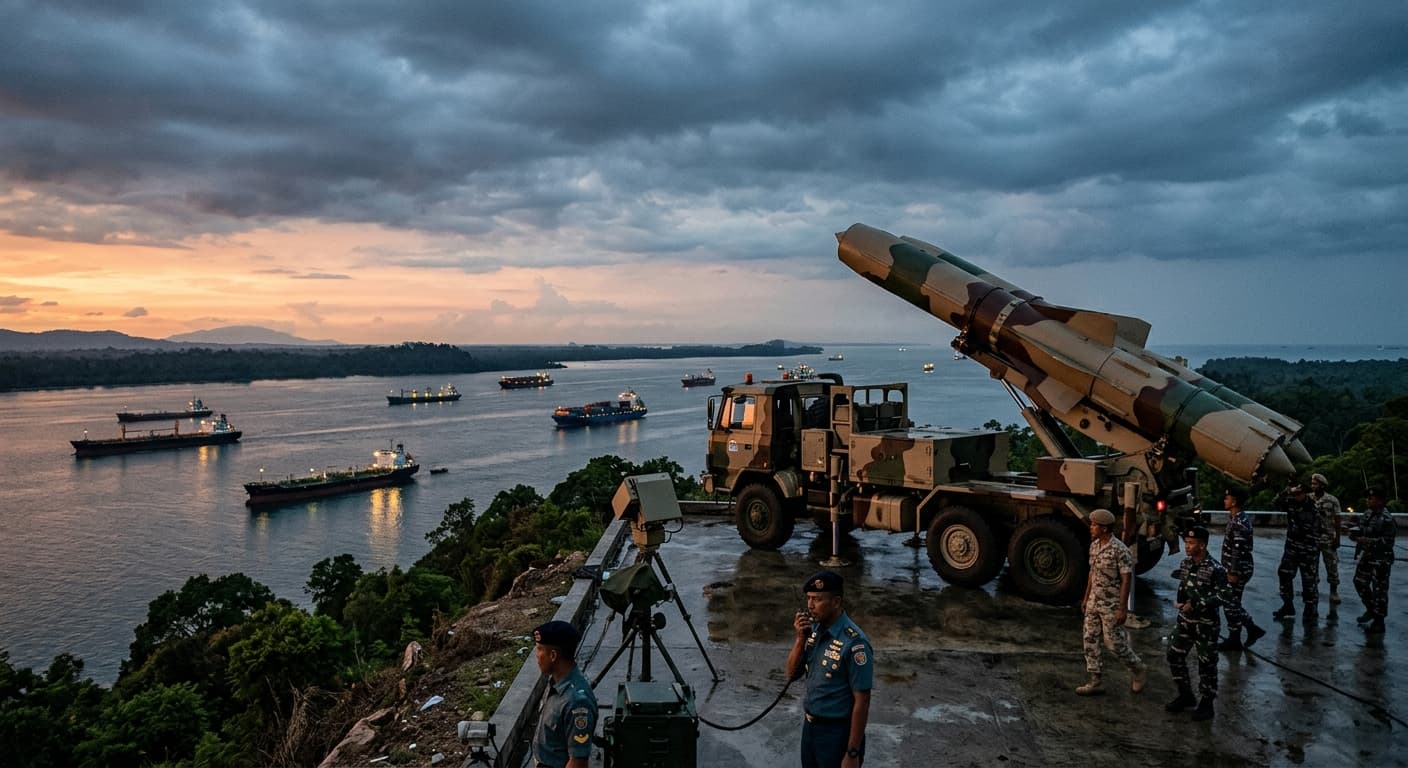
India's BrahMos Lands in Jakarta: Malacca Strait Geometry Shifts
India and Indonesia signed 14 pacts on July 7-8, 2026 including BrahMos and Astra missile deals — a shift that rewires Indo-Pacific security geometry around the Malacca Strait.
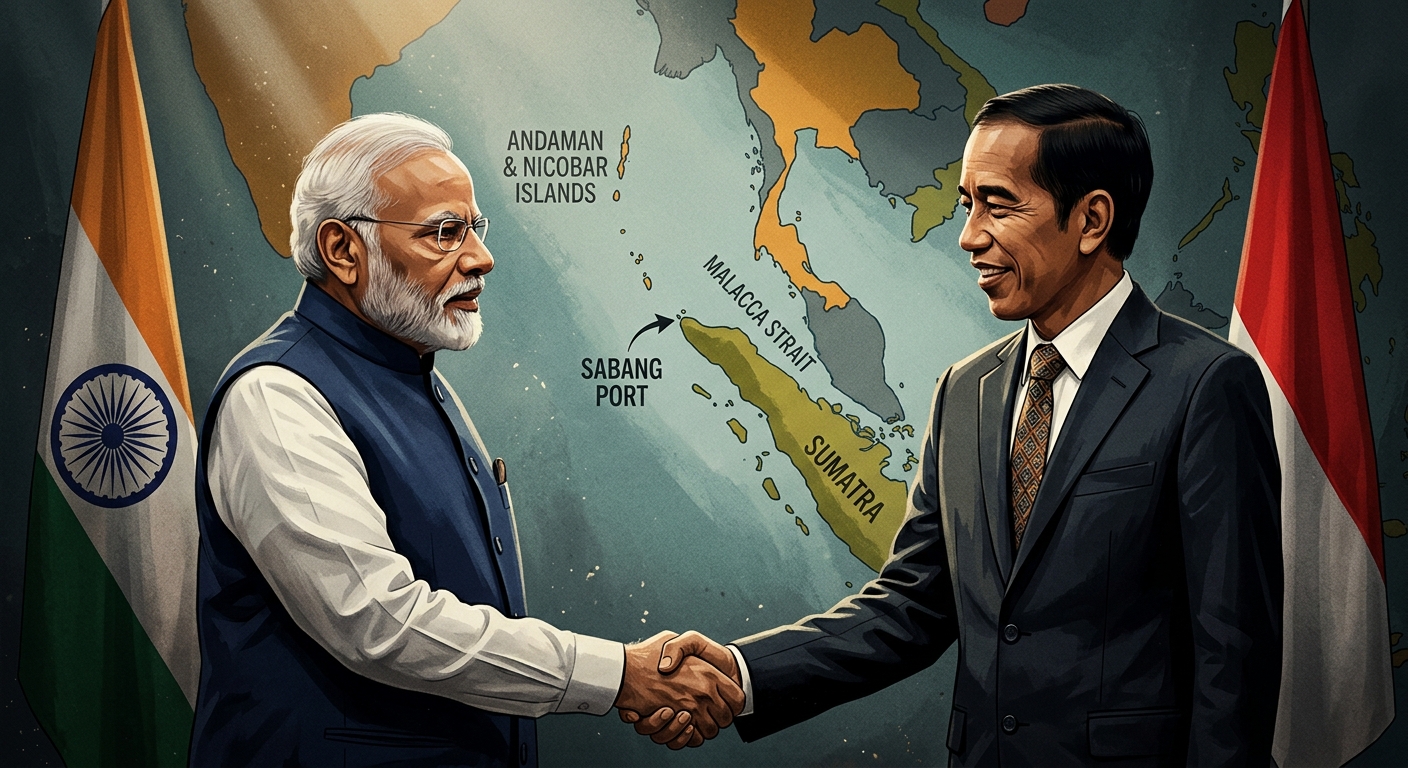
The 14 agreements Prime Minister Narendra Modi and President Prabowo Subianto signed in Jakarta on July 7, 2026 do one thing above all: they place Indian supersonic cruise missiles on the archipelago that owns the northern shore of the Malacca Strait, and they do so with a joint development plan for Sabang port sitting 90 nautical miles from India's Andaman and Nicobar command. That is not an arms sale. It is the operational scaffolding for a two-navy chokepoint posture at the seam between the Indian and Pacific Oceans — the first such arrangement India has ever signed with the ASEAN state that matters most, and the clearest signal yet that Prabowo's much-advertised non-alignment has a sharper edge than Beijing had priced in.
What was actually signed
The PMO joint statement issued on July 7, 2026 confirms that Modi and Prabowo agreed to "the elevation of defence cooperation, including through cooperation on BrahMos Missile System, and the Air-to-Air Missile Cooperation Agreement" — the diplomatic wrapper for the export of the Indo-Russian BrahMos supersonic cruise missile and DRDO's Astra beyond-visual-range missile. Wire reports and the
Daily Pioneer put the combined defence package at over $600 million; the Observer Research Foundation had earlier reported the
BrahMos component alone at around $450 million.
The maritime package is where the harder power sits. The joint statement records the "positioning of an International Liaison Officer (ILO) from Indonesia at Information Fusion Centre-Indian Ocean region (IFC-IOR) Gurugram," the renewal of the maritime safety MoU, and a new implementing arrangement between BAKAMLA (Indonesia's coast guard) and the Indian Coast Guard. Reporting from Cambodianess and
The CSR Journal confirms the Sabang port development, critical minerals supply-chain compact, UPI–QRIS payments integration, and an IIM Bangalore campus.
The load-bearing agreement is Sabang. IDSA's Manohar Parrikar Institute for Defence Studies and Analyses has flagged the port's decisive attribute: it is a deep-water facility "well-suited to host all kinds of naval vessels, including submarines," located at the northern tip of Sumatra at the mouth of the Malacca Strait. The
Institute of Peace and Conflict Studies put the strategic case bluntly — Sabang enables "preemptive blockading of the Malacca Strait during war time" and functions as a proximate base for eastern Indian Ocean manoeuvre.
Why Prabowo moved now
The strategic logic runs through Jakarta as much as New Delhi. CSIS analyst Andreyka Natalegawa observed in a May 2025 assessment that Prabowo has spent his first year running a "diplomatic charm offensive" that pairs BRICS accession, a China two-plus-two, and a Turkish drone deal with a hedge portfolio — Indonesia's "classic non-alignment while maximising its interests by actively pursuing a broad range of partnerships." The India package is the missing piece: hard deterrence hardware that neither Beijing nor Washington supplies, from a country with no colonial baggage and no lecture reflex.
For India, the ledger is even clearer. According to a Press Information Bureau factsheet, defence exports hit ₹23,622 crore (~$2.76 billion) in FY 2024-25 — a 34-fold rise from ₹686 crore in 2013-14. The government target is ₹50,000 crore by 2029, and
ORF's policy analysts note that Southeast Asia is the geography where India can plausibly scale that ambition. Indonesia becomes the third confirmed BrahMos customer in the region after the
Philippines' $375 million 2022 contract and a Vietnam deal now confirmed by India's defence secretary.
The Chatham House problem, resolved
The awkward reality that Modi's team had to overcome was that six months ago the bilateral was seen as underperforming. Chatham House's Chietigj Bajpaee wrote in February 2025 that warm rhetoric was masking "the lack of substance" in India–Indonesia ties. Gateway House's Rajiv Bhatia, reviewing Prabowo's January 2025 Republic Day visit, observed that
"no agreement emerged" on BrahMos then, despite heavy pre-visit signalling. In six months, that gap has closed — and closed on Jakarta's terms, with the missile deal packaged alongside critical minerals investment and payment-system integration that primarily benefit the Indonesian side of the ledger.
The gap-closer was the November 27, 2025 3rd Defence Ministers' Dialogue in New Delhi, referenced in the joint statement. That meeting appears to have unlocked both the BrahMos and Astra tracks after eighteen months of negotiation.
The critical minerals angle no one is talking about
Buried in the 14 documents is a supply-chain agreement that arguably matters more over a ten-year horizon than the missiles. Indonesia holds the world's largest nickel reserves and roughly half of global mined output; India's National Critical Mineral Mission and the ₹73 billion ($800 million) rare-earth magnet scheme approved in November 2025 both depend on securing offtake from precisely this kind of jurisdiction. The
BBC reported in early 2026 that India still imports 80–90% of its rare-earth magnets and related material from China, with 2025 magnet imports of $221 million; Indonesia's nickel, cobalt, and processing capacity are the most obvious near-term escape valve.
Indian steel and metals companies will now invest in Indonesian stainless-steel, nickel, and rare-earth magnet manufacturing under the framework. That places India inside the same industrial cluster where China has spent the last decade building the Morowali and Weda Bay complexes — a direct competitive intrusion into Beijing's most successful Belt and Road industrial project.
The Chinese calculation
ORF's Southeast Asia analysts have argued that BrahMos exports "shape China's periphery" by planting anti-ship missiles with 290-450 km range along the archipelagic ring that Chinese naval and merchant shipping must transit. The land- and ship-based anti-ship variants Indonesia is buying are the exact configuration that could, in a crisis, hold at risk PLA Navy vessels transiting the Sunda, Lombok, and Makassar straits — Beijing's Malacca-avoidance routes.
The NUS Institute of South Asian Studies noted earlier this year that more than 55% of India's own trade transits the Malacca Strait and Singapore, and that 80% of China's crude oil imports flow through the same waterway. The India–Indonesia arrangement does not close the strait — the four Malacca Strait Patrol littorals remain sovereign over the waterway — but it materially raises the cost of any Chinese effort to project coercive naval power into the eastern Indian Ocean without Indonesian acquiescence.
There is a second-order effect worth flagging: RAND's Derek Grossman, in a July 2023 assessment, argued that India was "becoming a power in Southeast Asia" precisely by combining discounted missile exports with training, spares and deployment support that Russia and Israel do not provide at that price point. Indonesia is now the biggest test case of that model.
The historical parallel
The Modi–Prabowo pact carries a longer shadow. In 1955, Jawaharlal Nehru and Sukarno co-anchored the Bandung Conference — the founding gathering of Afro-Asian non-alignment. The MEA's official brief on India-Indonesia relations still describes the two countries as "chief votaries of independence of Asian and African countries." What Modi and Prabowo have just done is give Bandung a hard-power edge for the first time in seventy years — non-alignment with anti-ship missiles.
Winners and losers
The clearest winners: BrahMos Aerospace, which converts a $250 million joint venture authorised capital in 1998 (per MP-IDSA) into an accumulating regional franchise; Larsen & Toubro and other Indian private defence primes exposed to the export pipeline; Adani and Vedanta on the minerals side; and Indonesia's TNI, which acquires a genuinely new deterrent capability against maritime coercion.
The losers, in order of magnitude: Russia, which loses ground as Southeast Asia's default arms supplier even as it keeps a royalty stream through the BrahMos joint venture; China, which now faces a second archipelagic BrahMos operator flanking its critical oil and container routes; and, quietly, the United States, which — as CSIS noted about Prabowo's Middle East and Russia trips — is being routed around as Indonesia diversifies away from Washington-centric security dependence. The Al Jazeera dispatch on the November 2025 Australia–Indonesia defence treaty makes the pattern clear: Prabowo is stacking bilateral security architecture with everyone except the Americans.
Diplomat View
The India–Indonesia package is best read as the first ASEAN test of a post-American Indo-Pacific security template: two large, non-treaty-allied democracies co-producing chokepoint deterrence without Washington's imprimatur or Beijing's consent. If Sabang port development moves from MoU to steel-in-the-water within 24 months, and if the BrahMos deliveries are configured with Indonesian personnel training in India (as the Philippines' were), the deal will have converted seven decades of Bandung sentimentality into a real regional balance-of-power instrument. The forecast changes if Prabowo — under Chinese economic pressure — quietly slow-rolls Sabang and confines BrahMos to inventory rather than doctrinal integration. That would be visible by mid-2027.
What to watch
- Q4 2026: First BrahMos delivery timeline and configuration (land-based vs. ship-based) — the operational signature matters more than the headline value.
- January 2027: Prabowo's expected next India visit around the ASEAN-India Summit cycle, when the Sabang joint task force is due to publish concrete port infrastructure milestones.
- Mid-2027: Whether Indian steel and nickel investments announced in the July 2026 package actually break ground in Sulawesi and North Maluku — the test of whether the critical minerals track is real or ornamental.
The Bottom Line
India has just signed the most consequential ASEAN defence and maritime pact of its history: BrahMos and Astra missiles for Indonesia, joint development of Sabang port at the Malacca Strait, and a critical minerals compact that pulls Indian industry directly into China's most successful Belt and Road industrial cluster. The July 7, 2026 agreements convert seven decades of Bandung-era non-alignment sentimentality into a working chokepoint deterrent — and mark the moment when Prabowo's much-hedged foreign policy quietly acquired its sharpest edge.
Discover more

US Politics
SNAP Food Assistance Faces Legal Challenges
In 2026, SNAP faces stricter eligibility rules and mounting legal challenges, threatening food assistance for the millions of Americans who rely on the program.
Global Politics
Xi Jinping Calls China-Russia Ties 'Precious'
Xi Jinping's description of China-Russia ties as 'precious' reflects a strategic imbalance, with Beijing dictating terms in the partnership.
India
Women's Reservation Bill 2026: A Political Sh
India's Lok Sabha rejected the Women's Reservation Bill, exposing a political maneuver to redraw electoral maps favoring the north over the south.

Conflict & Security
Drone Warfare Killing Aid Workers at Unprec
Over 1,000 humanitarian workers killed in three years as cheap armed drones collapse legal protections. Gaza, Sudan, Ukraine, and DRC see deliberate targeting of aid convoys and hospitals with zero prosecutions.