India's Ambitious Goal
Piyush Goyal's pledge faces significant growth challenges.
Model Diplomat7 min readAsia

India's $1 Trillion Export Goal: Ambition Meets Math
Piyush Goyal's July 3 pledge to hit $1 trillion in FY27 exports needs 16% growth — more than double India's four-year pace. Here's what has to break its way.
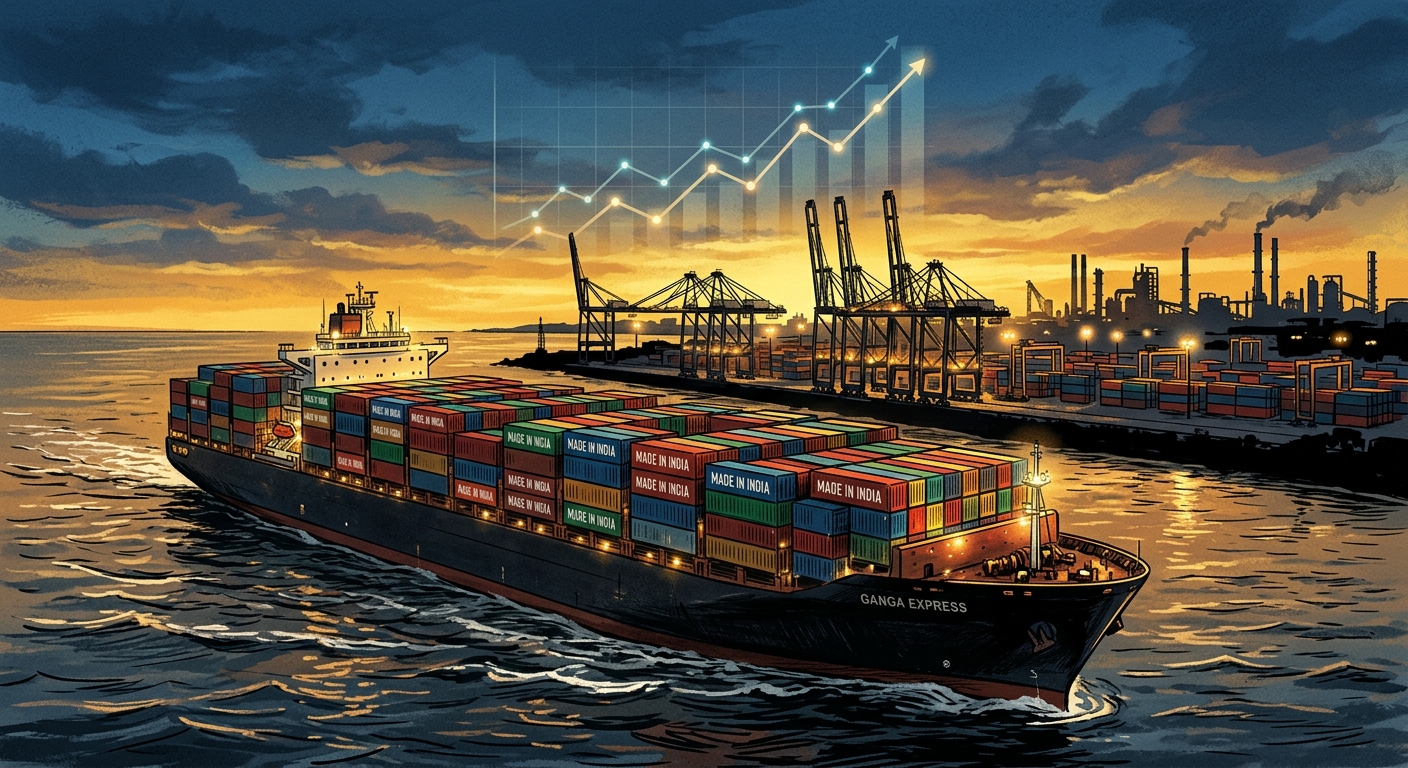
On July 3, 2026, commerce minister Piyush Goyal walked out of a Board of Trade meeting in New Delhi and told reporters that every exporter in the room had "taken an oath" to deliver $1 trillion in combined merchandise and services exports this fiscal year. The number is not new — it has floated through Viksit Bharat speeches for two years — but the timeline is. FY27 means twelve months, not twenty. India ended FY26 at $860.1 billion; closing the remaining $140 billion requires 16% headline growth, against a four-year compound rate of 6.9%. The target is achievable only if three things that happened between July 2025 and February 2026 — a British trade deal, a European one, and a Trump climb-down — compound in the same direction at the same time. That is the real story behind the oath.
The number Goyal actually needs
Strip the rhetoric and the arithmetic is stark. According to NITI Aayog's Trade Watch for Q4 FY26, India's total exports grew 4.2% in the year to March 2026, reaching $860.1 billion — with merchandise flat at $441.8 billion and services jumping 7.9% to $418.3 billion. To land at $1 trillion by March 2027, Goyal told reporters covered by
The Times of India, merchandise must rise to roughly $530 billion (about 20%) and services to $470 billion (about 12%).
For context, India's Ministry of Commerce has reported a four-year export CAGR of 6.9% between FY21 and FY25 — a period that included both post-pandemic reopening and record services growth. Doubling that pace in one year requires either a step-change in market access or a base-effect rebound from an unusually depressed prior year. Goyal is betting on both.
The FY26 base was, in fact, depressed. On August 27, 2025, US President Donald Trump's 50% tariff on Indian goods took effect — a 25% "reciprocal" rate plus a 25% penalty for continued purchases of Russian oil. BBC News reported that Indian goods shipments to the United States fell 37.5% from $8.8 billion in May 2025 to $5.5 billion in September, and were down roughly 40% across the four months following August. India's own commerce ministry, cited by
NPR, estimated the tariffs endangered $48.2 billion in annual exports — most of it labour-intensive textiles, gems, leather and shrimp. That is the hole FY27 has to climb out of before growth even starts.
Three deals that reset the base
What tilts the odds is what New Delhi banked while Washington was squeezing. Between July 2025 and February 2026, India closed the largest bilateral trade agreements it has ever signed — and none of them are with the United States.
The UK–India Comprehensive Economic and Trade Agreement was signed on 24 July 2025 and, per Goyal's July 3 briefing, becomes operational on July 15, 2026. The UK Department for Business and Trade's
impact assessment estimates the deal will lift India's long-run GDP by 0.06% — worth about £5.1 billion a year — and eliminate tariffs on 92% of India's goods imports from Britain over 10 years, with 64% liberalised at entry into force. For Indian exporters, 99% of goods will enter Britain duty-free, hitting a £27 billion import market.
Six months later, in New Delhi on 27 January 2026, Ursula von der Leyen and Narendra Modi announced the India–EU Free Trade Agreement. The European Commission's official release called it "the most ambitious trade opening that India has ever offered to a trade partner," covering 96.6% of EU goods exports to India, saving European exporters €4 billion a year in duties, and expected to double EU exports to India by 2032. The corollary — the reason Modi called it "historic" — is that Indian textiles, pharmaceuticals and engineering goods gain preferential entry into a €180-billion annual bilateral trade flow. Signing and ratification will run into 2027, but the political effect is immediate.
Then, on February 2, 2026, Trump blinked. Under a deal announced on Truth Social and confirmed by an India Ministry of Commerce press note, the US cut tariffs on Indian goods from 50% to 18%. On $30.94 billion of Indian exports, duties fell from 50% to 18%; on another $10.03 billion, they went to zero. Silk gained duty-free entry into a $113-billion US textiles market; leather, gems and jewellery, and machinery — the sectors gutted the previous autumn — all secured 18% preferential rates.
Al Jazeera noted Modi's parallel commitment to wind down Russian oil purchases and buy up to $500 billion in US energy, technology and farm goods over an unspecified horizon.
Why the target is more plausible than it looks — and still probably wrong
The consensus among trade economists is that the $1 trillion figure is aspirational rhetoric. That consensus is quietly incomplete.
Consider the composition. Services already grew 7.9% in FY26 to $418.3 billion, and the Economic Survey 2024-25 noted that India's services export growth averaged 14% during FY23–FY25, more than double its pre-pandemic pace. A 12% services growth path to $470 billion is below the recent trend and consistent with continued IT, telecom and Global Capability Centre expansion. That half of the target is not the constraint.
The constraint is merchandise. Getting from $442 billion to $530 billion in twelve months requires roughly $88 billion of net new goods exports — larger than India's entire annual pharmaceutical export book. Goyal claims Q1 FY27 (April–June 2026) merchandise growth of 15% and services growth of 11%, which if annualised would land close. The problem is what a 15% merchandise print actually reflects: rebound from a base crushed by 50% US tariffs and a rush of front-loaded shipments after the February deal. Base effects flatter for a quarter; sustaining them for a year is a different problem.
The Observer Research Foundation's Arya Roy Bardhan put it plainly ahead of the Union Budget: India's April-November 2025 merchandise trade deficit ran to $223 billion, and "competitiveness is a system-level problem spanning productivity, logistics, standards, credit, and incentives." The Vivekananda International Foundation's own
assessment notes India's share of global merchandise exports is just 2.2% — well below China's roughly 14%. Moving that needle requires more than tariff arithmetic.
Who benefits, who is exposed
The winners from Goyal's arithmetic are concentrated. Textiles, leather and gems and jewellery — the sectors that absorbed the 2025 tariff shock — now have both a US 18% rate and duty-free UK access from July 15. The Confederation of Indian Textile Industry, cited by BBC News, said the deal would let its members "compete effectively in the US market." Engineering goods, up 12.9% year-on-year in February 2026 per the commerce ministry's
monthly release, pick up EU access. Pharmaceuticals, which India's fourth-quarter Trade Watch pegs at $25.8 billion in 2025, add to a $22.4 billion trade surplus that neither Trump nor Beijing has been able to displace.
The losers are less obvious. India's trade deficit with China crossed $116 billion in FY26 — the first time above $100 billion — reflecting continued dependence on Chinese semiconductor components and electronics intermediates even as final exports of smartphones and electricals boom under the PLI scheme. Every dollar of assembled iPhone shipped to a US or EU market carries embedded Chinese content that is not disappearing on Goyal's timeline. That is the structural drag no FTA fixes.
What to watch next
Three catalysts will settle whether the trillion-dollar oath survives 2026:
- July 15, 2026: UK–India CETA enters into force. Watch first-quarter tariff-line utilisation data from Indian customs to see whether exporters actually claim the preferences.
- August–October 2026: Ratification of the India–EU FTA by the European Parliament and Council. A delay past 2027 defers the arithmetic materially.
- Late 2026: The next phase of the India–US bilateral agreement, still unresolved on agriculture and dairy access. Any US backslide — Trump has threatened one — reopens the tariff wound.
Diplomat View
The $1 trillion pledge will almost certainly fall short — expect a landing somewhere between $920 billion and $960 billion, driven by a services beat and a merchandise miss. That still represents 7–12% headline growth, roughly double India's historical run rate, and would validate the strategic bet Modi's government has actually made in the last twelve months: that Trump's tariff shock was a permission slip to close deals with everyone else. The number to watch is not the trillion; it is India's global merchandise share. If it moves from 2.2% toward 2.5% by 2027, the diversification thesis works. If it stalls, the ceiling is structural — logistics, quality infrastructure, Chinese intermediate dependence — and no oath fixes those. The forecast changes if the US backs out of the February deal, or if the EU ratification slips into 2028; both would shave $30–50 billion off the run rate.
The Bottom Line
India's $1 trillion FY27 export target is not primarily a manufacturing story or an IT story — it is a diplomacy story. New Delhi used Trump's 50% tariff as leverage to close, in seven months, the two largest trade deals in its history and force a US climb-down to 18%. Whether or not the trillion prints on schedule, the base has been permanently reset. That is the shift that matters.
Discover more

India
India-South Korea $50B Trade Expansion Plan
India and South Korea target $50 billion in bilateral trade by 2030, focusing on industrial cooperation and strategic alignment amid US pressures.
India
Modi's Women’s Convention in Varanasi
Modi's Varanasi rally frames women's reservation as a national mission, targeting the 2027 Uttar Pradesh elections with a strategic narrative.

Economics
Fed's Amex AML order puts correspondent banking on notice
Federal Reserve's Amex AML order requires board-level controls and a 90-day plan; OCC fined the bank $350 million over enterprise-wide deficiencies.

Conflict & Security
Guatemala: El Niño 2026–27 becomes regional security test
UNICEF: 25.8M children face El Niño risks in Latin America; Guatemala maps 188 municipalities for drought and food insecurity amid regional security test.