Indian Parliament Adjourns Sine Die
Historic loss for Modi's government on constitutional amendment
Model Diplomat8 min readIndia
India's Parliament Closes on Modi's First Constitutional Defeat
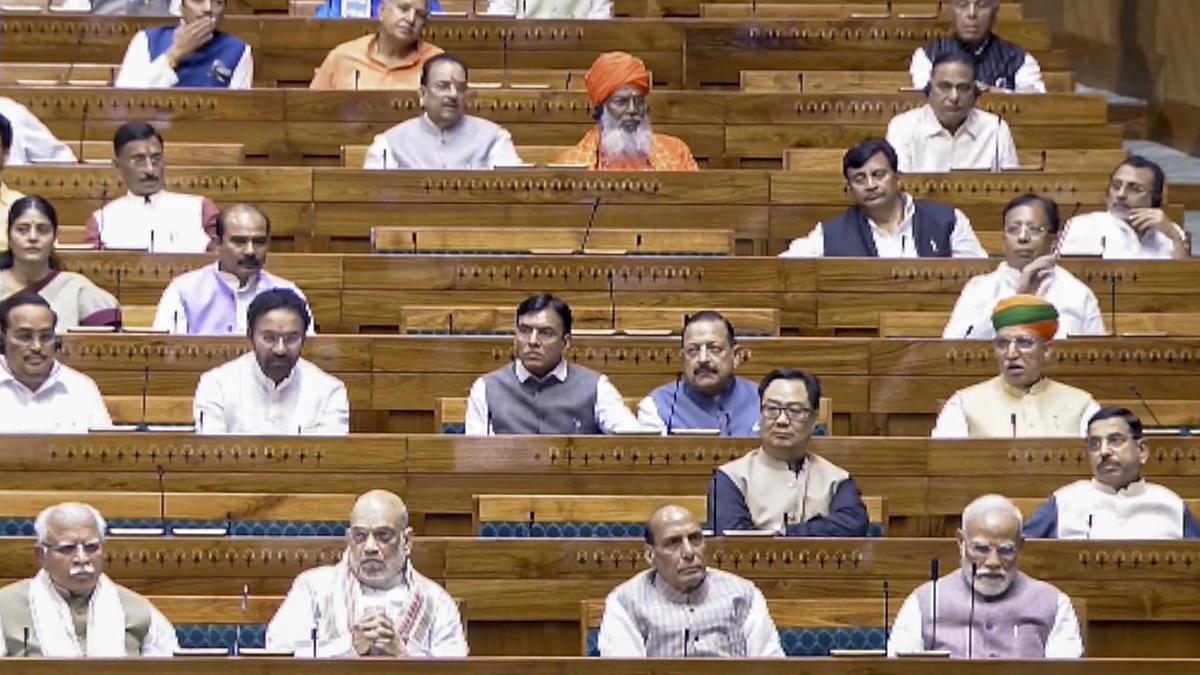
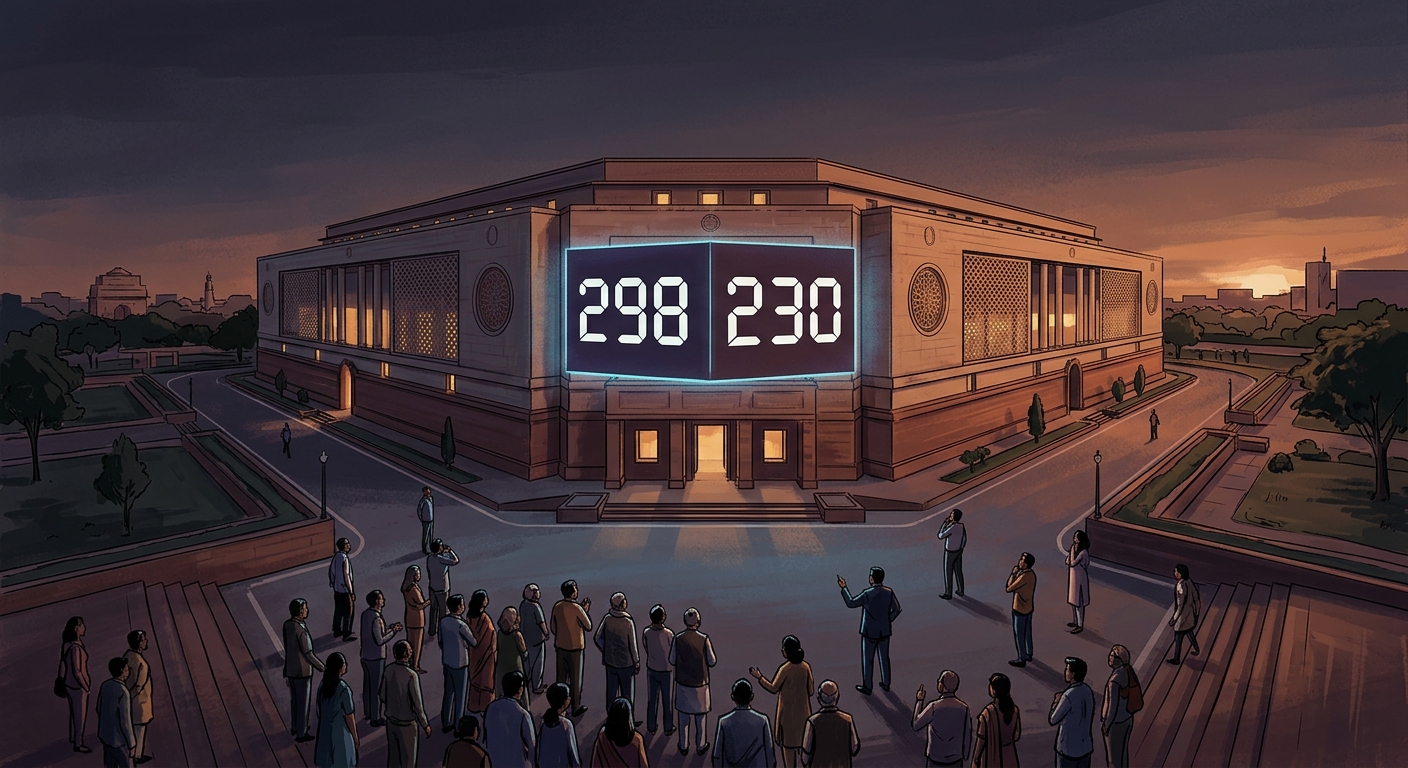
Parliament adjourned sine die on April 18, 2026 after the Constitution (131st Amendment) Bill fell 298–230 — the first floor defeat of a Modi-era constitutional amendment.
The Budget Session that closed in New Delhi on Saturday will be remembered less for the ₹50.65-trillion Union Budget it cleared than for a single division of votes 24 hours earlier: the Constitution (131st Amendment) Bill, 2026, went down 298–230 in the Lok Sabha, short of the two-thirds majority required and the first constitutional amendment the Narendra Modi government has ever lost on the floor. The government withdrew the companion Delimitation Bill within hours. Parliament then adjourned sine die on April 18 with the Treasury benches claiming a "conspiracy" against women and the opposition claiming custody of India's federal architecture. Both claims are exaggerated. What actually happened is that a minority government tried to bundle a popular gender reform to an unpopular electoral redraw, and a fractious opposition — for the first time since 2014 — held the line.
What the numbers actually say
Prime Minister Modi's National Democratic Alliance holds 293 seats in the 543-member Lok Sabha, according to Al Jazeera; a two-thirds majority of members present and voting would have required roughly 352 on a full turnout. The 298 "yes" votes therefore included every NDA member who showed up plus a handful of defectors from smaller regional parties — but not enough. The BBC's Hindi service reported the split as 298 in favour and 230 against after two days of debate wound up by Home Minister Amit Shah, per
BBC Hindi.
The Modi government had walked in knowing the math was thin. According to a Delhi-based analysis carried by BBC Hindi, senior journalists concluded the government proceeded despite lacking two-thirds because it wanted the vote itself — a floor moment it could weaponise in state campaigns in West Bengal and Tamil Nadu. That gamble mostly worked politically, as the May results would show. But procedurally, the loss is historic: no Modi-era constitutional amendment has failed a Lok Sabha vote since 2014, and the government has quietly become the first BJP-led administration to lose a bill of any consequence on the floor.
The bill the opposition was really voting against
The Constitution (131st Amendment) Bill, 2026 did two things at once. It would have expanded the Lok Sabha from 543 to 816 seats and reserved one-third for women, but only after a delimitation exercise based on the 2011 Census, per The Hindu. India already passed a women's reservation act — the Nari Shakti Vandan Adhiniyam — in 2023, with 454 of 456 MPs present voting yes, as the
BBC reported at the time. The Union Law Ministry notified that 2023 law into force on April 16, 2026 — the day the new bill was tabled. So the vote was never about whether women get 33% of seats. It was about which seats, based on which census, drawn how.
That reframing is the opposition's real win. Rahul Gandhi told the House the proposal was "not a women's reservation bill" but "an attempt to seize power through delimitation and gerrymandering," according to Al Jazeera. Tamil Nadu Chief Minister M.K. Stalin publicly burned a copy of the bill and hoisted a black flag; parliamentarians from southern states arrived in the chamber wearing black. The four southern states — Tamil Nadu, Kerala, Karnataka and Telangana — had for months sought a 25-year extension of the freeze on seat redistribution, and their objection landed. Arghya Sengupta of the Vidhi Centre for Legal Policy told the
BBC that the bill raised the cap from 550 to 850 on a "basis [that] is unclear and does not appear to be proportionate to population growth recorded in the 1971 and 2011 census." A CPI(M) MP, John Brittas, told the same BBC report the opposition wanted a straight 33% quota within the existing 543 seats.
The federal geometry explains why. As NPR's Devina Gupta noted before the vote, the last time India redistricted was after the 1973 delimitation, and southern states — which curbed fertility earlier and grew richer — would lose relative voice under a straight population formula, per NPR. Yamini Aiyar, the former CPR president, told NPR the BJP has "deeper roots" in the north and east and would gain most from expansion. The bill's failure preserves, for now, a 55-year-old political bargain that has kept the south over-represented relative to its share of India's 1.4 billion people.
What Parliament actually did — beyond the headline defeat
Strip out the constitutional drama and the session was, by the Speaker's own numbers, unusually productive. Both Houses passed nine bills each — Lok Sabha and Rajya Sabha closed the session with matching legislative output, according to the Press Information Bureau. The Lok Sabha ran for 31 sittings over 151 hours and 42 minutes at 93% productivity; the Rajya Sabha logged 157 hours and 40 minutes at roughly 110%, per the same PIB release confirmed in
The Hindu.
The bills passed include the Finance Bill, 2026 (cleared by the Lok Sabha on March 25); the Industrial Relations Code (Amendment) Bill; the Transgender Persons (Protection of Rights) Amendment Bill; the Insolvency and Bankruptcy Code (Amendment) Bill; the Andhra Pradesh Reorganisation (Amendment) Bill; the Foreign Contribution (Regulation) Amendment Bill; the Jan Vishwas (Amendment of Provisions) Bill; and appropriation legislation. The Budget itself, presented February 1, targets a fiscal deficit of 4.3% of GDP and shifts India from an annual deficit target to a debt-to-GDP anchor of 50% (+/-1%) by 2030–31, according to the BBC. Capital expenditure rises about 9% to ₹12.2 trillion; defence outlays are up more than 20%.
Two other set-pieces mattered. Prime Minister Modi delivered a formal statement on the West Asia crisis and India's energy security "in the wake of the war between the U.S.-Israel and Iran," as reported by The Hindu. And the Rajya Sabha re-elected Harivansh Narayan Singh as Deputy Chairman — a minor procedural continuity in a session otherwise dominated by rupture.
The historical parallel that reframes the moment
The convenient reference point is 2019, when the Modi government quietly let the Citizenship Amendment Bill lapse in the Rajya Sabha rather than face defeat, as the BBC reported at the time — a strategic retreat that preserved the Prime Minister's aura of legislative dominance. This time the retreat came after a public defeat. That is the real break from precedent.
The deeper parallel is 2021, when the government repealed its three farm laws under farmer protest. Then, as now, an analysis in the BBC argued that the reversal exposed "the BJP's lack of legislative acumen" and its "failure to engage with the opposition in parliament and rushing legislation." April 2026 fits that pattern with a twist: the government no longer commands a single-party Lok Sabha majority. It won 240 seats in the 2024 general election — a sharp drop from prior terms — and now relies on the Telugu Desam Party, the Janata Dal (United) and other allies, per
Al Jazeera. The 131st Amendment's failure is the first legislative bill that this arithmetic has taken down.
Who won, who lost — the political ledger
The immediate winner is not the Congress; it is the DMK and other southern parties whose federal case against population-based delimitation now has a Lok Sabha vote behind it. M.K. Stalin's very public bill-burning provided the campaign visual; the failed vote provided the substance. Yet the electoral verdict two weeks later complicates that narrative: the DMK was swept out of Tamil Nadu on May 4 by actor Vijay's TVK, as reported by the BBC, while the BJP breached West Bengal for the first time in half a century. Stalin's federalist argument won in Parliament and lost in his own state.
The immediate loser is Congress's parliamentary strategy against Modi. Congress President Mallikarjun Kharge framed the defeat as a defence of the constitution's basic structure, and Priyanka Gandhi accused the Centre of a "conspiracy to alter federal structure and stay in power," per The Hindu. But two of the INDIA alliance's central pillars — Mamata Banerjee's Trinamool Congress and Stalin's DMK — were dismantled at the ballot within a fortnight of the vote, per the
BBC's post-election analysis. The parliamentary win has not translated into a state-level firewall.
The medium-term winner is the BJP's political communication apparatus. Modi told the House that opposition parties would "have to pay a long price" for opposing the bill; Parliamentary Affairs Minister Kiren Rijiju accused Congress of an "anti-women mindset" and predicted the "wrath of women" at the polls, according to BBC Hindi. Senior journalist Sharad Gupta, quoted by the same BBC report, argued the government knew it lacked the numbers but proceeded because it wanted a campaign artefact for West Bengal, where women's votes are decisive. West Bengal fell to the BJP three weeks later.
The structural loser is the 2029 general-election timeline for women's reservation. The 2023 act mandates implementation only after delimitation. With the 131st Amendment defeated, the government's option is to wait for the 2025 census currently under way — a "formidable logistical challenge that will take a year to carry out and even longer for the data to be processed," per Al Jazeera — or return with a straight 33% quota within 543 seats, which would grant no political dividend to the north. Neither path delivers women's reservation by 2029. The reform first proposed in 1996 will remain stranded.
What to watch
The Monsoon Session, expected to open in mid-July 2026, is the next test. The government will need to decide whether to reintroduce a stripped-down women's reservation bill within the current 543-seat house — surrendering the delimitation logic and losing the northern seat dividend — or wait for the 2025 Census and push the whole reform beyond 2029. Watch also for a challenge before the Supreme Court on whether the 2023 act's implementation can be judicially compelled without waiting for delimitation.
Watch, too, for how the BJP's post-Bengal confidence translates into a legislative style. A party that has just broken through in India's most stubborn political frontier will not treat 240 Lok Sabha seats as a ceiling for long. The 2026 Budget Session may prove the last one in which the arithmetic favoured the opposition.
Diplomat View
The Modi government lost a bill and won a state — a trade it would make again. The 131st Amendment's defeat matters less as a constitutional event than as the first proof that the 2024 general election's diminished BJP majority actually constrains legislation. That constraint will bind again the moment the government tries to move any measure requiring a two-thirds vote: judicial appointments reform, a fresh delimitation formula, or anything touching Article 370's residual provisions in Jammu and Kashmir. Our forecast: the government does not re-table a bundled women's-reservation-plus-delimitation bill before the 2029 general election, and instead returns in the Monsoon Session with a stripped 33% quota within the existing 543 seats — a symbolic win that costs it the northern seat dividend. That forecast reverses if the ongoing 2025 Census is completed and published on an accelerated timeline before mid-2027, which would revive the delimitation math on the government's preferred terms.
The Bottom Line
Parliament adjourned sine die on April 18, 2026, but the real story is what closed the day before: the Modi government's first floor defeat on a constitutional amendment, and with it the assumption that a diminished BJP majority could still command two-thirds when it needed to. India's next legislative decade will be written under that new arithmetic.
Discover more
India
US Lifts Sanctions on Four Indian Firms
The US Treasury has delisted four Indian firms from sanctions, signaling a trade deal dividend and strategic alignment with India amid global energy crises.

India
Takaichi Lands in Delhi as China Squeezes
Japanese PM Sanae Takaichi arrives in Delhi for a summit amid China's export controls on Japanese entities, signaling a strategic partnership.

India
Singapore's 100x100 Bets $100M on India
100x100 launches a $100 million fund targeting India's climate sector, betting on its emissions profile and founder pool despite global funding retreat.

Conflict & Security
Drone Warfare Killing Aid Workers at Unprec
Over 1,000 humanitarian workers killed in three years as cheap armed drones collapse legal protections. Gaza, Sudan, Ukraine, and DRC see deliberate targeting of aid convoys and hospitals with zero prosecutions.