India-Maldives Investment Treaty Secures Ties
Bilateral treaty strengthens India's influence in Maldives amid China FTA.
Model Diplomat8 min readIndian Ocean
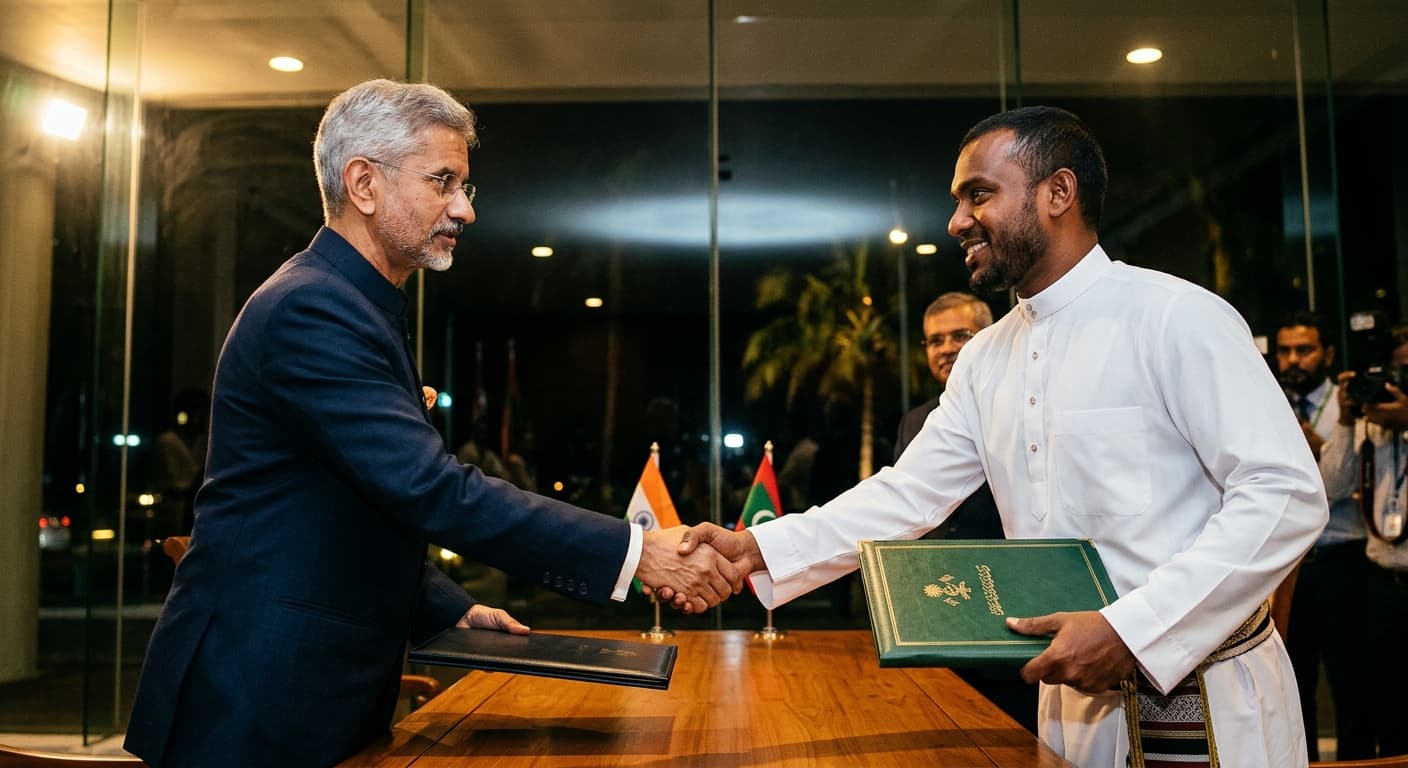
India Locks In Maldives With Investment Treaty, Countering China FTA
India and the Maldives concluded bilateral investment treaty talks July 8, 2026, locking in New Delhi's economic leverage as a China FTA and looming default reshape the Indian Ocean.
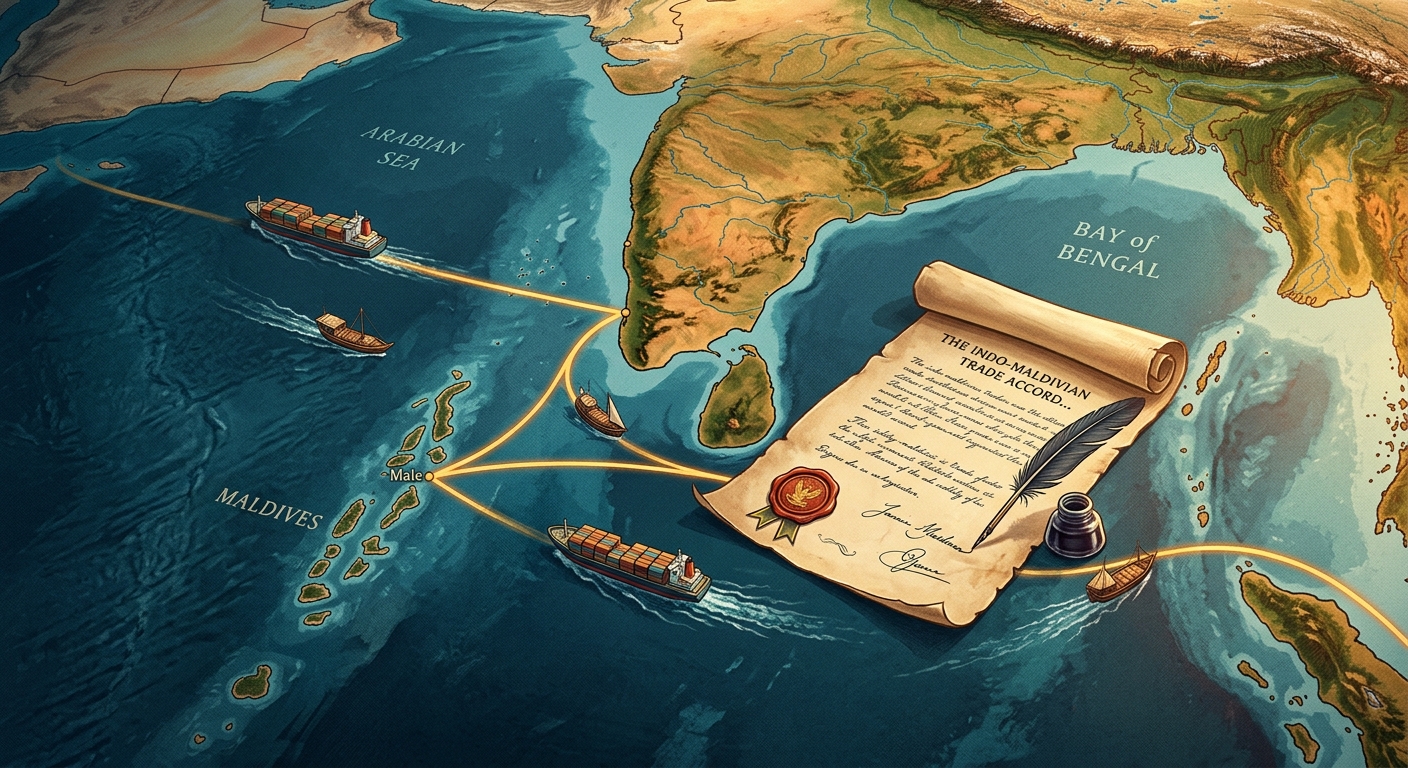
India and the Maldives concluded negotiations on a bilateral investment treaty on July 8, 2026, and are fast-tracking a parallel free trade agreement — a two-track deal that hardens New Delhi's economic hold over Malé exactly 18 months after the China–Maldives FTA came into force, and just as the archipelago slides toward another foreign-exchange crunch. The treaty is small in dollar terms — Maldivian FDI into India totals just $12.65 million since 2000, according to OrissaPOST/PTI — but its function is not to move capital. It is to legally cement India as the indispensable creditor, developer and rulemaker in an economy Beijing spent a decade trying to pry loose.
What was actually agreed
The announcement came after talks in New Delhi between Maldivian Minister of Economic Development, Transport and Trade Mohamed Saeed and Indian Commerce and Industry Minister Piyush Goyal. "BIT is concluded. We are just seeing the legal scrubbing process," Saeed told reporters, per PTI. A separate FTA negotiating round concluded July 7. The two sides now meet "almost every day" on the trade text.
The numbers underline how asymmetric this relationship is. Bilateral trade rose 13.5% to $771.76 million in 2025–26, with Indian exports of $458.71 million against $313 million in imports, according to Indian commerce ministry data reported by PTI. India ships pharmaceuticals, radar equipment, rice, cement and rock aggregates; it takes back scrap metal. A 1981 essential-commodities agreement still governs the quota supply of rice, sugar, wheat flour and construction materials that the Maldives cannot produce, as archived by India's commerce ministry.
Layered on top: a $565-million rupee-denominated line of credit and an amendatory agreement that cut the Maldives' annual debt service to India by 40% — from $51 million to $29 million — signed during Prime Minister Narendra Modi's July 25–26, 2025 state visit, per the Prime Minister of India outcome list. UPI and RuPay rails are live in the archipelago. Trade in rupees is being institutionalised. The BIT is the missing legal skin around this stack.
The angle: this is a counterpunch to Beijing's January 1, 2025 FTA
The story worth telling is not the BIT itself. It is the sequencing.
The China–Maldives FTA, signed in December 2017 and shelved by the pro-India Solih government, finally entered into force on January 1, 2025 under President Mohamed Muizzu. The Observer Research Foundation flagged the moment in a January 2025 commentary: the pact eliminates tariffs on 96% of goods traded between the two, and — critically — treats any China-origin good routed via third countries as tariff-free entry into the Maldives.
Chinese exports to the Maldives grew from under $60 million to $562 million between 2010 and 2022, per ORF, outpacing India's rise from $126 million to $485 million over the same period. The FTA was designed to lock in that trajectory. It also lets Beijing invoice in yuan; the People's Bank of China and the Maldives Monetary Authority signed a local-currency MoU in September 2024, and Maldivian banks now accept yuan letters of credit, as documented by ORF's December 2024 brief.
India's response is asymmetric by design. Rather than match tariff-for-tariff, New Delhi is bundling the FTA with a BIT, currency-swap architecture, UPI/RuPay integration and rupee-denominated credit — the full plumbing of a monetary sub-zone. The MP-IDSA think tank, run by India's defence ministry, framed the July 2025 Modi visit as "pragmatic recalibration" underpinning the "Neighbourhood First" and MAHASAGAR doctrines, in an August 2025 comment. Concluding the BIT one year later is the load-bearing beam.
The Maldives cannot afford to say no
The real leverage is fiscal. The World Bank's June 2026 Maldives Development Update projects growth to collapse to 0.7% in 2026 from 6.3% in 2025 as Middle East airspace closures and flight cancellations gut tourist arrivals — down 20.7% in March and 24.4% in April year-on-year. The current-account deficit is projected to widen to 20.6% of GDP. Public debt is heading past 140% of GDP over the medium term. External debt service exceeded $600 million in 2025 and tops $1 billion in 2026, per Moody's data cited by the
BBC.
Muizzu's original bet — that Beijing would refinance, restructure and invest its way out of the hole — has failed. China's outstanding loans to the Maldives fell from $613 million in 2021 to $473 million in 2025, per ORF's July 2025 analysis, and Beijing's ambassador has publicly declined new sovereign lending, citing debt sustainability. India's EXIM Bank exposure has moved the other way: from $15 million in 2021 to $572 million now, with over $800 million of committed loans still undisbursed.
That undisbursed pipeline is the choke point. It sits on the Indian side of the ledger. The BIT — which under India's post-2016 model treaty requires foreign investors to exhaust local remedies before international arbitration, per Brookings — makes disbursement legally coherent with investor protection. It gives Indian public-sector lenders and private developers a treaty backstop as they finance the Greater Malé Connectivity Project, the Thilafushi port, 4,000 more social housing units and the Hanimadhoo airport expansion.
The BIT model problem — and why Malé is signing anyway
India's Model BIT, cabinet-approved in December 2015, is the most state-friendly template in circulation. It uses an enterprise-based (not asset-based) definition of investment, excludes the most-favoured-nation clause, carves out taxation and government procurement, and requires investors to litigate in domestic courts for five years before triggering international arbitration, as detailed in Brookings' 2018 study. India served termination notices on 58 legacy BITs after 2016 to force renegotiation on this text.
The result: several European partners walked. The UK–India BIT remains unconcluded even after Chatham House confirmed the FTA was finalised in May 2025. Brussels split the investment protection agreement off from the
EU–India FTA package concluded in January 2026, per Institut Montaigne — a giveaway to India by design.
The Maldives is signing the same template that made Berlin and London blink. That is the tell. Malé's leverage is exhausted; New Delhi's is not. A BIT signed on Indian terms delivers exactly what the Maldives needs — a credible signal to a market whose sovereign is inches from default — while giving India regulatory space to defend the treaty against domestic Maldivian policy shifts should Muizzu tilt again. Under Article 15 of the Indian model text, general exceptions preserve the host state's right to regulate on public-morals, health, and prudential grounds; a future "China First" pivot cannot easily be neutralised through this treaty by an Indian investor.
The winners and losers
Winners. Indian EXIM Bank and NHPC-adjacent developers on the Thilafushi port; NPCI (via UPI rails and rupee settlement); the State Bank of India, which has rolled T-bills three times to keep Malé solvent; Adani-style logistics players eyeing transshipment hubs adjacent to the Minicoy naval base India is building 130 km north. Maldivian tourism operators facing Middle-East-driven arrival collapse get a partial rupee-tourist substitute — Indian visitors were the largest single source in 2023 before the "India Out" backlash cut them by 42%, per Al Jazeera.
Losers. Chinese contractors on Malé's public-works pipeline — the ORF documents Beijing shifting to grants and "small and beautiful" projects because it cannot compete with India's line-of-credit velocity. Maldivian domestic manufacturers who exist only in theory: an FTA will accelerate the flood of Indian pharma, cement and agri-produce, entrenching the trade deficit. And Colombo, Dhaka and Kathmandu, where India is now clearly demonstrating the template it will demand from any South Asian neighbour negotiating an FTA — investment protection first, market access second.
Diplomat View
The BIT is being read in New Delhi as an economic milestone. It is better understood as a containment instrument. Between January 1, 2025 (China–Maldives FTA in force) and July 8, 2026 (India–Maldives BIT concluded), New Delhi executed the fastest, deepest bilateral economic lock-in of any small Indian Ocean state since the 1981 essential-commodities agreement. The China FTA on paper looks broader; the Indian package, in practice, is stickier — because it comes with the rupees to pay for imports, the UPI to route the payments, and now a treaty that renders Indian capital in the archipelago legally sacrosanct.
Our call: the BIT will be signed before the end of Q4 2026, and the FTA will be initialled by mid-2027. That forecast revises if any one of three conditions changes — a snap political shift in Malé restoring "India Out" rhetoric ahead of the 2028 elections; a Chinese debt-restructuring package materially larger than the current $473 million exposure; or a Middle East tourism recovery that gives Muizzu enough fiscal room to slow-walk ratification. Absent those, this treaty is India's most durable diplomatic asset in the Indian Ocean until the Sri Lanka ETCA lands. Watch New Delhi replicate the sequence — BIT + rupee rails + LoC restructuring — with Dhaka next.
What to watch
- August–October 2026: Signing of the BIT text after legal scrubbing. Watch for whether the Maldivian Majlis holds a substantive ratification debate — Yameen's 2017 China FTA was rammed through in under an hour, and Muizzu's PNC still holds a supermajority.
- Q1 2027: Target window for concluding the FTA text. The tariff schedules — particularly on fish, which is 98% of Maldivian merchandise exports — are the sticking point.
- March 31, 2027: Renewal of India's essential-commodities quota under the 1981 agreement. A quiet lever; historically pulled to reward or punish Malé.
- End-2027: Maldives' next external debt-service peak of over $1 billion. If foreign reserves fall below $500 million again, expect India to bundle a second currency swap with FTA implementation.
- September 2028: Maldivian presidential election. The BIT is designed to survive it. Whether it does is the real test.
The Bottom Line
The India–Maldives BIT is not an investment story — it is a sovereignty story. India has bought the legal architecture of a monetary and regulatory sub-zone in the Indian Ocean's most contested archipelago for the price of a $565-million rupee credit line and a treaty template that Berlin refused to sign. If the deal signs on schedule, it will be the clearest evidence yet that in South Asia, Beijing's tariff diplomacy has been outflanked by New Delhi's plumbing diplomacy — currency swaps, payment rails, credit lines, and now treaty protection, layered one atop the other until leaving is no longer an option.
Discover more
India
Women’s Reservation in India
India's 33% women's reservation law is enacted but won't take effect until after 2029 due to political setbacks and census delays.

US Politics
US Launches $166B Tariff Refund Portal
The US is launching a $166 billion tariff refund portal to aid importers hit by Trump-era tariffs, with major implications for trade and supply costs.

International Relations
Economist Impact Sustainability Week 2026
Economist Impact Sustainability Week 2026 spotlights the energy transition, AI in clean technology, and supply chain resilience as themes for global leaders.

Economics
Fed's Amex AML order puts correspondent banking on notice
Federal Reserve's Amex AML order requires board-level controls and a 90-day plan; OCC fined the bank $350 million over enterprise-wide deficiencies.