India-EU Tech Council Blueprints Post-US,Post
India-EU TTC upgrades to supply-chain alliance with Horizon Europe talks
Model Diplomat8 min readEurope and South Asia
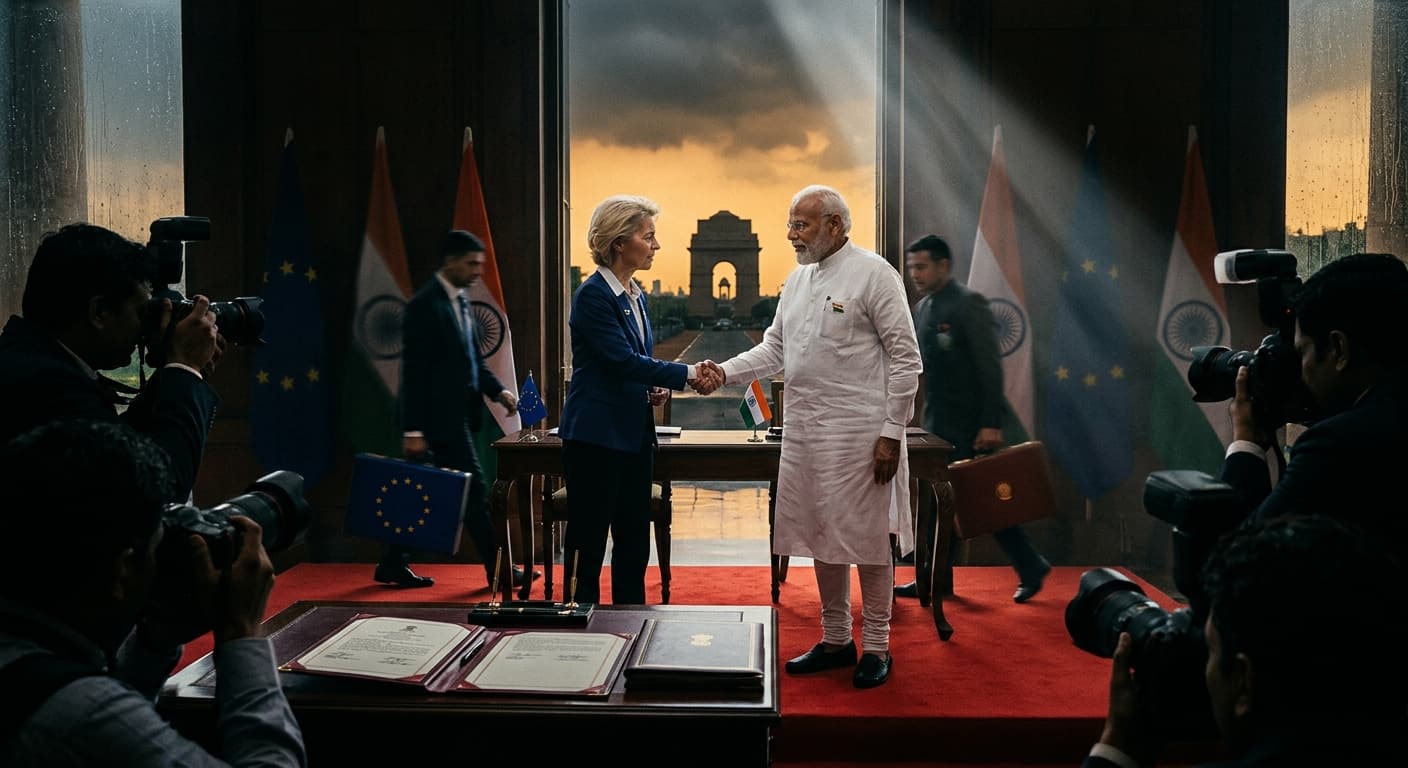
India-EU Tech Council Becomes the Blueprint for a Post-America, Post-China Supply Chain
The third India-EU Trade and Technology Council meeting in Brussels on July 15, 2026, moved Horizon Europe association to formal negotiations, pairing a concluded €180-billion free trade agreement with a technology-alliance architecture designed to outlast both Trump's tariffs and Beijing's rare-earth leverage.
The third ministerial meeting of the India-EU Trade and Technology Council (TTC), held in Brussels on July 15, 2026, did something its first two iterations could not: it turned a coordination forum into a supply-chain alliance. The meeting, co-chaired by External Affairs Minister S. Jaishankar, Commerce Minister Piyush Goyal, and Minister of State for Electronics Jitin Prasada on the Indian side, and Executive Vice-President Henna Virkkunen, Trade Commissioner Maroš Šefčovič, and Innovation Commissioner Ekaterina Zaharieva on the EU side, upgraded the council's mandate from dialogue to delivery — and the delivery vehicle is Horizon Europe. The formal launch of association negotiations with the EU's €93.5-billion research programme is the decisive move, because it plugs India into the deepest R&D ecosystem Brussels controls just as Washington retreats and Beijing's rare-earth leverage has an expiry date of November 2026. European Commission, DG Research & Innovation
This is not a trade story with a technology annex. It is a technology story riding on top of a trade deal — the "mother of all deals" free trade agreement concluded on January 27, 2026, which eliminates or reduces tariffs on 96.6% of EU goods exports to India and is projected to save European exporters roughly €4 billion per year in duties. European Commission Press Release IP/26/184 The FTA, the largest either side has ever signed, creates a free-trade zone of two billion people covering 25% of global GDP. But the FTA is the floor. The TTC is the ceiling — and the Brussels meeting is where the structural framework started going up.
The Horizon Europe play: 23 countries and counting
Association to Horizon Europe is the closest form of international cooperation the EU offers in research and innovation. Twenty-three non-EU countries are already associated, including the United Kingdom, Japan, South Korea, Canada, and Israel. European Commission, DG Research & Innovation Japan's association was concluded on December 21, 2025. India would be the largest non-Western economy to join — and the only one with both a population of 1.45 billion and a fast-growing technology base of roughly 2.23 million registered startups as of March 2026.
Observer Research Foundation
If negotiations conclude by end-2026 — the timeline both sides have set — Indian researchers and institutions would receive funding directly from Horizon Europe and lead projects from 2027, with India making a financial contribution to the programme. European Commission, DG Research & Innovation The first round of exploratory talks was held in New Delhi on February 6, 2026; the Brussels meeting moved the process from exploratory to formal. That upgrade is the single most consequential outcome of the third TTC, because it institutionalises India inside the EU's innovation architecture in a way that no tariff cut can.
The TTC timeline shows the acceleration:
Digital infrastructure: DigiLocker meets the EU Wallet
On the digital front, the two sides agreed to explore linking the EU Digital Identity Wallet with India's DigiLocker through pilot projects — a move that, if realised, would create the first interoperable digital public infrastructure (DPI) bridge between the EU and a major Global South economy. DD India Building on the Administrative Arrangement on Advanced Electronic Signatures and Seals signed earlier in 2026, the pilots would test mutual recognition of e-signatures across jurisdictions that together represent nearly two billion people.
A Joint Artificial Intelligence Roadmap was also agreed, with healthcare flagged as a potential focus area. The European AI Office and India AI Mission will cooperate on large language models and AI governance — an arrangement that gives Brussels regulatory-export ambitions a testbed in the world's most populous democracy, and gives New Delhi access to European frameworks it can adapt without ceding sovereignty. High-performance computing cooperation expands through the GANANA project (funded at roughly €5 million under EuroHPC), and discussions on quantum technologies are now formally initiated. European Commission, Digital Strategy
Semiconductors: design in India, prototyping in Europe
The semiconductor track produced the most concrete industry-facing outcome. India and the EU will explore cooperation between Semiconductor Design Facilities under the India Semiconductor Mission and EU Pilot Lines under the EU Chips Act, facilitating access to advanced process design kits and cost-effective silicon prototyping. DD India A joint roundtable is scheduled during Semicon India 2026.
This is the implementation layer of the EU-India Semiconductor Memorandum of Understanding signed in November 2023, and it maps directly onto the Joint Strategic Agenda "Towards 2030" adopted at the 16th India-EU Summit, which calls for "collaboration in research and development for chip design, heterogeneous integration, sustainable semiconductor technologies." EU-India Joint Strategic Agenda, Statement/26/224 The logic is complementary: India brings design talent and the cost structure for packaging and testing; the EU brings research infrastructure, the EU Chips Act's pilot lines, and regulatory depth. The winner is the European fabless design ecosystem, which gains a cost-effective prototyping path. The winner is also India's semiconductor mission, which gains access to advanced process nodes it cannot yet build domestically. The loser is China's packaging monopoly — the link in the chain where India has the most realistic chance of substitution.
The China clock and the CBAM friction
The strategic backdrop is not abstract. In November 2025, Beijing agreed to suspend the second wave of its rare-earth export controls — measures that earlier in the year had pushed EU prices as much as sixfold and left some German production lines within weeks of stoppage. That suspension runs only until November 10, 2026. ISPI The European Central Bank has estimated that more than 80% of large European firms sit no more than three intermediaries away from a Chinese rare-earth producer. Brussels has, in effect, been handed a pause, not a reprieve.
This is the strategic insight driving the TTC's upgrade. As ISPI analyst Soumya Bhowmick argues, treating India purely as an "alternative to China" misreads the problem — India is better understood as a load-bearing partner whose resilience is jointly determined with Europe's. Co-investment in production parks, joint qualification of non-Chinese sources, compatible standards, and shared stockpiling would lower risk for the entire downstream coalition at once. ISPI The Joint Strategic Agenda explicitly calls for cooperation on "resilient, secure and diversified critical minerals" including information sharing, early-warning, and emergency response.
EU-India Joint Strategic Agenda, Statement/26/224
But there is a friction point that could undermine the entire architecture: the EU's Carbon Border Adjustment Mechanism. CBAM entered its definitive regime in 2026, covering iron and steel, aluminium, cement, fertilizers, electricity, and hydrogen. India's Commerce Minister Piyush Goyal raised "strong objections" to CBAM, to EU safeguard measures on steel extended until June 2026, and to the EU Deforestation Regulation. European Parliament Research Service The share of CBAM-affected Indian exports to the EU increased to 10.5% as of the 2024–25 Economic Survey. Under the FTA, India is allowed to export 1.6 million tonnes of steel to the EU duty-free — roughly half what it currently exports annually — with the outcome of further quota talks due by June 30, 2026, before EU rules take effect July 1.
Al Jazeera If CBAM is not managed, it functions as a new border charge that could undercut the FTA's tariff gains for Indian industry, particularly MSMEs facing high compliance costs.
The American vacancy and the Indo-Pacific opening
The TTC's upgrade is also a response to the transatlantic rupture. The Trump administration imposed 50% tariffs on Indian goods — half of it retaliation for India's continued purchase of Russian crude — while simultaneously downgrading the US Indo-Pacific Strategy. Carnegie Endowment US Treasury Secretary Scott Bessent publicly lashed the EU for signing a trade deal with India while Washington was applying punitive tariffs.
Al Jazeera The Egmont Institute assesses that "mounting evidence suggests the present US administration has decided to abandon the American Indo-Pacific Strategy of the last decade" in favour of a strictly bilateral accommodation with China.
Egmont Institute
This creates a structural vacancy. The EU-India Security and Defence Partnership, signed on January 27, 2026, is modelled on EU agreements with Japan and South Korea. BBC The TTC is the economic-security complement — covering FDI screening best practices, research security, protection of sensitive technologies, and resilient supply chains for active pharmaceutical ingredients.
Council of the European Union, ST-5727-2026 The Indo-Pacific dimension is explicit: the Joint Strategic Agenda calls for enhancing cooperation through the Indo-Pacific Oceans Initiative, IORA, and the Indian Ocean Commission, and launching EU-India consultations on the Indo-Pacific.
EU-India Joint Strategic Agenda, Statement/26/224
Clean tech: €60 million and an innovation hub
Under the Green and Clean Technologies Working Group, the two sides reviewed progress on the €60-million joint research investment announced in 2025. Four collaborative projects have been selected across marine plastic litter, waste-to-renewable hydrogen, and EV battery recycling, with another scheduled for 2027. European Commission, DG Research & Innovation The first India-EU Innovation Hub, dedicated to EV charging technologies and testing, will be led by the European Commission's Joint Research Centre and the Automotive Research Association of India — bringing together research institutions, testing facilities, and startup ecosystems from both sides.
DD India
Diplomat View
The TTC's third meeting marks the point where India and the EU stopped coordinating policy and started building shared infrastructure — research, digital, semiconductor, and supply-chain infrastructure designed to function independently of both Washington's volatility and Beijing's coercion. The Horizon Europe association negotiation is the load-bearing pillar: if it concludes by end-2026, India joins the EU's deepest institutional layer and the partnership acquires a permanence that no tariff truce can deliver. The FTA, the Security and Defence Partnership, and the Joint Strategic Agenda "Towards 2030" are the scaffolding; Horizon Europe is the foundation.
The forecast turns on three variables. First, CBAM: if the EU does not create a workable compliance pathway for Indian industry, the FTA's tariff gains for steel and aluminium will be partially neutralised, and the political constituency for deeper tech cooperation weakens. Second, the FTA ratification timeline — the text requires legal revision, translation into 24 EU languages, European Parliament consent, Council decision, and Indian ratification, with entry into force expected in early 2027. European Parliament Legislative Train Third, China's November 10, 2026 rare-earth deadline: if Beijing reinstates export controls, the urgency — and the funding — behind India-EU critical-minerals cooperation scales up dramatically.
What to watch:
- End of 2026: Target for concluding Horizon Europe association negotiations. If met, Indian researchers participate from 2027.
- November 10, 2026: Expiry of China's suspension of rare-earth export controls — the deadline that should concentrate European minds.
- June 30, 2026: Deadline for India-EU steel tariff-quota talks before EU rules take effect July 1.
- Early 2027: Expected entry into force of the EU-India FTA, pending European Parliament consent and Indian ratification.
- Semicon India 2026: Joint India-EU semiconductor roundtable scheduled; first concrete design-facility cooperation outcomes expected.
Discover more
US Politics
House Ethics Committee Pushes Sexual Miscond.
The House Ethics Committee has shifted responsibility for sexual harassment settlement records to the Office of Congressional Workplace Rights, complicating disclosure efforts.
India
Congress Accuses Modi of Stalling Women's Law
Congress accuses Modi of stalling women's reservation law by linking it to delimitation, revealing a deeper electoral strategy.
US Politics
SNAP Food Assistance Faces Legal Challenges
In 2026, SNAP faces stricter eligibility rules and mounting legal challenges, threatening food assistance for the millions of Americans who rely on the program.

Economics
Fed's Amex AML order puts correspondent banking on notice
Federal Reserve's Amex AML order requires board-level controls and a 90-day plan; OCC fined the bank $350 million over enterprise-wide deficiencies.