India-EU FTA Clears Legal Scrub: The Deal
India and the EU finalise legal review of their landmark trade pact, targeting Q1 2027 entry into force.
Model Diplomat10 min readSouth Asia
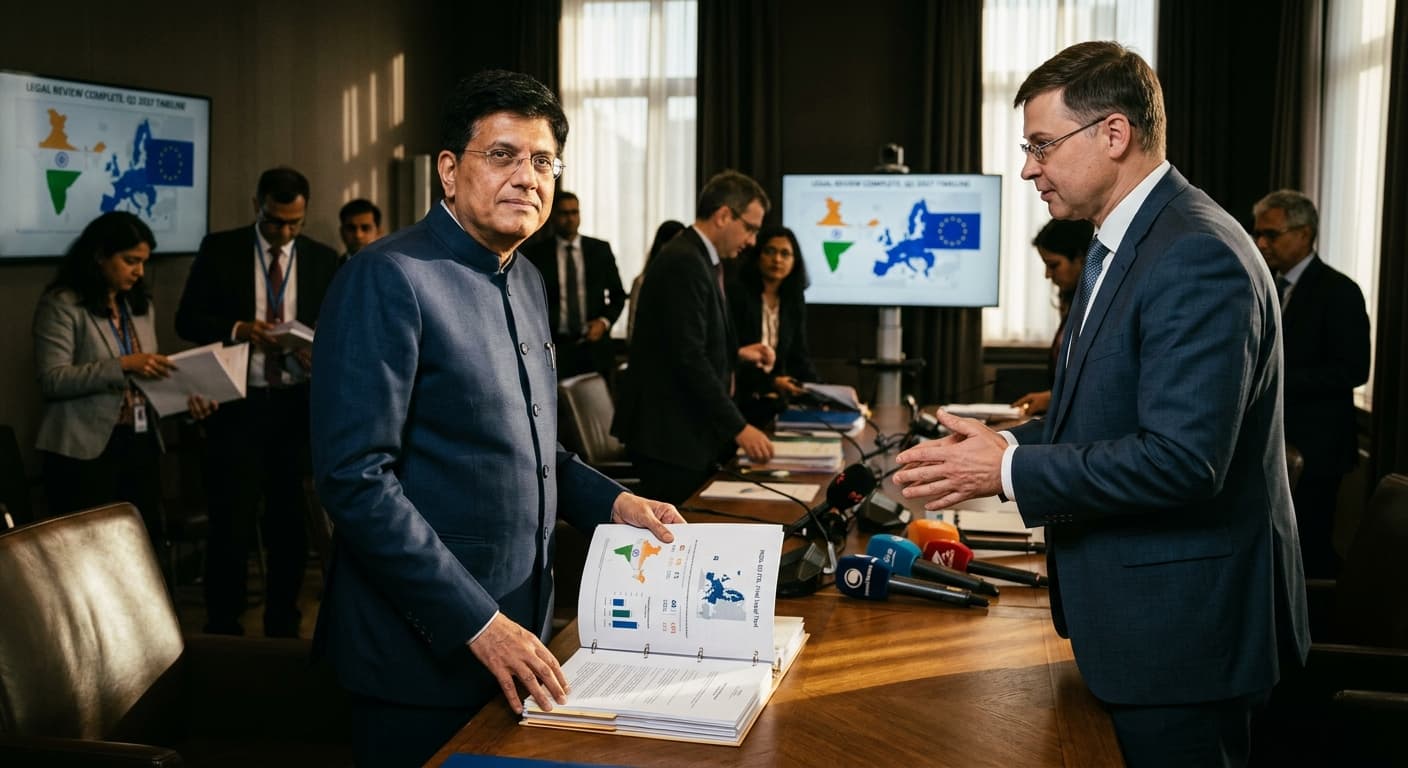
India-EU FTA Clears Legal Scrub: The Deal That Trump Built
India and the EU have completed legal review of their landmark trade pact, targeting Q1 2027 entry into force — but the tariff cuts were the easy part. The real fight is over carbon costs and steel quotas, where the agreement's architecture is thinnest.
India and the European Union have entered the final procedural stretch of their free trade agreement, with Commerce and Industry Minister Piyush Goyal telling the India-Spain Business Forum in Madrid on July 14, 2026, that legal scrubbing would conclude "in another week or two" and the pact would become operational in the first quarter of 2027, according to Organiser. The announcement, coming the day after the UK-India FTA entered force on July 15, marks the fastest corridor from political conclusion to implementation for any major EU trade deal in recent memory — and it is not a coincidence that this acceleration happened under the shadow of 50 percent US tariffs on Indian goods.
The decisive story is not the tariff schedule — it is that Donald Trump's trade war compressed two decades of intermittent negotiation into a geoeconomic alignment, and pushed both sides to defer the genuinely contentious issues to post-entry-into-force implementation. The FTA's 24 chapters cover goods, services, digital trade, intellectual property, and dispute settlement, but the agreement leaves its sharpest edges — carbon border costs, steel quotas, investment protection — for the implementation phase that begins in 2027.
The Architecture: What Was Agreed
Negotiations concluded on January 27, 2026, at the 16th India-EU Summit in New Delhi, where European Commission President Ursula von der Leyen declared "the mother of all deals" alongside Prime Minister Narendra Modi and European Council President António Costa, as recorded in the Council of the European Union joint statement. The pact creates a free trade zone of roughly two billion people representing about 25 percent of global GDP.
The tariff arithmetic is striking. India will eliminate or reduce duties on 96.6 percent of EU goods exports by value; the EU will liberalise 99.3 percent of Indian goods, according to the European Commission's Questions and Answers document. The Commission expects EU exports to India to double by 2032, saving European exporters approximately €4 billion per year in duties. The EU currently exports €49 billion in goods to India annually against €71 billion in imports, a deficit Brussels aims to close.
The headline market access concession is automobiles. India will cut car tariffs from as high as 110 percent to 10 percent under a quota of 250,000 vehicles per year — six times the 37,000-unit quota New Delhi granted London in its 2025 UK deal, as BBC News reported. Chemicals tariffs of up to 22 percent will be largely removed at entry into force; machinery tariffs will be halved immediately with the remainder phased over up to a decade; textiles and apparel see most duties eliminated immediately, per the
European Commission's chapter-by-chapter memo.
Crucially, the deal was structured under the EU's "exclusive competence" for trade policy under Article 218 of the Treaty on the Functioning of the European Union. This means ratification requires only the European Commission, the Council, and the European Parliament — not the national parliaments of all 27 member states. The Observer Research Foundation assesses this makes the India deal far less vulnerable than the EU-Mercosur agreement, which has been stalled for years pending national ratifications and a European Court of Justice referral. India's side is simpler still: cabinet approval, no parliamentary vote required.
On June 17, 2026, von der Leyen and Costa met Modi on the sidelines of the G7 in Évian and expressed the will to sign the FTA by end of 2026, according to the European Parliament's legislative train file. That timeline now appears achievable.
The Hidden Driver: Trump's Tariff Shock
The FTA's momentum is inseparable from the Trump administration's trade policy. Washington imposed 50 percent tariffs on Indian goods — half of them punitive measures for India's continued purchase of Russian crude oil — while US Treasury Secretary Scott Bessent publicly criticised the EU for signing a trade deal with New Delhi, telling ABC News: "We have put 25 percent tariffs on India for buying Russian oil. Guess what happened last week? The Europeans signed a trade deal with India," as Al Jazeera reported.
One EU diplomat told the BBC that Trump's tariffs proved a "useful tailwind in the homestretch" to get the deal over the line. The calculation on both sides was identical: diversify away from US market dependence before Washington's leverage increases. India has signed FTAs with the UK, Oman, and New Zealand in the past seven months; the EU has concluded deals with Mercosur, Indonesia, Mexico, and Switzerland. The India-EU pact is the centrepiece of this hedging strategy, creating a combined market of nearly $27 trillion.
The geopolitical alignment extends beyond trade. Modi and von der Leyen also launched a security and defence partnership modelled on EU agreements with Japan and South Korea. The joint statement committed both sides to "step up security and defence cooperation" — language that would have been unthinkable in the pre-Ukraine-war era when India's Russian defence dependency made Brussels wary.
The Fracture Lines: Steel, Carbon, and the CBAM Problem
The tariff cuts were politically manageable because both sides protected their sensitivities. India excluded dairy, poultry, and key agriculture; the EU excluded sugar, ethanol, rice, beef, and milk powders. But the deal's most consequential economic battleground — carbon costs and steel quotas — was only partially addressed.
The EU's Carbon Border Adjustment Mechanism entered its definitive phase on January 1, 2026, requiring importers of iron and steel, aluminium, cement, fertilisers, and hydrogen to purchase CBAM certificates reflecting embedded emissions. India is among the hardest-hit countries: its steel production has direct emissions intensity 2.6 to 2.7 times the EU average, according to a Nature Climate Change study published in 2026. Iron and steel account for approximately 90 percent of the total value of Indian exports subject to CBAM, and the
Observer Research Foundation estimates that CBAM tariffs on Indian iron and steel exports to the EU will amount to approximately €5 billion from 2026 to 2030.
The damage is already visible. India's steel and aluminium exports to the EU fell 24.4 percent from $7.71 billion in FY24 to $5.82 billion in FY25, with iron and steel exports dropping 35.1 percent, according to the Takshashila Institution. Indian exporters lacking verified emissions data face default values that add €55 to €80 per tonne at current EU carbon prices. Micro, small, and medium enterprises — which constitute roughly 30 percent of Indian GDP, 45 percent of manufacturing output, and 40 percent of exports — face the heaviest compliance burden.
The FTA includes a commitment that any CBAM flexibilities extended to third countries would also apply to India, plus deeper technical cooperation on recognising domestic carbon pricing mechanisms. Goyal stated the government has "taken up CBAM and the interests of our exporters like no one ever has, finding creative solutions through dialogue and trust," per ORF's analysis. The EU has also pledged a €500 million green transition assistance package, though the contours of disbursement remain unclear.
But the steel quota dispute is more immediate. Under the FTA as announced in January, India would be allowed to export 1.6 million tonnes of steel to the EU duty-free — roughly half its current annual volume, Al Jazeera reported. India sought improvements before EU steel rules took effect on July 1, 2026.
Those rules are now in force. Regulation (EU) 2026/1384, adopted on June 17, 2026, caps total duty-free steel imports at 18.3 million tonnes annually — a 47 percent reduction from 2024 allowances — and imposes a 50 percent out-of-quota duty, double the previous 25 percent, according to the EUR-Lex regulation text. The implementing regulation allocates India country-specific quotas across 26 product categories; for example, 597,274 tonnes in one category, 269,974 in another, per
Commission Implementing Regulation 2026/1457. Half the total quota is reserved for FTA partners, giving India preferential access — but the aggregate volume is significantly tighter than what New Delhi exports today.
The steel regulation explicitly distinguishes between FTA and non-FTA partners, and the Commission is empowered to amend quota volumes within a floor of 14.4 million tonnes and a ceiling of 22.2 million tonnes based on market conditions. This means India's steel access is not fixed by the FTA — it is subject to continuing Commission discretion under a regulation designed to protect European producers from global overcapacity.
Meanwhile, the European Parliament's Environment Committee voted on June 29, 2026, to extend CBAM to downstream steel and aluminium goods — fasteners, wire, springs, household articles — and removed the Commission's option to count Paris Agreement Article 6 carbon credits against CBAM obligations, according to the European Parliament press release. Parliament is scheduled to adopt its mandate in the September 2026 plenary. If enacted, the extension would compound Indian compliance costs precisely as the FTA's tariff benefits begin flowing.
Who Wins, Who Loses
The winners are European automakers, chemicals firms, and services companies. The car quota of 250,000 vehicles dwarfs what any other partner has secured from India. EU financial services and maritime services companies gain the most ambitious access India has ever granted in any trade agreement, per the Commission Q&A. European machinery and chemicals exporters see immediate tariff elimination on most lines.
The winners on the Indian side are textile, leather, marine product, gems and jewellery, and pharmaceutical exporters, who regain preferential EU market access lost when the EU withdrew Generalised Scheme of Preferences benefits in 2023. These labour-intensive sectors were hit hardest by Trump's 50 percent tariffs and now have a diversified outlet.
The losers are Indian steel and aluminium producers — particularly MSMEs that lack the capital to implement emissions monitoring, reporting, and verification systems compatible with CBAM. Large producers like Tata Steel and JSPL have begun green steel investments, but the Takshashila analysis notes the viability of these projects is uncertain. The Nature study found that during the CBAM transitional phase, high-emissions Indian firms experienced "pronounced declines" in export quantities and revenues while low-emissions firms maintained stable trading patterns — evidence that CBAM is already differentiating between cleaner and more carbon-intensive producers. The FTA accelerates this reallocation rather than cushioning it.
The biggest loser is US trade leverage. The India-EU deal, alongside the UK-India FTA that entered force on July 15, 2026, per GOV.UK, gives New Delhi alternative market access while Washington's bilateral negotiations with India remain unresolved. Brussels gains a strategic foothold in the Indo-Pacific at a moment when the US is alienating both partners.
What to Watch
- September 2026 European Parliament plenary: Adoption of the CBAM extension mandate for downstream goods. If passed, this widens the carbon cost burden on Indian exporters just as the FTA enters its implementation phase.
- Q4 2026 EU Council decision on FTA signature and conclusion: The Council must adopt the agreement before the European Parliament votes consent. The Évian summit signalled political will to sign by year-end.
- European Parliament consent vote: Expected late 2026 or early 2027. The
European Parliament's January 2024 recommendation flagged human rights and sustainability impact assessments as red lines; the FTA's Trade and Sustainable Development chapter and the human rights clause in the final provisions are designed to satisfy these, but MEPs have vetoed deals before — ACTA in 2012.
- Q1 2027 entry into force: Following EP consent and Council conclusion, India ratifies via cabinet approval. The five-year general review clause means the first formal renegotiation window opens in 2032.
- Investment Protection Agreement and Geographical Indications Agreement: Both remain under negotiation separately. The joint statement tasked teams to complete these "at the earliest opportunity," but neither has a firm deadline.
Diplomat View
The India-EU FTA will enter force in early 2027 because both sides calculated that deferring carbon and steel disputes to implementation was preferable to letting them block the geopolitical signal. That calculation is sound for the tariff phase but fragile for the carbon phase.
The FTA's architecture assumes CBAM flexibilities and technical cooperation will manage the carbon cost wedge. But the European Parliament's June 29 vote to extend CBAM downstream and remove Article 6 offsets — if it holds through the September plenary and Council negotiations — will raise Indian compliance costs precisely as tariff benefits begin. The steel quota regulation gives the Commission discretion to adjust volumes annually within a 14.4 to 22.2 million tonne band, meaning India's steel access is not locked in by the FTA but governed by a separate instrument designed to protect European producers.
The forecast: entry into force in Q1 2027 is highly likely; smooth implementation is not. The first serious test will come in the first half of 2027, when Indian steel exporters exhaust their reduced quotas and face the 50 percent out-of-quota duty alongside CBAM certificate costs. If New Delhi perceives that the FTA's CBAM flexibility commitments are not translating into operational relief, the Trade and Sustainable Development chapter and the joint dispute settlement mechanism — with binding panel reports enforceable through suspension of concessions — become the arena where this deal's durability is tested.
Revision condition: if the European Parliament's September plenary moderates the CBAM extension or the Commission exercises its delegated authority to raise steel quota volumes toward the 22.2 million tonne ceiling, the implementation risk eases. If neither happens, expect India to invoke the FTA's dispute provisions within 18 months of entry into force.
Discover more
India
Congress Accuses Modi of Stalling Women's Law
Congress accuses Modi of stalling women's reservation law by linking it to delimitation, revealing a deeper electoral strategy.

India
Delhi CM Rekha Gupta Blasts Opposition's Delm
Delhi CM Rekha Gupta's remarks on women's quota defeat reveal BJP's strategy for the 2029 Lok Sabha elections, focusing on delimitation.
India
BJP's Misunderstanding of Women's Quota Needs
The BJP's linking of the Women Reservation Bill to delimitation risks delaying women's empowerment in India, misreading the aspirations of female voters.

Economics
Fed's Amex AML order puts correspondent banking on notice
Federal Reserve's Amex AML order requires board-level controls and a 90-day plan; OCC fined the bank $350 million over enterprise-wide deficiencies.