India-China NSAs Meet as Border Thaw Deepens
Doval and Wang Yi signal normalization after military standoff
Model Diplomat3 min readAsia
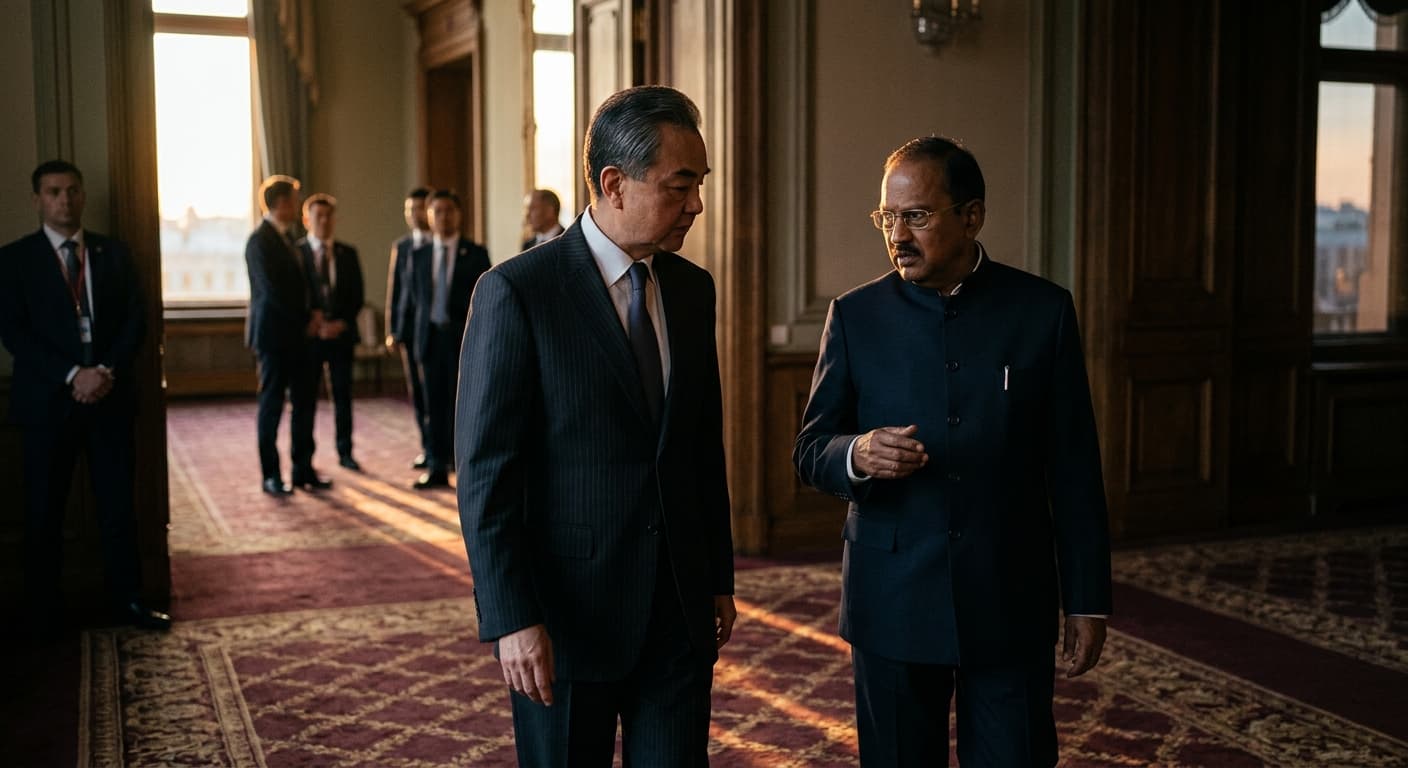
India-China NSAs Meet as Border Thaw Deepens
Doval and Wang Yi signal continued normalization after four-year military standoff, with September BRICS summit looming
India and China's top national security officials met on the margins of the BRICS security forum in New Delhi on Monday, with both sides describing their discussions as "constructive and forward-looking." National Security Advisor Ajit Doval and Chinese Foreign Minister Wang Yi—who functions as China's principal foreign policy strategist—reviewed progress in bilateral relations, explicitly noting momentum toward gradual border normalization nearly two years after the October 2024 understanding that halted a military standoff on the Line of Actual Control (LAC).
Doval emphasized that "stable, predictable and constructive bilateral relations contribute to building trust and better understanding between the two sides," according to the Ministry of External Affairs. The tone—cautious but deliberate—reflects both governments' intention to demonstrate to domestic audiences and BRICS partners that the world's two largest emerging economies are engineering a managed recovery from near-rupture.
The Real Leverage: Reciprocal Restraint
The timing and venue matter. Wang's visit is his first to India in nearly a year, and he is attending the 16th BRICS National Security Advisors meeting as part of preparations for the September summit in India. The symmetry is telling: both nations are using BRICS as a diplomatic envelope for bilateral conversation, with
Modi and Xi having already met at the SCO Summit in Tianjin last year to reset the relationship.
The substantive moves reveal what each side is willing to trade for stability. India has eased visa restrictions for Chinese nationals; China has lifted export restrictions on heavy machinery, rare earth magnets, and fertilizers. Both have reopened direct air services and revived the Kailash Mansarovar pilgrimage—symbolic gestures of people-to-people connectivity that lower the temperature. The LAC itself remains contested, but the pattern of alternating high-level visits (Doval to Beijing in December 2024, Wang to Delhi in August 2025, now this June 2026 meeting) shows both capitals have internalized that the alternative cost—an indefinite military posture—is economically and diplomatically unsustainable.
Why It Matters Now
The All Indian News Network report notes that the BRICS agenda extends beyond bilateral issues: terrorism, cybersecurity, and global governance reform will consume the June 22–23 agenda. This expansion of frame is deliberate. By anchoring India-China normalization within a broader BRICS security dialogue—with all eleven member states present—both countries signal to their partners (Russia, Brazil, South Africa, and the expanded membership of Iran, Saudi Arabia, UAE, and Egypt) that they are aligned on the need for reformed global institutions and coordinated stance on non-traditional security threats.
For India, the message is institutional: holding the BRICS chair in 2026 requires demonstrating that the bloc can keep its two largest Asian economies cooperative, not fractious. For China, the message is strategic: a functioning India-China relationship is foundational to any credible Chinese claim to multipolar governance.
What to Watch
The September BRICS summit will be the first real test of whether this thaw holds. By then, both sides will have executed multiple rounds of the Special Representatives mechanism on the border, the direct flights will have been fully operational, and India will have hosted the full bloc. If tensions resurface—a new incursion claim, a visa row, a statement from either foreign ministry about border violations—the diplomatic infrastructure being built now will show its brittleness.
The next inflection point is whether the two sides can move from confidence-building measures to substantive cooperation: joint infrastructure projects, defense industrial partnerships, or coordinated positions on international governance. Until then, the language will remain careful, the progress announced will be moderate, and the underlying territorial dispute will remain unresolved. That is the math of stable coexistence, not reconciliation.
Discover more

India
India-South Korea $50B Trade Expansion Plan
India and South Korea target $50 billion in bilateral trade by 2030, focusing on industrial cooperation and strategic alignment amid US pressures.
India
UN Expert Albanese: India Violates Law
UN Rapporteur Francesca Albanese accuses India of breaching international law, spotlighting human rights concerns in Kashmir and prompting diplomatic pushback.
India
CPI(M) Calls to Decouple Quota from Delimita
CPI(M) advocates for a 33% women's quota in Lok Sabha by 2029, removing the need for delimitation and census linkage.

Conflict & Security
Drone Warfare Killing Aid Workers at Unprec
Over 1,000 humanitarian workers killed in three years as cheap armed drones collapse legal protections. Gaza, Sudan, Ukraine, and DRC see deliberate targeting of aid convoys and hospitals with zero prosecutions.