India-Australia uranium deal unlocks nuclear
Australia-India uranium deal completes strategic arch for nuclear expansion
Model Diplomat9 min readAsia-Pacific
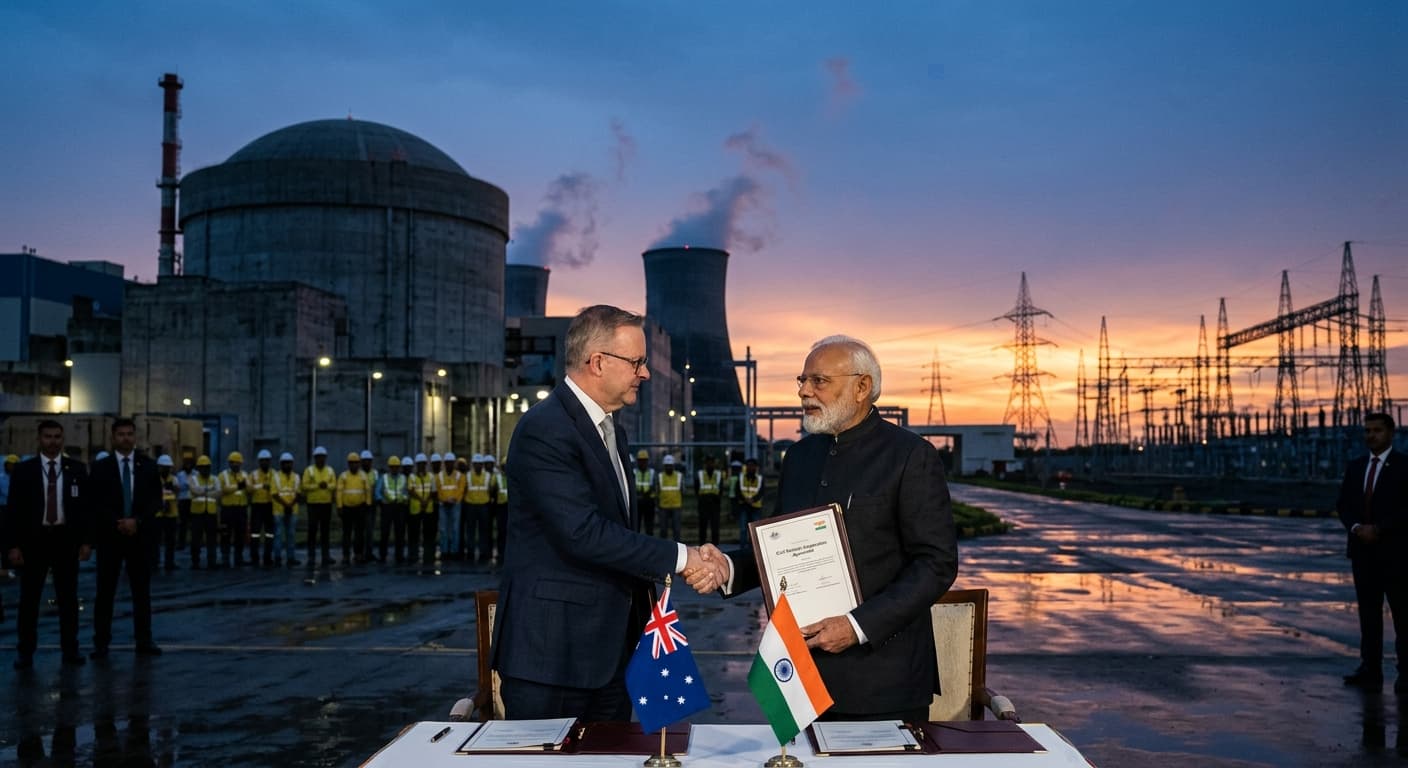
From Pokhran to Perth: The 12-Year Arch Behind India's Nuclear Unlock
On July 9, 2026, Australia and India finalised the Administrative Arrangement under their 2015 Nuclear Cooperation Agreement, enabling long-term uranium exports to India under IAEA safeguards. It is the operational keystone in a three-part arch of fuel security, private-sector reform, and Indo-Pacific alignment that finally lets India's 100 GW nuclear ambition proceed.
In Melbourne on July 9, 2026, Prime Ministers Anthony Albanese and Narendra Modi signed the Administrative Arrangement under the Australia-India Nuclear Cooperation Agreement — the technical instrument that, eleven years after the bilateral civil-nuclear pact was first inked, actually permits Australian uranium to flow to Indian reactors. The deal matters less for its tonnage than for what it completes: it is the third leg of a strategic arch — assured fuel supply, the December 2025 SHANTI Act that opened India's nuclear sector to private capital, and the Indo-Pacific strategic alignment that gives Canberra a stake in New Delhi's build-out. The biggest winners are not Australian miners but the Western reactor vendors who now have both a reformed legal framework and diversified fuel security to sell into a market India values at $214 billion.
A symbol of estrangement, converted
Australia holds roughly 28 percent of the world's identified uranium resources and has long been the supplier every nuclear-aspirant state has coveted — and, in India's case, was denied for decades (Al Jazeera). Canberra refused to sell uranium to New Delhi because India is not a signatory to the Nuclear Non-Proliferation Treaty. The rupture dates to May 1998. India's Pokhran-II nuclear tests prompted Australia to suspend defence cooperation, freeze military exchanges, and recall Indian officers from Australian defence colleges. As analyst Amitabh Mattoo noted, the journey "from sanctions to strategic partnership is arguably one of the most remarkable bilateral transformations in contemporary history" (
Al Jazeera).
The first repair came in 2014, when Prime Minister Tony Abbott signed a civil nuclear cooperation agreement with Modi — making India the first customer to buy Australian uranium without NPT membership (Al Jazeera). But the agreement remained a dead letter: Australian parliamentary politics and persistent concerns that Indian-origin material could be diverted to weapons kept exports bottled up. What was finalised this week in Melbourne is the "administrative arrangement" — the operational procedures for tracking and accounting that Canberra demanded before any shipment could leave port.
The Australian government's own Joint Statement on Energy Security, issued July 9, 2026, states the outcome plainly:
"Australia and India have finalised the administrative arrangements necessary to enable the export of Australian uranium to India for exclusively peaceful purposes and under International Atomic Energy Agency (IAEA) safeguards, as provided for under the Australia-India Nuclear Cooperation Agreement (2015)."
The Third Australia-India Annual Summit Joint Statement added that "Australia reiterated its strong support for India's membership of the Nuclear Suppliers' Group" — a longstanding Indian goal that Western non-proliferation hardliners have blocked since 2008 (Prime Minister of Australia).
The SHANTI Act: the other half of the unlock
The uranium deal would matter little without the domestic legal reform that preceded it. On December 17–18, 2025, both houses of India's Parliament passed the Sustainable Harnessing and Advancement of Nuclear Energy for Transforming India (SHANTI) Bill, the most significant overhaul of India's nuclear framework in a generation (BBC Hindi).
According to analysis by the Center for Strategic and International Studies, the act does four things. It ends the state monopoly on building and operating reactors by allowing private companies and joint ventures to enter. It replaces India's outlier supplier-liability regime — which had frightened off Western vendors since 2010 — with a graded liability cap ranging from roughly $12 million (₹100 crore) to $360 million (₹3,000 crore), aligned with the Paris and Vienna conventions. It grants statutory authority to the Atomic Energy Regulatory Board. And it exempts R&D from licensing, opening a lane for small modular reactor development (CSIS).
Crucially, Section 16 of the act removes the operator's right of recourse against suppliers except where contracts expressly provide it. This was the provision under the 2010 Civil Liability for Nuclear Damage Act that had made India an outlier and spooked Westinghouse and General Electric (Brookings). The Financial Times, citing Kazatomprom, pegs the investment opportunity unlocked by the reform at $214 billion (
FT Markets). According to the BBC's Urdu service, the SHANTI legislation also permits up to 49 percent foreign direct investment in certain nuclear activities, a threshold designed to keep Indian entities in majority control while drawing foreign capital and expertise (
BBC Urdu).
The reform pairs with the Nuclear Energy Mission announced in the February 2025 budget, which allocated ₹200 billion ($2.3 billion) for nuclear R&D and set a target of 100 GW of nuclear capacity by 2047, with five indigenous reactors to be deployed by 2033 (BBC). The government's roadmap envisions 54 GW of the 100 GW target coming from foreign cooperation — including both indigenous Pressurized Heavy Water Reactors and Light Water Reactors built with international partners (
BBC Urdu).
The fuel math and why it matters
India's fleet is small but growing. The country currently operates 24 reactors across seven sites with a total installed capacity of 8.78 GW, according to the official statement reported by IANS. Ten more reactor units with a combined 8,000 MW are under construction, and pre-project activities for 10 additional reactors are underway (IANS).
India's Pressurized Heavy Water Reactors — the workhorse of the domestic fleet — run on natural uranium, producing plutonium as a by-product. Assured uranium supply is therefore not a nice-to-have but the input that determines whether the reactor pipeline runs. India has historically imported uranium from Kazakhstan, Russia, France, and Canada. According to a parliamentary reply cited by BBC Hindi, India imported 18,842.60 metric tonnes of uranium between 2008-09 and 2024-25, with demand expected to rise as capacity expands toward 22 GW by 2031-32 (BBC Hindi).
Australian supply diversifies that base and hedges against single-source risk — a consideration that sharpened after the Russia-Ukraine war exposed the fragility of energy supply chains anchored to a single partner. The Albanese government framed it in strategic terms: "The arrangement facilitates Australian uranium exports to India to help increase the share of non-fossil-fuel power capacity, providing an additional market for the Australian resources sector" (Prime Minister of Australia). For Canberra, the deal also serves a domestic imperative: Australia is looking to diversify trade beyond its reliance on China, its top partner (
Al Jazeera).
Who benefits, who loses
The first-order beneficiaries are obvious. Australian uranium producers gain a major new customer, and India's state-run Nuclear Power Corporation gains fuel security. But the second-order winners are the Western reactor vendors who have been locked out of India for over a decade.
Westinghouse and GE had each received Indian government approval to build reactors at Mithi Virdi in Gujarat and Kovvada in Andhra Pradesh, respectively, but construction remained blocked by the liability impasse and by U.S. demands for tracking and accounting of nuclear material — the same kind of administrative arrangement that Australia has now satisfied (Brookings). With the SHANTI Act removing the supplier-liability obstacle and the Australian arrangement demonstrating that India can meet a partner's safeguards requirements, the U.S. administrative arrangement becomes the next logical piece.
France is already moving. In February 2025, India and France signed a letter of intent to co-design, co-develop, and co-produce small modular reactors, with Foreign Secretary Vikram Misri framing it as a way to "tackle complications faced in other conventional projects" — a clear reference to the decade-long stall on the Jaitapur megaproject in Maharashtra (BBC). The CSIS analysis notes that with supplier liability removed, U.S. companies can now compete in India's market for reactors, fuel services, and R&D partnerships for advanced technologies like small modular reactors "without the liability exposure that previously made India's market untenable" (
CSIS).
Russia's Rosatom, which has built India's Kudankulam reactors and has been the default partner when Western firms walked away, faces a thinner competitive moat. India's fast breeder reactor programme — a 500 MWe unit designed by the Indira Gandhi Centre for Atomic Research — represents the country's long-term bet on fuel self-sufficiency by breeding plutonium, but it remains in development and does not eliminate near-term import dependence (Al Jazeera).
The strategic loser is Beijing. The Melbourne summit produced not just the uranium arrangement but a Joint Declaration on Defence and Security Cooperation, a Joint Maritime Security Collaboration Roadmap, and the Australia-India Partnership on Cyber, Critical Technologies and Supply Chains. All were anchored in what the Australian government called a "shared vision for a peaceful, stable and prosperous Indo-Pacific" (Prime Minister of Australia). A critical minerals corridor and a refreshed MOU between Geoscience Australia and the Geological Survey of India further bind the two economies in the materials that underpin both clean energy and defence supply chains (
Prime Minister of Australia). Uranium is the energy layer on a broader architecture of decoupling from Chinese supply-chain dominance.
The 100 GW question
The 100 GW by 2047 target is the figure that frames everything — and it is the figure most likely to disappoint. Nuclear energy currently supplies about 3.1 percent of India's electricity, roughly 56,681 million units in 2024-25 (BBC Urdu). Reaching 100 GW would require a twelvefold expansion over 21 years, a pace no country has achieved outside of France in the 1970s and 1980s — and France started from a much larger industrial base with a centralised, state-directed programme.
CSIS analysis is blunt on the economics. Recent solar-plus-storage auctions in India have discovered prices between ₹3.1 and ₹3.5 per kilowatt-hour, while India's Central Electricity Authority finds the levelized tariff of nuclear reactors at roughly ₹6 per kWh — nearly double. The analysis warns that the 100 GW target, if pursued mechanically, could "cannibalize capital flows needed for faster-deploying, lower-cost renewable energy plus storage projects" and recommends right-sizing the goal (CSIS). High capital costs and long gestation periods — typically 8 to 12 years for a large reactor — compound the financing risk.
But the strategic logic may override the pure cost calculus. Nuclear power provides firm, dispatchable, low-carbon baseload that solar and wind cannot match without prohibitively large storage. For a country whose grid must serve a projected doubling of electricity demand by 2040 — driven by industry, data centres, and electrification of transport — the appeal of a non-fossil baseload source is not primarily economic. It is about energy security, grid stability, and hedging against the intermittency that renewables introduce at scale.
Diplomat View
The Australian uranium arrangement is not a fuel deal. It is the closing bracket on a 28-year arc from Pokhran sanctions to comprehensive strategic partnership, and it completes the enabling architecture — legal reform plus fuel security plus strategic alignment — that makes India's nuclear build-out investable for the first time. The forecast is that U.S. and French reactor vendors will announce concrete project commitments within 18 months, now that the two structural obstacles (liability and safeguards tracking) have been addressed. The 100 GW by 2047 target will not be met in full — a more credible trajectory lands between 30 and 50 GW — but even the lower bound would make India the world's third-largest nuclear generator by mid-century. The revision condition is straightforward: if the first privately built reactor does not break ground by 2030, the entire reform premise — that private capital will flow once the legal barriers fall — is falsified, and the target collapses to whatever the state sector can deliver alone.
What to watch:
- First commercial uranium shipment from Australia to India. Expected within 12 months of the Administrative Arrangement; the date and tonnage will signal whether the deal is operational or aspirational.
- U.S.-India civil nuclear administrative arrangement. The Australian template now exists; a U.S. equivalent would unlock Westinghouse and GE projects at Mithi Virdi and Kovvada.
- First private-sector reactor groundbreaking. The SHANTI Act's market test; if no private project commences construction by 2030, the reform's investment thesis fails.
- India's NSG membership bid. Australia's explicit support at the Melbourne summit revives a dormant file; the next NSG plenary is the test.
Discover more
US Politics
Congress Targets AI Chatbot Access for Terror
The House passed the Generative AI Terrorism Risk Assessment Act, focusing on AI's role in terrorism and potential surveillance implications.
US Politics
SNAP Food Assistance Faces Legal Challenges
In 2026, SNAP faces stricter eligibility rules and mounting legal challenges, threatening food assistance for the millions of Americans who rely on the program.
India
Modi's Women’s Convention in Varanasi
Modi's Varanasi rally frames women's reservation as a national mission, targeting the 2027 Uttar Pradesh elections with a strategic narrative.

Conflict & Security
Drone Warfare Killing Aid Workers at Unprec
Over 1,000 humanitarian workers killed in three years as cheap armed drones collapse legal protections. Gaza, Sudan, Ukraine, and DRC see deliberate targeting of aid convoys and hospitals with zero prosecutions.