IMF Warns Iran War Stalls Global Disinflation
IMF's WEO Update raises inflation forecasts amid geopolitical tensions.
Model Diplomat7 min readGlobal

IMF Warns Iran War Has Stalled Global Disinflation
The IMF's July 8, 2026 WEO Update lifts headline inflation to 4.7%, splits central banks between hikes and holds, and puts Egypt, Pakistan and frontier borrowers on a currency-crisis watchlist.
The IMF now forecasts global inflation at 4.7% for 2026 — its third upward revision this year — and that number, buried beneath a resilient 3.0% growth headline, is what will drive the next currency crisis. The Fund's July 8 World Economic Outlook Update quietly ratifies a policy split: the Federal Reserve has abandoned its cutting bias, the European Central Bank has become the first G7 hiker since 2023, and a dozen emerging-market central banks from Cairo to Islamabad now have to defend their currencies against a strong dollar and a war whose ceasefire collapsed the morning the WEO was released. If the Strait of Hormuz stays contested past mid-July — the IMF's baseline assumption — the countries that break first will be the ones with 2026 external debt-service walls already in view.
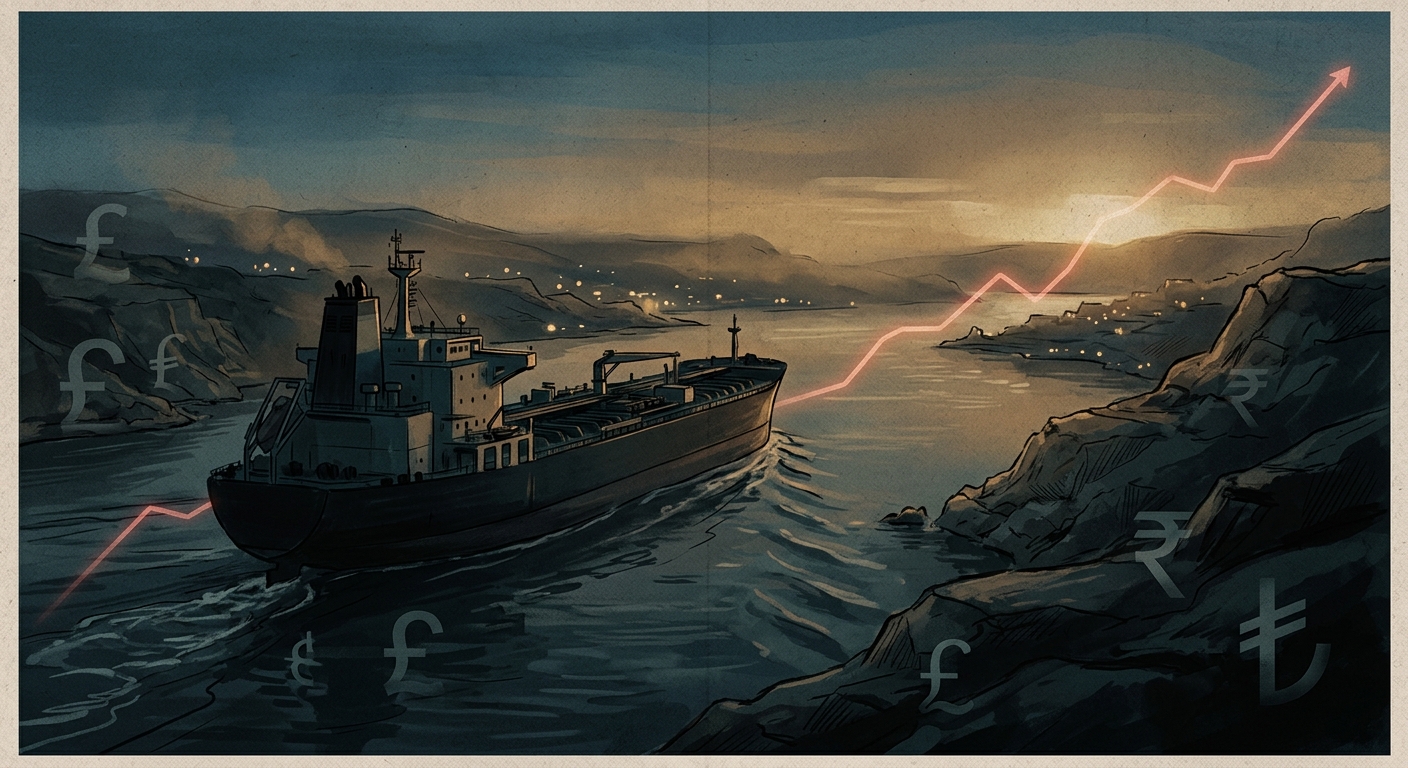
The number that reframes the outlook
Global growth of 3.0% in 2026 and 3.4% in 2027 is not the story. According to the IMF's press briefing transcript, Deputy Research Director Petya Koeva Brooks framed the outlook as "two powerful forces pulling in opposite directions: the lingering effects of the energy shock from the war in the Middle East and a technology-driven investment boom." That averaged out to a modest 0.1-point growth downgrade from April. The inflation revision is what changes central-bank behavior.
Headline global inflation was projected at 3.8% in January, 4.4% in April, and 4.7% now — a cumulative 0.9-point upward drift over six months, per the Wall Street Times' summary of the WEO series. Brooks was blunt in the transcript: "the disinflation trend that has been in place since early 2024 has stalled." Core inflation is "broadly unchanged," meaning the shock is running through commodity channels and second-round wage and services effects rather than through demand.
The IMF's baseline rests on one hard assumption. As the transcript states: "our forecast assumes that the Strait of Hormuz begins reopening in mid-July, with conditions normalizing to the pre-war state by March of 2027. Commodity price assumptions are based on market pricing as of June 10th, which implied an average oil price of $89 a barrel for 2026." That assumption was already visibly stressed when Brooks was speaking:
Al Jazeera reported Brent jumped 4.2% to $77.24 during the briefing after President Trump declared the US-Iran memorandum "over," then topped $79 later that day.
Al-Monitor quoted Brooks conceding that "developments overnight illustrate the uncertainty and risks that surround the outlook."
The G3 has split — and the split is now the policy
The war has done what a decade of divergent inflation prints could not: it has broken the correlation between advanced-economy central banks. Kevin Warsh's first Federal Open Market Committee meeting held the funds rate at 3.50–3.75% but stripped the statement of any easing bias. According to the BBC, the new statement ran 132 words versus roughly 350 in April, and nine of 18 FOMC participants now project a hike in 2026 against just one who sees a cut. Warsh's dot-plot is a de facto tightening signal without a move.
The European Central Bank went further, raising its deposit rate by 25 basis points — the first G7 hike since 2023 — with ECB President Christine Lagarde arguing the energy shock has broadened into food and services. The Bank of Japan lifted rates to 1.00%, using the shock as cover to accelerate normalization. The Bank of England held. That is not coordinated policy; it is four different bets on how sticky the energy shock will prove.
The IMF's own guidance is unusually pointed. In the transcript, Brooks said central banks "should remain focused on price stability, though the appropriate response will vary by country depending on how commodity prices, the tech-driven demand, and inflation expectations interact." Translation: the Fund is not going to referee the split. It will, however, use monthly reviews of program countries to enforce a de facto tightening on emerging markets whose expectations are drifting.
Where the currency crisis lives
The April 2026 Global Financial Stability Report already flagged that "frontier economies that have issued sizable amounts of debt since the beginning of 2025 could face heightened debt sustainability challenges." The July WEO Update did not walk that back — it hardened it. The mechanism is straightforward: a stronger dollar, higher-for-longer US rates, and an oil-import bill that is now $14 above the IMF's $75 pre-war anchor.
Egypt is the leading indicator. The IMF's April 2026 Regional Economic Outlook reports that "Egypt's currency depreciated by about 12%, acting as the primary shock absorber," with sovereign spreads widening more than 60 basis points and Pakistan's more than 50. The Fund's
June 29 staff-level agreement on Egypt's seventh EFF review kept the $8.1 billion program alive, but the Atlantic Council notes that Egypt faces
$27 billion in external debt service in 2026 against $53 billion in reserves — five months of import cover that a sustained $30 oil shock would eat rapidly.
Pakistan's $7.2 billion EFF, Jordan's $1.2 billion facility, and Morocco's $4.8 billion Flexible Credit Line form the second row of MENAP defenses. All four countries rely on GCC remittances worth roughly 5% of GDP, per the Regional Economic Outlook — a channel that thins when Gulf activity slows, and Gulf hydrocarbon exporters are now projected to grow just 0.3% in 2026 according to the
World Bank's June Global Economic Prospects.
Türkiye sits in its own category. TÜİK reported June CPI at 32.1% year-on-year, with the ENAG academic index putting the real figure at 51.5% per BBC Türkçe. The Central Bank of the Republic of Türkiye cut its policy rate from a 46% April 2025 peak to 37% by January 2026, but disinflation has stalled — an IMF
working paper argues services inflation there is now roughly ten times less sensitive to exchange-rate stability than goods, meaning even a stable lira will not break the cycle without policy support.
Nigeria offers the mirror image: an oil producer that should benefit, whose May 2026 Article IV still warns inflation will tick up to 17% by end-2026 and instructs the Central Bank of Nigeria to keep policy "tight for longer" and reduce reliance on portfolio inflows that pose "rollover risk."
The frontier tail
The World Bank's June 2026 Global Economic Prospects contains the number that should organize policymaker attention: the share of low- and middle-income countries in, or at high risk of, debt distress has risen from 26% in 2015 to roughly 50% in 2026. The Bank's own econometric work finds that in frontier markets, a one-percentage-point increase in the debt-to-GDP ratio raises sovereign spreads by 24 basis points — four times the sensitivity of larger emerging markets. Rising debt now compounds faster than rising revenues in the most vulnerable half of the developing world.
A July IMF working paper on frontier markets reinforces the point. Combined with the GFSR finding that emerging-market capital flows have taken on a "K-shaped pattern, heavily skewed toward" the United States — the debt-only leg of that K is Africa and South Asia. When Warsh signals no cut and the dollar bid firms, capital does not flow back.
Foreign Affairs' analysis frames the historical parallel bluntly: this is closer to the 1980s Latin American debt crisis than to 2022's inflation spike, but with a fragmented creditor base — Chinese state banks, Western asset managers, Gulf sovereigns — that makes coordinated restructuring far harder than the London Club era.
What breaks the forecast
The IMF's baseline is fragile on three assumptions, each with a near-term test.
- The Strait of Hormuz reopens on schedule. Shipping through the Strait carries roughly one-fifth of global oil and LNG trade,
Al Jazeera notes, and remains heavily constrained. Ryan Sweet of Oxford Economics told the outlet the Iran ceasefire "is the key domino that will determine whether other risks are amplified or dampened."
- Oil averages $89 per barrel for 2026. Brent sat at $78.76 on July 9. A sustained move above $100 breaks Egypt, Jordan and Pakistan simultaneously.
- The AI investment cycle does not correct. The
GFSR explicitly notes that AI-value-chain firms are "increasingly relied on circular financing arrangements, with hyperscalers in the center." A market repricing here would remove the one force offsetting the war shock in the WEO's cumulative growth math.
Diplomat View
The July 8 WEO is not a forecast — it is a conditional peace bet, and the condition failed the same morning. The IMF's baseline that Hormuz normalizes by March 2027 assumed a US-Iran memorandum that Donald Trump declared "over" hours before Brooks began her briefing. The Fund will not admit this until October, but the current numbers are already stale.
The consequential call is on the emerging-market monetary map. If the Fed follows its dot-plot and hikes once more this year while the ECB raises 50 basis points cumulatively, the dollar leg of the K-shape gets steeper and Egypt, Pakistan, Jordan, and Nigeria have to absorb the shock through further currency depreciation and higher policy rates just as their populations feel the fuel price. The forecast revises materially lower if any of three things occurs by October: Brent averages above $95 for a month, a frontier issuer (watch Kenya, Ghana, or Angola) misses a coupon, or Egypt's pound tests EGP 55/USD without CBE intervention holding. If none of those trigger, the "V-shaped" rebound to 3.4% in 2027 becomes the working assumption. If two do, the IMF's next WEO in October will not be an update — it will be a downgrade.
The bottom line: the IMF has told central bankers that disinflation is over and told finance ministers that the buffer is gone. The July 2026 WEO is the moment the Iran war stopped being an energy story and became a sovereign-debt story — and the countries whose currencies were the shock absorbers in April will be the ones that need the phone call from Washington by autumn.
Discover more
Economics
Dangote's Dollar Pricing Exposes Nigeria's Cr
Dangote Refinery switched fuel pricing from naira to dollars on July 13, 2026, exposing a structural crude supply gap that undermines Nigeria's naira-for-crude framework and threatens currency stability.
Economics
Dangote Dollar Pivot Breaks Nigeria's Naira-C
Dangote refinery ends naira pricing for fuel, exposing Nigeria's crude supply gap. The shift breaks Tinubu's currency stability policy and threatens inflation as NNPC fails to deliver enough domestic crude.

Economics
Warsh's Fed Tilts Hawkish: June Minutes
The Federal Reserve's June minutes reveal a hawkish shift, with policymakers favoring interest rate hikes, impacting global currencies and rates.

Economics
Tariff Pass-Through: Inflation's New Reality
New York Fed's survey shows 47% of firms expect ongoing price hikes from tariffs, challenging inflation forecasts and Fed rate decisions.