IMF Cuts 2026 Growth Forecast to 3%
Global growth forecast revised amid geopolitical tensions
Model Diplomat8 min readGlobal
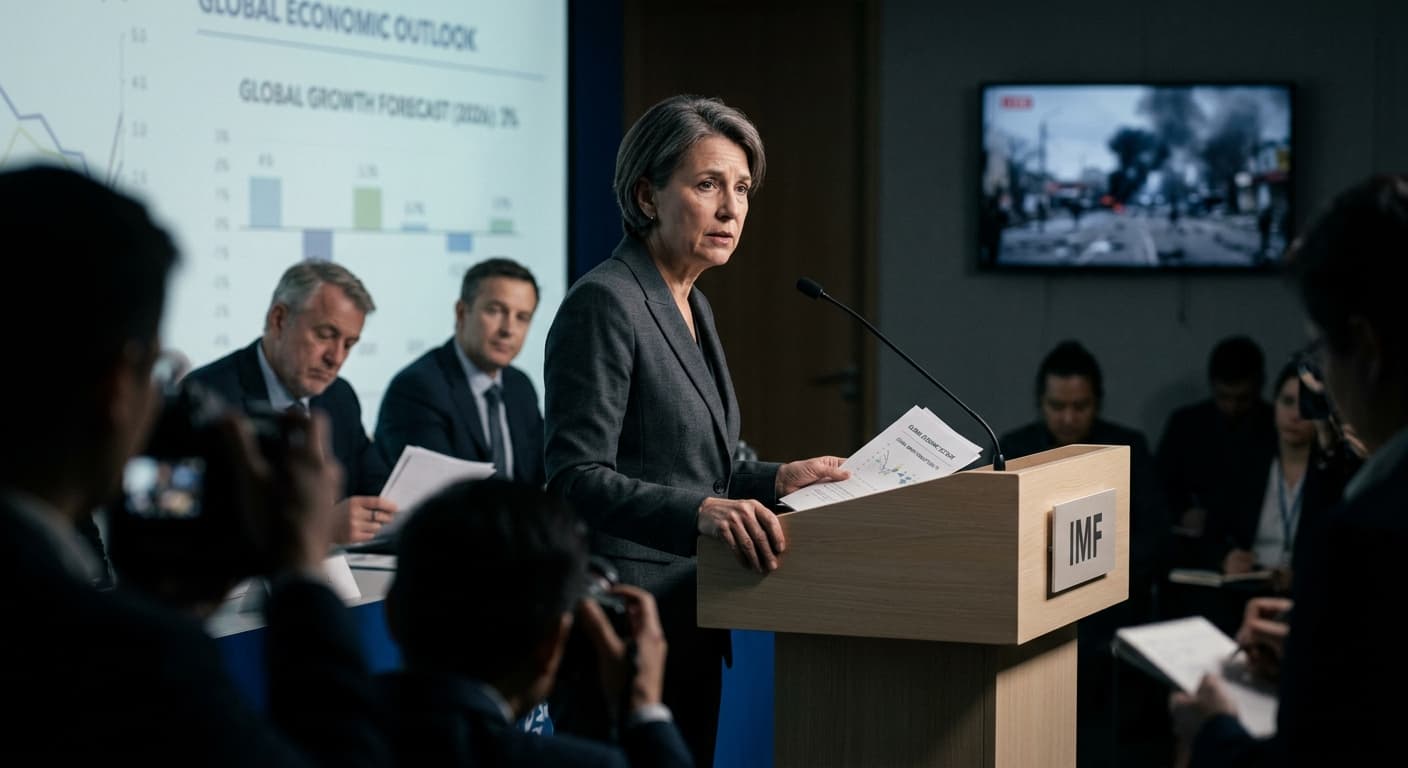
IMF cuts 2026 growth to 3%; central banks locked in as Iran war reignites
IMF's July 2026 WEO update sees global growth at 3.0% this year and 3.4% in 2027 — but the forecast rests on a Strait of Hormuz reopening Washington just undercut.
The International Monetary Fund on July 8, 2026 nudged its 2026 global growth forecast down to 3.0% and penciled in a rebound to 3.4% in 2027 — a "V-shaped" recovery that assumes the Strait of Hormuz begins reopening in mid-July and normalizes by March 2027, exactly the assumption President Donald Trump undermined a day earlier by revoking the sanctions waiver that bought that peace. The Fund's forecast, in other words, is a bet on a ceasefire the White House has already declared "over." That single sentence explains more than the headline number: it explains why the Federal Reserve is holding at 3.5–3.75% with nine of 18 policymakers projecting a hike, why the European Central Bank is stuck at a 2% deposit rate with Lagarde now hinting at tightening, and why Egypt, Pakistan and Jordan are heading into the second half of 2026 with sovereign spreads still 50–60 basis points wider than in January.
The forecast is a bet on a ceasefire Washington just undercut
The IMF's own primary text is unusually candid about its dependence on geopolitics. In her opening remarks to the July 8 press briefing, Deputy Research Director Petya Koeva Brooks said the Fund is "projecting global growth of 3.0 percent in 2026 and 3.4 percent in 2027 — broadly unchanged from April on a cumulative basis," with the disinflation trend "stalled" and headline inflation revised up to 4.7% in 2026 before easing to 3.9% in 2027, according to the IMF. She also spelled out the caveat verbatim:
Our forecast assumes the Strait of Hormuz begins reopening in mid-July, with conditions normalizing to the prewar state by March 2027… Commodity price assumptions are based on market pricing as of June 10, which implied an average oil price of $89 a barrel for 2026.
Twenty-four hours before that briefing, the US Treasury revoked the 60-day waiver on Iranian oil sales that had been the economic core of the June 17 Memorandum of Understanding between Washington and Tehran, and US Central Command began fresh strikes on Iran after attacks on three commercial vessels in the strait, according to Al Jazeera. At the NATO summit the next day, Trump told reporters the MoU was "over… I don't want to deal with them any more, they're scum," per the
BBC. Brent futures jumped more than 4% to $77.24, the highest level in two weeks, and Iranian parliamentary speaker Mohammad Bagher Ghalibaf — Tehran's chief negotiator — accused the US of breaching the deal on both sanctions and Strait passage.
The IMF's reference forecast was therefore already stale by the time it was delivered. The Fund's April "adverse scenario" — oil averaging around $110 and global inflation reaching 5.4% — is now the live scenario, not the tail risk, as Al Jazeera laid out at the Spring Meetings. Under the more severe April scenario, global growth would fall to about 2%, headline inflation would climb above 6% by 2027, and, per the
WEO chapter 1, the impact on emerging markets would be almost twice that on advanced economies.
The two-speed shock: AI investment vs. the energy tax
The story the Fund is now telling is a divergence trade. Growth of 3.0% is not global weakness — it is a US technology boom papering over an emerging-markets energy tax. The Council on Foreign Relations, citing IMF Managing Director Kristalina Georgieva, noted that the AI investment boom "accounted for as much as 40 percent of U.S. GDP growth over the past year" (CFR). US Q4 2025 tech-related capex remained strong even as headline growth softened to 0.5%, per the
April 2026 WEO chapter, and Chinese merchandise trade surplus hit a record $1.2 trillion (6% of GDP) in 2025 as exports were rerouted through Taiwan, Vietnam and Mexico. The World Trade Organization's
Global Trade Outlook found that AI-enabling goods alone could add 0.5 percentage points to 2026 merchandise trade growth even amid the war.
The other side of the ledger is uglier. The IMF's Middle East and Central Asia Department reported that the strait's near-standstill knocked more than 10 million barrels per day of oil and about 500 million cubic meters per day of gas offline at the peak, with Qatar's Ras Laffan complex — "roughly 17% of global LNG capacity" — sustaining significant damage, per the IMF regional key messages. Five Gulf oil exporters (Bahrain, Iran, Iraq, Kuwait, Qatar) are projected to contract in 2026. Qatar itself faces the steepest country-level downgrade globally at nearly 15 percentage points from October. Egypt's currency has depreciated about 12%; Bahrain, Pakistan and Egypt saw sovereign spreads widen 50–60 basis points; and Iran's own growth forecast was slashed 7.2 points, to a 6.1% contraction.
The distributional math is brutal. A Kiel Institute working paper modelling a full closure of Hormuz finds welfare losses in South Asia and sub-Saharan Africa "10–20 times larger" than the roughly 0.07% GDP hit to the United States, because energy disruptions cascade through fertilizer and chemicals into food prices. The World Bank's June
Global Economic Prospects — which uses market-exchange-rate weights and therefore prints lower than the IMF's PPP-weighted number — puts 2026 global growth at just 2.5%, "the lowest rate since the COVID-19 pandemic," with a 1.3% floor if energy disruptions combine with financial stress. Read together, the two multilaterals are describing the same thing: a global economy where advanced tech capex is doing the work of two policy levers that no longer function — coordinated central-bank easing and a rules-based trading system.
Pakistan is the canary. Prime Minister Shehbaz Sharif said the country's oil import bill has surged from $300 million before the conflict to $800 million now, erasing two years of macroeconomic progress, per Al Jazeera. Analyst Kaiser Bengali described a state "of absolute dependency, where even a $1 billion tranche… can make the difference between survival and collapse." The
UN's UNCTAD report identifies 61 vulnerable economies with dual exposure to oil and cereal import shocks — the emerging-markets tail the IMF's PPP-weighted 3.0% cannot see.
Central banks: locked in, not "higher for longer"
The clearest second-order effect of the IMF revision is on rates. The Federal Reserve on July 8 held the federal funds target at 3.5–3.75% at Chair Kevin Warsh's first meeting — a unanimous FOMC vote — but with nine of 18 dot-plot participants projecting a rate hike this year and only one a cut, the BBC reported. The FOMC statement was cut to just 132 words from 350 in April, saying only that "Economic activity is expanding at a solid pace despite elevated uncertainty… The Committee will deliver price stability." Minutes released the same day showed policymakers agreed "some policy firming would likely be warranted" if inflation stays elevated, according to the
Financial Times. US CPI ran at 3.8% in April, up from 2.1% before the war.
The ECB is in a mirror-image bind. After cutting to a 2% deposit facility rate by June 2025 and holding since, per the European Parliament's ECON briefing, Frankfurt has now signaled it could tighten — Lagarde told the FT the ECB "does not need to fight inflation with the same force" as in 2022–23 but is prepared for a modest hike, which would make the ECB the first G7 central bank to reverse course since 2023, per
FT reporting. A Dallas Fed working paper by Lutz Kilian and colleagues models the pass-through: 2026 Iran-war oil shocks are large enough to shift US inflation expectations meaningfully and delay any easing cycle, per the
Federal Reserve Bank of Dallas.
The load-bearing point: markets have stopped pricing "higher for longer" and started pricing "higher and stuck." Yield curves in the US, UK, euro area and Japan have steepened since February 28, with long-end rates rising most, per CFR's read of post-shock market-implied paths. For a world where dollar-denominated debt dominates emerging-market balance sheets, that is the transmission belt from Hormuz to Islamabad. As Foreign Affairs argued in How the Iran War Will Upend the Global Economy, the share of countries in debt distress has already "more than doubled, from 24 percent in 2013 to 54 percent in 2024" — and echoes of the 1980s Latin American debt crisis are increasingly audible.
Trade fragmentation is the sleeper variable
Trade is the third leg the IMF is watching, and it may be the most consequential over the two-year horizon. The Fund expects global trade growth to slow to about 3.5% in 2026 before rebounding to 4.3% in 2027, in line with UN DESA's World Economic Situation and Prospects 2026, which pegs 2026 trade growth at 2.7% under a more conservative volume measure and warns that "AI-related trade… accounted for nearly half of merchandise trade growth in value terms" in 2025.
That single number is the reframe. The AI capex boom is not just a US productivity story — it is a supply-chain fact holding global trade above stall speed. If AI expectations correct, as the IMF explicitly flags as a downside risk, the trade forecast collapses at the same moment the energy shock is amplified. That is the "double-shock" scenario the World Bank's GEP models at 1.3% global growth.
The second sleeper: OPEC+ is fracturing. The United Arab Emirates announced its withdrawal from OPEC+ on May 1, 2026, per the Policy Center for the New South, removing the coordination mechanism that stabilized oil prices through the 2020s and structurally raising the volatility premium in every IMF and central bank forecast for the next two years. The Centre for European Reform's
energy shock analysis argues that if Hormuz stays closed, Europe faces "a larger oil supply shock than in 2022" — up to 1,000 million tonnes of annual exports off the market, five times the volume displaced from Russia.
The historical parallel matters: the 1970s produced not one but two energy shocks, each rewiring central bank credibility and sovereign debt. The 2026 shock is arriving into a global economy that already spent its fiscal buffers on Covid and Ukraine, with G20 public debt near or above 100% of GDP across France, Italy, the US and Canada. As Georgieva told CFR, "there is no substitute for good policy, and many countries have missed an opportunity to get their fiscal houses in order."
What to watch
- July 17, 2026 — US Treasury waiver on Iranian oil sales formally lapses, blocking new transactions and testing whether Gulf producers can compensate.
- August 21, 2026 — the original MoU window with Iran expires; failure to reach a permanent agreement pushes Hormuz risk into the winter demand peak.
- September FOMC and ECB meetings — the first opportunity for either central bank to move; watch for a Warsh Fed hike signal or a Lagarde tightening pivot.
- October 2026 WEO — the IMF's next full forecast will either ratify the July "V-shape" or shift the reference case toward the April adverse scenario.
The Bottom Line
The IMF's 3.0% forecast is not a call on the global economy — it is a bet that Washington and Tehran will hold a peace neither side wants. Strip out the Hormuz reopening assumption and the AI capex boom, and the number the Fund is really forecasting looks closer to the World Bank's 2.5% and the April adverse scenario's 2.5%. The story of the next 12 months is whether the Fed's Warsh doctrine and Lagarde's tightening pivot arrive in time to preserve inflation credibility — or whether the 2020s become the decade central banks stopped being able to cut.
Discover more

India
Delhi CM Rekha Gupta Blasts Opposition's Delm
Delhi CM Rekha Gupta's remarks on women's quota defeat reveal BJP's strategy for the 2029 Lok Sabha elections, focusing on delimitation.

US Politics
SNAP Food Assistance Faces Legal Challenges
In 2026, SNAP faces stricter eligibility rules and mounting legal challenges, threatening food assistance for the millions of Americans who rely on the program.
India
Congress Accuses Modi of Stalling Women's Law
Congress accuses Modi of stalling women's reservation law by linking it to delimitation, revealing a deeper electoral strategy.

Conflict & Security
Drone Warfare Killing Aid Workers at Unprec
Over 1,000 humanitarian workers killed in three years as cheap armed drones collapse legal protections. Gaza, Sudan, Ukraine, and DRC see deliberate targeting of aid convoys and hospitals with zero prosecutions.