IEA Warns Mineral Supply Risks Deepen
IEA warns critical mineral supply chains are more concentrated than ever
Model Diplomat7 min readGlobal
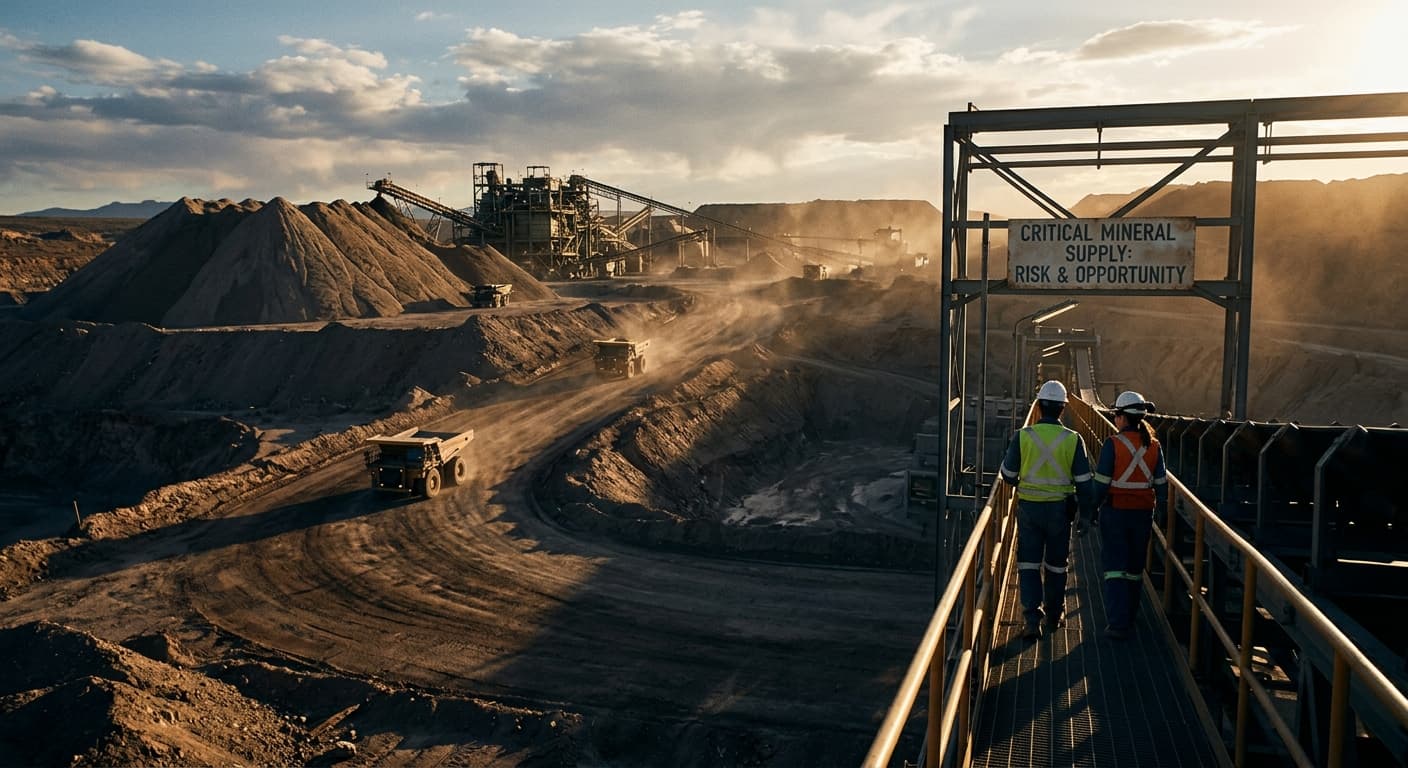
IEA Warns Mineral Supply Risks Deepen as Investment Falls 9% and Concentration Hits 90%
The International Energy Agency’s 2026 outlook finds that critical mineral supply chains are more concentrated than at any point since its landmark 2021 study — and investment is now in retreat, with $6.5 trillion in downstream production at risk if China’s export controls are fully enacted.
Global critical mineral supply chains have grown more concentrated, not less, in the two years since governments began pouring tens of billions of dollars into diversification. Investment fell by 9% in 2025, demand is set to double by 2040, and Beijing now leads refining for 19 of the 20 strategic minerals the International Energy Agency tracks. That constellation of findings, released on July 16 in the IEA’s Global Critical Minerals Outlook 2026, turns a theoretical vulnerability into an immediate economic security problem — and the beneficiaries are the very incumbents policymakers set out to sideline.
The Concentration Paradox
The headline numbers are unforgiving. The average market share of the top three producers across six major energy-transition minerals — copper, lithium, nickel, cobalt, graphite, and rare earths — has risen to nearly 90%, according to the IEA Financial Times. That is worse than the already alarming level recorded in the agency’s first critical-minerals study four years ago. “Even taking into account all the planned mineral projects worldwide, this high degree of concentration is only set to ease slightly over the next decade — taking it back to essentially the same level it was in 2020,” IEA Executive Director Fatih Birol wrote in an op-ed accompanying the report.
The concentration is most acute at the refining stage. Over the past two years, the top refiners — Indonesia for nickel and China for virtually everything else — accounted for more than three-quarters of total supply growth in several markets IEA. For manganese, nickel, and graphite, virtually all the growth came from the dominant supplier.
There are pockets of progress. New rare-earth refining capacity in the United States and expanded production in Malaysia pushed China’s share of rare-earth refining down from above 90% in 2023 to 85% in 2025 — and the IEA projects it could fall to 70% by 2035 if all planned projects come online IEA Outlook. But those projects are concentrated in mining, not processing. In rare-earth supply chains, planned refining capacity reaches only about two-thirds of expected mine output by 2035, and planned magnet production amounts to just one-third
IEA News. The choke point is not the ore — it is the factory.
The Market Trap: Well-Supplied but Starved of Investment
The second destabilizing dynamic is the widening gap between market signals and security needs. Critical mineral prices rebounded in 2025 and early 2026 as supply conditions tightened, amplified by a raft of new export restrictions from leading producers IEA News. Yet that price recovery did not unlock investment. Instead, global spending on critical mineral development fell 9% in 2025, ending consecutive years of growth. Projects involving new entrants — precisely the ones that would diversify supply — were hit hardest.
The IEA identifies a structural imbalance in where investment is flowing. Even when capital is deployed, it overwhelmingly goes to mining rather than refining or downstream processing. Projects outside the dominant supplier face capital costs roughly 50% higher than those in China or Chinese-backed Indonesian operations Financial Times. Without price-stabilization mechanisms, demand guarantees, or incentives tied to environmental standards, private capital cannot compete with state-backed Chinese firms that operate on longer time horizons and lower margins.
Meanwhile, government finance commitments more than quadrupled between 2023 and 2025, reaching $65 billion IEA News. That is a dramatic increase — but it mostly fills the gap left by retreating private capital, not the one needed to meet 2040 demand.
The $6.5 Trillion Exposure
The vulnerability is no longer hypothetical. In April 2025, China introduced rare-earth export licensing requirements that forced some automakers to cut production or temporarily suspend operations IEA Commentary. In October, Beijing expanded those controls. Their implementation was delayed by one year, but the IEA now calculates that if the measures are fully enacted, an estimated $6.5 trillion in annual downstream production outside China could be jeopardized
IEA News.
That figure — roughly three times the annual GDP of France — reframes the debate. The critical minerals market itself is small: roughly $325 billion at the aggregate level for key energy-transition minerals IEA Congressional Testimony. But it is the gatekeeper to a vast downstream economy spanning automaking, defense, aerospace, semiconductors, and artificial-intelligence infrastructure. China’s dominance in refining — an average 70% share across 19 of 20 strategic minerals — means a disruption at the processing stage cascades through supply chains the way a natural-gas cutoff would, only with fewer alternatives because substitution is far harder for magnet rare earths than for fuel.
“The recent expansion of export controls globally has transformed concerns around high supply concentration from a theoretical vulnerability into an immediate economic security challenge,” the IEA states in its 2026 Outlook. “Rare earth export controls introduced by China in April 2025 forced some automakers to reduce production or temporarily suspend operations.”
Winners and Losers
The report makes clear who benefits from the current trajectory. China remains the undisputed refining hegemon, with its position reinforced by state-backed overproduction that keeps prices low and competitors out. Indonesia, powered by Chinese capital and low environmental standards, has captured over half of global nickel refining and virtually all recent supply growth.
The losers are not confined to Western capitals. Automakers — already contending with the transition to electric vehicles — face the prospect of input disruptions that can idle assembly lines. Defense supply chains, where rare-earth magnets are essential for precision-guided munitions, satellite communications, and radar systems, are exposed. The Congressional Research Service notes that the United States is 100% net import reliant for scandium from Japan and China, and for yttrium from China, Germany, Austria, and South Korea — and China manufactures 94% of rare-earth-based magnets CRS.
The IMF has quantified what it would take to break this dependence. In its April 2026 World Economic Outlook Commodity Special Feature, IMF researchers found that achieving just 25% US self-sufficiency in rare-earth processing by 2035 — a target in line with IEA projections — would require an investment subsidy covering 77.2% of total investment costs if pursued unilaterally IMF. Coordinated action among importing nations reduces the fiscal burden substantially, but no such coordination framework exists with binding commitments.
The IMF concludes bluntly: “Sizable interventions would be needed to attain the 25 percent self-sufficiency target.”
What Washington Is Missing: The Demand-Side Blind Spot
Much of the policy response to date has focused on supply — new mines, processing facilities, stockpiles, and the $12 billion Project Vault strategic reserve announced in February 2026. But a growing body of analysis argues this approach misses a larger structural problem.
“The United States has treated critical minerals primarily as a supply problem, when it is equally a demand problem,” the Center for Strategic and International Studies wrote in an April 2026 analysis CSIS. In 2024, the US accounted for just 4.5% of global nickel consumption, 3.6% of cobalt, and 1.7% of rare earths. A country that represents less than 2% of global rare-earth demand cannot, on its own, generate the offtake commitments required to bring new processing facilities online outside of China.
The IEA’s 2026 Outlook reinforces this point with new analysis showing that the project pipeline outside the dominant supplier is structurally lopsided — mining-heavy, refining-light. The planned magnet production capacity outside China by 2035 amounts to just one-third of projected mine output IEA News. Without guaranteed buyers for the refined output, those mines will either remain stranded or, as happened with Brazil’s Serra Verde rare-earth mine, sell most of their output right back to Chinese refineries
CSIS.
Diplomat View
The IEA’s 2026 Outlook forces a reckoning that most capitals have avoided: four years of policy activism, export bans, and executive orders have not reduced dependence on China’s refining infrastructure — they have presided over its deepening. The price mechanism, far from attracting new entrants, is driving them away. The projects that are being built are building the wrong part of the supply chain.
The forecast is not hopeless, but it is conditional. The one-year delay on China’s October 2025 expanded export controls expires later this year. If Beijing follows through, $6.5 trillion in downstream production is directly exposed — and there is no fallback. That is the near-term stress test. Beyond it, the variable that changes the trajectory is demand aggregation: whether the new Forum on Resource Geostrategic Engagement (FORGE), announced in February 2026, can evolve from a talking shop into a genuine joint-offtake framework with binding commitments CSIS. Without it, Western governments will continue subsidizing mines whose output flows back to Chinese refineries — paying to reinforce the very dependency they claim to be escaping.
What to Watch
- October 2026 — Expiration of the one-year delay on China’s expanded rare-earth export controls. Full enactment would trigger the $6.5 trillion exposure.
- IEA Critical Minerals Security Programme technical webinar, July 21, 2026 — First detailed operational discussion of the Outlook’s recommendations; watch for stockpiling coordination proposals.
- Next FORGE ministerial — Whether member states will commit to a joint offtake framework with specific percentage targets for allied sourcing.
- US Defense Production Act timelines — The Department of Defense’s goal of a complete mine-to-magnet rare-earth supply chain by 2027, set under Executive Order 14347, faces a mid-2026 milestone review.
Key Takeaways
- Concentration in critical mineral refining has increased since 2023, with the top producer capturing over three-quarters of growth in nickel, graphite, and manganese.
- Global investment in critical minerals fell 9% in 2025, even as demand projections continued to rise sharply.
- China’s expanded export controls on rare earths, if fully implemented, put an estimated $6.5 trillion in annual downstream production outside China at risk.
- The project pipeline is structurally imbalanced — refining and magnet capacity outside China lags far behind mining, ensuring continued dependence on Chinese processing.
- Achieving even 25% US rare-earth processing self-sufficiency by 2035 would require an investment subsidy covering 77.2% of costs if pursued unilaterally, per the IMF.
Discover more
US Politics
House Ethics Committee Pushes Sexual Miscond.
The House Ethics Committee has shifted responsibility for sexual harassment settlement records to the Office of Congressional Workplace Rights, complicating disclosure efforts.
India
700 Activists Accuse PM Modi of MCC Breach
Over 700 activists allege PM Modi breached election code with a televised address attacking opposition parties just before state elections.

India
Delhi CM Rekha Gupta Blasts Opposition's Delm
Delhi CM Rekha Gupta's remarks on women's quota defeat reveal BJP's strategy for the 2029 Lok Sabha elections, focusing on delimitation.

Economics
Fed's Amex AML order puts correspondent banking on notice
Federal Reserve's Amex AML order requires board-level controls and a 90-day plan; OCC fined the bank $350 million over enterprise-wide deficiencies.