IEA Warns Critical Mineral Supply Crisis Deep
IEA warns price volatility and export controls are deterring investment, deepening China's refining dominance.
Model Diplomat9 min readGlobal
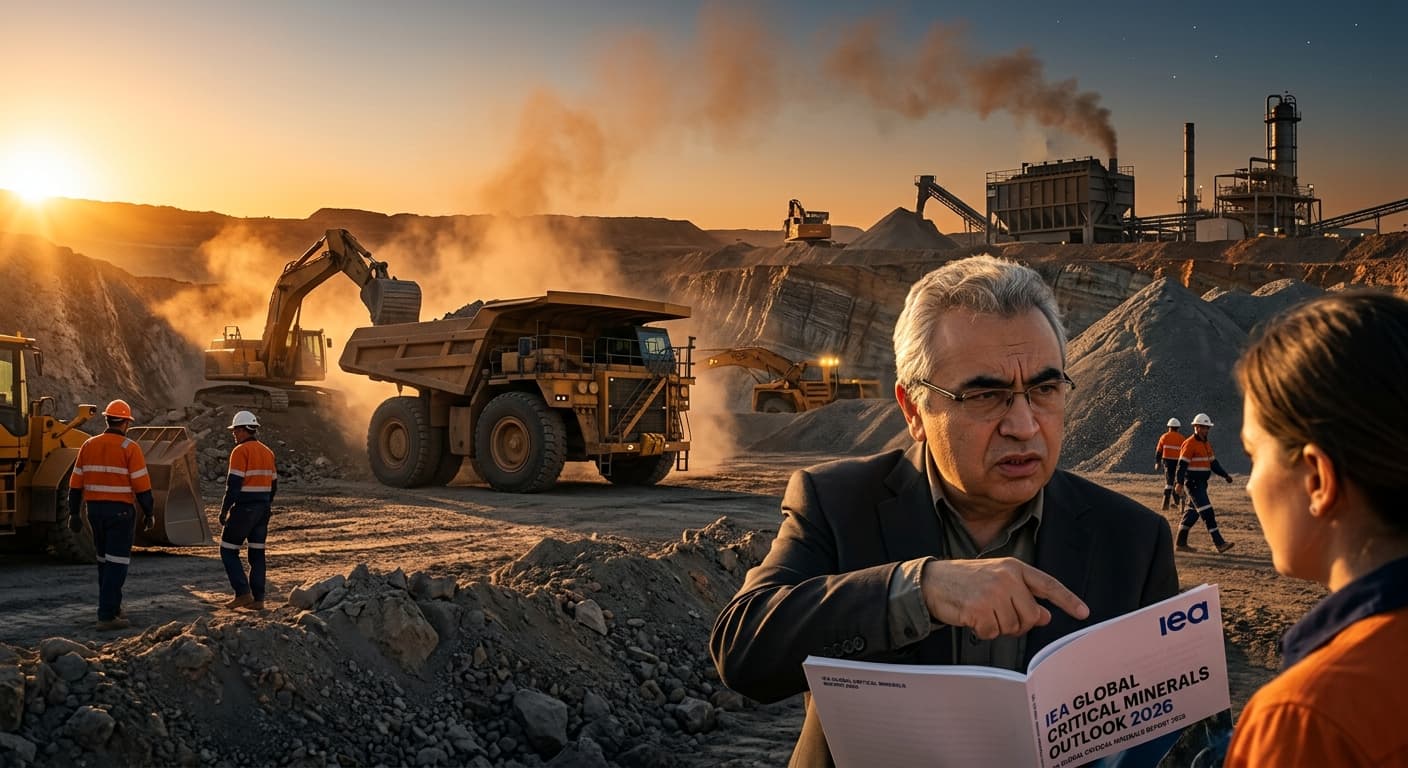
The Market Is Now the Obstacle: IEA's 2026 Minerals Report Reveals a Supply Crisis That Investment Cannot Fix
The IEA's Global Critical Minerals Outlook 2026 finds concentrated refining, proliferating export controls, and collapsing investment have turned mineral supply risk into an immediate economic threat — and the price spikes meant to incentivize new mines are killing the investment case instead.
The IEA has shifted the critical minerals conversation from "can the world produce enough" to "can industries reliably obtain what exists." The answer, delivered in the Global Critical Minerals Outlook 2026 released July 17, is no — and the mechanism of failure is more dangerous than a simple shortage. Price volatility triggered by export controls is now deterring the very investment needed to diversify supply away from China, locking in dependence even as advanced-economy governments spend record sums trying to break free. The market itself has become the obstacle.
The IEA estimates that if all suspended export controls were fully implemented, $6.5 trillion in annual downstream production outside China would be at risk. A complete disruption of battery-grade graphite trade alone threatens more than $300 billion in annual output. Those are not theoretical numbers. In 2025, Chinese controls on seven heavy rare earths forced automakers to reduce production or temporarily halt operations.
"Shifting the critical minerals dialogue from how much the world can produce to whether industries can reliably obtain them," the IEA writes in the 2026 edition, warning that "concentrated refining, expanding export controls, and weaker investment have turned supply risk into an immediate economic threat." Metal Tech News
The price signal is screaming — and that is the problem
The most visible evidence of tightening supply appears in prices. Between January 2025 and April 2026, aluminum, copper, and tin each rose roughly one-third. Lithium more than doubled amid strong energy storage demand and constrained supply. Cobalt climbed approximately 130% after the Democratic Republic of the Congo restricted exports. And tungsten — the densest, hardest-wearing metal in the defense arsenal — surged roughly sixfold as tighter availability and trade controls reshaped markets.
The tungsten story is the most extreme case of structural repricing. China controls roughly 80% of global tungsten mine supply. In February 2025, Beijing added tungsten products to its export control list. By late 2025, the government confirmed that only 15 companies would be authorized to export tungsten through 2027, granting the state direct control over volume, timing, and destination. Rotterdam ammonium paratungstate (APT), the European benchmark, traded near $3,200 per metric tonne unit by mid-2026 — up roughly 900% over the trailing twelve months from 2025 lows. Financial Times
The United States has not produced tungsten from a domestic mine since 2015. A new federal procurement rule — DFARS 252.225-7052 — takes effect on January 1, 2027, barring tungsten mined, refined, or processed in China, Russia, Iran, or North Korea from key U.S. defense applications. There is no domestic mine ready to fill the gap.
The IEA's report names tungsten, gallium, magnet rare earths, yttrium, graphite, germanium, tellurium, and cobalt as the materials with the highest risk exposure scores — characterized by extreme supply concentration, limited substitutes, strategic defense applications, and existing export restrictions. For gallium, graphite, manganese, and rare earths, the top refiner, China, accounts for over 90% of global supply. IEA
The investment paradox: record government spending, collapsing private capital
Here is the central paradox the IEA identifies: prices are rising, demand forecasts are bullish, and governments are pouring unprecedented sums into critical mineral supply chains — yet private investment is retreating.
Critical mineral investment fell 9% in 2025, ending several consecutive years of growth. Exploration spending declined more than 10%. Battery metal companies cut capital spending by over 20%, including roughly 40% among lithium producers specifically. Metal Tech News
Meanwhile, public financing commitments across advanced economies reached roughly $65 billion in 2025, more than four times the 2023 level. But the IEA cautions that much of that support "remains announced rather than deployed." This is the gap between political will and commercial reality: governments are promising capital, but the private sector — which must do the actual building — is pulling back.
The reason is straightforward and brutal. According to IEA Executive Director Fatih Birol writing in the Financial Times, projects in diversified regions face capital costs roughly 50% higher than those in China and other incumbent refiners. Price volatility, far from attracting capital, scares it away — "markets alone will not ensure a secure and reliable supply." When prices swing violently on geopolitics rather than fundamentals, financing a decade-long mining project becomes a gamble most boards will not take.
The CSIS reached the same conclusion: price volatility for minerals "has become a significant deterrent to private sector mining investment." CSIS Without credible long-term demand visibility, private capital stays on the sidelines — and without private capital, the diversification agenda stalls.
Concentration is deepening, not easing
The IEA's most alarming structural finding may be that supply concentration is getting worse, not better.
Over the past two years, Indonesia for nickel and China for most other key energy minerals have accounted for more than three-quarters of global refined supply growth — including virtually all gains in manganese, nickel, and graphite.
Since the IEA published its landmark 2021 study on critical minerals, the average market share of the top three producers has risen to nearly 90%. Even accounting for all planned projects worldwide, this concentration is projected to ease only slightly over the next decade — returning to roughly the level it was in 2020. Financial Times
For 19 out of 20 strategic minerals — those used across energy, aerospace, defense, and semiconductors — China is the leading refiner, with an average market share of 70%. More than half of these strategic minerals now face some form of export restriction or trade control, increasingly targeting not just raw materials but processing technologies and know-how. Chatham House
The pipeline compounds the problem. Even where projects advance, they remain weighted toward mining rather than the refineries and manufacturing plants needed to convert output into usable products. Planned rare earth magnet and battery cathode capacity sits at roughly one-third of the upstream supply expected by 2035. Metal Tech News As the European Parliament observed in a 2026 study, "the United States is structurally exposed due to limited domestic midstream processing infrastructure. Even a country with a strong domestic mining industry cannot achieve supply-chain sovereignty if it remains dependent on Chinese refining, separation and magnet manufacturing."
European Parliament
Supply deficits narrow — except where they widen
The IEA's base-case projections offer some relief: the copper supply gap has narrowed from roughly 30% to 25% as more projects advance, and lithium's gap has also shrunk. But cobalt tells the opposite story.
The projected cobalt supply gap has widened from just over 15% to over 25%, directly reflecting the DRC's export quota system. In February 2025, the DRC — which produces more than 70% of the world's cobalt — imposed a four-month export ban to arrest collapsing prices caused by Chinese oversupply. The ban was later converted into a quota system capping exports at 96,000 metric tons annually through 2027, roughly half of the country's 2024 export volume. CSIS
The quotas worked to boost prices in the short term but created a new structural gap. Glencore, the Swiss-based mining giant, saw its own-sourced cobalt production fall 39% in Q1 2026 compared to a year earlier, "mainly due to the introduction of the DRC's export quota system." The company is now stockpiling cobalt in-country and prioritizing copper. Financial Times
The DRC's policy volatility, the IEA notes, exemplifies the growing influence of "policy developments in key producing countries" on global supply — a risk factor that was barely visible in previous editions of the Outlook.
On the demand side, the trajectory is unrelenting. Demand for every key energy mineral is projected to rise through 2040 across all IEA scenarios. Lithium demand grows over threefold. Nickel, graphite, and rare earths grow 50% to 90%. Copper adds roughly 7 million tonnes by 2040, driven by electricity networks and next-generation technologies including AI data centers. Energy technologies — EVs, battery storage, renewables, grid infrastructure — remain the dominant demand driver. IEA
The market is the chokepoint — and that changes everything
What the IEA has done in the 2026 Outlook is reframe the problem from geology to market structure. The minerals exist. The technology to extract them exists. What is breaking is the mechanism by which capital gets allocated to the right projects in the right places.
The IMF's April 2026 World Economic Outlook quantified this dynamic for rare earths specifically. Its model-based analysis found that achieving just 25% self-sufficiency in rare earth processing by 2035 would require an investment subsidy covering 77.2% of total costs for U.S.-based producers if pursued unilaterally. Coordinated action among importer countries lowers that bill, but the fiscal cost remains "sizable." The IMF's conclusion: "De-risking supply chains through targeted industrial policies is fiscally costly." IMF
The World Bank's April 2026 Commodity Markets Outlook reinforced the urgency, warning that "securing supplies of critical minerals" may "intensify" as a policy priority in the wake of Middle East disruptions affecting global commodity flows — and that "historically, most such agreements have a limited record of success." World Bank
The IEA offers two near-term mitigations. First, strategic stockpiles covering 11 high-risk materials would carry a net annual cost of less than $900 million for countries outside the dominant supplier — a relatively modest insurance premium. Second, recycled supply could nearly double its contribution to key mineral markets by 2040, though reaching that level requires continued investment in collection and recycling infrastructure that does not yet exist at scale. Metal Tech News
Neither stockpiles nor recycling addresses the core problem: processing capacity. The CFR noted in a February 2026 report that expanding traditional mining and processing capacity "takes years, often decades, and is insufficient to address potential escalation of tensions with China in the present." The report argued that the U.S. should "leapfrog China's dominance by scaling disruptive innovation, recovery, and recycling, which is cheaper, cleaner, and faster to deploy today." CFR
Diplomat View
The IEA report marks the end of a comfortable fiction: that markets, left alone, would diversify critical mineral supply. They have done the opposite. Every year since the 2021 landmark study, concentration has risen. The price spikes that should incentivize new entrants instead drive them under — because the projects needed to compete with China face 50% higher capital costs and decade-long timelines, while Beijing can flood the market or restrict it at will.
The real winner of this dynamic is the Chinese processing complex, which grows more indispensable with every supply disruption. The losers are every Western automaker, defense contractor, and clean-energy manufacturer that bet its supply chain on the market solving the problem. That bet is now explicitly contradicted by the IEA's own data.
Two conditions would change the forecast. First, if Western governments shift from announcing support to deploying it — converting that $65 billion in commitments into operational refineries, not just mine permits — the concentration trajectory could bend. Second, if coordinated demand-side policy — pooled allied purchasing, price floors, long-term offtake guarantees — materializes at the scale of the problem rather than the scale of current pilot programs.
The date to watch is January 1, 2027, when the U.S. defense procurement ban on Chinese tungsten takes effect with no domestic mine ready. It is the first hard test of whether Western policy can outrun the market it is trying to fix. If that deadline is met with stockpile drawdowns rather than new production, it will confirm what the IEA is now saying explicitly: the market is not the solution. It is the problem.
What to watch:
- January 1, 2027 — U.S. DFARS procurement ban on Chinese/Russian/Iranian/North Korean tungsten takes effect for defense applications
- Q3 2026 — DRC cobalt quota implementation and any adjustments; Glencore normalization timeline
- Late 2026 — Whether the $65 billion in announced public financing begins converting into operational processing capacity, particularly for rare earth magnets and battery cathode materials
Discover more

US Politics
House Ethics Committee Pushes Sexual Miscond.
The House Ethics Committee has shifted responsibility for sexual harassment settlement records to the Office of Congressional Workplace Rights, complicating disclosure efforts.

India
BJP's Misunderstanding of Women's Quota Needs
The BJP's linking of the Women Reservation Bill to delimitation risks delaying women's empowerment in India, misreading the aspirations of female voters.

India
Delhi CM Rekha Gupta Blasts Opposition's Delm
Delhi CM Rekha Gupta's remarks on women's quota defeat reveal BJP's strategy for the 2029 Lok Sabha elections, focusing on delimitation.

Conflict & Security
Drone Warfare Killing Aid Workers at Unprec
Over 1,000 humanitarian workers killed in three years as cheap armed drones collapse legal protections. Gaza, Sudan, Ukraine, and DRC see deliberate targeting of aid convoys and hospitals with zero prosecutions.

