ICC Ruling on Duterte's Belongings Signals
Court prepares for trial against Duterte
Model Diplomat7 min readAsia
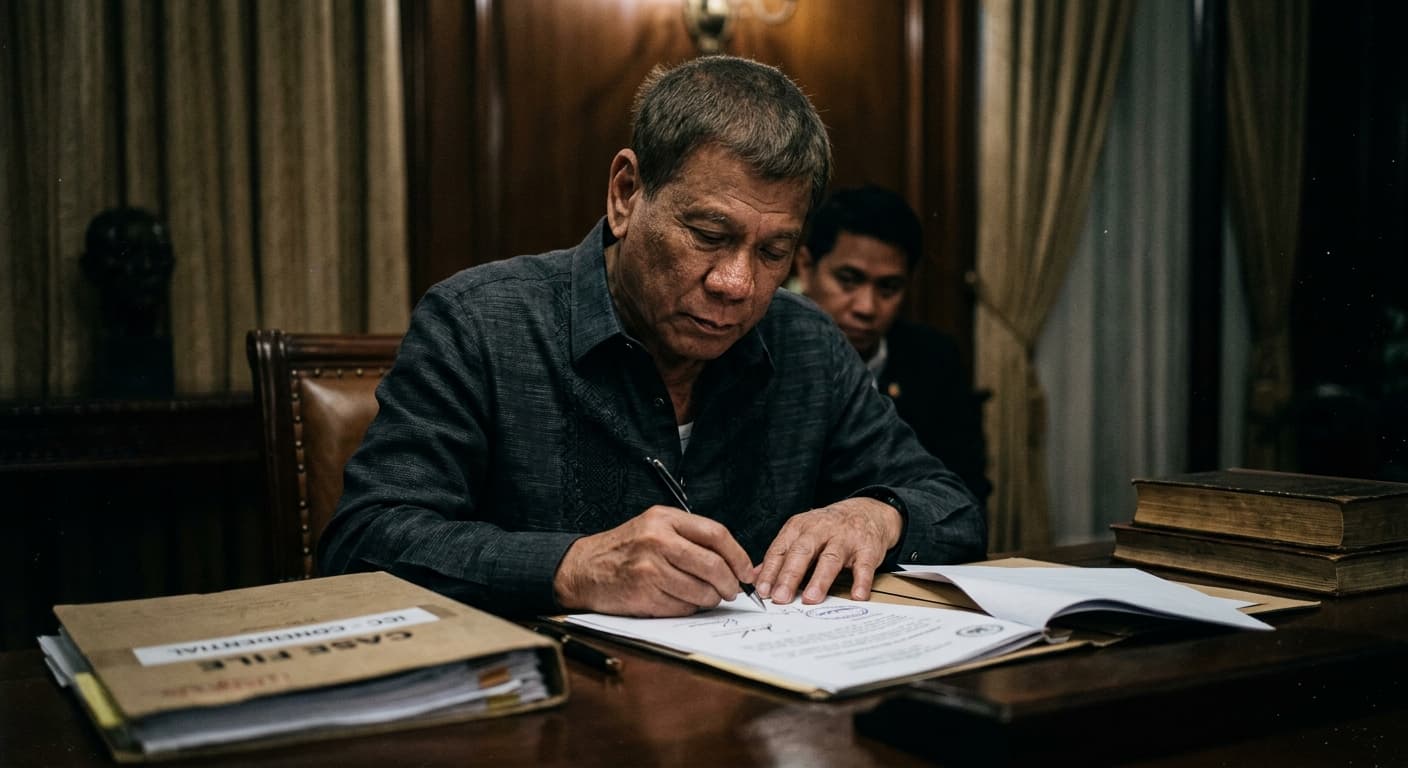
ICC Ruling on Duterte's Belongings Signals Trial-Ready Court
The International Criminal Court, on July 3, 2026, allowed prosecutors to examine items seized from Rodrigo Duterte on arrest — a narrow decision that operationalises the court's expansive jurisdictional finding of April 22, 2026.
The International Criminal Court's Trial Chamber III on July 3, 2026 released a redacted decision granting prosecutors access to two specific categories of material seized from former Philippine president Rodrigo Roa Duterte at his March 12, 2025 surrender, while denying a blanket request for "all keys" recovered from his person. The procedural ruling, published in the case The Prosecutor v. Rodrigo Roa Duterte (ICC-01/21-01/25), is minor on its face. It matters because it is the first tangible evidentiary act by the Trial Chamber since the Appeals Chamber affirmed on April 22, 2026 that a state's withdrawal from the Rome Statute does not defeat the court's jurisdiction over crimes committed while it was a party — converting a contested legal doctrine into an active prosecution five months from trial.
What the Trial Chamber decided
The six-page decision, filed as ICC-01/21-01/25-473-Red, was issued by a three-judge panel presided over by Judge Joanna Korner, with judges Keebong Paek and Nicolas Guillou. It responds to the Prosecution's second request, filed June 9, 2026, for materials in the custody of the Registry — the ICC's administrative arm that holds items seized on arrest. Prosecutors sought access to two redacted categories of items and, separately, "all keys" recovered from Duterte.
On the two specified items, the Chamber found "reasonable grounds to believe that the examination of these materials would produce evidence that is necessary for the investigation," according to the decision published on the ICC website. It ordered the Registry to transmit them to the Prosecution by June 24, 2026, and required the Prosecution to return the materials within two months of receipt and to treat any of Duterte's personal information as confidential.
On the keys, the Chamber sided with the defence. The Prosecution "does not specify to what items the Keys relate to, nor how such items may provide evidence that are necessary for the investigation," the ruling states. The defence had argued the keys were "seized while he was travelling with members of his family," raising the risk that examining them would "intrude upon the privacy rights of third parties." The Chamber concluded the request was "neither necessary nor proportionate."
The order sets a hard deadline — any further Prosecution request for Registry-held materials must be filed by June 30, 2026 — signalling the Chamber's intent to close the pre-trial evidentiary file well before the November 30 opening.
Why a procedural ruling matters
Read alone, the decision is a small administrative step. Read against the case's trajectory, it marks the moment the Duterte prosecution shifted from a jurisdictional argument into a functioning trial machine.
Until April 2026, Duterte's defence had two large procedural cards: fitness to stand trial and jurisdiction. Pre-Trial Chamber I disposed of the first on January 26, 2026, ruling him fit after a three-expert medical panel. The Appeals Chamber disposed of the second on April 22, 2026, upholding Pre-Trial Chamber I's October 23, 2025 finding that Article 127(2) of the Rome Statute preserves jurisdiction over conduct occurring while a state was a party — even after withdrawal.
The Appeals Chamber's reasoning, set out in filing ICC-01/21-01/25-415, is the doctrinal core of the case:
"It would be incompatible with this object and purpose to enable a State Party to evade its responsibilities under the Statute by depositing a written notice of withdrawal once it discovers that alleged crimes committed on its territory or by its nationals are being examined by the Prosecution."
The Philippines deposited its withdrawal notification on March 17, 2018 — approximately one month after then-prosecutor Fatou Bensouda announced a preliminary examination into the "war on drugs," a sequence the ICC's Philippines situation page records in detail. The Appeals Chamber's April ruling means that sequence cannot be used to defeat the case.
The July 3 decision on Duterte's belongings is what those rulings look like once they stop being briefs and start being investigative acts.
The charges and the numbers
Pre-Trial Chamber I on April 23, 2026 unanimously confirmed three counts of crimes against humanity — murder and attempted murder under Article 7(1)(a) of the Rome Statute — and committed Duterte to trial. The ICC press release states the charges cover a "widespread and systematic attack against a civilian population" between November 1, 2011 and March 16, 2019, spanning Duterte's tenure as mayor of Davao City and his presidency.
The confirmed charges cite a non-exhaustive list of 49 incidents and 78 victims. Prosecutors have separately named eight other individuals as alleged co-perpetrators in a lesser-redacted version of the document containing charges released February 13, 2026, Amnesty International reported. No further arrest warrants have been made public.
The underlying casualty universe is far larger. The June 2020 report of the UN High Commissioner for Human Rights, mandated by Human Rights Council resolution 41/2, documented at least 8,663 killings in official Philippine data from July 2016 alone, noting that the true figure "could be triple" that number. The Center for Strategic and International Studies has
summarised the Philippine government's own conservative estimate at 6,252 deaths in drug-war operations, while OHCHR's calculation reached "nearly 9,000."
Domestic accountability has stalled. Human Rights Watch reports that in nearly a decade since the nationwide campaign began, five domestic cases have produced convictions of a total of nine police officers. No senior official has been convicted in Philippine courts.
The disclosure record
The evidentiary base for trial is now substantial. In a filing dated December 24, 2025, the Prosecution reported disclosing 1,303 items of evidence to the defence between July 7 and December 18, 2025 — 906 classified INCRIM (incriminating), 389 as Rule 77 background material, and 8 as PEXO (potentially exonerating). Additional Registry-held items are now being drawn into the investigative file through the process the July 3 ruling formalises.
The Presidency constituted Trial Chamber III on April 24, 2026, in decision ICC-01/21-01/25-420. Trial Chamber III inherits the pre-trial record and will run the trial.
The wider legal context
The Duterte prosecution is proceeding against an unusually hostile political backdrop for the court. On February 6, 2025, US President Donald Trump signed Executive Order 14203, authorising asset freezes and travel bans on ICC officials and non-US persons who materially support ICC investigations of "protected persons" — a category defined to include US and allied nationals not consenting to ICC jurisdiction. Prosecutor Karim Khan was named in the order. On June 5, 2025, the US Treasury added four ICC judges — Reine Adélaïde Sophie Alapini-Gansou of Benin, Solomy Balungi Bossa of Uganda, Luz del Carmen Ibáñez Carranza of Peru, and Beti Hohler of Slovenia — to the sanctions list, according to an
ICC press release.
Judge Alapini-Gansou sat on the Pre-Trial Chamber that confirmed the Duterte charges. That the case has advanced on schedule despite sanctions on one of its confirming judges is itself a data point for how the court is weathering pressure. Brookings scholar Kelebogile Zvobgo, writing after Duterte's surrender, argued that Manila's cooperation shows "no one, not even a head of state or government, is free to violate international law." The Philippines is only the second country ever to arrest a former head of state and assist a transfer to the ICC — after Côte d'Ivoire in the Laurent Gbagbo case.
The politics in Manila
Duterte's arrest and prosecution have not translated into a domestic pivot. The current administration of Ferdinand Marcos Jr. has cooperated with the transfer but has not repudiated the "war on drugs" as government policy, and has not moved to rejoin the Rome Statute. Human Rights Watch called for Marcos to "begin the process of the Philippines' rejoining" the Statute in its April 23, 2026 statement; no such move has been announced.
The Duterte political bloc has treated the arrest as a sovereignty affront. Vice President Sara Duterte characterised it as "an affront" to the Philippines when her father was flown to The Hague, and Duterte allies continue to mobilise supporters. That domestic environment matters for a specific reason: the ICC's confirmed charges list is non-exhaustive, and the Office of the Prosecutor has flagged eight named co-perpetrators. Any further arrest warrants would land inside Philippine politics, not outside it.
What to watch
- June 30, 2026 deadline (elapsed): The Chamber's cut-off for any further Prosecution request for Registry-held materials. Any late-filed application will indicate whether the Prosecution intends to expand the pre-trial evidentiary base or considers it closed.
- Redacted filings due by mid-2026: The Chamber ordered the parties and Registry to file public redacted versions of their submissions on both materials decisions. Publication will reveal what the redacted items in the July 3 order actually are.
- November 30, 2026: Scheduled opening of trial before Trial Chamber III. Status conferences before that date will fix witness lists, victim participation modalities and webstreaming arrangements. The ICC has said
practical trial information will circulate closer to the date.
- Further arrest warrants: Eight co-perpetrators are named in the confirmed charges. Whether Prosecutor Khan seeks additional public warrants — and whether Manila would execute them — is the next test of Philippine cooperation.
The Bottom Line
The July 3 ruling on Duterte's belongings is a procedural footnote that reveals the shape of the case around it: after the Appeals Chamber closed the withdrawal-jurisdiction escape hatch in April, the ICC is now working with the granular tools of a trial court — inventories, keys, deadlines. For international criminal law, the Duterte case is becoming the answer to a question Rome Statute drafters left ambiguous: whether a state can escape accountability by leaving the treaty after it is investigated. The Trial Chamber's answer, five months from opening, is that it cannot.
Human Rights Watch, in its April 2026 statement, framed the stakes in operational terms: "ICC member countries should redouble their efforts to protect the court and those supporting its work, so it can deliver on its essential mandate in the Philippines and beyond."
The bottom line: The Prosecutor v. Duterte is no longer a jurisdictional experiment. It is a scheduled trial of a former head of state whose country left the ICC to avoid exactly this proceeding — and the doctrine the court has built to get here will outlast the verdict.
Discover more
US Politics
SNAP Food Assistance Faces Legal Challenges
In 2026, SNAP faces stricter eligibility rules and mounting legal challenges, threatening food assistance for the millions of Americans who rely on the program.
Global Politics
Xi Jinping Calls China-Russia Ties 'Precious'
Xi Jinping's description of China-Russia ties as 'precious' reflects a strategic imbalance, with Beijing dictating terms in the partnership.
India
Women's Reservation Bill 2026: A Political Sh
India's Lok Sabha rejected the Women's Reservation Bill, exposing a political maneuver to redraw electoral maps favoring the north over the south.

Economics
Fed's Amex AML order puts correspondent banking on notice
Federal Reserve's Amex AML order requires board-level controls and a 90-day plan; OCC fined the bank $350 million over enterprise-wide deficiencies.