Hormuz's New Normal: Prediction Markets Fail
Kalshi traders misjudge Strait of Hormuz risks.
Model Diplomat7 min readMiddle East
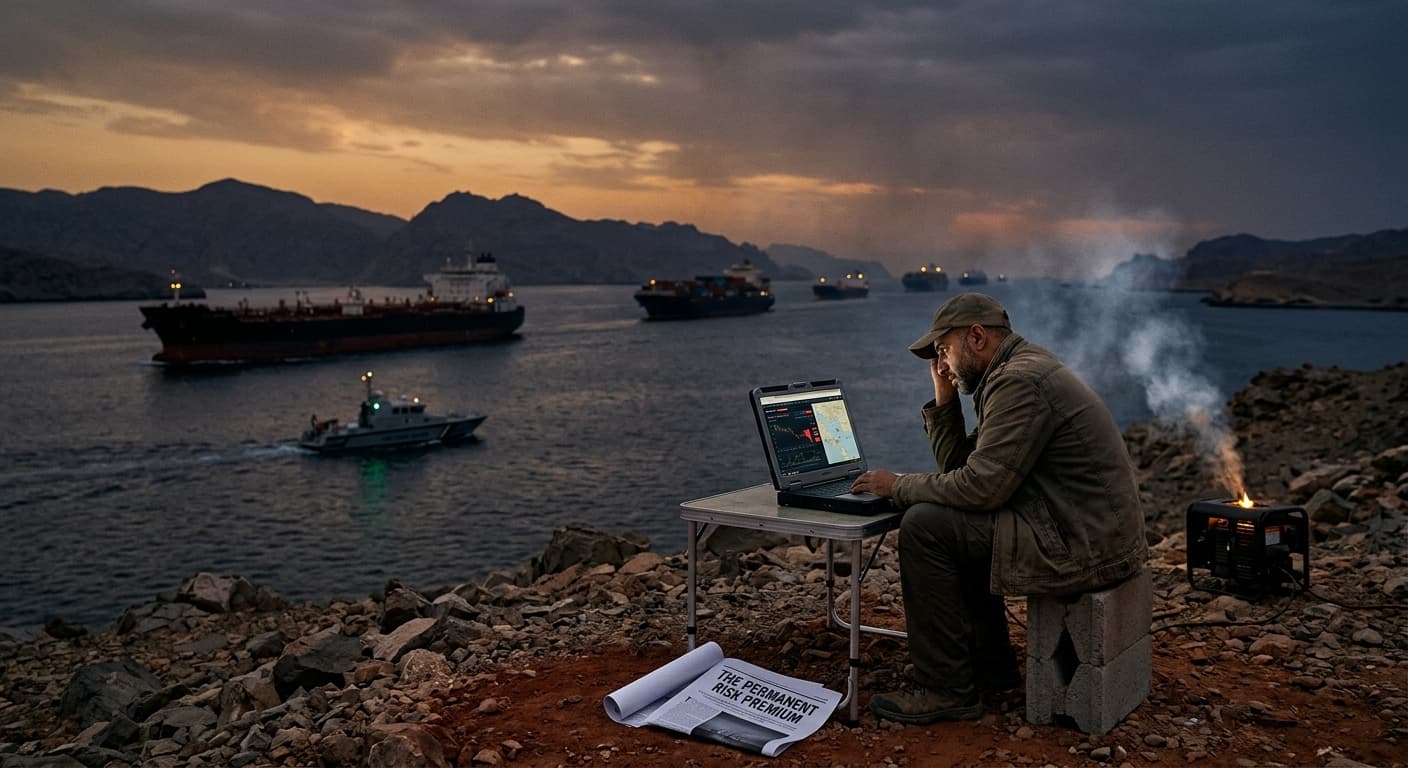
Hormuz's New Normal: Prediction Markets Keep Losing the Bet
Kalshi traders keep pricing the Strait of Hormuz as a temporary shock. The July 7 tanker strikes and the WTO's own data suggest it is now a permanent risk premium — and a structural break for global energy security.
The load-bearing assumption inside every reopening bet on the Strait of Hormuz is that the world eventually returns to the pre-February 2026 baseline of 120–140 daily transits and 20 million barrels a day of oil moving unmolested to Asia. That assumption is quietly dying. After the July 7 tanker attacks and the U.S. strikes on Bandar Abbas that followed, Kalshi's contract for normal Hormuz traffic before January 2027 is priced at just 53% — the fifth downward revision since March, and the first time traders concede a return to "normal" is essentially a coin flip a year and a half into the war. The story of this chart is not a wobble in odds. It is a market repeatedly mispricing a regime change as a series of shocks — and the second-order consequences, for climate policy as much as for oil, are already visible in Delhi, Doha, Tokyo, and Brussels.
What the prediction markets keep getting wrong
Kalshi defines "normal" using IMF PortWatch data: a seven-day moving average above 60 transit calls. On that yardstick, the platform has been consistently, systematically too optimistic. In March, traders priced a 76% probability of normalization by July 1, according to IBTimes' reconstruction of the contract history. By April the number for July 1 had already slipped to 59%. May pushed the median expectation into September; June, into 2027. On July 8, a parallel
Manifold market on end-of-July normalization crashed to roughly 2% after Iran's Islamic Revolutionary Guard Corps hit three commercial vessels and the U.S. responded with 90 targets across Iran's southern coast.
That pattern — five straight monthly revisions in the same direction — is what statisticians call model misspecification. Traders are running a mean-reversion model against a process that no longer mean-reverts. The Council on Foreign Relations put the underlying reality bluntly on July 9: "there is simply no precedent for unwinding a market disruption of this magnitude" — a shut-in equivalent to more than 10 million barrels per day and roughly 300 million cubic meters per day of LNG for over 100 days. Even the optimistic scenarios in CFR's Clara Gillispie's analysis assume a phased restart measured in years, not weeks.
The primary document: WTO says the ceasefire barely moved the ships
The most damning data on the "new normal" thesis is not in a Kalshi order book. It is on the WTO's own dashboard. The joint WTO–AXSMarine Strait of Hormuz Trade Tracker, updated through late June, reports that since the June 17 Memorandum of Understanding "shipping through the Strait of Hormuz has shown only limited and uneven signs of restarting." Outbound crude is "limited to only a few isolated shipments." Outbound LNG has produced "no visible AIS-traceable" shipments to destinations outside the Persian Gulf. Fertilizer-related outbound flows have "remained absent or effectively at zero."
That is a WTO judgment, on WTO infrastructure, three weeks after Donald Trump publicly declared the strait reopened. It is the primary-source refutation of the market's optimism. It is also consistent with Kpler data cited by Al Jazeera: in the three weeks after the MoU, average daily transits of commodity vessels reached only 34, peaking at 59 on June 24 — still below the Kalshi threshold. Wartime crossings have since fallen back below 20 a day.
Why this is not just an oil story
The reason a Hormuz "new normal" matters for climate as much as for crude is that the strait is quietly the world's fertilizer chokepoint. Roughly 30% of seaborne fertilizer trade transits Hormuz, and the World Bank's fertilizer price index has climbed to its highest level since October 2022, according to figures cited by former Kuwaiti diplomat Abdulla Banndar Al-Etaibi in Al Jazeera. The Food and Agriculture Organization has warned the resulting shortfall in urea will show up as lower yields through the 2026–2027 growing season, hitting food-insecure economies in Africa and Asia hardest.
That is the slow-burn tail. The fast one is on health and labour markets. In an unusually direct primary text, the World Health Assembly's resolution A79/A/CONF./4 formally recognises that "disrupted shipping flows through the Strait of Hormuz affect the supply of food, fertilizers, and the availability of essential health commodities." The ILO has projected that the shock could cut world merchandise trade growth in 2026 from 4.7% to as low as 1.5%, in a
May 2026 technical note building on UNCTAD modelling. And the International Renewable Energy Agency, in
an April 2026 policy advisory, argues that only accelerated renewables build-out can move the region — and its customers — from crisis to durable security.
The paradox worth watching: in the short run, a permanent Hormuz risk premium is bullish for coal. Carbon Brief's analysis of 60 national responses documents that Japan, South Korea, Germany, Italy, Bangladesh, the Philippines, Thailand and Pakistan have all leaned harder on coal since March. In the medium run it is bearish for LNG demand growth, because it destroys LNG's marketing pitch as a "reliable" transition fuel. The
Institute for Energy Economics and Financial Analysis argues that spot LNG prices in Asia have doubled and are "widely projected to remain elevated through 2027," pushing South Korea to restart six nuclear reactors and the Philippines to cancel two LNG-to-power projects outright.
That is the climate signal buried in the Kalshi curve: chronic Hormuz instability is not just an oil-price story. It is quietly rewriting the LNG demand curve for the 2030s, and it is one of the few forces on earth capable of accelerating renewables and coal simultaneously.
Who is preparing for the "new normal" — and who isn't
Follow the capex. TotalEnergies CEO Patrick Pouyanné told a Paris conference on June 24 that bypassing Hormuz is now "an absolute priority," pushing pipeline diversification through Iraq, Syria, and Turkey. According to OilPrice.com, his argument is that only new export infrastructure — not tankers or storage — durably reduces the chokepoint premium. The UAE is fast-tracking a second parallel pipeline to Fujairah, targeting more than 3 million bpd of bypass capacity by 2027. Iraq's Kirkuk–Ceyhan pipeline has been reactivated to handle 170,000–250,000 bpd, held up mainly by an unresolved dispute with Ankara.
The India–Middle East–Europe Economic Corridor (IMEC), launched at the 2023 G20 and stalled by war, has been redesigned around Oman rather than the UAE — precisely so ships from India can offload outside the strait. If completed, planners estimate IMEC could divert 60% of Hormuz-transiting container traffic. Combined pipeline capacity, per the U.S. Congressional Research Service's Iran Conflict and the Strait of Hormuz report, currently offers only 2.6 million bpd of bypass — against the 20 million bpd that moved through in 2024. The bypass gap is the "new normal" priced into steel.
India, which historically routed 45% of crude, 50% of LNG and 90% of LPG through Hormuz, has quietly pivoted: the United States became India's largest LNG and LPG supplier in May 2026, with LNG shipments tripling month-on-month. That is a structural shift, not a spot trade. It is also the clearest illustration that customers, not just producers, are pricing Hormuz as permanent risk. New Delhi is not waiting to see whether Kalshi's next contract prints 44% or 53%.
The insurance market has already moved. War-risk premiums on Hormuz transits sat below 0.25% of hull value pre-war, according to industry sources cited by Al Jazeera; after the MoU they stabilised at 1–3%, and spiked as high as 5–8% after the July 7 attacks. On a $100 million hull, that is $1 million to $8 million per voyage — a premium that behaves like a permanent tax, not a temporary spike. Washington's International Development Finance Corporation has committed up to $40 billion in reinsurance capacity to keep vessels moving. When the state has to become the insurer of last resort for a "reopened" waterway, the market has already told you the reopening is fiction.
Diplomat View
The dominant frame — "when will Hormuz reopen?" — is the wrong question. It has already reopened, three times, and reclosed three times, since June 17. The correct question is whether transit capacity above the 60-vessel threshold can be sustained without a fresh U.S. bombing campaign every two weeks. On present evidence — Iran's Persian Gulf Strait Authority still standing, its national insurance scheme still soliciting bookings, the Article 5 dispute over "arrangements" still unresolved, and roughly 80 mines still in the main channel per CFR — the answer is no.
Our thesis, falsifiable: Hormuz normalization by January 1, 2027 will not happen. What will happen is a two-tier regime — an Iranian-approved northern route and a U.S./Omani southern route — with periodic violence pricing a permanent 2–4% risk premium into every Gulf barrel and every Gulf cargo. The forecast is wrong if two conditions revise simultaneously: Iran dismantles the Persian Gulf Strait Authority and accepts UNCLOS transit-passage language in a final deal, and mine clearance is verified by an IMO-led mission. Absent both, prediction markets will keep chasing the tape.
What to watch:
- July 17, 2026 — U.S. Treasury waiver on Iranian oil sales expires; a full sanctions snapback would end even the fiction of the MoU.
- August 16, 2026 — 60-day MoU negotiating window closes; Article 5 language on strait "arrangements" must be reopened or extended.
- October 2026 — QatarEnergy's post-strike Ras Laffan repair schedule delivers its first restart signal; damage there is projected to persist up to five years, per CFR.
- COP31 — first multilateral setting where the Hormuz risk premium collides directly with LNG "transition fuel" politics; watch Japan and Germany's language on coal-return commitments.
The Bottom Line
Prediction markets are not wrong about Hormuz because they are badly designed; they are wrong because they are pricing a shock model against a regime change. The WTO data, the WHO resolution, the IEEFA numbers on LNG demand destruction, and the $40 billion U.S. reinsurance backstop all point the same way: the "new normal" is a permanently taxed chokepoint, and the beneficiaries are American LNG exporters, Chinese refiners buying discounted Iranian crude, and the renewables build-out in Asia — not the shipping economy that Kalshi keeps betting on.
Discover more

Climate & Energy
IEA Warns Critical Mineral Supply Crisis Deep
IEA's 2026 Global Critical Minerals Outlook warns that export controls and price volatility are deterring private investment, deepening China's refining dominance and threatening $6.5 trillion in downstream production.
Global
Strait of Hormuz War Escalates to Water War
US bombs Iran for ninth night, striking Tabriz for first time; Iran hits Kuwaiti desalination plants. The Strait of Hormuz war escalates into a battle over survival infrastructure as the June ceasefire collapses.
Global
Iran's $6 Billion Oil Windfall During US Truc
Iran shipped 70 million barrels of crude worth $6 billion to China during a 30-day US sanctions pause, blunting the renewed naval blockade's economic impact for months.
Global
Iran's $6 Billion Oil Surge During US Truce
Iran exported 70 million barrels of oil worth $5-6 billion during a 27-day US truce in June 2026, exploiting a temporary OFAC license to refill its war chest and exposing a structural flaw in the blockade strategy.