Ukraine Strikes 35 Russian Tankers in 96h
Ukrainian drones disrupt Russia's fuel supply to Crimea.
Model Diplomat8 min readEurope
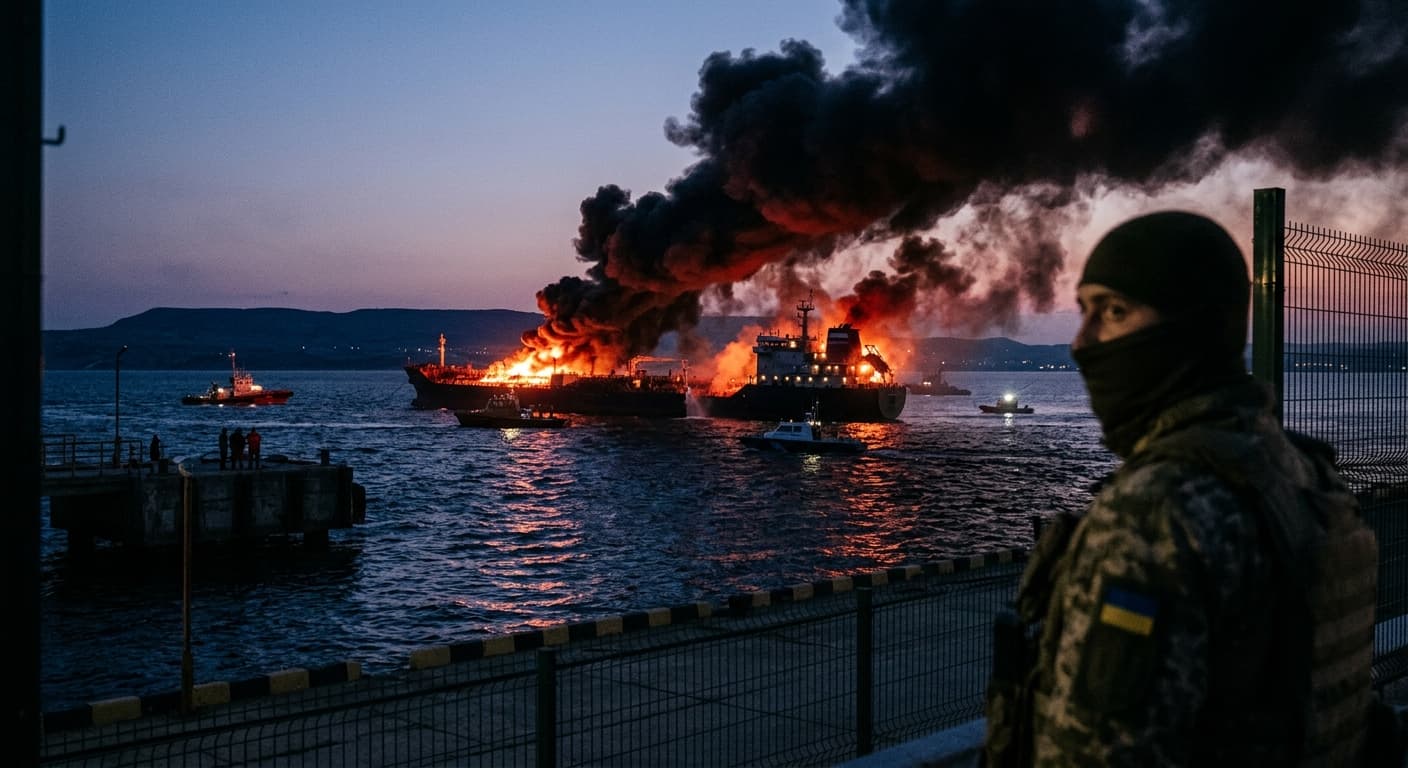
Ukraine strikes 35 shadow-fleet tankers in 96 hours, choking Crimea
Ukraine says 35 Russian shadow-fleet ships were hit in four days, including 14 overnight July 9. The strikes are severing Crimea's fuel lifeline where sanctions could not.
Ukraine's Unmanned Systems Forces (USF) hit 14 more Russian vessels in the Sea of Azov overnight into July 9, 2026 — 12 tankers, one dry cargo ship, and one tugboat — bringing to 35 the number of shadow-fleet ships Kyiv claims to have struck in 96 hours, according to a Telegram statement from USF commander Robert "Magyar" Brovdi that has not been contested by Russian pro-war channels. The strategic point is not the ship count. It is that Ukrainian drones have done in four nights what three years of Western sanctions did not: they have made a specific, high-value slice of Russia's shadow fleet — the tankers running gasoline from Taganrog to occupied Crimea — commercially untenable to operate at all.
That reframes a story usually told through sanctions-package numbers. The G7 price cap, EU designations, and Baltic boarding regimes have raised costs and forced re-routings, but Russian oil has kept flowing. In the Sea of Azov, Kyiv has removed the intermediary. It is destroying the hulls.
What happened, in precise detail
Brovdi began reporting strikes on July 6, initially claiming two Project 15781 tankers of roughly 7,000-tonne deadweight, each said to be carrying about 7,000 tonnes of fuel from the Taganrog area to Crimea. By July 7, according to the BBC's Russian and Ukrainian services, the tally had reached eight tankers, one dry cargo vessel, and one ferry. Brovdi named seven of the vessels — Venera-3, Sanar-1, Sanar-17, Klimena, Thetis, Alexey Savrasov and Penelopa — describing them as sanctioned, roughly 140 metres long, and built between 2006 and 2012.
On July 8, the USF reported nine additional tankers hit, and Ukraine's General Staff released naval-drone footage of an attack on a sanctioned tanker named Blue, said by Kyiv to have occurred near Yalta on Crimea's southern coast. Russia's Rostov governor Yuri Slyusar acknowledged that two "empty" tankers hit in Taganrog Bay were still burning the next day. Overnight into July 9, Brovdi reported 14 more vessels struck — 12 tankers, one dry cargo ship and one tugboat — and posted individual clips of drones flying onto stern-mounted wheelhouses. "The battle for gasoline for Crimea in the Sea of Azov continues," he wrote. Not every strike has been independently verified, and some ships may have been hit more than once,
BBC News noted.
Kyiv's framing is explicit. The Ukrainian General Staff called the vessels part of Russia's "shadow fleet" used to supply "fuel and lubricants to Russian military units" and to move sanctioned oil. The strikes are the maritime extension of what Ukraine has branded a "logistics lockdown" of Crimea — a campaign that in June already forced Moscow-appointed governor Sergey Aksyonov to halt public fuel sales on the peninsula and impose 20-litre-per-driver rationing.

Why the Sea of Azov is the weak point
The geography matters more than the number. Russia's main seaborne oil exports move through the Baltic and Novorossiysk on the Black Sea; those flows have continued, and rising post-Hormuz crude prices have more than compensated for lost export volumes so far, according to the Carnegie Endowment for International Peace. But the Sea of Azov is different. It is a shallow, semi-enclosed basin under 15 metres deep in most places, ringed by Russian-occupied coastline, and closed to civilian traffic under Kyiv's blockade regime. Vessels sailing it are, by definition, engaged in Russian domestic or military logistics — chiefly the movement of gasoline and diesel from Rostov-region refineries to Kerch and Feodosia in Crimea.
Vladimir Putin estimated in late June 2026 that Crimea needs about 70,000 tonnes of fuel per month, promising to guarantee supply by sea and land. A single Project 15781 tanker of the type Kyiv has been targeting carries about 7,000 tonnes — the equivalent, Brovdi noted, of "200 rail tank-cars." Ukraine has now claimed to hit at least 19 such tankers in 72 hours. Even accounting for exaggeration and double-counting, that is a supply shock the peninsula's rationed distribution system cannot easily absorb.
The strikes coincide with Ukraine's broader deep-strike campaign against refineries. According to the OSW Centre for Eastern Studies, the Omsk Oil Refinery — 2,500 km from the Ukrainian border — was hit on July 6, which the Ukrainian General Staff described as the last of Russia's 11 largest fuel producers to remain outside long-range Ukrainian reach. Russia has now banned diesel exports, and BBC News reports fuel rationing in more than 90% of Russian regions.
Why Western sanctions could not do this
The Sea of Azov strikes expose the ceiling of the Western sanctions strategy. On April 23, 2026, the EU adopted its 20th sanctions package, bringing the total number of shadow-fleet vessels on the EU list to 632, and formalising mandatory "no-Russia" clauses in tanker sales — codified in
Council Regulation (EU) 2026/506, which requires due diligence on all EU tanker sales and prohibits transfer to any entity "for use in Russia." Approximately 17% of the world's oil tanker fleet is now considered part of a shadow fleet, according to the
Stiftung Wissenschaft und Politik (SWP).
Yet the effect on Russian revenues has been marginal. SWP estimates Russia still generates more than €10 billion per month in oil export revenues, and the Kyiv School of Economics calculates that Russia has lost about $166 billion in cumulative oil revenues between March 2022 and January 2026 — a real number, but one absorbed over four years, not four days. Brookings' Robin Brooks and Ben Harris document that by March 2025, 77% of the identified shadow fleet had been sanctioned by at least one Western jurisdiction,
yet the fleet kept expanding, with over 40% of new tankers sold in by EU — chiefly Greek — owners.
Europe's inability to interdict physically has been the binding constraint. France, the UK, Estonia and Germany have each boarded suspect vessels this year, but Russia contests those actions under the UN Convention on the Law of the Sea, and legal caution has kept the Baltic effectively open. The Atlantic Council notes that even after the UK's June boarding of a shadow tanker — its first — more than 200 sanctioned tankers had transited British waters in the 11 preceding weeks unchallenged.
Kyiv's Azov campaign short-circuits that debate. UNCLOS does not restrain a state at war from striking military logistics inside a theatre of active conflict. Where Baltic and Mediterranean shadow tankers can still argue insurance certificates, an Azov tanker cannot argue with an FPV drone.
The insurance angle — where this hurts most
The second-order effect is where the Sea of Azov strikes may reset the economics of the entire shadow fleet. Roughly 85% of shadow tankers already rely on undercapitalised or opaque insurance — a "systemic liability gap" identified by the New Strategy Center's Ghost Fleet report — because IG P&I clubs will not underwrite above-cap voyages. In late February 2026, according to Lloyd's List cited by the
Atlantic Council, roughly one-third of tankers crossing the Baltic sailed on certificates from sanctioned Russian or Russian-linked insurers.
Kinetic risk changes those maths. Hull war-risk premiums for the Black Sea rose sharply after the 2022 invasion; a wave of confirmed strikes inside the Sea of Azov gives Russian and third-country insurers who cover shadow-fleet voyages a live claims problem, not a hypothetical one. The Kremlin has options — self-insurance through Russian state insurers, or outright compensation to owners — but each transfers the cost from the buyer back onto the Russian budget, which is precisely what the price cap was designed, and largely failed, to do. That is the quiet mechanism by which Ukrainian drones are finishing the sanctions job.
Who benefits, who loses
The immediate loser is Russia's Southern Military District logistics chain and, through it, Crimea's civilian and military fuel economy. Aksyonov's June rationing decree was already politically embarrassing for Moscow at the height of tourist season; the July strikes make lifting rationing implausible for weeks.
The less obvious loser is Russia's newly formalised "official" shadow-fleet insurance ecosystem — Russian Maritime Register of Shipping-flagged vessels and sanctioned domestic insurers — which Moscow has spent 2025 and 2026 building precisely to defeat Western pressure. That model assumes the risk is regulatory. It does not price kinetic loss.
The clearest beneficiary is Ukraine's Unmanned Systems Forces, which The Economist described in March as pioneering methods "NATO is yet to learn." Brovdi's forces account for 2% of Ukraine's military but claim a third of all confirmed targets destroyed,
according to the BBC. The Azov operation is a proof-of-concept for the next phase of Ukraine's war strategy — using cheap, mass-produced drones to enforce economic outcomes that expensive sanctions regimes cannot.
Counter-perspective
The Carnegie Endowment argues that focusing on physical export disruption misreads Russia's fiscal architecture: Moscow's oil tax is levied at the wellhead, indexed to average monthly export prices, so temporary volume losses matter less than headline prices. By that logic, striking tankers hurts Rosneft and Lukoil balance sheets more than the federal budget — until strikes force actual production cuts, which no analyst yet claims. Russian pro-war Telegram channels, notably, did not dispute Brovdi's July 8–9 footage, an unusual concession that suggests the operational damage is real. But whether it translates into strategic effect depends on whether Ukraine can sustain the tempo.
What to watch
- Crimea fuel prices and Aksyonov's next decree: Will rationing tighten from 20 litres per driver, and will diesel supplies to Russian military units on the peninsula be affected in the next 10 days?
- Kerch and Feodosia tanker traffic: Satellite imagery already shows fewer tankers loitering off Kerch after last month's port strike; a further decline would confirm Russia is pulling vessels out of Azov entirely.
- Insurance market signals: Watch Lloyd's List and IUMI commentary on war-risk premiums for Russian domestic tanker routes — the first hard data on whether kinetic risk is repricing shadow-fleet economics.
- EU 21st sanctions package: Council of the EU meetings across July and September will indicate whether Brussels moves on shadow-fleet insurers and port operators, as
SWP and Carnegie have urged.
- Russian retaliation vectors: Increased missile pressure on Odesa port infrastructure and the Ukrainian Black Sea export corridor, which has now carried
more than 8,000 civilian vessels since 2022, according to Ukrainian Navy spokesperson Dmytro Pletenchuk.
The Bottom Line
Ukraine's 96-hour strike wave has done to a slice of Russia's shadow fleet what the G7 price cap, 20 rounds of EU sanctions, and Baltic boarding operations combined have not managed in three years: it has taken the ships out of service. The strategic message is that the shadow fleet's real vulnerability was never regulatory — it was physical, and it lives in a shallow sea Kyiv now controls with drones. If the tempo holds through July, the story stops being about how Russia evades sanctions and starts being about whether Moscow can insure its own war logistics at any price.
Discover more
US Politics
House Ethics Committee Pushes Sexual Miscond.
The House Ethics Committee has shifted responsibility for sexual harassment settlement records to the Office of Congressional Workplace Rights, complicating disclosure efforts.

India
BJP's Misunderstanding of Women's Quota Needs
The BJP's linking of the Women Reservation Bill to delimitation risks delaying women's empowerment in India, misreading the aspirations of female voters.

US Politics
White House Pressures Congress for Crypto Leg
The Trump administration's push for the CLARITY Act aims to reshape crypto regulation, impacting trillions in market value and the Trump family's wealth.

Economics
Fed's Amex AML order puts correspondent banking on notice
Federal Reserve's Amex AML order requires board-level controls and a 90-day plan; OCC fined the bank $350 million over enterprise-wide deficiencies.