Hormuz Oil Supply Shock: Reality Check
Analyzing the true impact of the Hormuz crisis on oil supply.
Model Diplomat8 min readMiddle East

The Hormuz Supply Shock Was Half the Size Advertised
Traders now put the net Gulf oil loss at 2 million barrels a day, not 14. Here's why the "largest disruption in history" barely broke $95 Brent — and who benefits.
The largest oil supply shock ever recorded turned out, on the numbers that actually cleared, to be roughly one-seventh the size advertised. Headline estimates from the International Energy Agency put Gulf output losses at more than 14 million barrels per day after Iran shut the Strait of Hormuz on March 4, 2026; by mid-June, two major trading houses were telling Reuters the true global imbalance was closer to 2 million barrels a day once alternative logistics, strategic releases and Chinese demand destruction were netted out. That gap — between the disaster forecast and the physical market — is the reason Brent peaked at $126 in April and was back to $72.68 by June 25, and it is quietly reshaping how governments, insurers and climate planners will price the next Gulf shock.
The number that shrank
The initial estimates were not wrong; they were measuring the wrong thing. The IEA's March 2026 Oil Market Report called this the "largest supply disruption in the history of the global oil market," with Gulf countries cutting output "by at least 10 mb/d" as shipping through Hormuz collapsed from 20 mb/d to a trickle. The
World Bank's April 2026 Commodity Markets Outlook recorded 10.1 mb/d lost in March and projected a 6.9 mb/d year-on-year drop in Q2 output — the sharpest quarterly decline since the pandemic. The U.S. Energy Information Administration, cited by
NPR, later pegged the May shortfall at "more than 11 million barrels a day."
Those figures measured production shut-ins and lost seaborne exports. They did not measure the net barrels missing from global consumption after buffers ran. That distinction is where the market lived. By early April, Petro-Logistics data cited by CSIS showed Gulf crude and condensate exports via Hormuz had fallen from 16.3 mb/d to 1.2 mb/d — but 3.7 mb/d were already being redirected by Saudi Arabia to the Red Sea and by the UAE to Fujairah in the Gulf of Oman. Kpler's cumulative loss estimate of 961 million barrels through late May implied over 11 mb/d in supply gone, but its own analysts noted that "after an initial disruption, flows strengthened as alternative logistics scaled up."
By June, Reuters was reporting that traders at two major houses saw actual physical losses of just 5–6 mb/d — and that once China's own demand collapse was subtracted, the total oil market imbalance was closer to 2 mb/d.
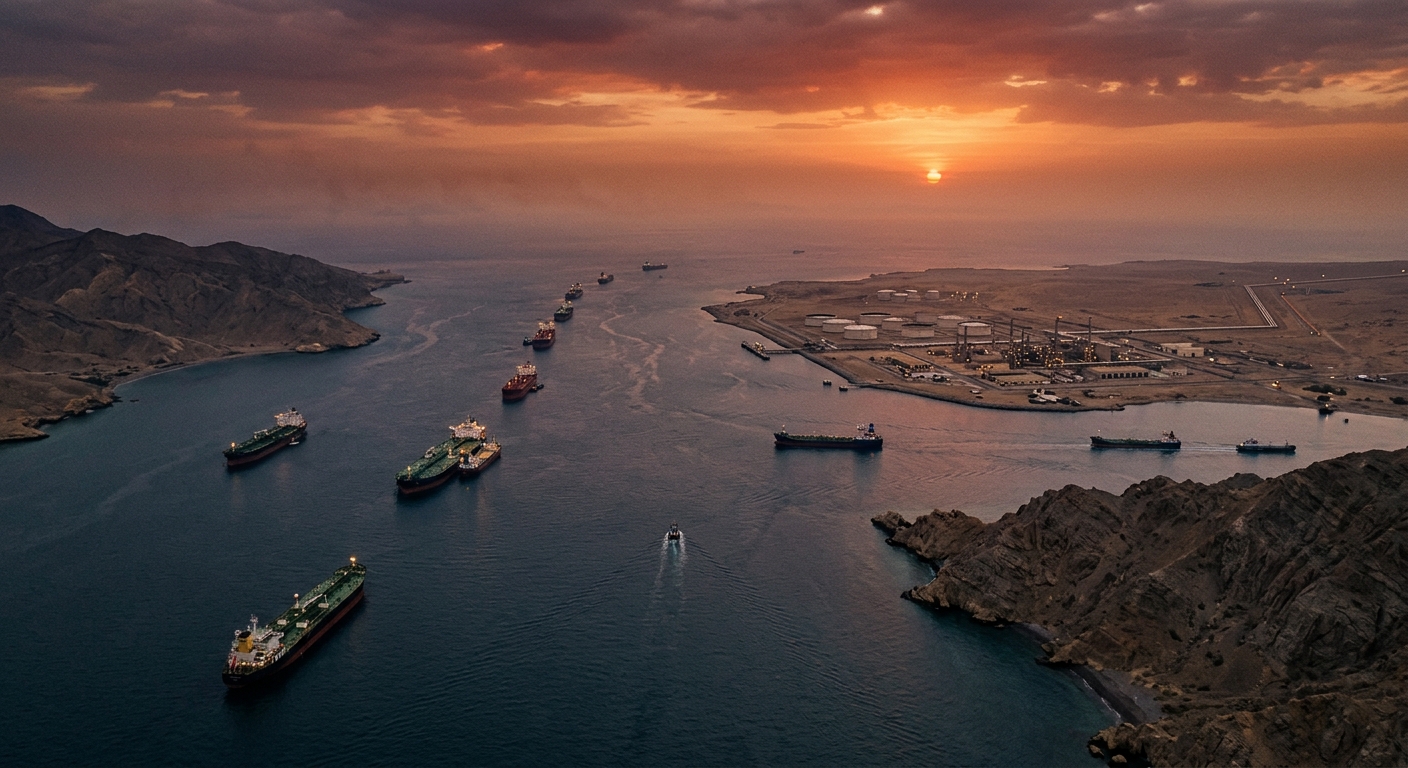
The three shock absorbers no one priced
Three buffers did most of the work, and none was fully captured in the March headlines.
The first was pipelines. Brookings' June 2026 assessment documented that Saudi Arabia's East-West pipeline ran at its full 7 mb/d capacity to Yanbu on the Red Sea and the UAE's Habshan–Fujairah line at its full 1.8 mb/d — utilisations that pre-war capacity assessments by the
Congressional Research Service had put at just 2.6 mb/d of available bypass. Gulf producers used every inch of that infrastructure and then some, including "dark mode" transits by tankers that switched off transponders to slip past the IRGC.
The second was strategic reserves. The IEA coordinated the largest reserve release in its history — nearly 400 million barrels, roughly a third of member governments' 1.2 billion-barrel stockpile. Executive Director Fatih Birol said the release added 2.5–3 mb/d to the market. A parallel
Brookings supply-shortfall model estimated Russian floating stocks contributed another 1.6 mb/d through April and Iranian floating stocks 1.3 mb/d through May. Combined "permanent" buffers replaced roughly 6.4 mb/d of lost Hormuz crude — a number the March panic simply did not price.
The third, and the one that surprised the traders, was demand. The IEA's April report cut 2026 demand growth from +640,000 bpd to a projected fall of 80,000 bpd, calling for a Q2 contraction of 1.5 mb/d — "the deepest since COVID." China did the heavy lifting:
Al Jazeera reported that Chinese seaborne crude imports fell from 11.51 mb/d in February to 10.19 mb/d in March, with Middle Eastern crude accounting for over half of that intake. Beijing drew on a reserve pile CSIS's
ChinaPower project values at roughly 1.4 billion barrels — enough to cover about four months of net crude imports — and ordered refiners to stop exporting fuel to keep domestic prices controlled, per
BBC reporting.
Net it out and the "biggest shock in history" was, in traded terms, absorbed by pipes, tanks and a demand cliff.
Winners, losers and the toll booth
The redistribution of gains and pain is where this crisis is quietly rewriting the map.
Winners. Saudi Aramco reported a 26% first-quarter profit jump, per NPR, as the East-West pipeline kept Riyadh's barrels flowing at prices well above pre-war levels. Iran, paradoxically, was a mid-war winner too: with competitors bottled up and Brent north of $110,
Kpler data cited by Al Jazeera shows Iranian exports averaged 1.84 mb/d in March at an estimated $5.13 billion in monthly revenue — until the April 13 U.S. blockade collapsed volumes to under 300,000 bpd. The IRGC's tolling scheme, reported at $1–$2 per barrel by
CSIS and up to $2 million per tanker at peak by
Al Jazeera, is likely to persist in some form — a Danish-Sound-style transit fee grafted onto 21st-century energy trade, as the
International Crisis Group has argued.
Losers. Qatar's Ras Laffan LNG complex will need up to five years to rebuild, according to CFR analysis, stripping roughly 20% of global LNG supply and 5% of world natural gas for the foreseeable future. Iraq bore the sharpest export cut — 82% from February to March, per
Kpler data analysed by Al Jazeera — and lacks the pipeline options of its Gulf neighbours. Europe absorbed a specific pain: half its jet fuel imports came from the Gulf, per
HCSS, and Brussels was forced into its fourth temporary state-aid framework since 2020 to subsidise consumer prices.
The quiet beneficiary is China. Beijing turned a supply crisis into strategic depth: its 1.4-billion-barrel reserve was assembled largely from sanctioned Iranian and Russian crude at deep discounts, giving it "roughly 109 days of seaborne import cover," as Bruegel's Alicia García-Herrero noted. When U.S. sanctions on Iran were temporarily lifted under General License X in late June,
Atlantic Council analysis found that Chinese purchases held steady while India — running dangerously low on fuel — became the swing buyer courting Iranian barrels.
The historical parallel that matters
The 1973 Arab oil embargo removed about 7% of global production and defined a generation of energy policy. The Atlantic Council calculated that the 2026 Hormuz crisis at its peak reduced 13% of global oil supply — nearly double 1973 — yet Brent never sustained levels above the $128 April 2 spike, and by late June was trading below its pre-war average of the 2022 Ukraine invasion aftermath.
Why? Because the 1973 shock hit a market with no strategic reserves, no shale, and no China stockpile. The 2026 shock hit a market with a 1.2 billion-barrel IEA cushion, an American oil sector that set a monthly production record of 13.934 mb/d in April 2026 per Al Jazeera's citation of EIA data, and a Chinese reserve system larger than any single member of the IEA. Even the Congressional Research Service's
historical review had warned that "actual Iran-related events since 1980 have not resulted in clear and significant price rises ex-post." The 2026 outcome confirms the pattern at a shocking new scale: geopolitical chokepoints matter far less than the buffer stack around them.
The climate second-order effect
Here is what did not happen in 2026: a durable pivot to renewables driven by fear of Gulf supply. Because the shock cleared faster than anyone modelled, the political case for accelerating the energy transition — the case Europe made after 2022 — is weaker in 2026 than the IEA's own Al Jazeera-reported demand-destruction figures might suggest. Chinese EV adoption, per the
ChinaPower analysis, was already the country's primary insulation from the shock; the war reinforced Beijing's cost-of-electrification calculation but did not force it. Europe's
AccelerateEU response leaned heavily on temporary subsidies rather than structural fuel-switching. And OPEC+, per
Al Jazeera's July 6 report, is now adding 188,000 bpd to June quotas as barrels come off the shelf — a glut signal, not a green one.
Diplomat View
The Hormuz closure will be remembered less as a supply shock than as a stress test — and the buffer stack passed. That is precisely the problem for anyone hoping this crisis would break the world's oil dependence. When the physical damage cleared, actual missing barrels ran at roughly 2 mb/d, alternative logistics did the heavy lifting, and Chinese demand destruction did the rest. The result is a market that will now underprice the next chokepoint event, because the 2026 counterfactual will read as "we absorbed 14 million barrels a day and Brent still ended below $75." That mispricing is where the real risk sits: Qatar's LNG capacity will not be back until 2030, at least 80 mines remain in the strait per CFR, IRGC missile strikes hit two tankers on July 7, and the MOU could collapse this month. Our forecast: Brent averages $78–$85 in H2 2026 as reopening continues, but the security premium returns above $95 within 90 days if the MOU fails or Ras Laffan repairs slip. What would change the call: (1) a durable US–Iran framework replacing the 60-day MOU; (2) confirmation that Saudi and UAE spare capacity was structurally damaged, not merely trapped; (3) evidence that Chinese demand rebounds rather than resets lower.
Catalysts to watch:
- August 16, 2026: 60-day MOU window expires; renewal or collapse sets Q4 baseline.
- Mid-July 2026: IEA July Oil Market Report — the first post-reopening data on physical flow normalisation.
- August 2026: OPEC+ meeting on further quota increases; the glut-versus-shortage inflection.
The Bottom Line
The bottom line: the Hormuz shock's real lesson is not that the Gulf remains indispensable — it is that global oil markets have quietly built enough redundancy to absorb a 14 million-barrel-a-day headline number down to 2 million barrels of actual imbalance. That is a triumph of buffer engineering and a defeat for anyone who assumed the next Gulf crisis would force a climate reckoning. It will not. The barrels are back, the toll booth stays open, and the transition still has to win on economics — not on fear.
Discover more
Global
Iran's $6 Billion Oil Windfall During US Truc
Iran shipped 70 million barrels of crude worth $6 billion to China during a 30-day US sanctions pause, blunting the renewed naval blockade's economic impact for months.
Global
Iran's $6 Billion Oil Surge During US Truce
Iran exported 70 million barrels of oil worth $5-6 billion during a 27-day US truce in June 2026, exploiting a temporary OFAC license to refill its war chest and exposing a structural flaw in the blockade strategy.
Global
US Strikes Push Inland to Iran's Missile Fact
US strikes hit Iran's Semnan missile factories and disable a tanker running the Hormuz blockade, escalating a conflict that has slashed strait traffic to 11 vessels daily and pushed Brent crude toward $86.
Global
Trump's Hormuz Toll Reversal Masks a Bigger
Trump reverses 20% Hormuz cargo fee, replacing it with Gulf state investment demands. Strait traffic collapses 84% as US-Iran war escalates with strikes on power plants and bridges threatened.