Oil Rises After US Strikes on Iran
Market reacts to US-Iran tensions and oil price dynamics
Model Diplomat7 min readMiddle East
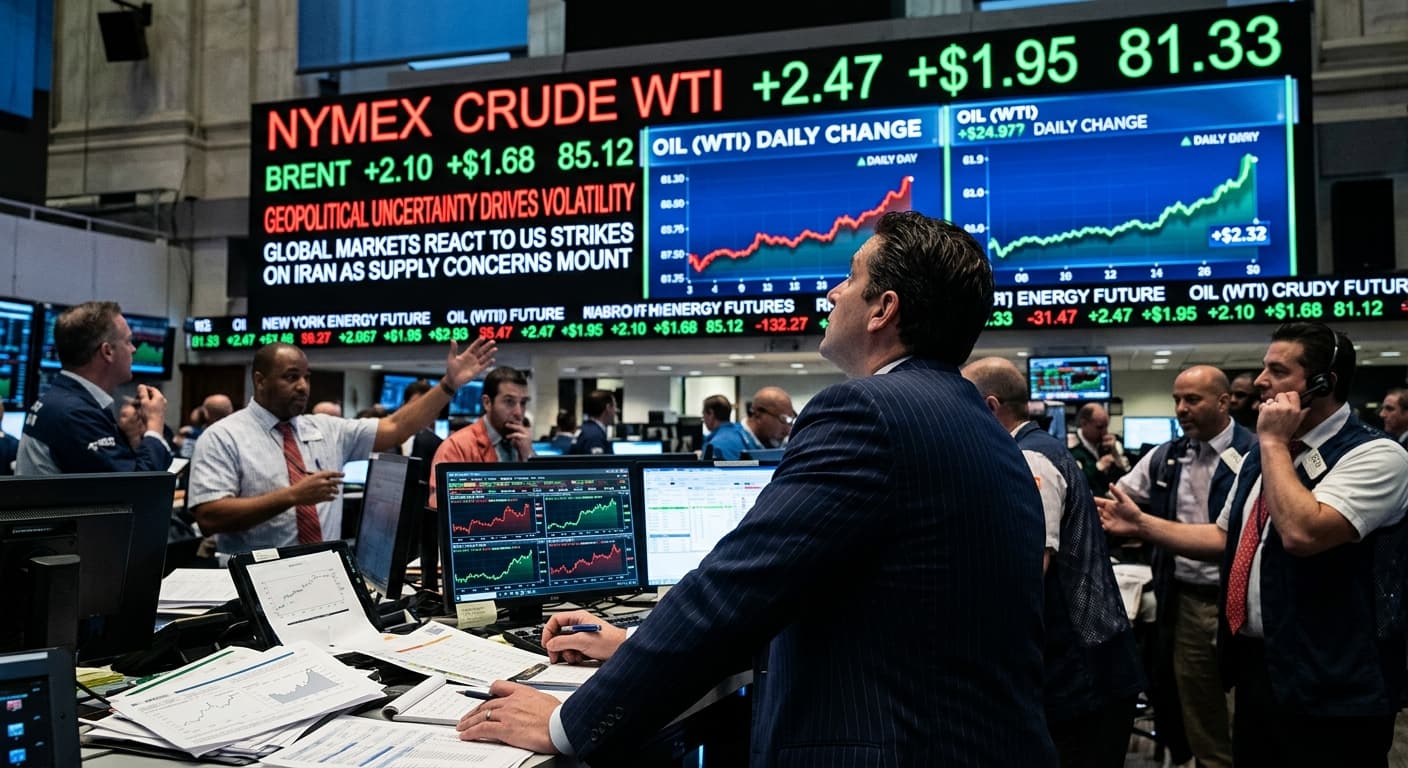
Oil rises after fresh US strikes on Iran: what the $78 ceiling means
Brent hit $78.80 as US strikes on Iran resumed and the June 17 ceasefire collapsed — but the market is pricing a chokepoint neither Washington nor Tehran can afford to fully close.
Oil closed higher for a second straight session on July 9, 2026, with Brent trading at roughly $78.80 a barrel and WTI at $74.26, after US Central Command struck 90 more Iranian targets overnight in what President Donald Trump called "retribution" for Iranian attacks on three tankers in the Strait of Hormuz. The move-up looks modest — Brent traded above $120 as recently as May — and that restraint is the story. Markets are betting that Washington and Tehran are locked into a controlled-escalation equilibrium: bad enough to keep a risk premium in the price, not bad enough to close the strait a second time. The party quietly winning that bet is Abu Dhabi.
What happened, in precise detail
CENTCOM said its Tuesday-night wave hit "over 80 targets with precision munitions" in response to strikes on the Marshall Islands–flagged M/T Al Rekayyat, Saudi-flagged M/T Wedyan and Liberian-flagged M/T Cyprus Prosperity, all reportedly sailing close to Omani waters when they were fired on by IRGC small boats, according to Al Jazeera. A second round on Wednesday night struck 90 targets across Bandar Abbas, Bushehr, Chabahar, Konarak, Iranshahr and Aq Qala, per
Al Jazeera's rolling coverage. Iran retaliated against US bases in Bahrain, Kuwait and Qatar;
BBC News reported explosions in central Manama and Kuwaiti interceptions of drones and missiles.
Trump declared the June 17 memorandum of understanding "over" from Turkey, where he was attending a NATO summit, telling reporters the US had "hit them very hard last night" and would "probably hit them hard again tonight," according to the BBC. The MoU's fifth clause — Iran's pledge of "best efforts for the safe passage of commercial vessels, with no charge for 60 days" — is now the fault line. Tehran reads it as sovereign authority to direct traffic and levy service charges; Washington reads it as unfettered right of transit passage under the Law of the Sea. Parliamentary speaker and lead Iranian negotiator Mohammad Bagher Ghalibaf posted on X that "the Strait of Hormuz will only open with Iranian arrangements — not American threats."
Treasury moved in parallel. The Office of Foreign Assets Control's Iran Sanctions page confirms the revocation and wind-down of General License X1, the June 21 authorisation for Iranian crude sales that was to have run until August 21. Money from cargoes shipped before July 7 goes into a blocked, interest-bearing account.
Why $78 — not $122 — is the important number
In early May, when Iranian mines and drones had effectively closed the strait, Brent briefly touched $122, its highest since 2022, on BBC reporting of an "extended" US blockade. Goldman Sachs then estimated the closure and infrastructure damage had knocked 14.5 million barrels a day off global supply, according to
Al Jazeera — a shortfall Brookings scholar Samantha Gross described as "larger than those in the 1973 and 1979 oil crises combined" in a
Brookings analysis published in late April.
That the current escalation moved Brent only $2–3 tells you three things about how traders are reading July 8.
First, the strait is functioning, if imperfectly. The June 17 MoU lifted the US naval blockade and reopened commercial transit; NPR's April interview with maritime insurance analyst Cormac Treyz noted that only about a third of the strait's channel was cleared in the immediate aftermath, but volumes have crept back since. War-risk premiums, which spiked from 0.25% of hull value to as high as 8% during the closure — a $3-to-$8 million surcharge on a single VLCC — remain elevated but priced-in, according to a July 8 Al Jazeera opinion analysis by Abdulla Banndar Al-Etaibi.
Second, US backstops are unusually generous. The same analysis notes that the International Development Finance Corporation is providing up to $40 billion in reinsurance capacity to keep Hormuz shipping moving — Washington has effectively become the insurer of last resort. That capital line is what allows the tanker market to shrug at 90-target airstrikes it would otherwise flee.
Third, and most important, the market has already digested the structural fact: there is no real spare capacity to absorb another closure. The US Congressional Research Service puts 2024 Hormuz throughput at "approximately 20 million barrels per day," or 27% of global maritime oil trade. The Saudi East-West and UAE Fujairah bypass pipelines together offer roughly 2.6 million b/d of usable capacity, per EIA estimates cited in the same report. Everything else Iran can interdict.
The quiet winner: Abu Dhabi
Trace the money and one actor keeps appearing on the right side of every ledger: the United Arab Emirates.
On May 1, Abu Dhabi formally exited OPEC and OPEC+, a move Energy Intelligence called the most consequential shift in the cartel's 66-year history. UAE crude production stood at 3.4 million b/d before the war; Energy Intelligence calculates Abu Dhabi can add roughly 1.36 million b/d of spare on short notice and is aiming at a 5 million b/d capacity ceiling by 2027, with 6 million on the horizon. Rystad's
special report frames the exit as "the Strait of Hormuz disruption masking a much larger structural shift."
The UAE is also the one Gulf producer with a working out-of-strait export route: the Habshan–Fujairah pipeline delivers directly to the Gulf of Oman, bypassing Hormuz entirely. When the strait's status is contested — as it has been since February 28 and is again this week — Fujairah barrels command a scarcity premium that Saudi Red Sea barrels only partly match. Chatham House warned in a June brief that insurers had not meaningfully reduced Hormuz premiums even after the June 17 MoU, which locks in that Fujairah advantage.
The strategic corollary is uglier for Riyadh. Saudi Arabia holds roughly 2.16 million b/d of spare, but almost all of it must exit through the strait it can no longer guarantee. Brookings' Gross put it bluntly: "It's difficult to imagine Saudi Arabia continuing to be the secure marginal supplier of oil so long as Iran can harass traffic through the strait." The producer that dominated the OPEC era is quietly ceding its swing role to the neighbour that just quit the club.
Who else is bleeding
China. Beijing takes close to 40% of its crude imports via Hormuz and buys more than 80% of Iranian oil exports outright, per the July 8 Al Jazeera analysis — simultaneously Tehran's biggest customer and one of the war's most exposed bystanders. The revoked General License X1 pushes those cargoes back into sanctioned-trade territory, forcing Chinese "teapot" refiners either to take steeper discounts and legal risk, or to bid up Middle-East substitutes.
Global food importers. The World Bank's fertiliser price index rose more than 12% in Q1 2026 and has since hit its highest level since October 2022 — driven, per the Al Jazeera analysis, by Hormuz-linked disruption of Qatari and Iranian urea. The FAO warns yields will fall through the 2026–27 season across import-dependent African and Asian markets. Unlike oil, that damage has a 12-month lag and no obvious ceasefire dividend.
US consumers, slowly. NPR's economic write-up notes that gasoline reached $4 a gallon during the March–April closure and had drifted back before this week's escalation. Every $10 move in Brent still adds roughly 25 cents to a gallon at the pump on a 6-to-8-week lag. The Fed's July path — a September hold rather than a cut — depends heavily on whether the current $78 range holds or drifts back toward $100.
Congressional war-powers hawks. The White House's own Statement of Administration Policy on H. Con. Res. 86, issued in May, argues that the February 28 hostilities "terminated with the ceasefire ordered by the President on April 7, 2026," citing I.N.S. v. Chadha to dismiss concurrent-resolution constraints. That legal posture is now stretched: the same document declared the war over two months before the strikes resumed on June 26, June 27, July 7 and July 8. Expect renewed hearings.
Diplomat View
The consensus that this week's strikes are "another round" mis-reads the structure. This is a stable disequilibrium, not an escalation ladder. Washington and Tehran have discovered they can trade limited kinetic exchanges — 80 targets here, three tankers there, drones at bases with adequate warning — without breaking the shipping-and-insurance regime that keeps roughly 17–18 million b/d flowing. As long as CENTCOM strikes coastal military assets rather than energy infrastructure, and Iran hits US bases rather than Saudi or Emirati export terminals, the market cap on Brent sits near $85. Our call: Brent stays in a $75–90 range through Q3 2026, absent one of three revision triggers. First, a direct Iranian strike on Ras Tanura, Abqaiq, or an UAE FPSO — the Scenario 4 that CSIS warned would push Brent above $100. Second, a US strike on Kharg Island or Iranian refining capacity, which would trigger Iranian "use-it-or-lose-it" attacks on Gulf infrastructure. Third, a Chinese decision to escort its own tankers, which would internationalise the strait in a way neither Washington nor Tehran currently wants. Absent those, the price is telling you what the diplomats have not yet said aloud: nobody is going back to the June 17 MoU, and nobody is going back to war either.
What to watch next
- August 21, 2026 — original expiry of the now-revoked General License X1. Watch whether OFAC re-issues a narrower waiver, or lets the wind-down complete and formally kills Iranian legal oil sales.
- September FOMC meeting — Fed pricing assumes Brent stays sub-$90. Any sustained break above triggers a rate-path repricing before the US election cycle heats.
- Fujairah loading data — a jump in Fujairah–Singapore VLCC fixtures would confirm the UAE is monetising its post-OPEC+ freedom faster than Riyadh can respond via the Red Sea route.
The Bottom Line
The oil market's tepid response to US strikes on Iran is not complacency — it is a considered judgement that Washington and Tehran have found a low-grade equilibrium that keeps Hormuz half-open, insurance premiums bearable, and the strait's real winner, an ex-OPEC+ Abu Dhabi, quietly compounding market share. The story is not whether Brent moved to $78. It is that the Gulf's next decade of oil geometry is being rewritten in Fujairah while everyone watches Bandar Abbas burn.
Discover more
US Politics
House Ethics Committee Pushes Sexual Miscond.
The House Ethics Committee has shifted responsibility for sexual harassment settlement records to the Office of Congressional Workplace Rights, complicating disclosure efforts.
India
700 Activists Accuse PM Modi of MCC Breach
Over 700 activists allege PM Modi breached election code with a televised address attacking opposition parties just before state elections.

India
India-South Korea $50B Trade Expansion Plan
India and South Korea target $50 billion in bilateral trade by 2030, focusing on industrial cooperation and strategic alignment amid US pressures.

Conflict & Security
Drone Warfare Killing Aid Workers at Unprec
Over 1,000 humanitarian workers killed in three years as cheap armed drones collapse legal protections. Gaza, Sudan, Ukraine, and DRC see deliberate targeting of aid convoys and hospitals with zero prosecutions.