Hormuz Oil Shock Rewires COP31 Agenda
Turkey's electrification bet reshapes climate summit goals.
Model Diplomat4 min readGlobal
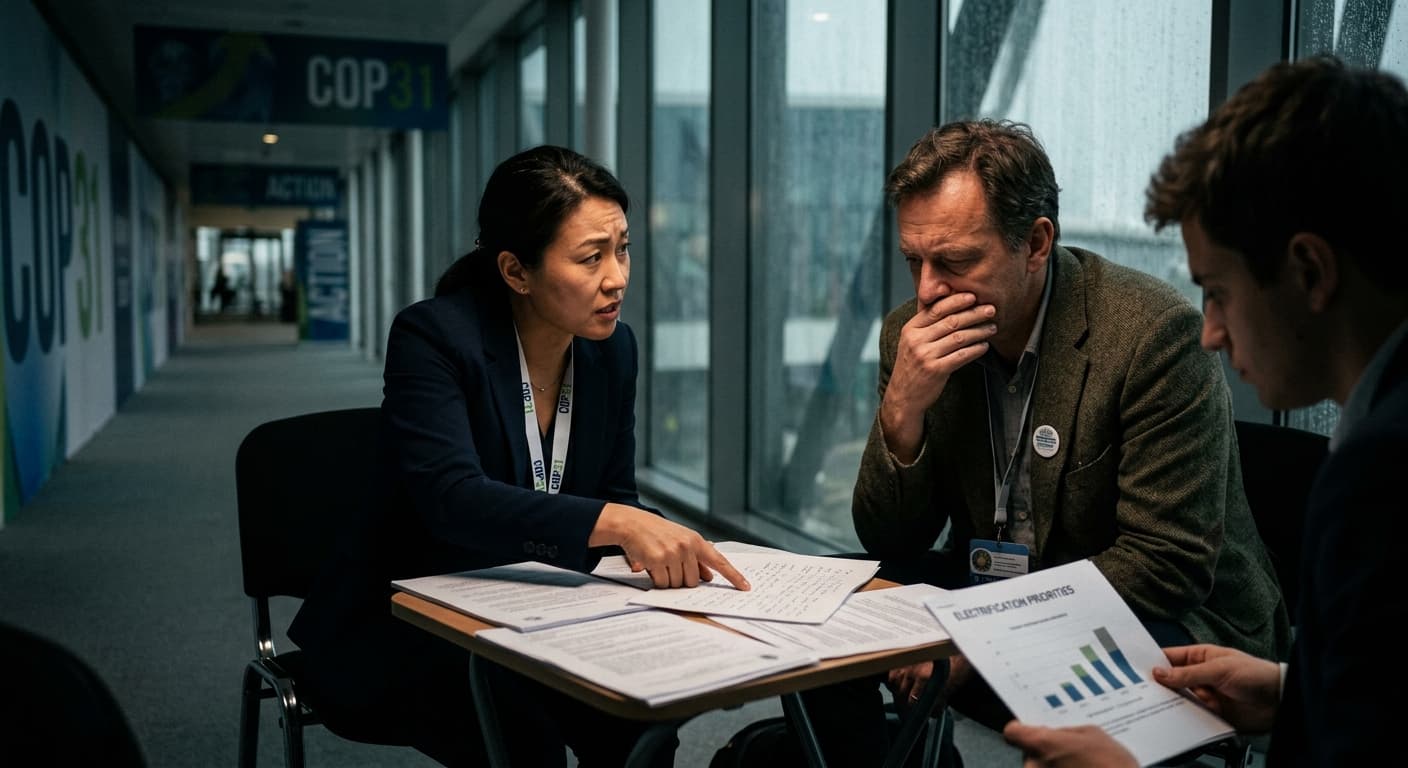
Hormuz Oil Shock Rewires COP31: Turkey's Electrification Bet
How the Iran war's 10 million-barrel supply crunch reshaped the Antalya climate summit's agenda — and handed China the geopolitical prize.
The Iran war's oil shock has done what a decade of climate diplomacy could not: it has moved electrification from a technocratic sub-plot to the headline deliverable of a UN climate summit. When ministers gather in Antalya on November 9, 2026, the COP31 presidency will ask them to endorse a target of meeting 35% of final energy consumption with electricity by 2035 — a threshold framed not as decarbonisation but as insurance against the next Strait of Hormuz. The politics work because the alternative is priced in barrels: Brent hit $126 in April, according to Al Jazeera, and the biggest beneficiary of the pivot is not in the room: China, whose solar-panel and EV supply chains are positioned to capture the bulk of the $2 trillion in accelerated clean-energy spending the IEA projects through 2030.
The shock that reset the agenda
The US–Israeli campaign against Iran that began on February 28, 2026 removed roughly 10.1 million barrels per day of supply in March — the largest disruption in oil-market history, according to the International Energy Agency. IEA Executive Director Fatih Birol told an audience in Canberra that the crunch exceeded the twin 1970s oil shocks and the 2022 Russian gas cut-off combined,
Al Jazeera reported. LNG supplies were down some 140 billion cubic metres — nearly double the shortfall after Russia's Ukraine invasion — and at least 40 energy facilities across nine countries had been severely damaged.
The politics moved faster than the tankers. The IMF cut its 2026 global growth forecast from 3.3% to 3.1%; the S&P Global Clean Energy Transition Index rose 70.92% year-on-year. Governments across Asia — South Korea, Thailand, India, Cambodia, Indonesia, Vietnam, the Philippines — rolled out rooftop-solar tax breaks, restart plans for mothballed nuclear reactors, and emergency renewables tenders. An IEA report cited in that reporting counted 150 countries with active policies to advance renewable and nuclear deployment, 130 with energy-efficiency and electrification policies, and 32 with critical-minerals supply-chain strategies. A Bonn intersessional in June turned into a de facto rewrite of the COP31 draft agenda.
The second-order effect is a rare policy alignment. Countries that would normally sit on opposite sides of any UNFCCC text — Saudi Arabia and Germany, India and the EU — share a new interior interest: reducing exposure to a chokepoint that any middle-sized navy or drone flotilla can now close. That convergence is not a climate argument — it is a security argument wearing climate clothes, which is precisely why it travels further in Antalya than it did in Belém.
Turkey's opening — and its coal problem
Turkey secured the presidency on November 20, 2025, after Australia withdrew its bid in Belém. Under the compromise ratified at COP30, Environment Minister Murat Kurum runs the venue in Antalya from November 9–20; Australia's Chris Bowen holds the gavel as President of Negotiations, with the authority to appoint co-facilitators, draft cover text, and issue decisions, the BBC reported. Fiji and Tuvalu will host pre-COP events in October to preserve the "Pacific voice" Canberra had promised its low-lying neighbours before conceding the summit — a concession that Papua New Guinea's foreign minister told AFP left the region "not happy and disappointed",
per Al Jazeera.
Kurum has priced the oil shock into his pitch. In Istanbul on July 3, he named five priorities — clean-energy transition, zero waste and methane, climate-resilient cities, an implementation mechanism, and green industrialisation — and told reporters that "energy security and climate targets" would not be treated as alternatives, BBC Türkçe reported. The IEA is now formally a "strategic partner" of the presidency, according to an
IEA statement that quoted Bowen: "Conflicts can't stop the sun, the wind doesn't depend on shipping."
The presidency's headline number — 35% electrification of final energy consumption by 2035 — is not a slogan. It comes directly from an IEA implementation pathway for the UAE Consensus and was road-tested at a London dialogue during Climate Action Week, according to the IEA. If Antalya adopts it as a global target, COP31 will have delivered the first quantified milestone under the "transitioning away from fossil fuels" language that Belém preserved but did not extend, per
UN News. Belém's other legacy is a Brazilian commitment to produce two separate roadmaps on deforestation and fossil-fuel transition, which hands Bowen a text to build on rather than one to negotiate from scratch.
The vulnerability is on the host's own grid. Turkey generates more than half its electricity from fossil fuels and over a third from coal, BBC Türkçe reported. The World Bank finds Turkey imports 93% of its oil and must deeply decarbonise its power sector by 2040 to meet its 2053 net-zero pledge, per a
World Bank document. Kurum's silence on a coal phase-out date is the negotiation's soft spot. WWF Türkiye's climate lead Tanyeli Sabuncu told BBC Türkçe that halting new coal investments and planning a phase-out would be "a historic step" completing the presidency's vision. Beyond Fossil Fuels campaigner Duygu Kutluay put it more bluntly: without a dated coal-exit timetable, Kurum's five priorities are a wish list, not a mandate.
Discover more
Global Politics
Xi Jinping Calls China-Russia Ties 'Precious'
Xi Jinping's description of China-Russia ties as 'precious' reflects a strategic imbalance, with Beijing dictating terms in the partnership.
India
Congress Accuses Modi of Stalling Women's Law
Congress accuses Modi of stalling women's reservation law by linking it to delimitation, revealing a deeper electoral strategy.
US Politics
House Ethics Committee Pushes Sexual Miscond.
The House Ethics Committee has shifted responsibility for sexual harassment settlement records to the Office of Congressional Workplace Rights, complicating disclosure efforts.

Conflict & Security
Drone Warfare Killing Aid Workers at Unprec
Over 1,000 humanitarian workers killed in three years as cheap armed drones collapse legal protections. Gaza, Sudan, Ukraine, and DRC see deliberate targeting of aid convoys and hospitals with zero prosecutions.