Hormuz Corridors: Gulf's Climate and AI Hedge
New Middle East corridors reshape energy and climate security.
Model Diplomat7 min readMiddle East
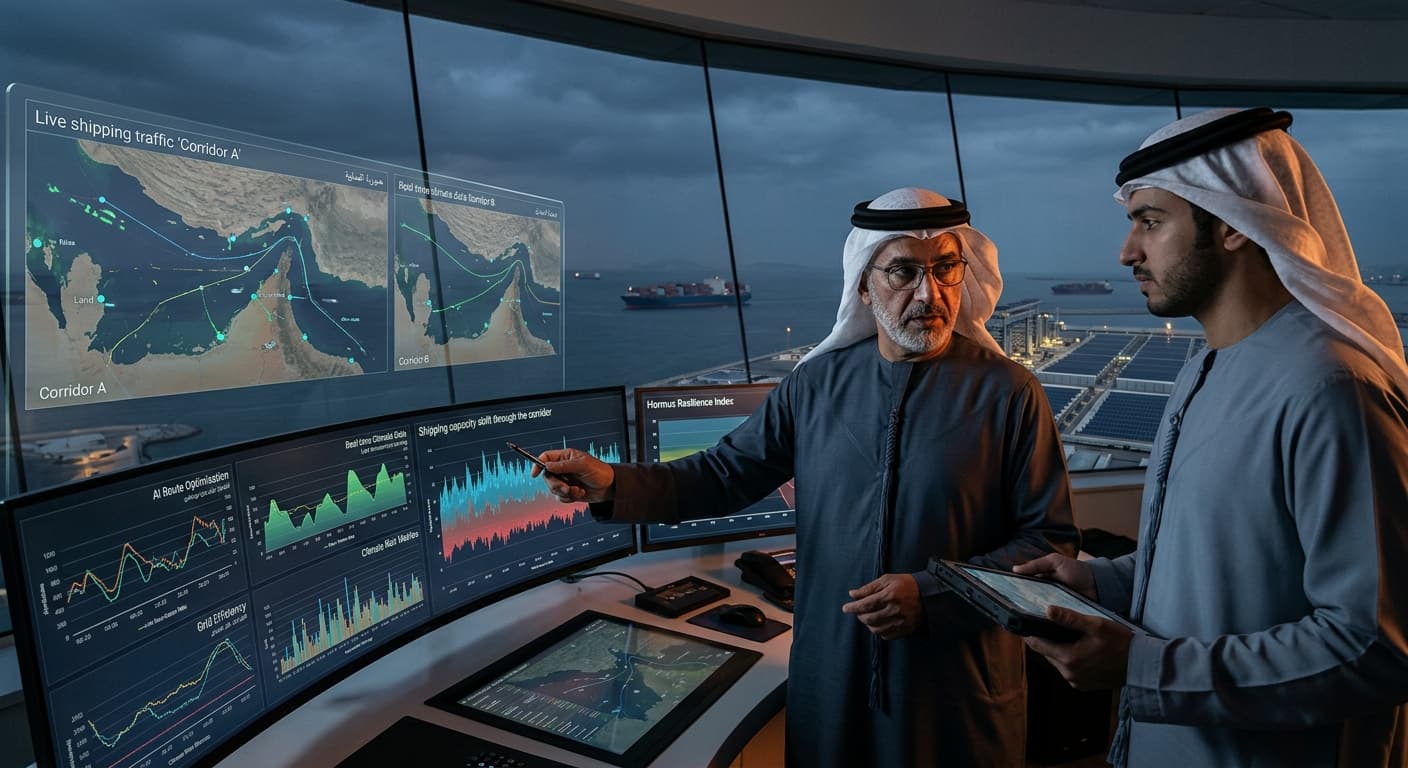
Hormuz corridors are becoming the Gulf's climate and AI hedge
After the 2026 Strait of Hormuz shock, new Middle East corridors — pipelines, rail, compute — are quietly rewriting energy security and climate leverage.
The disruption of the Strait of Hormuz on February 28, 2026 stripped roughly 10.1 million barrels a day from global supply — the largest oil supply shock the International Energy Agency has ever recorded — and the corridors now being fast-tracked from the Gulf to the Mediterranean are not just about oil escaping a chokepoint. They are the physical scaffolding of a second bargain the Gulf is striking with the West: replace the guarantee that petro-molecules will flow with a guarantee that AI compute, fertiliser, and low-carbon fuels will flow — through infrastructure the United States, India and Europe now have direct financial and strategic stakes in. That reframes climate diplomacy as much as it reframes shipping.
The Atlantic Council's Allison Minor, in a July 6, 2026 MENASource brief, argues the corridor surge is being misread as a maritime workaround. The projects — NEOM logistics build-out, a revived Jordan–Syria rail, UAE–Oman's Hafeet Rail, a doubled Habshan–Fujairah pipeline, a mooted Middle East "compute corridor" — are, she writes, "about more than just bypassing the Strait of Hormuz." They are a bet that overland integration can lock in political relationships that the old maritime order took for granted.
The shock that made corridors politically unavoidable
For four months the strait was effectively shut. The BBC's ship-tracking analysis found that even after President Trump's June 17 deal with Tehran, only seven vessels had exited in the first days while 580 waited in the Gulf; Iran's mine-clearance timeline runs 30 days to six months, and the Islamic Revolutionary Guard Corps has floated "service fees" that would formalise its toll on the world's most critical waterway. Al Jazeera reported on July 2, 2026 that Hormuz traffic peaked at 70 transits on June 24 before
collapsing again after ship attacks.
The macro numbers are extraordinary. The World Bank's April 2026 Commodity Markets Outlook projected energy prices up 24% year-on-year and Brent averaging $86 a barrel, with an escalation scenario at $115. A May 29, 2026
joint statement by the heads of the IEA, IMF, World Bank and WTO warned of inventories being "drawn down at a record pace" ahead of northern-hemisphere peak demand. Brookings estimated pipeline bypasses replaced only about 5.7 mb/d of the roughly 12.5 mb/d that Hormuz normally carries — leaving the rest to be absorbed by strategic reserves and demand destruction, per its
chokepoint analysis.
That gap — the difference between what pipelines and rail can carry and what the strait once carried freely — is the fiscal and geopolitical logic of every corridor now being sold to sovereign wealth funds and Western capitals.
What is actually being built, and by whom
Saudi Arabia's East-West pipeline is running at its full 7 mb/d ceiling to Yanbu on the Red Sea, and the UAE is accelerating its Habshan–Fujairah expansion to roughly double export capacity outside the strait. Iraq and the Kurdistan Regional Government, brokered by Washington, restarted the Iraq–Türkiye Pipeline on March 17, 2026 — but only 250,000 barrels per day are flowing against Iraq's pre-crisis 3.5 mb/d, according to Atlantic Council analysis of the
Kirkuk–Ceyhan restart.
The bigger story is on land. In March 2026, Saudi Arabia Railways opened the North–South freight line to the Jordanian border at Al-Haditha — over 1,700 kilometres from Dammam, carrying more than 400 containers per train and, in Atlantic Council language, functioning as "a rail alternative to the Strait of Hormuz." Etihad Rail has connected all seven emirates to the Saudi border; Hafeet Rail, the first cross-border railway in the Gulf, is under construction to link Sohar to Abu Dhabi in 100 minutes — a route the Observer Research Foundation calls the GCC Railway's most viable anchor segment.
The Syrian leg matters more than its capacity suggests. Since Bashar al-Assad's fall in December 2024, DP World signed an $800 million Tartous port deal with Damascus in July 2025, CMA CGM took a 30-year concession at Latakia, and Syria announced $14 billion in infrastructure agreements last August. The World Bank formally re-engaged with Damascus on
November 19, 2025, followed by a $20 million public-finance grant in March 2026 and an
assessment putting reconstruction at $216 billion. Feasibility work on restoring a 100 km Hejaz Railway segment through Jordan — the missing link that would create a continuous rail spine from Dammam through Damascus to Tartous and Latakia — is under way.
The angle everyone is missing: this is a climate and compute play
Read only the shipping press and the corridors look defensive — plumbing to route around a hostile Iran. Read the capital flows and they look offensive.
The Middle East Institute argues the Gulf is converting the exact same advantages — surplus energy, sovereign capital, geographic centrality — from a crude-oil stack into an AI-compute stack. The UAE currently operates 34 data centres and Saudi Arabia 36; Riyadh's HUMAIN and Abu Dhabi's Stargate are planning a combined 8–10 gigawatts of AI capacity. Nvidia's most advanced chips began flowing to both countries in late 2025 under bilateral agreements — deals the
BBC reported alongside President Trump's Gulf tour. The Israeli think tank INSS calls it a deliberate substitution:
the Gulf will export data instead of oil, and expects Washington to defend its compute the way it once defended its wells.
That is why the Atlantic Council's Minor talks about a "Middle East compute corridor" in the same sentence as pipelines. Fibre and gigawatts follow the same rights of way as freight rail and crude — and they need the same overland guarantees when the Bab al-Mandab is unsafe (Houthi attacks) and the Strait of Hormuz is contested (IRGC tolls). A CSIS analysis warns that data centres and undersea cable chokepoints in the Bab al-Mandab are now legitimate targets in any future regional escalation.
The climate angle is the sting in the tail. Carnegie's Middle East program argues that Gulf-hosted data centres are effectively exporting fossil fuels through the cloud — carbon-embedded computing capacity dressed as diversification. With COP31 opening in Antalya in November 2026, the same states that host the world's fastest-growing AI infrastructure will arrive at the negotiating table as both hydrocarbon producers and custodians of the digital economy's power draw. That is not a lobbying position climate diplomats have prepared for.
Winners, losers, and what changes
The immediate winners are Saudi Arabia and the UAE, whose bypass infrastructure already exists and whose sovereign funds — PIF, Mubadala, MGX — can price the political risk of Syrian and Jordanian rail extensions in a way private capital cannot. Oman is the sleeper: its Sohar, Duqm and Salalah ports sit outside both Hormuz and Bab al-Mandab, and India's Comprehensive Economic Partnership Agreement with Muscat, combined with the Empty Quarter Highway that opened in February 2026, makes it the fastest-activating IMEC node.
The losers are Iran, whose leverage over global markets shrinks each time a barrel exits by rail or bypass pipeline, and Iraq — whose failure to build the Basra–Aqaba line, forty years after Iraqi planners first drew it, cost the country roughly 3 million barrels per day of export capacity during the crisis. Kuwait, Qatar and Bahrain, which have no meaningful pipeline outlet beyond the strait, sit uncomfortably in between.
For Europe and India, the corridors are the operational skeleton of the India–Middle East–Europe Economic Corridor, which the Atlantic Council estimates has a $5 billion financing gap and could move 1.5 million TEUs annually once minimally operational. The German Marshall Fund's Dan Marks and others describe
IMEC's comeback as a "grand de-risking strategy" — one of the few large projects on which EU and US approaches still align.
What to watch
- September 2026, Riyadh hosts the fourth Global AI Summit, where the compute-corridor narrative will be formalised alongside GCC energy diplomacy.
- November 2026, COP31 in Antalya: watch whether Saudi Arabia and the UAE frame data-centre power demand as a climate-transition necessity — the leverage Carnegie flagged.
- US G20 presidency, December 2025 through late 2026: the Atlantic Council has urged Washington to use the chair to set an IMEC coordinating structure; the sherpa process is where the corridor either institutionalises or drifts.
- Iraq–Jordan–Egypt trilateral: any move to fund the Basra–Aqaba pipeline's first phase (2.25 mb/d) would be the single biggest structural change to Gulf export geometry since the East-West line.
- Hejaz Railway feasibility (Jordan segment): the 100 km rail gap that unlocks Dammam-to-Latakia container flow.
Diplomat View
The corridors are a bet — by Riyadh, Abu Dhabi, New Delhi and Washington — that the next Hormuz crisis will be politically survivable because the infrastructure to route around Iran will already exist, and that the same infrastructure will carry AI compute, green hydrogen, and Indian containers when it is not carrying crude. That bet is falsifiable in three ways. First, if Brent settles back below $75 and Iran accepts a genuine reopening of the strait, the pipeline projects with cross-border complexity — Basra–Aqaba above all — will lose their political oxygen and be shelved for a fifth time. Second, if COP31 hardens fossil-phasedown language, the Gulf's compute-as-diversification pitch collapses back into a hydrocarbon-defence posture. Third, if Riyadh and Jerusalem do not normalise, IMEC's northern leg through Israel remains a corridor on paper. Our base case: two of the three go the Gulf's way, and by 2030 the region will export electrons and containers on the same rights of way it once used only for barrels. Revise if the Hejaz feasibility slips past mid-2027, or if a second Hormuz closure finds the corridor network no larger than it is today.
The Bottom Line
The 2026 Hormuz shock did not just accelerate pipelines — it converted Middle East corridors into the physical layer of a compute-and-climate bargain that binds Washington to the Gulf more tightly than the old oil-for-security deal ever did. The corridors' real payoff is not the barrels they reroute but the leverage they build for Riyadh and Abu Dhabi at COP31 and inside the AI supply chain. Iran loses the veto it thought Hormuz gave it; Iraq pays the price of forty years of unbuilt infrastructure; and the country most likely to be quietly indispensable to how it all works is Oman.
Discover more

India
Delhi CM Rekha Gupta Blasts Opposition's Delm
Delhi CM Rekha Gupta's remarks on women's quota defeat reveal BJP's strategy for the 2029 Lok Sabha elections, focusing on delimitation.
US Politics
House Ethics Committee Pushes Sexual Miscond.
The House Ethics Committee has shifted responsibility for sexual harassment settlement records to the Office of Congressional Workplace Rights, complicating disclosure efforts.
India
Congress Accuses Modi of Stalling Women's Law
Congress accuses Modi of stalling women's reservation law by linking it to delimitation, revealing a deeper electoral strategy.

Economics
Fed's Amex AML order puts correspondent banking on notice
Federal Reserve's Amex AML order requires board-level controls and a 90-day plan; OCC fined the bank $350 million over enterprise-wide deficiencies.