Hezbollah's Finances: Sanctions and Survival
Exploring the financial network sustaining Hezbollah amid sanctions.
Model Diplomat7 min readMiddle East
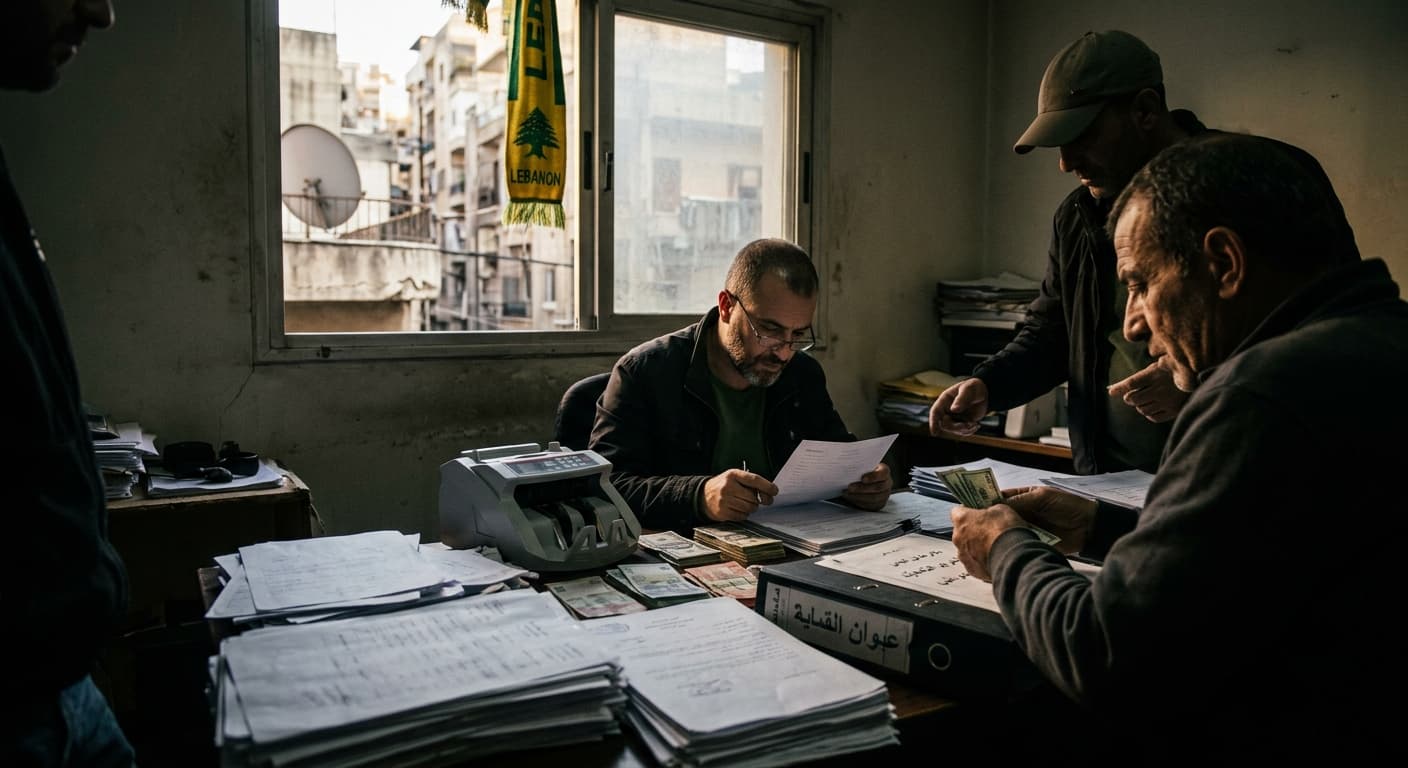
Behind Hezbollah's Finances: Inside the Sanctioned Network Keeping It Alive
How the June 30, 2026 TFTC joint designation of Al-Qard Al-Hassan, Bayt al-Mal and 16 operatives exposes the shadow-bank architecture that has already survived a war, sanctions, and Israeli airstrikes.
Hezbollah does not have a central bank — it has a workaround, and that workaround just took the largest coordinated Gulf-U.S. sanctions hit in five years. On June 30, 2026, the seven-member Terrorist Financing Targeting Center jointly designated five entities and 16 individuals sitting at the core of Hezbollah's financial machine, from the quasi-bank Al-Qard Al-Hassan (AQAH) to the treasury Bayt al-Mal to the man who signs the payroll, Ibrahim Ali Daher. The action does not create new pressure so much as publish a map of the network that Washington's earlier sanctions had already lit up piece by piece — a map that shows why non-state actors like Hezbollah keep functioning after currency crises, ceasefires, and maximum-pressure regimes: they replicate the sovereign toolkit (deposit-taking, gold vaulting, payroll, procurement) inside a civilian-registered NGO the local central bank cannot touch.
That is the story worth telling on the day the Alma Research and Education Center published its own dissection of the network, and while a U.S.-brokered Israel–Lebanon framework signed four days earlier hinges on disarming the very organization these institutions bankroll.
What the June 30 designation actually did
The joint designation was announced through the U.S. Treasury and mirrored by Bahrain, Kuwait, Oman, Qatar, Saudi Arabia and the UAE. Every target had already been sanctioned unilaterally by the Office of Foreign Assets Control, some as far back as 2006 (Bayt al-Mal, Yousser Company) or 2007 (AQAH itself), according to the U.S. Department of the Treasury. What is new is the multilateralization: Gulf capitals that host large Lebanese diaspora communities and correspondent-banking relationships now share the target list.
The Alma Research and Education Center, in its July 9 analysis by Dr. Zoe Levornik, argues the action's utility is diagnostic rather than punitive: it "publicly exposes the organizational structure of Hezbollah's financing mechanism and the methods it has developed over the years to circumvent sanctions." The names read as an org chart.
- The quasi-bank. AQAH, founded in 1983 and formally registered as a Ministry of Interior NGO in 1987, operates roughly 30 branches, holds deposits, extends gold-collateralized microloans, and moves cash — all without a Banque du Liban license. Chatham House's Lina Khatib documents that AQAH sits outside Lebanon's cash-and-lending law entirely, a
regulatory loophole no other Lebanese party has replicated at scale.
- The treasury. Bayt al-Mal was designated by OFAC on September 7, 2006. After the Second Lebanon War destroyed most of its offices, Hezbollah re-registered its bank accounts in the names of senior AQAH employees — the
origin of the "shadow banker" pattern OFAC has been chasing ever since.
- The nerve center. Central Finance Unit 104, led by Ibrahim Ali Daher (Hajj Jihad), consolidates revenues, sets the annual budget, and pays operatives. Daher, first sanctioned May 11, 2021, sits on Hezbollah's Executive Council and reports directly to the Secretary-General,
- The professional class. July 3, 2025 designations targeted seven AQAH executives — Nehme Ahmad Jamil, Issa Hussein Kassir, Samer Hasan Fawaz, Imad Mohamad Bezz, Ali Mohamad Karnib, Ali Ahmad Krisht and one more — plus Tashilat SARL, the mortgage-lending arm co-owned with previously sanctioned AQAH director Adel Mansour. Bezz alone runs gold operations that moved over $2.5 million between shadow accounts, according to the
- The new front. On February 10, 2026, OFAC designated Jood SARL, a Lebanon-registered wholesaler of jewelry and precious metals set up on June 3, 2025, that "senior Al-Qard al-Hassan officials established … to trade gold in Lebanon and potentially overseas," Treasury Secretary Scott Bessent said in a
statement carried by Al Jazeera.
The number that reframes the sanctions debate
Iran supplies roughly $700 million per year in direct support — about 70 percent of Hezbollah's estimated $1 billion annual budget, per U.S. official figures cited by the Atlantic Council. The remainder comes from a diaspora-and-illicit-trade mosaic: Latin American charcoal exports (the
Amer Mohamed Akil Rada network sanctioned in September 2023), Captagon trafficking with Syria's now-collapsed Fourth Division, Iranian oil resold through Turkish and Panamanian shells like Mira Ihracat Ithalat Petrol and Brilliance Maritime Ventures, and African cash channels overseen by Hasan Abdallah Ni'mah.
That distribution matters. Every dollar OFAC pulls out of AQAH's shadow-banking corridor is a dollar Hezbollah is more likely to replace via hawala or trade-based laundering, not lose. The Institute for National Security Studies in Tel Aviv, in its analysis of the network, argues bluntly that "military strikes alone — without an international financial strategy focused on the organization's financial network — are unlikely to significantly undermine its long-term financing capabilities." AQAH is a node, not a chokepoint.
Why the sanctions still bite — a different way
The pressure is real, but it registers on a different balance sheet: Hezbollah's welfare obligations to its own base.
Since the November 2024 ceasefire, AQAH has struggled to make good on compensation payments to families whose homes were destroyed. Alma's February 10, 2026 update reports that AQAH announced the resumption of temporary housing payments on February 6, routed through the construction arm Jihad al-Binaa. Roughly 7,000 families in the Dahiyeh area alone remained displaced; rehabilitating some 490 damaged buildings was priced at approximately $37 million; 5,400+ payment vouchers were to be disbursed in Beirut that month alone. The scale is the point — and the strain.
Carnegie's Michael Young and Brookings analysts converge on the same read: after the 2006 war Hezbollah out-competed the state on reconstruction cash, but in 2026 "Hezbollah's resources are considerably less," Brookings' William Galston writes, giving Beirut its first genuine window to reclaim service delivery from the party. INSS's Orna Mizrahi documents visible
"cracks in Shiite support" tied directly to unpaid compensation. Sanctions do not need to bankrupt AQAH; they only need to make it slower than the state — a bar Lebanon's bankrupt government has never before been able to clear.
That is what makes Jood SARL so telling. Treasury said Hezbollah directed AQAH to spin up a gold-trading chain specifically because it faced challenges "throughout early 2025 to secure funding." When a shadow bank starts liquidating its bullion into a boutique jeweler set up six weeks earlier, that is not resilience — it is triage.
The Lebanese banking system is the real target
The most consequential legal fact hiding in the OFAC filings is not who was designated but how they moved money. The 2021 "shadow bankers" file — Ahmad Yazbeck, Abbas Gharib, Wahid Subayti, Mostafa Harb, Ezzat Akar and Hasan Othman — describes AQAH officials running personal accounts at Lebanese banks, most notoriously Jammal Trust Bank, to conduct mirrored transactions worth over $500 million on Hezbollah's behalf, per the Treasury designation. JTB was designated in 2019 and collapsed within three weeks.
Every subsequent action — including the July 2025 targeting of Tashilat SARL and Auditors for Accounting and Auditing, and the March 20, 2026 "Global Network Diverting Funds to Benefit Hizballah" round listed on OFAC's recent actions page — traces the same pattern: professional nominees, mirrored ledgers, gold intermediation, Panama- and Türkiye-registered shipping shells. Correspondent banks in the Gulf now have a shared blacklist against which to screen. That is where a joint TFTC action, however symbolic in Washington, exerts leverage the U.S. unilateral list cannot.
Diplomat View
The TFTC's June 30 action will not cripple Hezbollah's finances — nothing has, since 2007. Its function is to compress the party's ability to compete with the Lebanese state for its own Shia base at the exact moment President Joseph Aoun and Prime Minister Nawaf Salam are attempting to translate the June 26 trilateral framework — which conditions any Israeli withdrawal on "verified disarmament of non-state armed groups" — into pilot-zone reconstruction that the state, not Jihad al-Binaa, delivers.
The falsifiable call: if Gulf and international reconstruction money actually flows into Dahiyeh and the south under Lebanese Armed Forces cover within 90 days, AQAH's political franchise erodes faster than its balance sheet, and Hezbollah negotiates from a weaker floor at the next Washington round. If it does not — if the LAF stays skittish about a sectarian confrontation, and Iran secures sanctions relief that Brookings warns Tehran will race to convert into cash for Hezbollah — the June 30 designations become, as Hezbollah itself put it in May, a "badge of honour" that changes nothing.
What would move the forecast: (1) any Banque du Liban rule that pulls AQAH under formal banking supervision; (2) a Gulf sovereign commitment to fund Lebanese state reconstruction contingent on state-run delivery; (3) an Iran–U.S. deal that unfreezes Iranian assets without conditioning them on cutting Hezbollah transfers.
What to watch next:
- July–August 2026: Next round of Israel–Lebanon talks in Washington; pilot-zone selection is the near-term test of state versus Hezbollah service delivery.
- September 2026 (indicative): UN General Assembly week, when a Lebanese donor conference tied to the framework is expected to be tabled by France and Saudi Arabia.
- Ongoing: OFAC's next Hezbollah tranche — Treasury has run designations roughly quarterly through 2025 and 2026, and the U.S. State Department's standing $10 million reward for information on disrupting Hezbollah's
The Bottom Line
Hezbollah's financial network is not a bank — it is a sovereign function replicated inside a Ministry of Interior NGO, and the June 30, 2026 TFTC designation confirms Washington and the Gulf now share a single map of it. The sanctions will not bankrupt the party; they will make it slower than a Lebanese state that, for the first time since 2006, has both a mandate and a framework to compete for the loyalty of its Shia base. Whether that competition is real or theatrical will be decided not by OFAC's next tranche, but by whose cash reaches Dahiyeh first.
Discover more
Global Politics
US-Iran Tensions Rise
Tensions escalate in the Strait of Hormuz as Iran and the US clash over maritime control, with a ceasefire hinging on a contested MoU paragraph.
India
Women’s Reservation in India
India's 33% women's reservation law is enacted but won't take effect until after 2029 due to political setbacks and census delays.
US Politics
House Ethics Committee Pushes Sexual Miscond.
The House Ethics Committee has shifted responsibility for sexual harassment settlement records to the Office of Congressional Workplace Rights, complicating disclosure efforts.

Economics
Fed's Amex AML order puts correspondent banking on notice
Federal Reserve's Amex AML order requires board-level controls and a 90-day plan; OCC fined the bank $350 million over enterprise-wide deficiencies.