Guyana's Oil Transforms Diplomatic Role
Oil wealth reshapes Guyana's foreign policy amid Venezuelan threats.
Model Diplomat4 min readamericas
Guyana's Oil Turns a Diplomatic Minnow Into a Strategic Player
Oil wealth and Venezuela's saber-rattling have forced Guyana's foreign policy into a high-stakes transformation — and the ICJ is set to rule on the Essequibo in 2026.
Guyana's foreign policy has been remade by a single geological fact: the 2015 ExxonMobil discovery that gave this nation of roughly 800,000 the largest per capita crude reserves in the world. The result is an economy that the IMF projects will grow by double digits annually for the next five years — and a diplomatic apparatus racing to keep pace with the threats that wealth attracts.
The central threat is Venezuela. The Maduro regime claims roughly two-thirds of Guyana's territory — the Essequibo region, a 160,000-square-kilometer expanse containing oil, gold, diamonds, and lithium. Since December 2023, when Maduro held a referendum to claim the territory and then ordered troops to the border, Guyana has been executing what CSIS analysts call "defense diplomacy" — using multilateral institutions, alliance-building, and legal processes as its first line of defense against a far larger military adversary. CSIS
That strategy has been operationalized on multiple fronts. Guyana took up its non-permanent seat on the UN Security Council in January 2024 — a position that let it request the Council's closed-door session on Venezuela's December 2023 referendum. The country's UN permanent representative, Carolyn Rodrigues-Birkett, a former foreign minister, brought deep institutional knowledge to the post. Guyana also leveraged CARICOM, which held an emergency heads-of-government session and "speaks with one voice" supporting territorial integrity and the ICJ process, according to Trinidad and Tobago's foreign minister. CSIS
The Oil Leverage — and the Risks
Guyana's oil output averaged 616,000 barrels per day in 2024 and is projected to reach 940,000 bpd later in 2025 — enough to exceed Venezuela's own declining production. This makes Guyana a compelling energy partner for Washington. U.S. Secretary of State Marco Rubio visited Guyana in March 2025 as part of a Caribbean tour explicitly aimed at promoting energy independence from Venezuela and "curbing illegal migration, drug trafficking, and gang violence." He warned that Venezuela would face "consequences for aggressive actions." Council on Foreign Relations
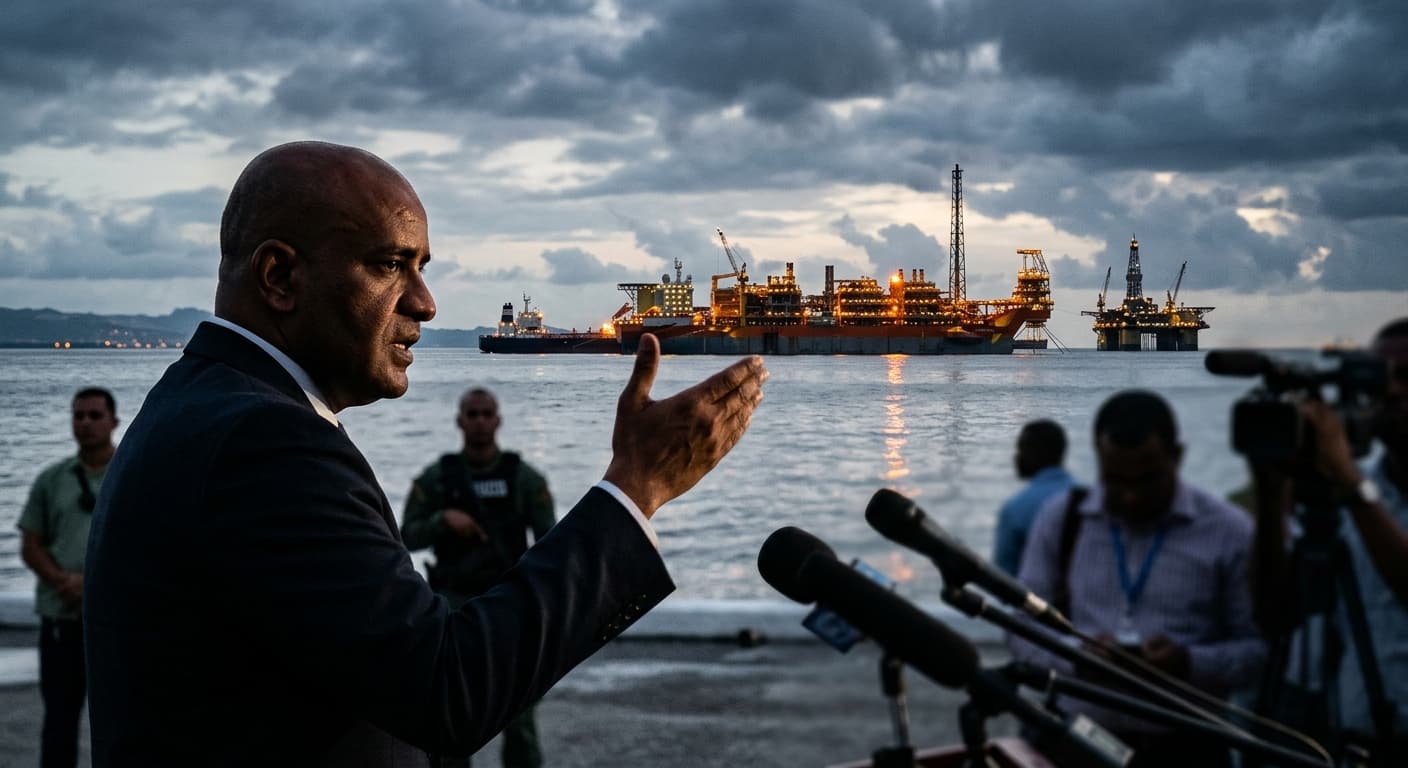
But the same oil wealth that draws U.S. attention also makes Guyana an attractive target. On March 1, 2025, a Venezuelan navy warship approached ExxonMobil's Liza Destiny FPSO vessel roughly 200 kilometers offshore from Georgetown — well outside any contested zone — and broadcast live-fire exercises. The message, CSIS concluded, "was very clear: Guyana's oil operations are at the mercy of Venezuela's armed forces." CSIS
The costs are material: Lloyd's Market Association added Guyana's offshore sector to its elevated-risk list, placing it alongside the Red Sea and Black Sea. Shipping insurance costs for crude exports have risen accordingly.
The Diplomatic Architecture
Guyana has diversified its backing well beyond Washington. The Argyle Declaration of December 2023, brokered in Saint Vincent and the Grenadines, committed both sides to refrain from force and established a joint commission. Brazil — which reinforced its Boa Vista garrison with armored vehicles as a hedge — hosted subsequent foreign-minister-level talks in Brasília. The UK dispatched HMS Trent to Guyana in late 2023. France, whose overseas territory of French Guiana abuts the region, initiated a first-ever joint defense working group with Guyana in May 2024. CSIS
Notably absent from Guyana's support coalition is China. Beijing, which holds a stake in the ExxonMobil-led consortium through CNOOC, has called for "negotiations" without endorsing the ICJ process — a position Georgetown criticized as effectively backing Caracas's preference for bilateral talks that bypass the court. Council on Foreign Relations
What to Watch
The ICJ ruling, expected in 2026, is the decisive event. Venezuela does not recognize the court's jurisdiction, but a ruling in Guyana's favor would crystallize the international legal position — and raise the stakes for Maduro, who has institutionalized "Guayana Esequiba" as a new Venezuelan state, held elections for its phantom representatives, and barred from public office anyone who denies Venezuelan sovereignty over the territory. Al Jazeera De-escalation after a favorable ruling may prove structurally difficult for Caracas: dismantling the military apparatus built around the Essequibo claim would risk internal blowback from an armed forces whose stature has grown on the issue.
The second watchpoint is Guyana's diplomatic staffing. CSIS has flagged that key missions — Brussels, Caracas, Brasília, London — still lack permanent, experienced envoys nearly two years into the crisis. For a small state whose first line of defense is diplomacy, that deficit is a vulnerability.
Discover more
US Politics
U.S. House Passes Alert Act for Aviation
The House passed the ALERT Act 396–10, replacing the ROTOR Act after Pentagon intervention, impacting aviation safety regulations.
Global Politics
Xi Jinping Calls China-Russia Ties 'Precious'
Xi Jinping's description of China-Russia ties as 'precious' reflects a strategic imbalance, with Beijing dictating terms in the partnership.

US Politics
Senate Repeals Minnesota Mining Ban for Twin
The Senate's repeal of a 20-year mining moratorium in Minnesota allows Twin Metals to proceed, raising concerns over environmental impacts and foreign ownership.

Conflict & Security
Drone Warfare Killing Aid Workers at Unprec
Over 1,000 humanitarian workers killed in three years as cheap armed drones collapse legal protections. Gaza, Sudan, Ukraine, and DRC see deliberate targeting of aid convoys and hospitals with zero prosecutions.