Gulf States Balance Diplomacy and Deterrence
Gulf states adopt a dual strategy towards Iran post-2026 war.
Model Diplomat8 min readMiddle East
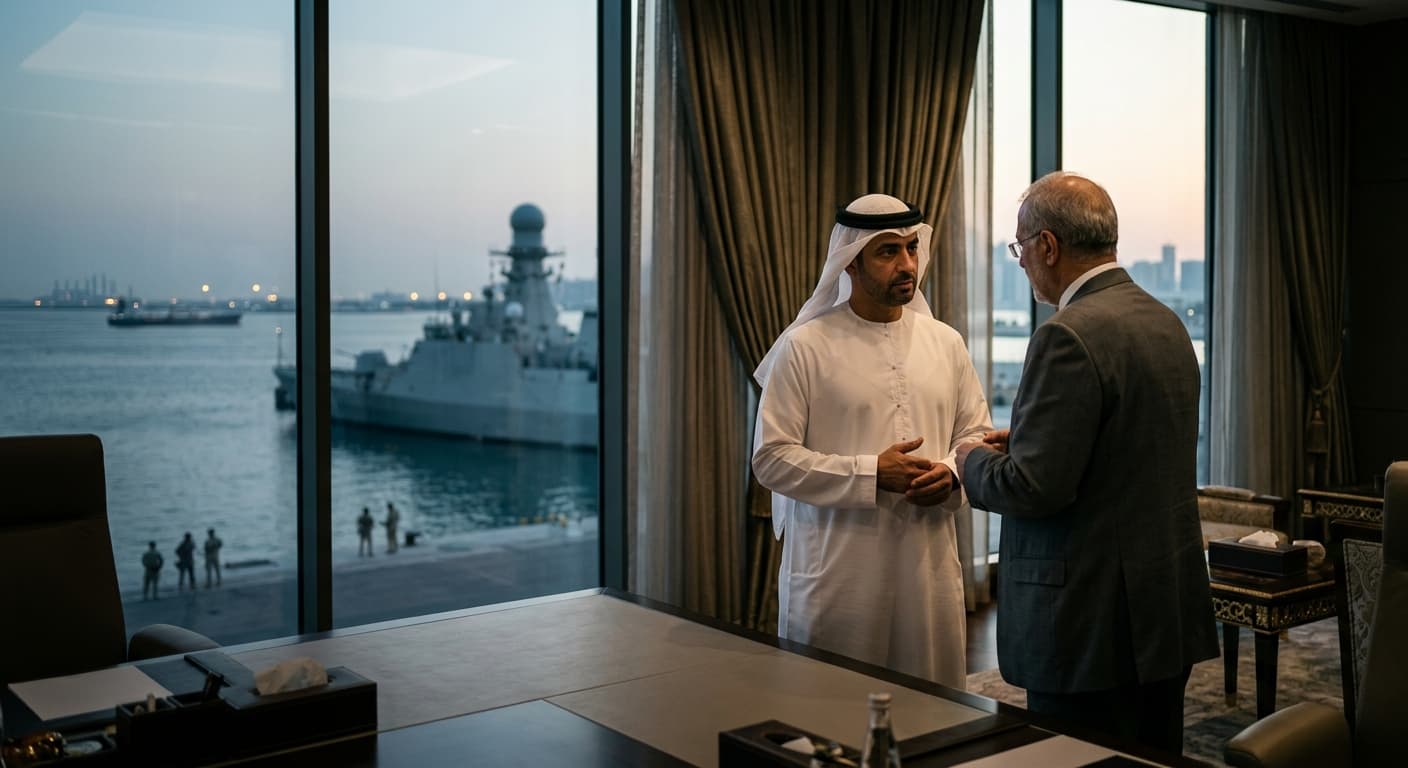
Gulf States Rewrite Iran Playbook: Diplomacy Plus Deterrence
Gulf states are pairing engagement with credible deterrence toward Iran after the 2026 war — a Manama-driven framework that ties investment to behavior and puts Hormuz at the center.
The Gulf's new Iran strategy is not a pivot to accommodation. It is a paired bet: keep the diplomatic channel open through a U.S.-brokered deal while quietly building the deterrence — Pakistani nuclear cover, diversified air defenses, and conditional economic leverage — that the war of February–April 2026 exposed as missing. That is the message of the June 25 Manama communique, and it means the region's most consequential Iran policy is no longer being written in Washington or Tel Aviv, but in Riyadh, Abu Dhabi, Doha and Manama, with Beijing and Islamabad in the wings.
The war that forced the recalibration
Between February 28 and May 17, 2026, Iran fired more than 6,700 drones and missiles at Gulf Cooperation Council states, according to a Congressional Research Service brief circulated on Capitol Hill in late May. Nearly half of those strikes landed on the United Arab Emirates. One drone hit a generator outside the Barakah nuclear plant on May 17. Bahraini and Kuwaiti desalination facilities were targeted. The war, launched as "Operation Epic Fury/Roaring Lion," was supposed to isolate Tehran; instead it demonstrated that every Gulf capital sits inside Iran's retaliatory envelope.
The political effect was immediate. In a June 25 feature, Al Jazeera quoted Farah al-Qawasmi of Qatar University describing a Gulf posture "shaped more by realism than reconciliation" — a pragmatic engagement designed to deter. Mehran Haghirian of the Bourse & Bazaar Foundation put it more bluntly: "This war has really initiated a complete rebalancing of the entire region."
The Council on Foreign Relations reached the same conclusion from Washington's side. In his July 2026 analysis, Steven Cook wrote that the U.S.-Iran memorandum of understanding signed at Versailles on June 17 "will likely lead to additional Gulf hedging in the form of non-aggression pacts with Iran." The Gulf states, he added, "did not advocate for this war" — and are now forced to manage its consequences largely without U.S. backing, since the MoU commits U.S. forces to pull back from areas around Iran within 30 days of a final agreement.
The Manama framework: conditional engagement
The formal architecture of the new approach was unveiled in Manama on June 25. Co-chaired by Secretary of State Marco Rubio and Bahraini Foreign Minister Abdullatif bin Rashid Al Zayani, the GCC-U.S. ministerial produced a joint statement that welcomed the MoU but built a fence of conditions around it. According to Al Jazeera's readout, the ministers declared that "any trade and investment with Iran is conditional and reversible" and stated that "lasting regional peace and security requires addressing the full spectrum of Iran's threats, including its ballistic missiles, drones, and support of proxies in the region."
That last clause is the load-bearing wall. It moves the Gulf position beyond the JCPOA's nuclear-only frame — a shift Gulf capitals had wanted since 2015 — and folds ballistic missiles, drones, proxies, and the Strait of Hormuz into a single leverage package.
The communique also explicitly targeted Hezbollah, calling for "full disarmament of all such groups and the restoration of the Lebanese state's monopoly of force." And it rejected "any tolls, fees, or attempts to assert control over the strait." Tehran responded within 24 hours, calling the statement "interventionist, irresponsible, and provocative" — and, tellingly, urging Gulf states to reconsider hosting the U.S. bases used during the war.
The deterrence half: Pakistan, air defense, and diversification
Diplomacy alone would not have moved Tehran. The Gulf's second track — deterrence — was already in motion before the first Iranian missile flew. On September 17, 2025, Riyadh and Islamabad signed a Strategic Mutual Defence Agreement declaring, in the words of Pakistan's foreign ministry, that "any aggression against either country shall be considered an aggression against both." Chatham House called the pact a precedent for extended deterrence involving a nuclear-armed state; the
Brookings Institution noted it formalized four decades of quiet cooperation into a public commitment.
The war then accelerated diversification. In a July 2 assessment, Annelle Sheline of the Quincy Institute told Al Jazeera that U.S. bases "became targets" and "actually, the presence of the U.S. military in Gulf countries had the opposite of a deterrent effect." Gulf states responded by buying Ukrainian counter-drone systems, deepening defense procurement talks with France, South Korea, and Turkey, and — per CSIS analysts Michael Ratney and Abdullah Alhenaki in their
July 6 commentary — reportedly denying U.S. overflight rights when Washington tried to launch a naval escort mission called "Operation Freedom" in May 2026 without consulting Riyadh. The operation collapsed after two days.
Yet the U.S. remains indispensable at the top of the escalation ladder. According to figures cited in the CRS brief, U.S. Central Command reported that integrated U.S.-partner missile defenses intercepted "over 6,000 one-way attack drones and more than 1,500 ballistic missiles" during the war. THAAD, Patriot, and — in a striking datapoint — at least one Iron Dome battery operated by Israeli soldiers in the UAE did most of the intercepting. The Gulf's hedge is not to replace Washington; it is to make sure no single patron controls the button.
Deterrence through investment: the UAE model
The most novel piece of the strategy is deterrence through economic entanglement. On June 12, Reuters reported that the UAE had agreed to release up to $10 billion in frozen Iranian assets — with more than $3 billion already delivered — in exchange for a halt to Iranian attacks on Emirati territory and a rebuilding of intelligence and economic ties. Two other sources put the eventual total at $20 billion. Officials of Iran's Revolutionary Guard reportedly visited Abu Dhabi and stayed at the guest house of Sheikh Tahnoon bin Zayed Al Nahyan, the UAE's national security adviser.
The logic is that Vice President JD Vance articulated in remarks quoted by Al Jazeera: the Emiratis, "by far the most hawkish, by far the most pro-Israel country in the [GCC]," were now having conversations with the IRGC that "have never happened before" — asking, "Here's what we'd need to see to make your country investable." Sheline calls it "electricity infrastructure" deterrence: if Gulf and Iranian economic interests are intertwined, Tehran thinks twice before striking.
The framework's ceiling is a proposed $300 billion reconstruction fund for Iran, floated by the White House and described by Qatar's Prime Minister Sheikh Mohammed bin Abdulrahman as "aspirational" in a Financial Times interview. Rubio insisted in Kuwait on June 24 that Gulf states would not be forced to underwrite it. No Gulf state has yet committed a dollar. That is the leverage — money Tehran wants, contingent on behavior Gulf capitals want.
The Hormuz problem and the primary document
The reason the Gulf can afford neither pure confrontation nor pure accommodation sits in the water. On March 19, the UN Security Council adopted Resolution 2817 (2026) by a vote of 13–0, with China and Russia abstaining. According to the official UN press release, Ambassador speakers at a subsequent Council session recalled that the resolution demands "navigational rights and freedoms through the Strait of Hormuz must be respected." Secretary-General António Guterres told the Council: "Let ships pass. Let the global economy breathe."
The MoU nominally reopened the strait. But as Bruce Jones of Brookings documented, Iran established a "Persian Gulf Strait Authority" during its blockade and has not dismantled it. Article 5 of the MoU obliges Iran only to "conduct dialogue with the Sultanate of Oman to define the future administration" of the strait. Chatham House scholar Sanam Vakil warned in a
June essay that "the war has broken a psychological barrier that will not be rebuilt" — Iran will now integrate the threat of closing Hormuz permanently into its strategy.
That is why the Manama statement was so specific about tolls, and why Kuwait, Qatar, and Bahrain — which, unlike Saudi Arabia and the UAE, have no pipeline options to bypass the strait — have taken the lead in pressing Washington to keep military pressure on Iran even as they engage it economically.
Diplomat View
The Gulf's play is coherent and, on balance, likely to hold through 2026. Six states have converged on a single proposition: Iran is too dangerous to isolate and too weakened to appease. The war destroyed the JCPOA-era illusion that a nuclear deal alone buys stability, and it destroyed the counter-illusion — Israeli and hawkish American — that military pressure produces a compliant Tehran. What remains is the classical hedge: keep the Americans, add the Pakistanis, buy the French and Koreans, unfreeze money for the Iranians, and let Beijing broker at the margins.
The forecast the evidence supports: the Manama framework survives the 60-day MoU window, at least one bilateral Gulf-Iran non-aggression understanding is announced by year-end (Saudi Arabia is the likely candidate, building on the March 2023 Beijing agreement), and Israeli-Saudi normalization stalls further — because the war made normalization politically radioactive without a Palestinian state, and because Riyadh now sees Israel's freedom of action as its own strategic problem.
What would revise this forecast: a collapse of the Hormuz arrangement after the 60-day window, an Iranian strike that reveals the UAE payments as extortion rather than diplomacy, or a Trump administration decision to sell the Gulf's security back to Israel in exchange for a normalization deal. Any of those would break the framework — and force Gulf capitals to choose the deterrence half over the diplomatic half.
What to watch next:
- August 16, 2026 — expiration of the 60-day MoU negotiation window; the deadline for terms on nuclear inspections, sanctions architecture, and Hormuz governance.
- October 2026 — expected GCC summit; the venue where a common Gulf position on the Iran reconstruction fund and Hezbollah disarmament will be formalized or fracture.
- The next Israeli strike on Lebanon or Iran — the single event most likely to force Gulf capitals off the fence and toward the deterrence pole.
The Bottom Line
The Gulf is not choosing between the U.S. and Iran, or between Iran and Israel. It is building a framework in which engagement with Tehran is the reward for restraint, deterrence is the price of aggression, and no single outside power — American, Israeli, Chinese, or Pakistani — gets veto authority over Gulf security. The Manama statement is the first public draft of that framework. If it survives August 16, it becomes the operating system for Gulf policy toward Iran for the rest of the decade.
Discover more

US Politics
House Ethics Committee Pushes Sexual Miscond.
The House Ethics Committee has shifted responsibility for sexual harassment settlement records to the Office of Congressional Workplace Rights, complicating disclosure efforts.
India
Congress Accuses Modi of Stalling Women's Law
Congress accuses Modi of stalling women's reservation law by linking it to delimitation, revealing a deeper electoral strategy.
US Politics
Congress Targets AI Chatbot Access for Terror
The House passed the Generative AI Terrorism Risk Assessment Act, focusing on AI's role in terrorism and potential surveillance implications.
Conflict & Security
Guatemala: El Niño 2026–27 becomes regional security test
UNICEF: 25.8M children face El Niño risks in Latin America; Guatemala maps 188 municipalities for drought and food insecurity amid regional security test.