GreenMet's Rare Earths Hub and Pentagon Ban
A $150M plant in West Virginia targets 2027 DoD restrictions.
Model Diplomat8 min readNorth America
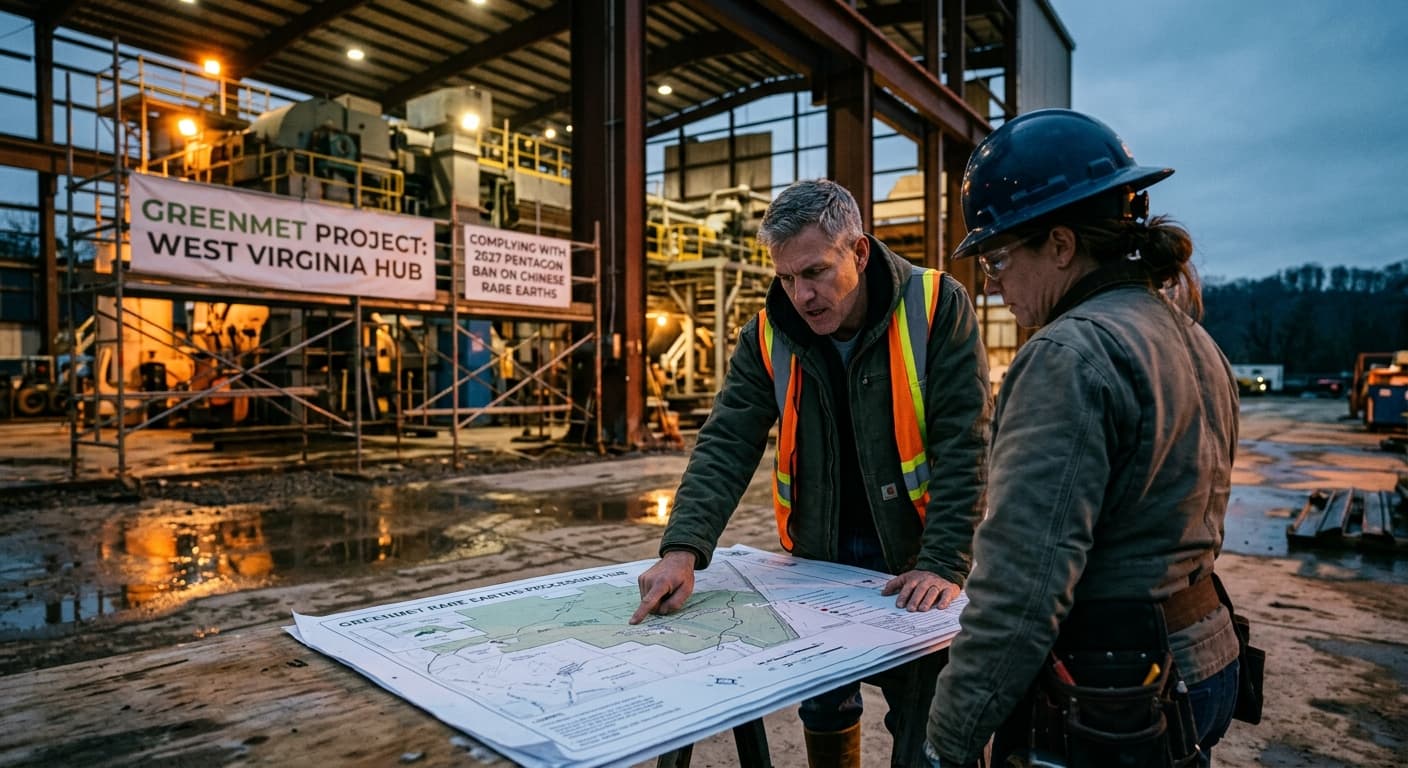
GreenMet's West Virginia Rare Earths Hub Bets on the 2027 Pentagon Ban
A $150M Greenbrier County processing plant, built on coal tailings and allied ore, is timed to the Jan. 1, 2027 DoD ban on Chinese rare earths — the real prize is the defense supply chain.
GreenMet and three partners unveiled a $150 million critical-minerals processing hub in Rupert, West Virginia on July 8, 2026. The geopolitically interesting number is not $150 million or the 250 promised jobs — it is January 1, 2027 — the date the Pentagon's ban on Chinese-origin rare earth magnets in "covered systems" takes full effect. The Greenbrier County facility is engineered less as a mining project than as a regulatory arbitrage play on U.S. defense procurement rules — turning Appalachian coal waste, plus offtake from Greenland, Canada and Cameroon, into the one thing Washington cannot yet buy at scale: heavy rare-earth oxides and metals whose entire supply chain is provably free of China.
That thesis is not aspirational. The Defense Federal Acquisition Regulation Supplement (DFARS) rule finalized in May 2024 replaces the current "melted or produced" test with a full "mined, refined, separated, melted, or produced" restriction on samarium-cobalt and neodymium-iron-boron magnets from China, Russia, Iran and North Korea, effective January 1, 2027, per the Federal Register. That single sentence is why capital is now flowing into unglamorous places like Rupert, population 950.
The Rupert hub, decoded
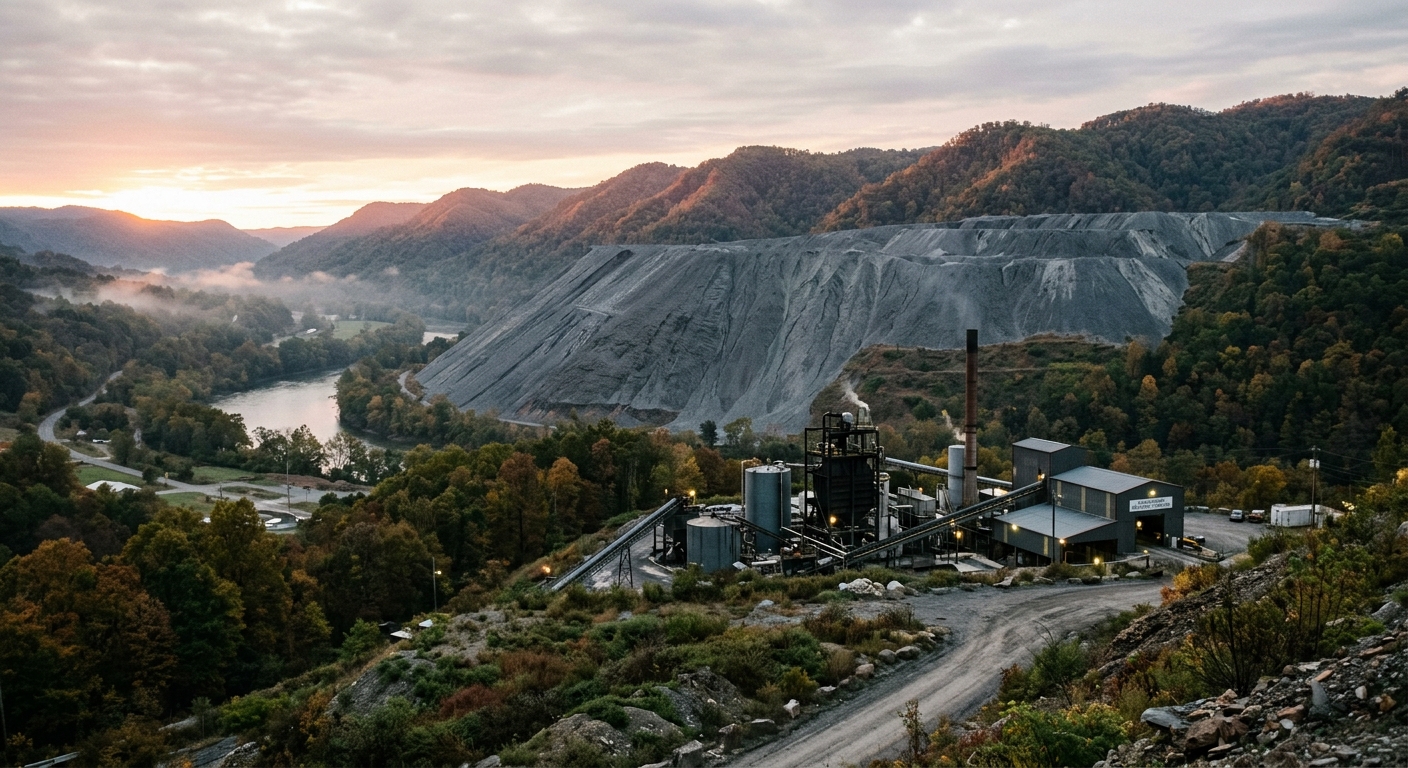
The consortium is deliberately mixed. GreenMet, the Washington, D.C.-based trade name for Greentech Minerals Holding, is the arranger. Flash Metals USA brings the technology — a licensed spin-out of James Tour's Rice University group whose flash Joule heating process reaches ~3,000°C in a one-second electric pulse and roughly doubles rare-earth leachability from coal fly ash, according to a peer-reviewed paper in Science Advances. AmForge Corporation supplies downstream metals and forging capacity. Greenbrier Smokeless Coal Company contributes feedstock — decades of coal tailings and acid mine drainage sludge accumulated across southern West Virginia.
The geological premise is unusual but sound. A Senate Energy Committee report backing the Rare Earth Element Advanced Coal Technologies Act cited a National Energy Technology Laboratory estimate that acid mine drainage sludge in West Virginia and Pennsylvania alone contains roughly 610 to 2,700 tons per year of rare earth elements, per Senate Report 116-74. That is roughly 10% of current U.S. annual REE consumption, sitting in waste piles the coal industry already wants cleaned up.
The hub-and-spoke design matters. Rupert is the central plant; the spokes are offtake agreements with Critical Metals Corp.'s Tanbreez project in southern Greenland, Woodstock Manganese in New Brunswick, and unnamed Cameroon feedstock, as flagged in the announcement carried by Metal Tech News and
MINING.com. Tanbreez is the same asset the U.S. Export-Import Bank has offered a $120 million letter of interest to finance — a project
the BBC reports still needs roads, port and plant built from scratch.
Why the Pentagon rule is the real product
The economics of a small hydrometallurgy plant in Appalachia do not close on merchant-market prices. They close on the DoD price wedge.
Section 844 of the FY21 National Defense Authorization Act amended 10 U.S.C. §4872 to bar the department from procuring covered magnets "mined, refined, separated, melted, or produced" in China. Section 854 of the FY24 NDAA pushed the effective date to January 1, 2027, and DoD's implementing rule applies the restriction to all prime contracts and subcontracts at any tier, per Congressional Research Service IF11226. The prohibition covers aircraft, missiles, ships, tanks, weapon systems and ammunition. There is no phase-in for the primes.
Beijing has been pushing the other direction hard. China's Ministry of Commerce announced Export Control Announcement No. 61 on October 9, 2025, requiring foreign firms to obtain Chinese approval to export magnets containing even 0.1% Chinese-origin heavy rare earths, and effectively barring exports to any company "affiliated with foreign militaries" from December 1, 2025, according to CSIS. The
European Parliamentary Research Service notes the second wave was partially suspended until November 2026, but the licensing regime for the first seven elements remains in force.
The market response was swift and severe. Chinese exports of dysprosium oxide effectively stopped for four months in 2025; when they resumed in August, shipments went only to South Korea and Japan. European dysprosium spot prices ran 289% above Chinese prices post-controls, per a Swedish Institute of International Affairs study using Argus data. Global magnet exports fell 73% in May 2025.
That is the price umbrella under which Rupert has to make sense. The Trump administration is engineering the U.S. side of it deliberately. On July 10, 2025, the Department of Defense took a 15% equity stake in MP Materials for $400 million, extended a $150 million loan for heavy rare-earth separation, and set a 10-year floor price of $110 per kilogram for neodymium-praseodymium — roughly double the June 2025 spot price, per BBC and
CSIS. In October 2025, Commerce agreed to a $1.6 billion package for USA Rare Earth in Oklahoma; in February 2026 the White House unveiled "Project Vault," a $12 billion Strategic Critical Minerals Reserve, per
CRS IF13171.
GreenMet has announced no comparable federal package — and doesn't need one. The market it is selling into already has a buyer of last resort (DoD), a price floor (MP Materials' $110/kg NdPr contract), and a compliance mandate (DFARS 252.225-7052) that together do the commercial underwriting.
The technology that makes coal waste economic
Coal fly ash contains rare earth phosphates locked inside microscopic glass beads formed during combustion. Conventional acid leaching gets less than 20% recovery. Flash Joule heating shatters the glass and reduces the phosphates to acid-soluble oxides in a one-second pulse, boosting recovery to roughly double using dilute (0.1 M) HCl at an electrical cost of about $12 per ton of ash, per Science Advances. A
Nature Reviews Clean Technology review notes Flash Metals USA is the licensee commercializing the process — with James Tour as a stakeholder, though not an officer.
The DOE program authorizing this line of research is codified at 42 U.S.C. §13344, which authorizes $26.6 million for FY2025 and $27.8 million for FY2026 for extraction of REEs from coal and coal byproducts, plus $140 million originally authorized for a full-scale extraction-to-refinery demonstration. NETL's West Virginia and Pennsylvania sites have been the pilot ground since 2014. Rupert is what a decade of publicly funded R&D looks like when it hits a market with a policy tailwind.
The politics: coal country as national-security infrastructure
The West Virginia location is not incidental. Governor Patrick Morrisey campaigned on defending coal against federal environmental rules, and Rupert sits in a Republican district that lost roughly 80% of coal employment in Boone County alone between 2008 and 2016, per Brookings. Reframing coal tailings as strategic feedstock lets the same political constituency that opposed decarbonization sponsor what is, functionally, a decarbonization project: cleaning up abandoned mine waste while feeding electric-vehicle motors and F-35 magnets.
The Wyoming precedent is instructive. Ramaco Resources' Brook Mine outside Sheridan, profiled by NPR in May 2026, uses the same coal-as-REE-host thesis. CEO Randall Atkins put the point bluntly: "Rare earth to the 21st century is going to be the oil of the 20th century." The Ramaco project is not yet in commercial production. Neither is Rupert. Both are betting the U.S. cannot import its way out.
Who benefits, who doesn't
The direct winners are the four consortium partners and their financial sponsors — including, per NPR's January 2026 reporting on an OCCRP investigation, "passive investor" shareholders identified as former Trump Organization executive George Sorial and former White House aide Keith Schiller. The connection surfaced when reporters traced GreenMet's Greenland offtake arrangements to the administration's Greenland policy. GreenMet has said the two men have no management role.
The indirect winner is the Pentagon, which by January 2027 needs at least a paper-thin non-China supply for magnets that go into virtually every weapon system — even F-35s use roughly 900 pounds each of rare-earth material, and submarines can exceed 9,000 pounds, per NPR. A functioning Rupert hub gives contracting officers a defensible compliance narrative even at low tonnage.
The losers are quieter. Chinese processors lose optionality: extraterritorial rules cut both ways, and every kilogram of separated dysprosium or terbium produced in Greenbrier County is a kilogram Beijing cannot embargo. Automakers, the biggest civilian consumer of NdFeB magnets, will pay the price-floor tax indirectly, since the $110/kg NdPr floor is above merchant spot. The environmental case for coal tailings recovery is real, but the volumes will not close the acid-mine-drainage liability on their own; Appalachia has more waste than any single processor can absorb this decade.
"Effective January 1, 2027, the Contractor shall not deliver under this contract any covered material mined, refined, separated, melted, or produced in any covered country, or any end item, manufactured in any covered country, that contains a covered material." — DFARS 252.225-7052, as finalized in the
Federal Register, May 30, 2024.
Diplomat View
The Rupert hub is best read not as a mining story but as the first Appalachian test of whether U.S. industrial policy can conjure a defense-grade rare-earth chain by regulatory fiat before Beijing's export controls become permanent. Our call: GreenMet's plant will physically operate on the announced timeline — the technology is proven at pilot scale and the coal-tailings feedstock is essentially free — but the $10 billion "broader network" figure floated in the announcement will not materialize without a DoD equity or offtake anchor comparable to MP Materials'. Without one, Rupert becomes a specialty separator selling into a price-supported niche, not a hub. The forecast changes if two things happen: an explicit DoD Defense Production Act Title III award to Flash Metals USA or GreenMet before FY27 appropriations close, or a signed offtake between the Rupert plant and a magnet maker on the Vulcan Elements or USA Rare Earth tier. Absent either by mid-2027, the project trades down from "strategic hub" to "regional pilot."
Five signals to track:
- January 1, 2027 — full DFARS 252.225-7052 restriction takes effect; primes must certify non-China supply chains at every tier.
- November 10, 2026 — expiration of China's temporary suspension of its second-wave REE export controls (per EU Parliament research); re-imposition would tighten heavy REE availability further.
- FY2027 NDAA markup (expected fall 2026) — a Title III set-aside or DPA Presidential Determination naming coal-derived REE processing would be the most likely federal on-ramp for Rupert.
- Tanbreez financing close — the $120M EXIM letter of interest needs to convert; if it doesn't, GreenMet's Greenland feedstock leg wobbles.
- DoD equity announcements — a second MP Materials-style deal, potentially with USA Rare Earth or Vulcan Elements, would set the price of admission for any Appalachian hub seeking similar terms.
Discover more
US Politics
House Ethics Committee Pushes Sexual Miscond.
The House Ethics Committee has shifted responsibility for sexual harassment settlement records to the Office of Congressional Workplace Rights, complicating disclosure efforts.
Global Politics
Trump's Conflicting Messages on Iran War
Trump's mixed messages on Iran reflect a strategy of audience management, benefiting Tehran amid a complex geopolitical landscape.

India
Romanian Coalition Party Demands PM Resign
Romania's Social Democrats withdrew from coalition, joining far-right AUR to topple PM Bolojan, risking €10 billion in EU funds by August 2026.

Conflict & Security
Drone Warfare Killing Aid Workers at Unprec
Over 1,000 humanitarian workers killed in three years as cheap armed drones collapse legal protections. Gaza, Sudan, Ukraine, and DRC see deliberate targeting of aid convoys and hospitals with zero prosecutions.