Greece's Vertical Gas Corridor Books 45%
Tariff cuts make Greek corridor fourth-cheapest route into Ukraine
Model Diplomat8 min readEurope
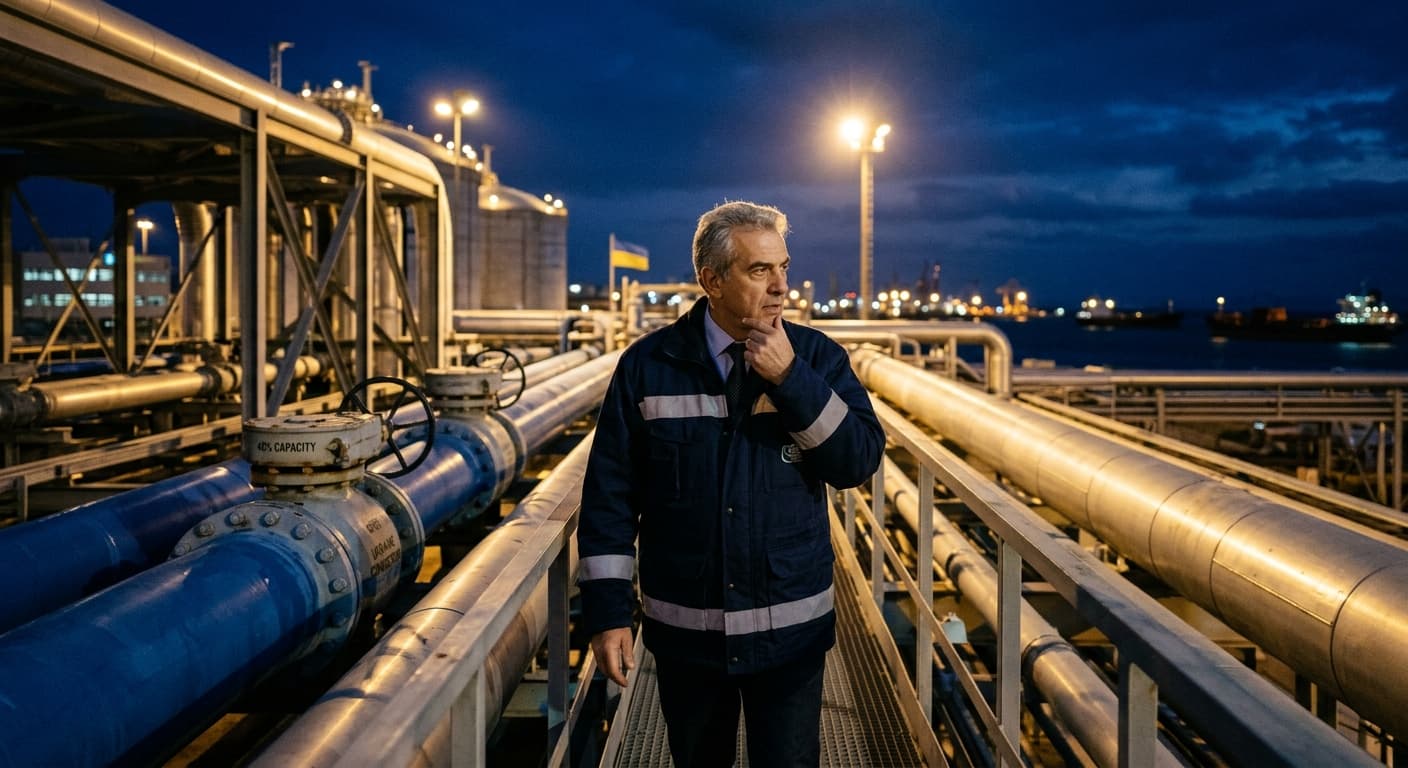
Greece's Vertical Corridor Books 45% Capacity, Redrawing Europe's Gas Map
Greece's Vertical Gas Corridor secured bookings for over 45% of its transport capacity through 2030 after tariff cuts made it the fourth-cheapest import route into Ukraine — positioning U.S. LNG flowing through Greek terminals to replace Russian gas across the Balkans before the EU's 2027 phase-out deadline.
On July 8, 2026, Serbia SEE Energy Mining News reported that annual capacity auctions for the 2026/2027 gas year attracted bookings for more than 45% of available capacity across the next four gas years at the Sidirokastro interconnection point on the Greece-Bulgaria border. The result marked the first auction under a revised commercial framework agreed by five transmission system operators in Athens on March 27, 2026, which introduced lower transmission tariffs and additional discounts across selected sections of the route. The corridor — linking Greek LNG terminals through Bulgaria, Romania, Moldova, and Ukraine — has moved from strategic concept to commercially active infrastructure at the precise moment the European Union is legally bars Russian gas imports. The companies that booked the capacity are almost entirely Greek. The gas they intend to ship is overwhelmingly American. And the route they are displacing is TurkStream.
The tariff breakthrough that made it commercial
The Vertical Corridor's commercial viability hinged on a simple arithmetic problem. Before the March 2026 framework revision, transport costs to Ukraine via the corridor were nearly three times higher than competing routes, according to eKathimerini. That made the route commercially unworkable regardless of its geopolitical appeal. The revised framework, aligned with
EU Regulation 2017/460 on network code rules, introduced transparent cross-border pricing and discounts that brought the corridor's delivered cost down enough to rank as the fourth-cheapest import route into the Ukrainian market.
The mechanism matters. Transmission system operators from Greece (DESFA), Bulgaria (Bulgartransgaz), Romania (Transgaz), Moldova (Vestmoldtransgaz), and Ukraine (Gas TSO of Ukraine), together with ICGB — the operator of the Greece-Bulgaria interconnector — agreed to offer a wider range of capacity products starting October 2026: daily, monthly, quarterly, and annual, according to Energy Circle. This flexibility is not cosmetic. It addresses the core complaint from shippers that long-term capacity commitments on the corridor carried disproportionate risk without corresponding commercial upside. Until full implementation, the TSOs requested regulatory approval to extend current capacity products through October 2026 to maintain supply stability for Ukraine during the transition.
The tariff reform's effect is measurable. Approximately 46% of available export capacity for the 2026/2027–2029/2030 gas years was booked at Sidirokastro, while 26% was reserved for 2030/2031, per Serbia SEE Energy Mining News. More striking: market participants secured long-term transport rights extending to the 2040/2041 gas year. That kind of horizon signals expectations of sustained demand, not speculative positioning.
Named winners: who's booking and why
The auction results reveal a concentration of Greek commercial actors positioning themselves as intermediaries between U.S. LNG suppliers and Eastern European buyers. Atlantic SEE LNG Trade, a joint venture between Aktor Group (60%) and DEPA Commercial (40%), secured approximately 13,000 MWh per day — roughly 4.7 TWh annually — according to Sofokleous10. Metlen booked an additional 20,000 MWh per day for five years through 2031, making it one of the largest single commitments on the corridor. The total export capacity offered at Sidirokastro reached 100 GWh per day, with auction demand broadly matching market expectations.
The commercial logic is straightforward. Greek companies are leasing transport capacity to move LNG — regasified at Greece's Revithoussa and Alexandroupolis terminals — northward through the Balkans into markets that previously depended on Russian pipeline gas. The Shell-METLEN memorandum of understanding signed on February 24, 2026, in Washington, D.C., exemplifies the model: 0.5 to 1.0 bcm per year over 2027–2031, delivered to Greek LNG facilities and distributed via the Vertical Corridor. The signing ceremony — attended by U.S. Energy Secretary Chris Wright, Interior Secretary Doug Burgum, and Greek Environment and Energy Minister Stavros Papastavrou — underscores that this is not merely a commercial arrangement but a U.S.-backed geopolitical alignment.
DESFA, Greece's gas transmission operator, is the structural beneficiary. Every additional unit of gas crossing the Greek network generates regulated transit revenue. The European Commission's PCI factsheet for the Greece-Bulgaria interconnector notes that the IGB — a 182-km pipeline from Komotini to Stara Zagora with a current capacity of 3 bcm/year, expandable to 5 bcm — was designed precisely to enable this northward flow. The EU contributed EUR 33.15 million through the European Regional Development Fund and EUR 45 million through the European Energy Programme for Recovery, according to the
European Commission's regional policy database. That investment is now generating returns.
The Russian gas squeeze: timing meets infrastructure
The Vertical Corridor's commercial breakthrough coincides with the EU's legal codification of Russian gas elimination. On February 2, 2026, the EU published Regulation (EU) 2026/261 in its Official Journal, formalizing a gradual but permanent ban on Russian natural gas imports. The regulation prohibits new contracts immediately, bans Russian LNG by end of 2026, and mandates a complete cessation of pipeline gas imports by November 30, 2027, per the
European Commission's REPowerEU roadmap. Member States were required to submit national diversification plans by March 1, 2026.
The geopolitical framing is explicit in primary documents. A Council of the EU note dated December 10, 2025, states that "the activation and progressive development of the Vertical Corridor stand at the center of Greece's growing role in strengthening the security of energy supply across Southeastern and Eastern Europe." The document frames the corridor as reducing "dependence on traditional supply channels such as the TurkStream pipeline" and enabling "greater flexibility in the sourcing and delivery of LNG." Greece and Ukraine formalized an energy cooperation agreement on November 16–17, 2025, securing U.S. LNG flow through Greek terminals for Ukraine's winter supply, according to the same Council document.
The timing is not coincidental. The EU's REPowerEU roadmap, adopted May 6, 2025, identified Greece as a diversification node for Central and Eastern Europe, noting that "Norway, the EU's largest gas supplier, as well as Romania and Greece, can help diversification in Central and Eastern Europe, traditionally dominated by Russian gas, through the Baltic Pipe and the Trans-Balkan pipeline respectively." The Commission committed EUR 184.7 billion to energy-related diversification initiatives under national Recovery and Resilience Plans and the Connecting Europe Facility.
The bottleneck that could break the model
The corridor's success is not guaranteed. Critical analysis from Altanalyses identifies a structural problem: the missing Rupcha–Vetrino pipeline link in Bulgaria. Without it, the corridor's second and third routes remain stalled, and substantial idle capacity — over 13 bcm through Kardam–Negru Voda 2/3 — sits with near-zero throughput despite demand in Moldova, Romania, and Ukraine. The article argues that actual non-Russian gas flows through the corridor remain limited compared to TurkStream volumes, and that the 45% booking at Sidirokastro, while positive, may reflect demand concentrated at the Greece-Bulgaria leg rather than end-to-end transit to Ukraine.
The Brookings Institution adds a pricing caveat: electricity prices in southeastern Europe — from Greece through the Western Balkans — remain significantly higher than in much of the EU because gas-fired generation often sets the market price, and the switch from Russian pipeline gas to LNG made that gas more expensive. The Vertical Corridor can improve supply security but cannot, on its own, resolve the cost premium that LNG carries over pipeline gas in the region. The same analysis notes that the corridor's success depends on whether "actual flows align with booked volumes" — a question that the 2026/2027 gas year, beginning October 2026, will begin to answer.
Hungary remains the corridor's most visible holdout. A separate Brookings analysis notes that Hungary signed a deal with Turkey in April 2024 to receive gas supply — likely Russian — to replace volumes potentially lost if Ukraine's gas transit ended. Hungary's continued reliance on Russian gas via TurkStream creates a gap in the corridor's northward reach: the route can serve Bulgaria, Romania, Moldova, and Ukraine, but cannot easily penetrate a Hungarian market that has chosen a different supplier.
Historical parallel: TAP and the Southern Gas Corridor
The Vertical Corridor's trajectory mirrors the Southern Gas Corridor and the Trans-Adriatic Pipeline (TAP), which began delivering Azeri gas to Europe in 2020. Both projects faced years of tariff negotiation, regulatory alignment across multiple jurisdictions, and skepticism about whether political backing would translate into commercial commitments. TAP succeeded because it secured long-term transport agreements anchored by Shah Deniz gas from Azerbaijan, giving shippers supply certainty. The Vertical Corridor faces a different challenge: its supply is LNG-based, meaning shippers must secure both pipeline capacity and LNG cargoes independently. The Shell-METLEN MoU is the closest analogue to TAP's Shah Deniz anchor, but at 0.5–1.0 bcm annually it is an order of magnitude smaller than what the corridor's full capacity would require.
The key difference is urgency. TAP was developed over a decade with no hard deadline. The Vertical Corridor must prove its utility before November 2027, when the EU's Russian gas phase-out takes full effect. The 45% booking is an early signal that the market is responding — but as the OSW Commentary on Central European gas dynamics noted, short-term bookings have become more popular than long-term commitments across the region, and the corridor's sustainability depends on converting initial interest into firm, multi-year contracts.
Diplomat View
The Vertical Corridor's 45% capacity booking is a genuine commercial breakthrough — but a narrow one. The winners are identifiable and concentrated: DESFA collects transit revenue, Greek energy companies (DEPA, Metlen) control the merchant flow, and U.S. LNG producers gain a regulated corridor into Eastern Europe. The losers are equally clear: TurkStream's strategic value erodes as the EU's 2027 deadline approaches, and Gazprom loses its last leverage point in the Balkans. The corridor's weakness is structural, not commercial. Without the Rupcha–Vetrino link in Bulgaria, the route cannot reach its designed throughput. Without a larger anchor supply than the Shell-METLEN MoU provides, utilization beyond 2027 is uncertain. The forecast hinges on two conditions: whether Bulgaria completes the missing infrastructure by 2027, and whether a second major LNG supply agreement materializes at scale. If both hold, Greece becomes Southeast Europe's indispensable gas gateway. If either fails, the corridor remains a partial solution — commercially real but strategically incomplete.
What to watch
- October 2026: Start of the 2026/2027 gas year — first test of whether booked capacity converts to actual physical flows through the corridor under the revised tariff framework.
- End of 2026: EU deadline for phasing out Russian LNG imports — the moment when Greek LNG terminals become structurally critical, not merely competitive.
- November 30, 2027: Deadline for complete cessation of Russian pipeline gas imports under Regulation (EU) 2026/261 — the hard cliff edge that determines whether the Vertical Corridor was built in time or too late.
- Bulgaria's Rupcha–Vetrino link: No announced completion date. This is the corridor's single most important unbuilt component. Watch for a Bulgarian government FID or EU CEF funding announcement.
Discover more

US Politics
House Ethics Committee Pushes Sexual Miscond.
The House Ethics Committee has shifted responsibility for sexual harassment settlement records to the Office of Congressional Workplace Rights, complicating disclosure efforts.

US Politics
Virginia's Redistricting Referendum
Virginia's redistricting referendum is drawing a flood of dark money, shaping future elections and the fight for congressional control amid party stakes.

India
BJP's Misunderstanding of Women's Quota Needs
The BJP's linking of the Women Reservation Bill to delimitation risks delaying women's empowerment in India, misreading the aspirations of female voters.

Economics
Fed's Amex AML order puts correspondent banking on notice
Federal Reserve's Amex AML order requires board-level controls and a 90-day plan; OCC fined the bank $350 million over enterprise-wide deficiencies.