Grenada's Strategic Balancing Act
How Grenada navigates US and China for climate finance
Model Diplomat4 min readamericas
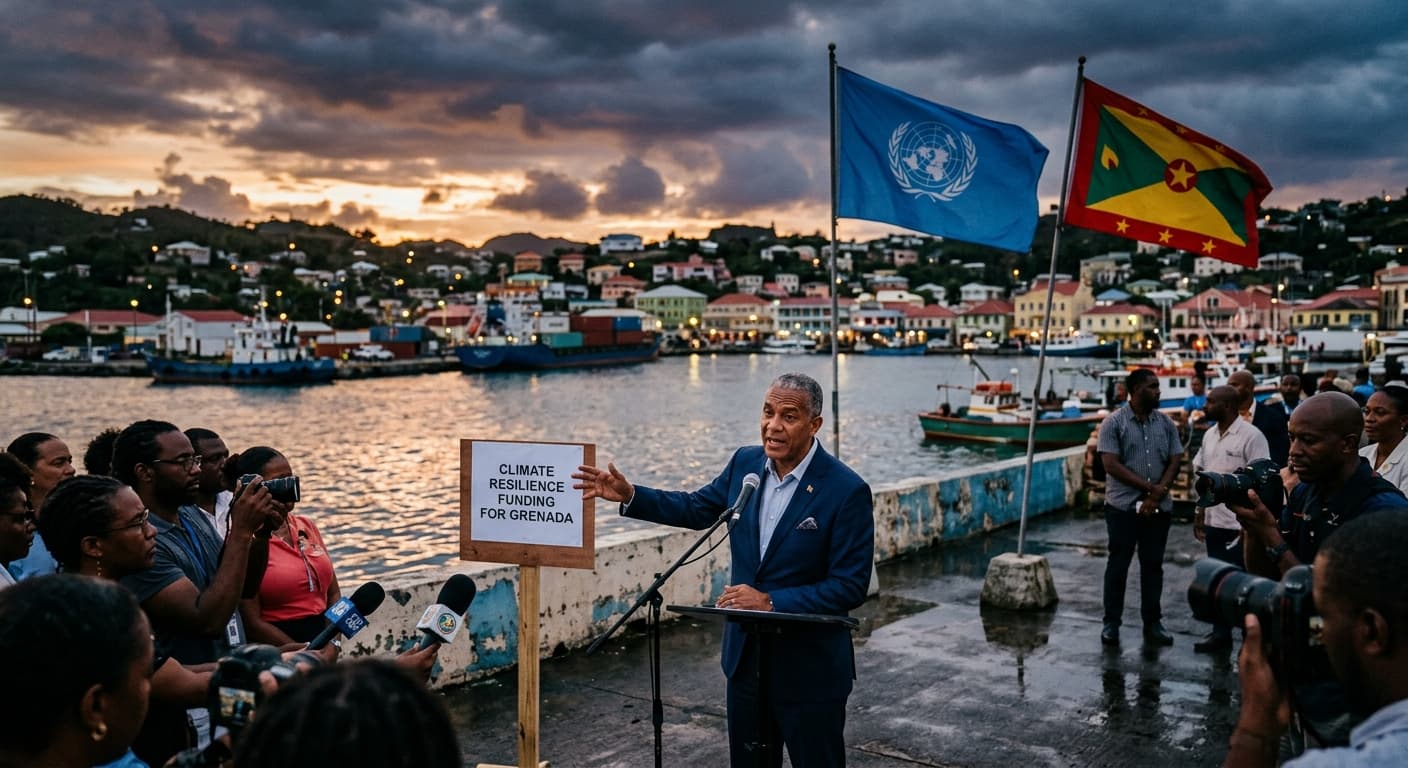
Grenada's Multipolar Gambit — How a Tiny Island Plays Washington and Beijing
Grenada wields its UN vote and strategic location to extract maximum climate finance — refusing to choose between the US and China.
Grenada, population 117,000, has emerged as one of the most strategically dexterous small states in the Caribbean. The reason isn't diplomatic philosophy — it's survival. Hurricane Beryl's July 2024 landfall inflicted damages equivalent to 16.5% of GDP on the islands of Carriacou and Petite Martinique, and the government of Prime Minister Dickon Mitchell has since pursued a foreign policy that is nothing less than transactional about climate finance, infrastructure, and the value of its vote at the UN.
The Beryl Imperative
Beryl reshaped Grenada's fiscal calculus overnight. The World Bank's GRADE assessment put total losses at $218 million, with housing accounting for 74% of the damage World Bank. Mitchell described the destruction as "almost Armageddon-like" and, surveying the wreckage, called Beryl "a direct result of global warming" while accusing "the countries that are responsible for creating this situation" of sitting "idly by"
NPR.
The government moved fast on the fiscal front. Mitchell's administration triggered the escape clause in the Fiscal Resilience Act, suspended the 1.5% of GDP primary balance rule, and drew down post-disaster contingent financing — including CCRIF insurance payouts and the World Bank's Catastrophe Drawdown Option. The IMF endorsed the approach in its January 2026 Article IV consultation, noting Grenada's economy grew 4.4% in 2025 on reconstruction spending, and projecting 3.1% for 2026 IMF. But the deficit is now 3.5% of GDP, and the fiscal rule suspension runs through 2026.
That is the material backdrop for every diplomatic move Grenada makes.
Two Patrons, One Strategy
Grenada's external posture is a carefully calibrated balancing act. Mitchell completed a two-day official visit to Washington on May 18–19, 2026, meeting Deputy Secretary of State Christopher Landau to advance cooperation on investment, energy, trade, infrastructure, and regional security Model Diplomat. The US remains Grenada's dominant security partner — a legacy of the 1983 intervention that dismantled the Bishop regime — and its largest tourism source market.
But Beijing has been writing checks. China built a national cricket stadium in St. George's, upgraded the international airport, and continues to deepen its footprint through infrastructure lending. As The Economist noted in December 2025, "China built a swanky cricket pitch to win over tiny Grenada — the locals love them for it" The Economist. Grenada switched diplomatic recognition from Taiwan to Beijing in 2005 and has not looked back.
The balancing act is this: Grenada accepts Chinese infrastructure investment but reinforces US security ties when it matters. Mitchell's 2026 Washington visit was a signal that St. George's understands its defense umbrella is American. MapDis ranks the US and UK as Grenada's closest military and diplomatic partners, while China registers as an economic partner only MapDis.
The UN Vote as Leverage
In multilateral forums, Grenada votes with the Alliance of Small Island States (AOSIS) and CARICOM — consistently backing climate finance resolutions, Palestinian statehood measures, and positions that put it at odds with Washington. Grenada voted for the 2017 Jerusalem resolution that called on the US to withdraw recognition, and its UN General Assembly votes routinely align with the Global South on climate and development issues BBC News.
This isn't ideology. It's the most valuable asset a microstate has. When the UN General Assembly voted on May 21, 2026 to support the ICJ's landmark climate ruling finding states have a "legal obligation to act on the existential threat of climate change," 141 states voted yes — including Grenada — while the United States voted no Al Jazeera. For a country that produces 0.002% of the CO2 the US has emitted but bears the cost of Category 5 storms intensified by warming seas, the vote is the point
BBC Future.
Mitchell's government understands that Washington wants Grenada's vote — or at minimum its abstention — on resolutions involving China, Venezuela, and Cuba. As long as that vote is in play, Grenada retains leverage to press for concessional climate finance rather than debt-creating loans.
What to Watch
The 2026 budget, tabled at EC$1.9 billion, extends the fiscal rule suspension and bets heavily on Project Polaris — a five-year, $250 million hospital project — to sustain growth as reconstruction spending tapers. The downside risks are real: a slowdown in US or UK tourism, disruption to Citizenship-by-Investment revenues, or another hurricane before the fiscal cushion rebuilds. The primary balance rule is supposed to return in 2027. Whether Mitchell's government can meet that deadline without sacrificing climate resilience investment will determine whether Grenada's balancing act holds, or whether it must choose a patron after all.
Discover more
Global Politics
US-Iran Tensions Rise
Tensions escalate in the Strait of Hormuz as Iran and the US clash over maritime control, with a ceasefire hinging on a contested MoU paragraph.
Global Politics
Trump's Conflicting Messages on Iran War
Trump's mixed messages on Iran reflect a strategy of audience management, benefiting Tehran amid a complex geopolitical landscape.

US Politics
SNAP Food Assistance Faces Legal Challenges
In 2026, SNAP faces stricter eligibility rules and mounting legal challenges, threatening food assistance for the millions of Americans who rely on the program.

Economics
Fed's Amex AML order puts correspondent banking on notice
Federal Reserve's Amex AML order requires board-level controls and a 90-day plan; OCC fined the bank $350 million over enterprise-wide deficiencies.