GOP Divided Over Trump's Tariff Policies
Republicans face a crucial vote on tariffs before midterms.
Model Diplomat8 min readNorth America
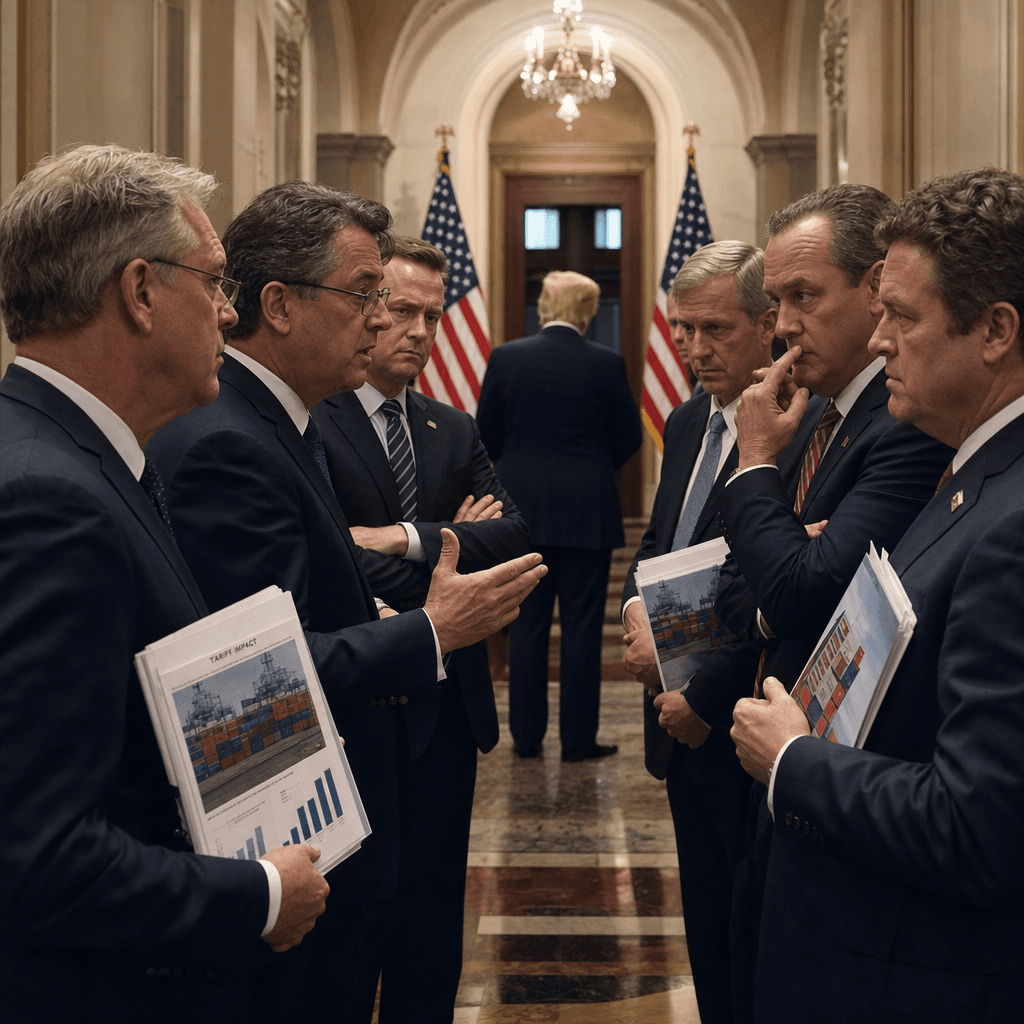
GOP Divided Over Trump's Tariff Policies: The July 24 Reckoning
Republicans are split three ways on Trump's tariffs — and a July 24 expiration date will force every senator to pick a side on the record before the midterms.
The Supreme Court's 6–3 ruling on February 20, 2026, that stripped the president of emergency tariff powers did not settle the Republican civil war on trade — it scheduled the decisive vote. On July 24, the 15% global tariff Donald Trump imposed under Section 122 of the 1974 Trade Act automatically lapses unless Congress extends it, forcing House Speaker Mike Johnson and Senate Majority Leader John Thune to hold a recorded, filibuster-eligible vote roughly 100 days before an election in which Trump's approval is underwater in farm-state Iowa and coastal swing districts alike. The decisive question is no longer whether the GOP is divided on tariffs — it is whether Thune has 60 votes to extend them, and if he doesn't, whether Trump takes the loss or defies the statute.
The court closed one door, Trump opened three more
In Learning Resources, Inc. v. Trump, Chief Justice John Roberts wrote for the majority that IEEPA "contains no reference to tariffs or duties" and that "until now no President has read IEEPA to confer such power," per the Supreme Court opinion. Six justices — including Trump appointees Neil Gorsuch and Amy Coney Barrett — joined the core holding, with three invoking the major-questions doctrine to reinforce it. The Congressional Research Service confirmed in its
legal sidebar that the ruling voids both the "fentanyl" tariffs on Canada, Mexico and China and the April 2025 "reciprocal" tariffs on virtually every U.S. trading partner.
Within hours, Trump signed an executive order invoking Section 122, then raised the rate from 10% to 15% — the statutory ceiling — the next day. He also directed U.S. Trade Representative Jamieson Greer to open Section 301 investigations designed to reconstitute the tariffs on a firmer legal footing. Two probes are already running: one country-by-country, and a second on "forced labour" spanning 60 jurisdictions including the EU, UK, Canada and China, according to the BBC. Treasury Secretary Scott Bessent has told markets the combination "will result in virtually unchanged tariff revenue in 2026."
That is the administration's real answer to the Supreme Court: replace $175 billion in IEEPA-derived duties, per the Council on Foreign Relations, with a stack of narrower authorities that don't need Congress. But Section 122's 150-day clock — and a May 2026
Court of International Trade ruling that Trump had failed to make the required balance-of-payments finding — mean the legal bridge is fraying just as the political one has to hold.
Three GOP factions, not two
The conventional framing of a "MAGA vs. moderate" split understates the fracture. There are at least three coherent Republican positions, and each has a face.
The codifiers, led by Senator Bernie Moreno of Ohio, want to use budget reconciliation to lock Trump's tariff regime into statute — a move that would sidestep the Democratic filibuster and moot the Supreme Court's ruling by supplying the delegation the Court found missing. Moreno told colleagues on Truth Social within hours of the ruling that Senate Republicans should "codify Trump's tariff regime," per the Financial Times. The vehicle exists: Republicans have already used reconciliation twice this Congress, most recently the
$70 billion ICE funding measure in April.
The institutionalists, led by Senate Judiciary Chairman Chuck Grassley of Iowa, want the opposite — to claw back tariff authority Congress has ceded for decades. Grassley's bipartisan bill with Maria Cantwell, the Trade Review Act of 2025, would require congressional approval within 60 days of any new tariff and mirrors Grassley's 2019 Section 232 reform. After the ruling, Grassley pointed out he is "one of the only sitting members of Congress who was in office during IEEPA's passage" and repeated that Congress "needs to reassert its constitutional role over commerce," per his
official statement.
The defectors are the ones who have actually been voting against Trump. Susan Collins of Maine, Lisa Murkowski of Alaska, Rand Paul of Kentucky and Mitch McConnell of Kentucky have joined Democrats on every Senate termination vote since April 2025, with Thom Tillis of North Carolina peeling off on Brazil. In the House, Thomas Massie, Don Bacon, Kevin Kiley, Dan Newhouse, Brian Fitzpatrick and Jeff Hurd broke ranks on February 12, 2026, to pass a Canada-tariff termination 219–211, per Al Jazeera. Bacon's floor argument was constitutional, not economic: "Why doesn't the Congress stand on its own two feet and say that we're an independent branch?"
The fourth group — the largest one — is the silent Republican majority that privately opposes tariffs and publicly votes with Trump. One member told Semafor via the Council on Foreign Relations, "I am no fan of tariffs," but voted the party line because with a certain veto the vote was just "a political thing." That calculus changes on July 24, when the vote actually decides whether the tariffs stay.
What the numbers do to the politics
Public opinion is not close. A survey cited by Brookings scholars found more than 60% of Americans disapprove of the tariffs, including nearly a quarter of Republicans and roughly three-quarters of independents. The Yale Budget Lab, as reported in the same Brookings analysis, calculates that losing IEEPA tariffs would drop the effective U.S. tariff rate from 16% to 9.1%, while the Section 122 replacement pushes it back to 13.7% — a 16% net revenue loss against the Congressional Budget Office's ten-year $2.4 trillion estimate.
The revenue math matters because it locks Republicans into a trap of their own making. The One Big Beautiful Bill Act, passed on reconciliation in 2025, was scored assuming the tariff revenue stream would offset the tax cuts. Strip out IEEPA duties, and either the deficit balloons or Section 301 has to produce equivalent revenue — which means broader, harder-to-defend tariffs on named allies exactly as the midterms arrive.
Farm country is where that math turns into political blood. China stopped buying U.S. soybeans in bulk in 2025, per NPR reporting from South Dakota, forcing Trump to announce a $12 billion one-time relief payment in December — smaller than the 2019 bailout despite a larger shock. Mississippi Delta farmers told NPR the
Farmer Bridge Assistance Program covered only 20–25% of last year's tariff losses. USDA's own statement puts total ad hoc farmer assistance since January 2025 above $30 billion.
The map of pain is also the map of the Senate calendar. Iowa (Joni Ernst retiring), North Carolina (Tillis on the ballot), and Maine (Collins) are the three seats most exposed to a tariff extension vote. Trump's own team has flagged the risk: he flew to Iowa in January and Wisconsin in June explicitly to shore up farmers, per Al Jazeera.

The Section 122 trap
Here is the structural point everyone in the Capitol understands and few are saying out loud: the Supreme Court didn't just strike down tariffs — it handed Democrats a weapon.
Section 122's 150-day cap means the tariff extension vote cannot be filibustered indefinitely under an ordinary process — but any extension requires an affirmative act of Congress within a legislative window that expires on July 24, 2026. Brookings notes Senate Democrats could filibuster an extension, and CSIS's summer trade agenda reports that Greer has floated simply letting the tariffs lapse and re-imposing them after a "short interval" — a workaround that "would certainly lead to yet another lawsuit."
If Thune brings the extension to the floor, he has to whip roughly a dozen Republican senators publicly on the record for a tax hike that 60% of the country opposes. If he doesn't, Trump's tariff regime rests entirely on the Section 301 investigations, which take months and are themselves subject to CIT review. Speaker Johnson's control is even thinner: three House Republicans broke his rule on February 11, and six broke his whip the next day. The House GOP has a 218-seat majority, per Al Jazeera — four defections flips any vote.
The historical parallel isn't Smoot-Hawley. It's 2018, when Republican senators drafted resolutions to constrain Trump's steel and aluminum tariffs and then, faced with a certain veto, let them die. What's different now is the statutory clock. Section 122 runs out whether Congress acts or not, converting an omission into a policy defeat. As Brookings political scientist Vanessa Williamson framed it, echoing David Mayhew, lawmakers are graded on "the positions they take, not the policy outcomes that follow."
Winners and losers, named
The clear winners of the ruling and the split are the four Republican defectors — Collins, Murkowski, McConnell, Paul — plus Grassley, who have spent 18 months building a paper trail against tariffs and now look prescient. Susan Collins in particular gains a talking point in Maine, where she argued on the Senate floor in April 2025 that she supported tariffs on China but saw "no case for Canada."
The losers are the silent majority. Every House Republican who voted against the Meeks resolution on February 12 while privately opposing tariffs now has a recorded vote to defend if the economy sours further and Section 301 duties bite constituents. Semafor's reporting that 205 Republicans "stood with him despite widespread doubts" is not a footnote — it is the vote Democrats will run against in October.
The unexpected beneficiary is Brazil. Argentine and Brazilian soy producers picked up 35% more harvested area during Trump's first trade war, per the International Food Policy Research Institute, and the Section 301 investigation announced against Brazil in June — over "alleged trade violations including illegal deforestation," per Al Jazeera — has become a domestic issue in Brazil's own October election, with Flavio Bolsonaro asking Washington to delay tariffs until after voters go to the polls. The trade war has become a bank shot into other countries' politics.
What to watch next
- July 24, 2026 — Section 122 tariffs expire. Watch whether Thune schedules an extension vote or lets them lapse and re-declares.
- Late July / August — Expected rollout of Section 301 tariffs from the country-by-country and forced-labor probes. USTR public comment periods close through July.
- October pre-election recess — Any Meeks-style privileged resolution reaching Trump's desk would trigger a veto-override fight. The last two Trump vetoes were not overridden, per CFR.
- The Supreme Court, again — The May 2026 CIT ruling against Section 122 is on appeal. If it reaches the high court before the midterms, the entire Section 122 bridge collapses.
Diplomat View
The GOP tariff split is not a values fight — it is a timing fight. Every faction, from Moreno to Grassley to Collins, understands the same underlying math: Trump's tariff regime has been rebuilt on statutory sand, and the July 24 deadline forces a recorded vote that the party would rather never take. Our forecast: Section 122 lapses without an extension vote, Trump attempts a re-declaration, and the resulting litigation runs past the November midterms — giving vulnerable Republicans the fig leaf of "the court did it, not me." This forecast would revise if Thune signals in the next two weeks that he has 50 Republicans committed to extension, if Moreno's reconciliation gambit clears the Senate parliamentarian's Byrd-rule review, or if Section 301 duties are ready to snap in before July 24 — none of which currently appears likely. The larger structural point is that the Supreme Court has done what Congress would not: it has made every future tariff a political vote with a named author. That is the constitutional victory Grassley wanted, delivered in a form no Republican wanted to cast the ballot for.
Discover more
US Politics
Next Generation Republicans
A leaked survey shows 39% of Republicans under 30 do not identify as MAGA, revealing a split in the GOP's future leadership.

Conflict & Security
Drone Warfare Killing Aid Workers at Unprec
Over 1,000 humanitarian workers killed in three years as cheap armed drones collapse legal protections. Gaza, Sudan, Ukraine, and DRC see deliberate targeting of aid convoys and hospitals with zero prosecutions.

Global
World Normalises Taliban as Afghan Women Eras
UN data shows Afghan women erased from public life as Russia recognises the Taliban, EU hosts officials in Brussels, and ICC warrants for gender persecution go unenforced.

Conflict & Security
West Africa Food Crisis: Three Shocks in 2026
Conflict, climate extremes, and the Strait of Hormuz closure drive a severe food crisis in West and Central Africa, with fertilizer prices surging 80% and millions displaced.