Global Leftists Rally in Barcelona Against F
Progressives unite against far right and Trump
Model Diplomat8 min readEurope

Global Leftists Rally in Barcelona Against Far Right and Trump
Sánchez and Lula convened 6,000 progressives in Barcelona on April 18–19, 2026 to build a Trump-era coalition against the global far right.
Spanish Prime Minister Pedro Sánchez and Brazilian President Luiz Inácio Lula da Silva convened more than 6,000 progressives from over 100 organisations in Barcelona on April 18–19, 2026, six days after Viktor Orbán's landslide defeat in Hungary — turning what was billed as an anti-far-right rally into the founding meeting of a Trump-era progressive coalition whose real project is not domestic ideology but a coordinated pushback against Washington's foreign policy. The "In Defence of Democracy" summit produced no manifesto and no institution. It produced something more useful to its organisers: a stage on which the leaders of Spain, Brazil, Mexico and Colombia jointly declared that Cuba's sovereignty must be respected under international law — a message aimed squarely at Donald Trump.
That reframing is the story. The Barcelona meeting is being reported globally as leftists "hoping to spark a resurgence" (per Reuters, via Japan Times). It is better understood as the moment when Europe's Socialists and Latin America's Pink Tide 2.0 formally merged their anti-Trump agendas — and started competing with the Alliance of Democracies bloc for ownership of the word "democracy" itself.
What actually happened in Barcelona
The gathering was the fourth iteration of Sánchez's "In Defence of Democracy: Fighting Against Extremism" initiative, launched in 2024 and previously hosted alongside meetings with European Council President António Costa. The BBC confirmed roughly 20 heads of state and government or their representatives attended, including Mexico's Claudia Sheinbaum, Colombia's Gustavo Petro and former Chilean president Gabriel Boric. US Senator Chris Murphy (D-Conn.) delivered the American Democrats' contribution, celebrating Orbán's defeat from the Barcelona podium, as
The New Indian Express reported.
Sánchez opened with a line calibrated for the room: "Democracy cannot be taken for granted… We are witnessing attacks on the multilateral system, one attempt after another to challenge the rules of international law, and a dangerous normalisation of the use of force." Lula, in remarks reported by Al Jazeera and
BBC Brasil, went further, calling the UN Security Council's five permanent members — the US, China, Russia, France and the UK — "lords of war" and demanding regulation of social-media platforms he described as offering "little that is social and much hate."
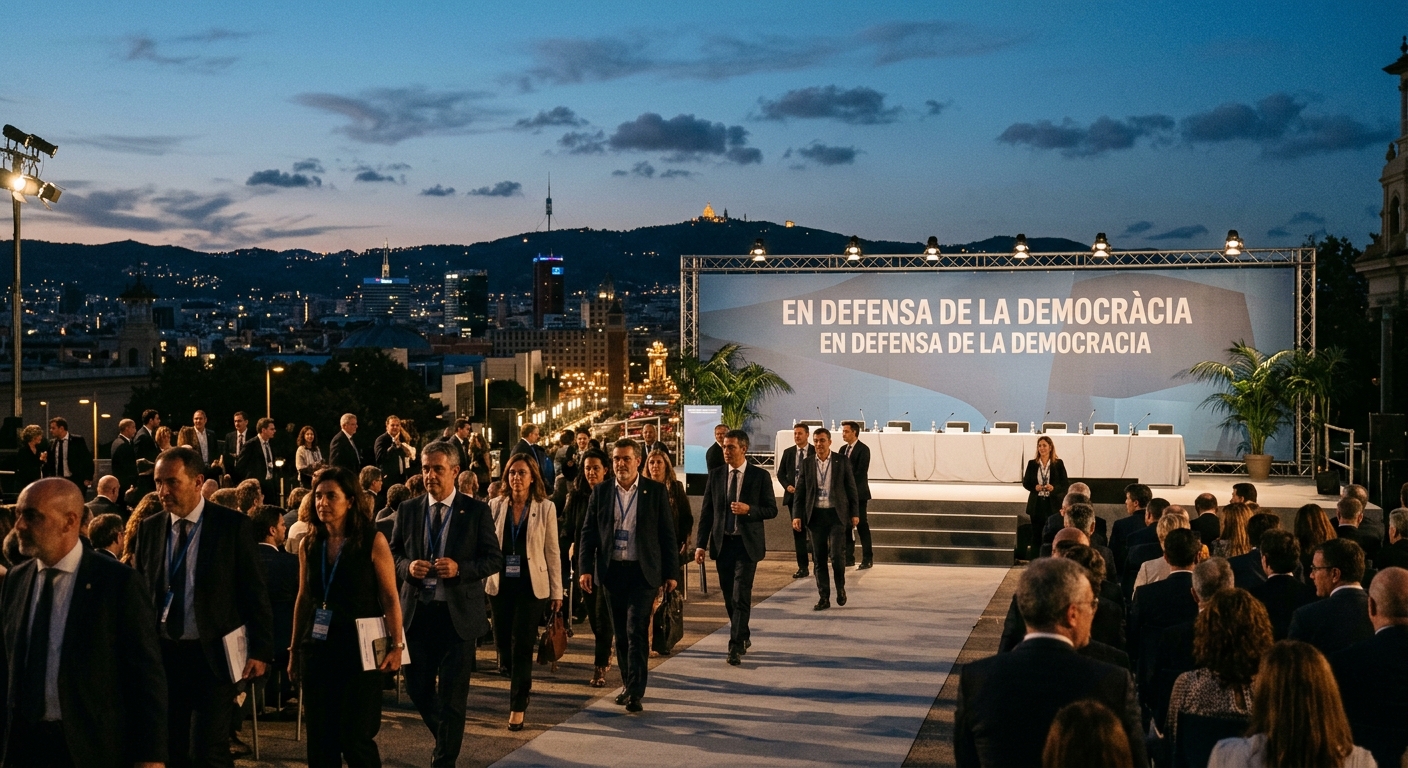
Neither leader named Donald Trump. Neither had to. The concrete deliverable of the summit was a trilateral statement from Spain, Brazil and Mexico pledging expanded humanitarian aid to Cuba and warning against actions "contrary to international law" — verbatim language chosen to avoid mentioning Washington while indicting it. The statement called for respect for "territorial integrity, sovereign equality and peaceful settlement of disputes" as outlined in the UN Charter. Trump's administration has escalated economic pressure on Havana and, in January 2026, orchestrated Nicolás Maduro's arrest and removal from Caracas, an intervention that has redrawn Latin America's diplomatic map.
The window that opened it
Barcelona did not appear from nowhere. It followed a compressed sequence of far-right setbacks that gave Sánchez the political oxygen to convene it.
On March 22, 2026, France's Rassemblement National failed to capture Paris, Lyon or Marseille in municipal runoffs. On the same day, Slovenian Prime Minister Robert Golob defeated Janez Janša's SDS by 29 seats to 28, and Italian voters rejected Giorgia Meloni's flagship judicial reforms 53.5% to 46.5%, with turnout above 58% — a "significant rebuke," Hungarian sociologist Gábor Scheiring told Al Jazeera. Three weeks later, on April 12, Péter Magyar's Tisza party demolished Fidesz 138 seats to 55 in Hungary, on a record 79.5% turnout, according to preliminary results reported by the
BBC.
That Orbán defeat is the load-bearing beam of the Barcelona narrative. Foreign Affairs' analysis by Kim Lane Scheppele, How Orbán Defeated Himself, notes that Tisza consolidated pro-democracy voters into a single movement, exploited corruption fatigue, and used Orbán's own hyper-majoritarian electoral system against him — a template opposition parties in "competitive authoritarian" states are already studying. The OSW Centre for Eastern Studies in Warsaw calls the result
the "triumph of Péter Magyar" and warns Fidesz faces its worst crisis since 2002.
The problem for Sánchez's coalition is that four data points are not a trend. As Carnegie Europe's Célia Belin argued in a post-municipal analysis, France's electorate is drifting rightward even as the RN failed to take metros; Bardella leads 2027 first-round polls at 30%+ with no left-wing candidate above 11%. The Konrad-Adenauer-Stiftung's
April 2025 party barometer shows Portugal's Chega still polling 16–21%, AfD stable in Germany, and PES-family parties flat or declining across most member states. The wave has crested unevenly — and only where opposition forces united tactically.
The real project: an anti-Trump foreign-policy bloc
Read the guest list, not the speeches. What Barcelona assembled is not a left-wing programmatic alliance — Sheinbaum's Morena, Lula's PT, Sánchez's PSOE and Petro's Historic Pact disagree on trade, energy transition, and Venezuela — but a group of governments whose bilateral relations with the Trump administration have all deteriorated in specific, parallel ways.
Sánchez is the most exposed. On March 3, 2026, Trump threatened to "cut off all trade with Spain," calling it a "terrible" NATO partner after Madrid refused US access to Morón and Rota air bases for strikes on Iran, per the BBC. On April 24, Reuters revealed an internal Pentagon email floating the suspension of Spain from NATO — a symbolic move with no treaty basis, as
Al Jazeera and NATO officials clarified. Spain is the only alliance member to have publicly refused Trump's 5%-of-GDP defence-spending target. A CIS poll cited by BBC found 77% of Spaniards hold a "bad" or "very bad" view of Trump — political cover Sánchez has translated into leadership of a bloc.
Lula's calculus is different. Brazil signed a US–Brazil DESARMA security partnership on April 10, and Lula told Spanish and Brazilian executives in Barcelona: "I don't want a fight with Trump," per BBC Brasil. But he faces re-election in October 2026 and needs the progressive-international optics without triggering tariff retaliation on Brazilian coffee, beef and aircraft. The EU–Mercosur trade agreement enters provisional force on May 1, 2026 —
Al Jazeera reports Lula framed it as "a response to unilateral tariffs" from Washington. Barcelona was, for Lula, an insurance policy in Europe.
Sheinbaum is arguably the biggest beneficiary. Her decision to attend, and to say publicly that "there is no diplomatic crisis" with Spain over the conquest-apology dispute that soured relations under her predecessor Andrés Manuel López Obrador, restarted Madrid–Mexico City relations at zero cost. Petro, Boric and Chilean leftist candidates gain a stage. The joint Cuba statement — anchored on UN Charter language — is the closest thing to a primary document the summit produced.
The institutional counter-move
Barcelona is also a bid for narrative ownership. The word "democracy" is now contested terrain. In Copenhagen on May 13–14, 2026, former NATO Secretary General Anders Fogh Rasmussen unveiled his "Democracies-7" (D7) proposal at the Alliance of Democracies Summit — an economic bloc of the EU, UK, Canada, Australia, New Zealand, Japan and South Korea, complete with a proposed "Economic Article 5," according to Stockholm Free World Forum. John Bolton and Chrystia Freeland headlined.
That is a transatlantic-liberal frame that specifically excludes Brazil, Mexico, Colombia and South Africa. Sánchez and Lula's Barcelona bloc is the counter-offer: a Global South–southern Europe axis that puts UN Charter multilateralism, Security Council reform and wealth taxation at the centre. The European Commission's own European Democracy Shield, published on November 12, 2025 (JOIN(2025) 791 final), sits awkwardly between the two — Brussels' institutional response to disinformation and foreign interference, technocratic where Barcelona is political.
The Progressive Alliance's Hyderabad Declaration, adopted in April 2025 by parties from more than 100 countries, is the actual programmatic document Barcelona builds on: wealth tax, UN reform, platform regulation. Sánchez's summit gave that programme heads-of-state validation.
What the numbers say
The uncomfortable truth for the Barcelona bloc: the far right has not retreated so much as plateaued at historically high levels, then bled ground only where competent opposition consolidated.
The Stiftung Wissenschaft und Politik in Berlin found in its post-2024 European Parliament analysis that the ECR, Patriots for Europe and Europe of Sovereign Nations groups collectively held their strongest position in EP history, with governments including ECR or PfE parties representing 26.1% of the EU population — one large member-state away from a Council blocking minority. The European Parliament, in a
report adopted 328-199 on April 29, 2026, warned explicitly of "democratic backsliding, political interference in the judiciary, shrinking civic space" across member states — including some governed by nominal centrists.
The Barcelona bet is that Orbán's fall is inflection, not aberration. The evidence for that thesis rests on four elections in twenty-two days and a hostile US administration whose foreign policy is unifying otherwise disparate leftist governments. It is a real bet, but a contested one.
Diplomat View
The Barcelona summit is best read not as a resurgence of the global left, but as the incorporation ceremony of a specific coalition: Sánchez's PSOE, Lula's PT, Sheinbaum's Morena, Petro's Historic Pact and the Democratic Party's foreign-policy wing. Its glue is not ideology — these governments disagree on markets, migration and Venezuela — but shared exposure to a US administration that has threatened Spain with NATO suspension, imposed tariffs on Brazil, arrested Maduro without regional consultation, and menaced Mexico with troop deployments. That is a durable adhesive.
The bloc's forecast turns on three tests. If Bardella wins France in April 2027, Barcelona becomes a support group, not a movement — the largest Continental power will be governed by the RN and the anti-Trump coalition will have lost its European heavyweight. If US Democrats retake the House in November 2026, Sánchez's frame will look prescient and Lula will have insurance for his own October election. If Meloni's Italy holds together despite the March referendum defeat, the PfE's Council leverage remains intact and Barcelona's momentum stalls. The single event that would revise this forecast is a French Socialist–Green–LFI unification pact before the 2027 first round. Absent that, Barcelona is a rhetorical win, not a structural one.
What to watch
- May–October 2026: Brazilian presidential campaign. Lula's Barcelona performance is a test of whether progressive-international optics play at home without inviting Trump retaliation on Mercosur.
- November 3, 2026: US midterm elections. A Democratic House flips the political ecology around every leader who spoke in Barcelona.
- April 2027: French presidential first round. Bardella leads polls at 30%+; the left has no unified candidate.
The Bottom Line
Barcelona was not a leftist revival — it was the founding meeting of an anti-Trump foreign-policy coalition wearing anti-far-right branding, anchored by a Spain–Brazil–Mexico axis whose real deliverable was a joint statement on Cuban sovereignty. The coalition's durability depends on France in 2027 and the US midterms in 2026, not on the momentum of Orbán's defeat. If Bardella wins the Élysée, Sánchez's Global Politics project becomes a support group for a shrinking club.
Discover more
Global Politics
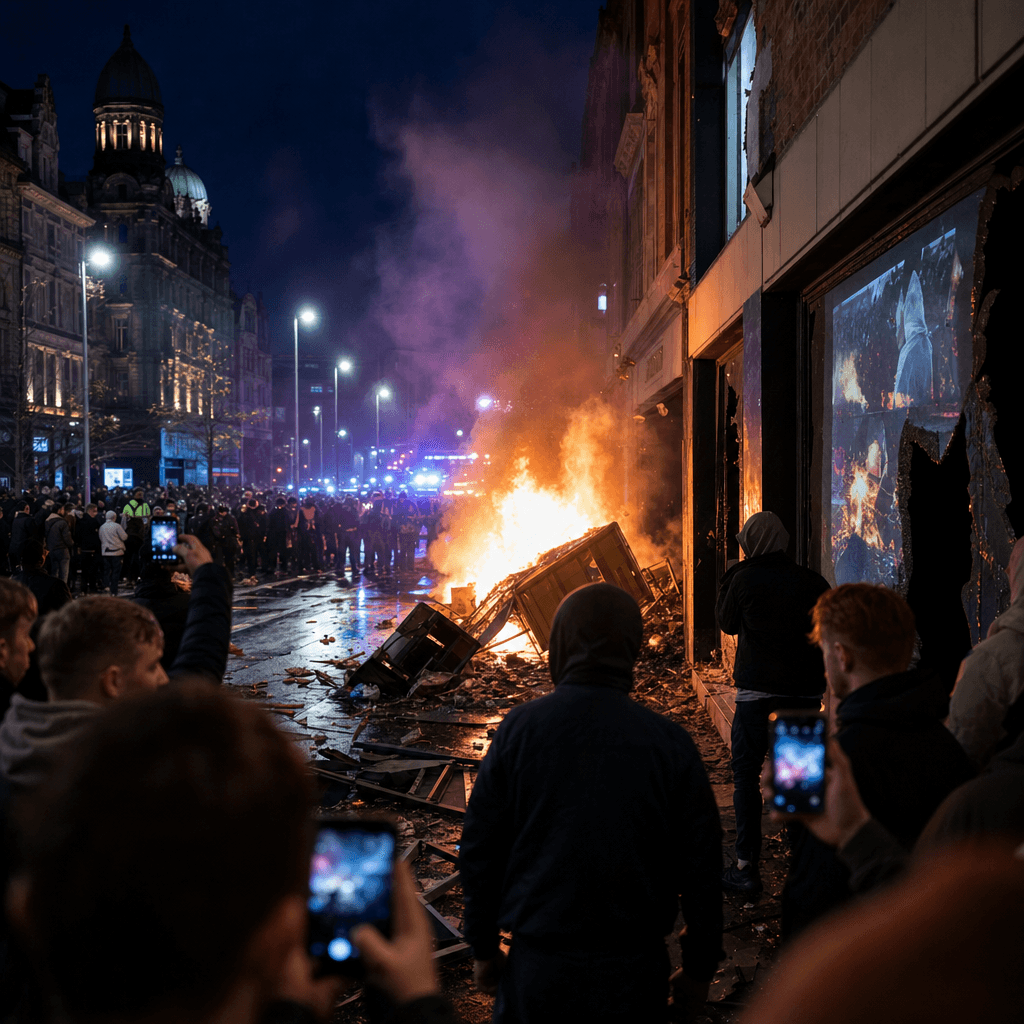
Belfast Burning: The Far-Right Spark
Belfast faces a surge in far-right violence fueled by online disinformation, as sectarian tensions and immigration anger ignite unrest across Northern Ireland.
International Relations
Macron Faces Far Right Challenge in EU Vote
The far right gained in the EU elections, but Emmanuel Macron took the bigger hit as National Rally's surge forced him onto the defensive at home in France.
Global Politics
EU Election 2024
Far-right parties surged in the 2024 EU elections, yet the center-right EPP held its grip on power, reshaping the bloc's balance as Macron and Scholz weaken.
Global Politics
Charles Alloncle's Attack on French Media
A parliamentary report demands €1 billion cuts to France's public broadcasters, positioning the far right for the 2027 elections and benefiting Vincent Bolloré.