Ghana's $700M Eurobond Early Repayment
Ghana rewrites debt repayment rules in Africa.
Model Diplomat7 min readSub-Saharan Africa
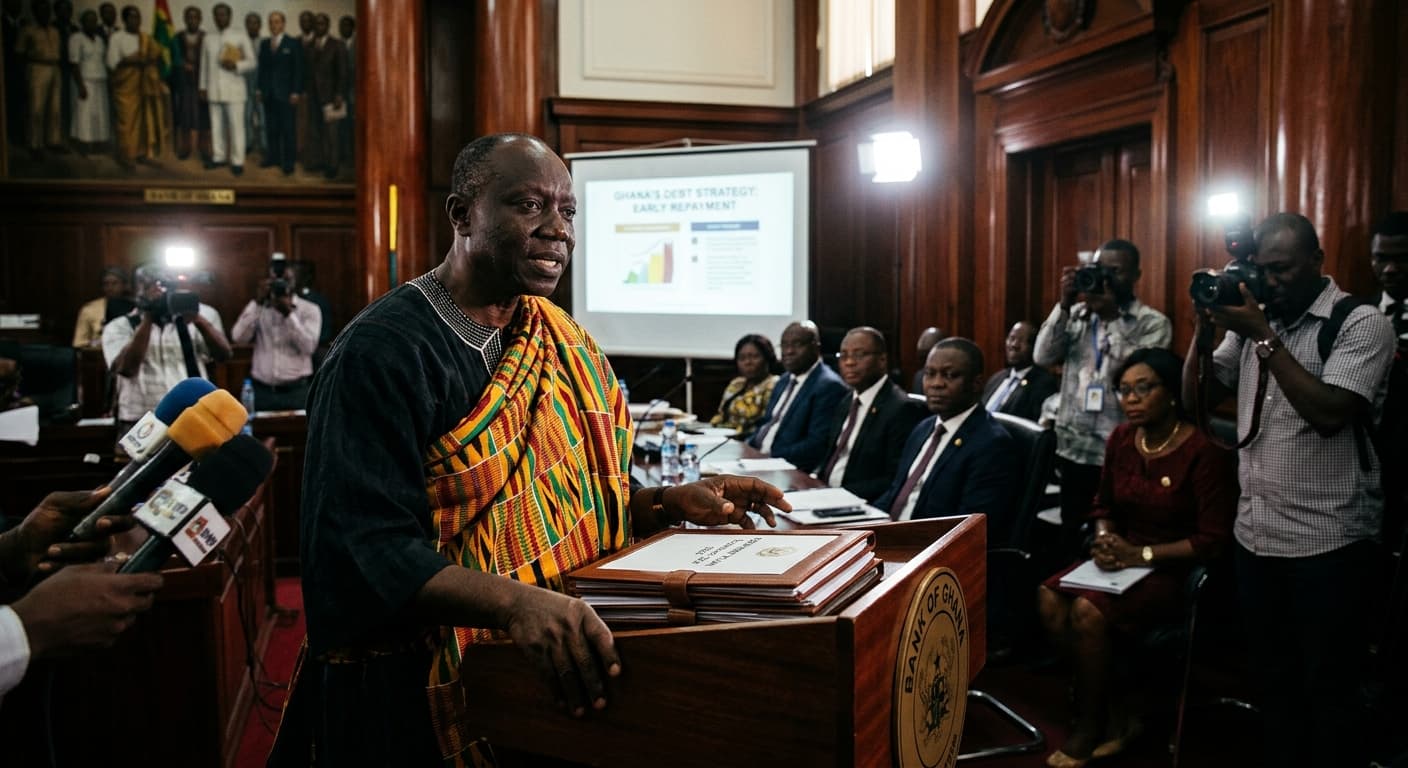
Ghana Pays $700m Eurobond Early: Africa's Debt Playbook Rewritten
Ghana settled $700 million in Eurobond debt ahead of schedule on July 6, 2026 — a rare early repayment that reframes how Sub-Saharan Africa can exit the Common Framework.
Ghana wired $700 million to Eurobond holders on July 6, 2026 — ahead of schedule — and in doing so quietly rewrote the script other Sub-Saharan African debtors have been forced to read from since 2020. Twenty months after completing a $13 billion restructuring with international bondholders, the Mahama government is now paying down the new bonds early rather than rolling them, using windfall gold revenue and an appreciating cedi to reduce foreign-currency exposure at the exact moment Zambia and Ethiopia are still fighting over comparability of treatment. The signal to investors — and to Accra's peers — is that a Common Framework restructuring can end not in slow-motion negotiation but in accelerated repayment, provided commodity prices and fiscal discipline hold.
The $700 million payment, according to Medafrica Times, split into $525.2 million of principal and $174.8 million of interest, bringing cumulative service under the Eurobond Debt Exchange Programme to $2.1 billion. Ghanaian outlet
3News reported the Ministry of Finance framed the transfer as a deliberate reserves-protection move, not a scheduled coupon.
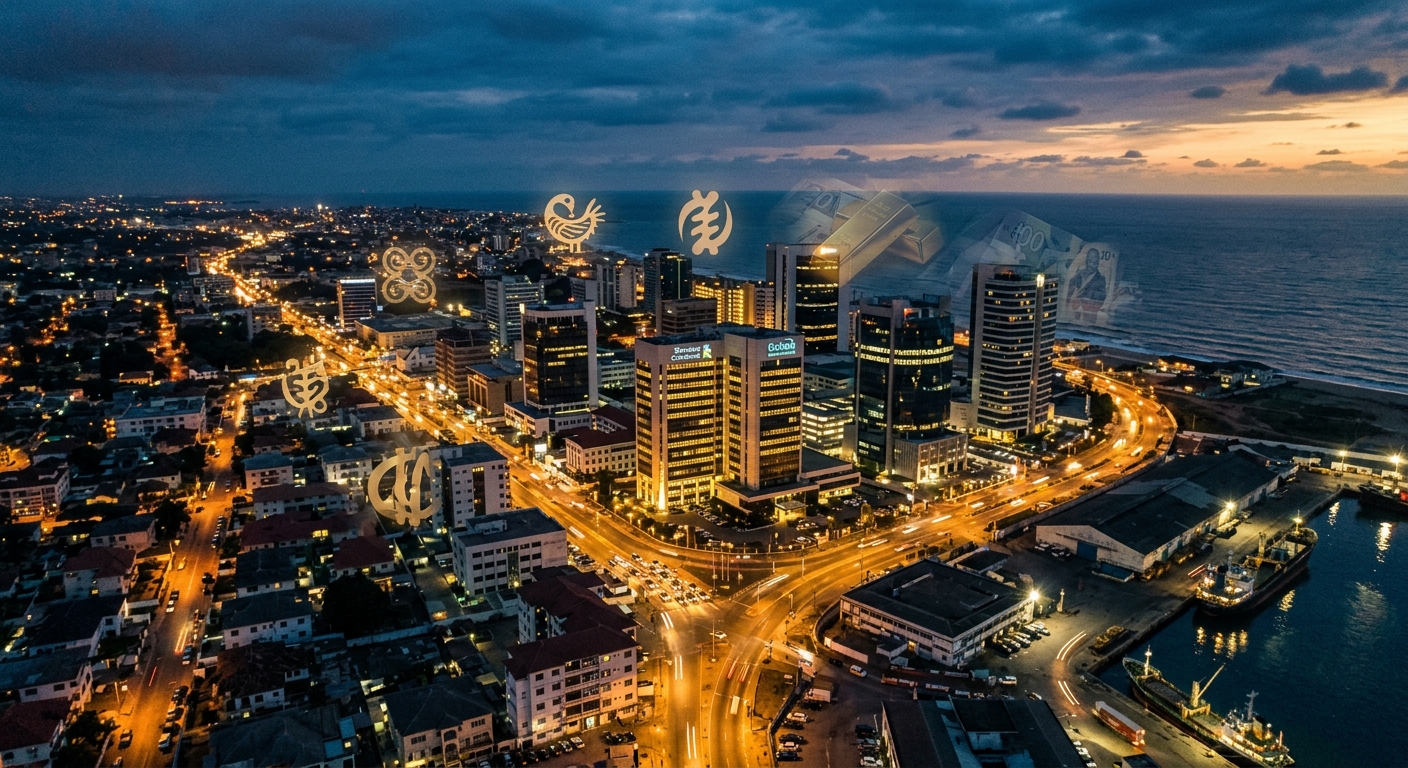
From default to prepayment in 43 months
Ghana declared a moratorium on external debt service on December 19, 2022, a decision the Financial Times reported at the time as the "latest deeply indebted developing country to fail to make good on its foreign obligations." The World Bank's own
factsheet records that the International Development Association had to activate its policy-based guarantee on the 2030 Eurobond three times — April 2023, October 2023 and April 2024 — because Accra could not make coupons.
That collapse produced the numbers that now define the turnaround. The World Bank's Ghana country page reports a debt-to-GDP ratio of 92.4% in 2022, with the cedi in free-fall and reserves near zero. By the time the Fund's staff
visited Accra in April–May 2026 for the Article IV consultation, the primary balance had swung to a 2.5% of GDP surplus, headline inflation was 3.3% in February 2026, and reserves covered more than 5.7 months of imports. The public debt ratio, in the IMF's language, "declined sharply."
The IMF's Fifth Review staff report documents the mechanics: gross international reserves reached $9 billion at end-October 2025, the cedi appreciated 36% against the dollar in the year to that date, and the current account swung to a 3% of GDP surplus on "historically high gold and increased cocoa exports." That is the fiscal space now being deployed against the Eurobond stack.
Why this changes the Common Framework debate
Only four countries have applied for debt treatment under the G20 Common Framework — Chad, Zambia, Ethiopia and Ghana — and the
Atlantic Council counted 22 low-income Sub-Saharan countries in or at high risk of debt distress entering 2026. The Framework's reputation, as
ISS Africa documented in the Zambia case, is one of process failure: Lusaka's 2023 official-creditor deal was almost torpedoed by China's insistence that bondholders had received 18 cents more on the dollar than Paris Club creditors. Ethiopia has been in default on its December 2024 Eurobond coupon since late 2023, according to
Brookings.
Ghana's contrast is stark. As the ISPI's Rafiq Raji argued in 2024, Accra pursued a "simple refinancing" model — old bonds for new bonds with a haircut — rather than the messier Zambian sequence. That deal closed in October 2024. The July 2026 prepayment is the second-order consequence: because the exchanged bonds carried step-up coupons and PDI (past-due interest) instruments, retiring principal early meaningfully compresses future debt-service costs.
The lesson for other African finance ministries is not that the Common Framework works — it is that it can be exited on the debtor's terms if the macro tailwind arrives. For Ghana, that tailwind is gold. The IMF's April 2026 Sub-Saharan Regional Economic Outlook noted that median public debt across the region fell from 57.2% of GDP in 2024 to 53.1% in 2025, driven by "stronger growth and favorable exchange rate developments." Ghana, Ethiopia and Zambia were singled out as making "significant progress with sovereign debt restructuring."
The winners and the invisible losers
The immediate winners are the Eurobond holders — Amundi, Ashmore, Abrdn, Greylock and the retail pool absorbed into the two committees — who took a nominal haircut in October 2024 but are now receiving accelerated cash returns on the new instruments, closing net-present-value gaps faster than modeled. Sovereign ratings have followed. The IMF's Fourth Review staff report notes that "Ghana's credit rating has been upgraded by key international credit rating agencies" against a backdrop of restructuring progress; the April 2026 IMF regional outlook confirms upgrades for Ghana alongside South Africa and Zambia.
Finance Minister Cassiel Ato Forson, who presented Ghana's 2026 budget in November 2025 with GHc 357 billion (about $34 billion) in planned spending and a scrapping of the COVID-19 levy, can now point to public debt falling from GHc 726 billion to GHc 630 billion year-on-year. That is the political dividend of prepayment: fiscal room to cut a tax without breaching the fiscal rule.
The invisible losers are more interesting. The first is the Bank of Ghana's balance sheet. IMF staff flagged in May 2026 that "losses associated with the Domestic Gold Purchase Programme (DGPP) underscore the importance of increasing transparency and limiting quasi-fiscal activities that weaken the central bank's balance sheet." Every ounce the BoG buys in cedis at appreciated rates and holds against depreciating dollar-value reserves generates paper losses. The FX intervention machine that has powered the cedi's rise — $9 billion in FX sales in 2025 alone, per the IMF Fifth Review — is not costless.
The second loser is the World Bank's operational portfolio in Ghana. Because the government is severely limiting externally-financed capex to hit ECF fiscal targets, the Bank reports its disbursement ratio for Ghana has collapsed to 2.81% in FY2026, from 19.5% in FY2025. Debt sustainability is being purchased, in part, by deferring the education, road and health projects that IDA money was meant to fund. That is a distributional choice — one that has not been publicly debated.
The third loser is any hope of a quick Common Framework fix for the countries watching. Ghana's turnaround was underwritten by gold prices at record levels, a governing coalition politically insulated by a December 2024 landslide, and an IMF program signed before the bond markets fully reopened to Africa in 2025. Kenya, Côte d'Ivoire and Benin issued new Eurobonds in 2024, and the IMF now records $14 billion in African Eurobond issuance in 2025 and $5.5 billion in the first two months of 2026. Countries considering the Common Framework will find the market prefers refinance over restructure, and the political cost of default now looks higher, not lower, because Accra recovered so visibly.
The Cocobod problem — and what happens after the ECF
Two vulnerabilities remain, and both were highlighted by IMF staff in May 2026. The first is the cocoa sector. Ghana Cocoa Board's finances have been repeatedly bailed out through farmgate price adjustments and quasi-fiscal financing; the IMF has warned that "deeper reforms are needed to address longstanding vulnerabilities," including more frequent farmgate price adjustments and rationalising Cocobod's cost base. The second is the energy sector, where Electricity Company of Ghana's distribution losses continue to accumulate arrears against independent power producers.
The macroeconomic buffer against these shocks is now the sinking funds established under the Mid-Year Budget Review, which the IMF Fifth Review notes were created "to provide liquidity buffers and ensure timely redemption of maturing bonds." The July 6 payment is, functionally, the first major test of that architecture.
The ECF expires later in 2026. The staff-level agreement reached in May commits Ghana to a 36-month non-financing Policy Coordination Instrument — no cash, only surveillance — anchored on a legislated debt-to-GDP ceiling of 45% of GDP by 2034. That is the number to watch. The Mahama administration has effectively pre-committed to a fiscal rule that constrains any successor government, and IMF staff signalled that the primary surplus target could be lowered from 1.5% to 0.5% of GDP from 2027 to create development spending space — provided public financial management reforms hold.
What to watch next
- September 2026, sixth ECF review at the IMF Board. Final tranche disbursement and formal launch of the PCI. If structural benchmarks on Cocobod and ECG slip, market pricing on Ghana's new bonds will move first.
- Q4 2026, first full-year T-bond auction cycle. The Debt Management Office resumed domestic bond issuance in early 2026; take-up at longer maturities will test whether Ghana can lengthen the domestic curve without paying a punitive premium.
- Ethiopia bondholder deal. If Addis Ababa closes a Eurobond restructuring at terms materially softer than Ghana's, the argument that Common Framework restructuring is a controlled process — rather than a lottery — will weaken again.
- Gold price. Ghana's fiscal miracle is a commodity story dressed as a reform story. A 20% correction in bullion would restore the old constraints inside a single quarter.
Diplomat View
Ghana's early repayment is not proof that the G20 Common Framework works — it is proof that a mid-sized African economy with a defaulted Eurobond stack can exit crisis in under four years if it captures a commodity super-cycle and an IMF anchor at the same time. That is a narrower lesson than Accra's supporters will claim. The falsifiable call: Ghana will remain current on Eurobond service through the end of 2027 and secure at least one further ratings upgrade to a single-B category before end-2026, provided gold averages above $2,800 per ounce and Cocobod's producer-price reform passes cabinet. The forecast would need revision if the DGPP-related central-bank losses force an unbudgeted recapitalisation of the Bank of Ghana, or if the PCI is diluted by parliament ahead of the 2028 election cycle. On current trajectory, Ghana has become the Common Framework's first success story — and, precisely because of that, the reason fewer countries will use it.
Discover more
International Relations
Economist Impact Sustainability Week 2026
Economist Impact Sustainability Week 2026 spotlights the energy transition, AI in clean technology, and supply chain resilience as themes for global leaders.
US Politics
SNAP Food Assistance Faces Legal Challenges
In 2026, SNAP faces stricter eligibility rules and mounting legal challenges, threatening food assistance for the millions of Americans who rely on the program.
Global Politics
Trump's Conflicting Messages on Iran War
Trump's mixed messages on Iran reflect a strategy of audience management, benefiting Tehran amid a complex geopolitical landscape.

Economics
Fed's Amex AML order puts correspondent banking on notice
Federal Reserve's Amex AML order requires board-level controls and a 90-day plan; OCC fined the bank $350 million over enterprise-wide deficiencies.