Georgia Tech's CM-MAP: A China Hedge
Georgia Tech's $7.5M project redefines U.S. mineral security.
Model Diplomat7 min readNorth America
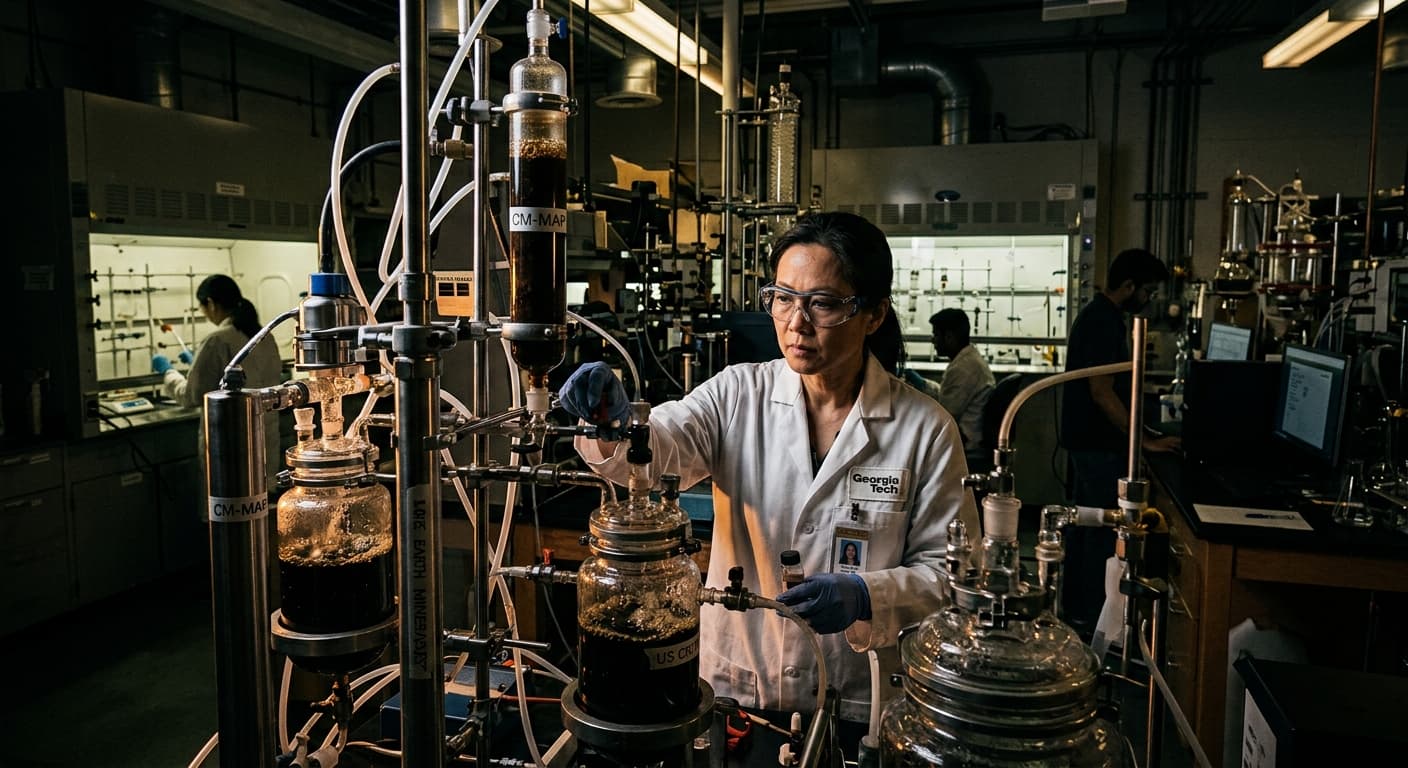
Georgia Tech's CM-MAP Turns Coal Ash and Kaolin Into a China Hedge
A $7.5M DOE award to Georgia Tech reframes U.S. critical-minerals security around industrial byproducts — not new mines — with direct consequences for the China trade war.
The most consequential U.S. critical-minerals move of the week is not a billion-dollar mine deal or a new tariff — it is a $7.5 million Department of Energy award announced on June 3, 2026, sending Georgia Tech to map rare earths and gallium in kaolin tailings, coal ash and phosphate residues across the Atlantic seaboard. The bet: America's fastest route around China's rare-earth chokehold runs through the waste piles it already owns, not the mines it has not yet permitted. If that thesis holds, the Southeast — not Nevada, not Greenland, not Ukraine — becomes the near-term center of gravity in U.S. mineral security, and the winners are chemical engineers, not diggers.
What DOE actually funded
The award, made by DOE's Office of Critical Minerals and Energy Innovation, sends Georgia Tech to lead the Critical Minerals in the Atlantic Seaboard Plain project — CM-MAP — an extension of DOE's Carbon Ore, Rare Earth, and Critical Minerals (CORE-CM) initiative, as reported by Metal Tech News. CM-MAP is paired with a $7.5 million sister grant to the University of Nevada, Reno for the Pacific Coast Basin and Range, together forming a $15 million package that DOE's Mining Engineering publication describes as scaling CORE-CM "from 13 basins in the continental United States to eight broader regions across the nation," per
Mining Engineering Online.
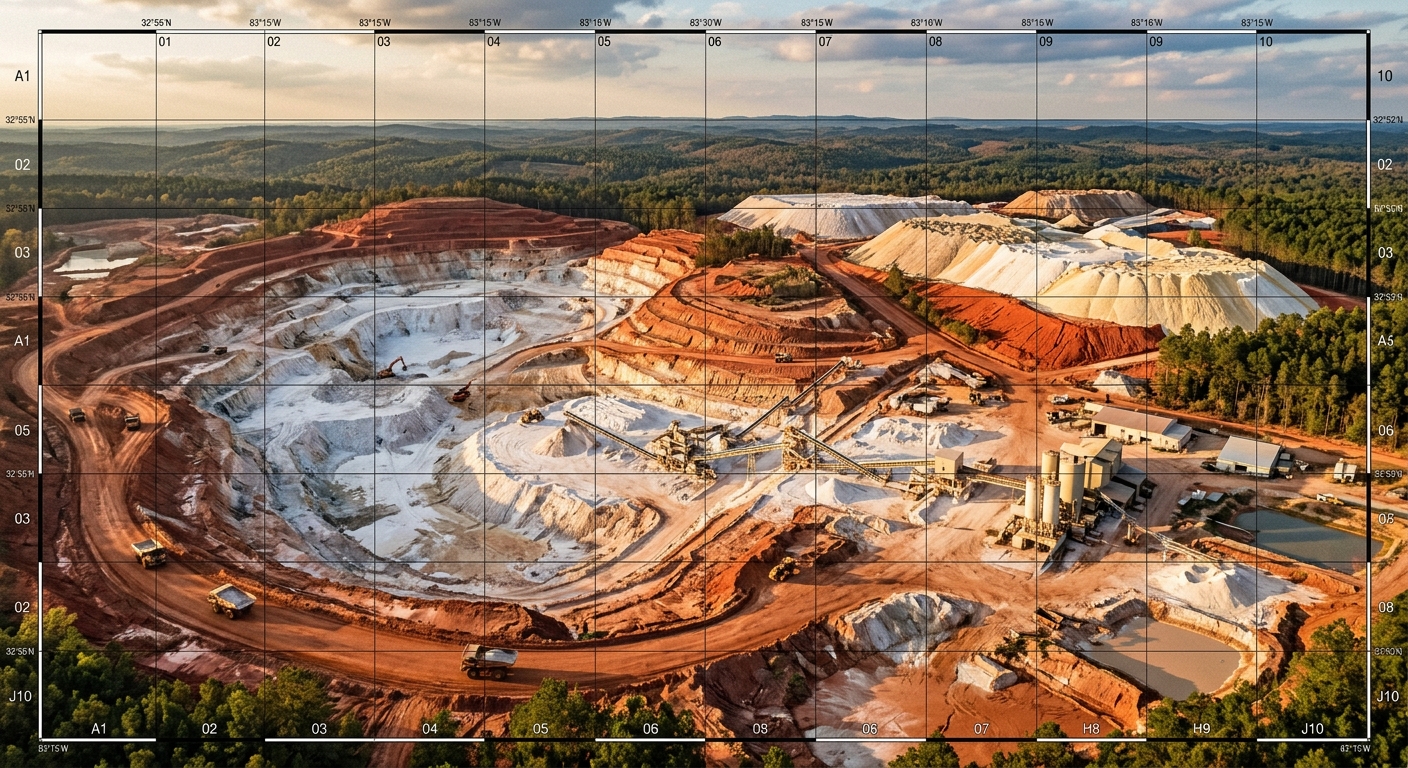
The scope is specific. Principal investigator Yuanzhi Tang, the Georgia Power Professor at Georgia Tech's School of Earth and Atmospheric Sciences, will target four sedimentary hosts — kaolin, bauxite, heavy mineral sands and phosphate — plus legacy mining residues and coal combustion byproducts across the Southeast. Georgia Tech researchers will run AI and machine-learning models over field-sample data to predict where recoverable critical minerals sit, and to design the extraction pathways.
That matters because the science is not speculative. A 2024 peer-reviewed study in Clays and Clay Minerals measured rare-earth concentrations in central Georgia kaolin tailings and associated sands at up to 4.6% by weight — grades higher than most operating rare-earth mines. A companion paper found heavy-mineral subfractions of the kaolin "grit" running at 0.50 wt.% total REE and enriched 10–100 times in the heavy rare earths — dysprosium, terbium and their neighbors — relative to the upper continental crust. Those are the exact elements Beijing restricted in October 2025.
Why $7.5 million is bigger than it looks
The dollar figure is trivial next to the $1.6 billion the Trump administration committed to USA Rare Earth in January 2026, per the BBC, or the $12 billion "Project Vault" strategic reserve announced on February 2, 2026, per
Al Jazeera. But CM-MAP is upstream of all of them. Reserves and offtake deals only work if there is a domestic pipeline to feed. Mines take a decade to permit; byproduct recovery can plug into existing kaolin, phosphate and coal-ash infrastructure the Southeast has been operating for a century.
That is the argument the Council on Foreign Relations makes in its 2026 report on leapfrogging China: "waste-based recovery is cleaner, easier to permit, and increasingly cost-competitive with Chinese production" and represents "one of the most immediate opportunities for the United States to achieve material gains in supply-chain security." A 2023 University of Texas at Austin study, cited by
BBC Future, valued rare earths sitting in U.S. coal-ash piles alone at $8.4 billion.
CM-MAP is one node in a coordinated federal architecture. On July 2, 2026, DOE's Office of Fossil Energy and Carbon Management announced a separate $75 million commitment to five pilots recovering rare earths, gallium, germanium and aluminum from coal-based feedstocks, per Metal Tech News. USGS's Earth Mapping Resources Initiative, authorized under §40201 of the Infrastructure Investment and Jobs Act at $320 million over five years, is running the geologic survey underneath — a program the
Congressional Research Service describes as prioritizing "critical mineral resources" and mine-waste characterization. Congress is preparing the legal chassis: H.R. 3617, the Securing America's Critical Minerals Supply Act, passed the House and was received in the Senate in early 2026, per
Congress.gov.
Read together, the message is stark. The U.S. is not trying to out-mine China. It is trying to out-process it — and CM-MAP is the mapping layer that tells industry which byproduct stream is worth building a plant next to.
The China context that gives it urgency
CM-MAP would exist without Beijing. But it would not exist at this scale, on this timeline, without the past 24 months of escalation.
China's April 2025 export licensing regime for heavy rare earths and permanent magnets "triggered rapid disruptions across allied defense and automotive supply chains," according to CSIS. Beijing's Ministry of Commerce Announcement No. 61 of 2025, dated October 9, tightened those controls into a foreign-direct-product-rule analogue — any foreign magnet with ≥0.1% Chinese heavy REE content now needs a license, and, per
CSIS analysis, companies "with any affiliation to foreign militaries" are largely denied. A U.S. Geological Survey estimate cited by CSIS put the GDP cost of a total gallium-germanium ban at $3.4 billion.
The elements CM-MAP is chasing map almost perfectly onto that pressure list. Kaolin residues carry heavy rare earths — the class hit hardest by Announcement No. 61. Bauxite processing byproducts host gallium. Coal fly ash carries germanium, scandium and light rare earths. The 2025 USGS critical-minerals list, published in the Federal Register on November 7 and summarized in CRS report R47982, added phosphate as a critical mineral for the first time — a direct nod to the byproduct chemistry CM-MAP will exploit.
The transatlantic architecture is aligning too. The U.S.–EU Critical Minerals Action Plan, published by the Office of the U.S. Trade Representative and available at USTR, commits Washington and Brussels to "coordinated trade policies and mechanisms, including market and trade measures based on reference prices, such as border-adjusted price floors, standards-based markets, price gap subsidies, or offtake-agreements." Georgia Tech's U.K.–U.S. working group linking southwestern U.K. and southeastern U.S. researchers plugs the CM-MAP corpus directly into that framework.
Who wins, who loses
The obvious beneficiary is Georgia Tech itself, which founded its Center for Critical Mineral Solutions in 2024 and now anchors a federally funded regional ecosystem knitting together national labs, industry, technical colleges, and international partners. But the deeper beneficiaries are less obvious.
Southeastern industrial incumbents win. Georgia's kaolin producers — an industry that has operated in Wilkinson, Twiggs and Washington counties for more than a century — suddenly hold monetizable heavy-REE inventory in what were previously liability piles. Phosphate producers in Florida and coal-plant owners across the Southeast get a second revenue line and a plausible route out of their environmental legacy costs. That is why the CFR report frames waste recovery as producing "a kind of symbiosis" between industry and environmentalists.
Junior mining companies lose relative ground. The near-term political attention — and defense-adjacent capital — is rotating toward chemistry and separation, not primary extraction. So do foreign suppliers courting Washington on the promise of new mines: Greenland, Ukraine and Central Asia. If CM-MAP's grades hold up in scaled pilots, the geopolitical premium on those partnerships softens. China loses too, but not immediately. The CSIS reading of the December 2024 export ban was that it was "largely symbolic rather than practical" because shipments had already collapsed. Byproduct recovery at scale would make it structurally so.
The wild card is environmental permitting. Georgia environmentalists blocked the Twin Pines titanium mine adjacent to the Okefenokee refuge in July 2025, per NPR. CM-MAP's political durability rests on the argument that reprocessing existing waste avoids that fight altogether. Every kaolin tailings pile that yields dysprosium is a mine that does not have to be permitted.
Diplomat View
The forecast: CM-MAP is the first federally funded U.S. mineral program built on the premise that the fastest way to beat China is to skip the mine. Expect two to three of the Southeast's largest kaolin, phosphate or coal-ash operators to announce rare-earth or gallium recovery pilots before end-2027, financed on the back of Project Vault offtake commitments and the DOE FECM $75 million pilot pool. Expect the Department of War (formerly Defense) to extend the MP Materials playbook — equity plus price floor — to at least one Southeast processor within 18 months.
What would revise this call: if CM-MAP's field sampling shows grade heterogeneity too extreme to support commercial recovery, or if China unwinds its October 2025 rare-earth licensing regime as part of a broader Xi-Trump trade détente after the fall 2026 leaders' meeting, the political oxygen for byproduct recovery thins fast. Watch the first CM-MAP data release — DOE CORE-CM projects typically publish year-one resource inventories — and the Senate floor vote on H.R. 3617.
What to watch next
- December 1, 2025 onward: China's tightened Announcement No. 61 licensing regime for foreign-military end users is now in force; watch for the first denied U.S. defense magnet applications.
- Q4 2026: CM-MAP's first regional resource inventory expected; the grade data will determine whether Southeast byproducts move from research to industrial-scale pilots.
- 2027: DOD's stated goal to secure a complete mine-to-magnet REE supply chain per Executive Order 14347, per
CRS — the deadline against which CM-MAP will be judged.
The Bottom Line
The bottom line: Georgia Tech's $7.5 million CM-MAP award is small money buying strategic real estate — the mapping layer that decides which Southeast waste piles become the U.S. answer to Chinese rare-earth licensing. If the grades in Georgia's kaolin tailings and coal-ash lagoons scale, Washington will have found a way to build critical-minerals independence without opening a single new mine, and the geopolitics of Greenland, Ukraine and the Lithium Triangle will look markedly less urgent by 2028. *
Discover more

US Politics
House Ethics Committee Pushes Sexual Miscond.
The House Ethics Committee has shifted responsibility for sexual harassment settlement records to the Office of Congressional Workplace Rights, complicating disclosure efforts.

India
Congress Accuses Modi of Stalling Women's Law
Congress accuses Modi of stalling women's reservation law by linking it to delimitation, revealing a deeper electoral strategy.

India
BJP's Misunderstanding of Women's Quota Needs
The BJP's linking of the Women Reservation Bill to delimitation risks delaying women's empowerment in India, misreading the aspirations of female voters.

Conflict & Security
Drone Warfare Killing Aid Workers at Unprec
Over 1,000 humanitarian workers killed in three years as cheap armed drones collapse legal protections. Gaza, Sudan, Ukraine, and DRC see deliberate targeting of aid convoys and hospitals with zero prosecutions.