Gaza’s Board of Peace
Analyzing the US-backed Board of Peace's strategy in Gaza
Model Diplomat3 min readMiddle East
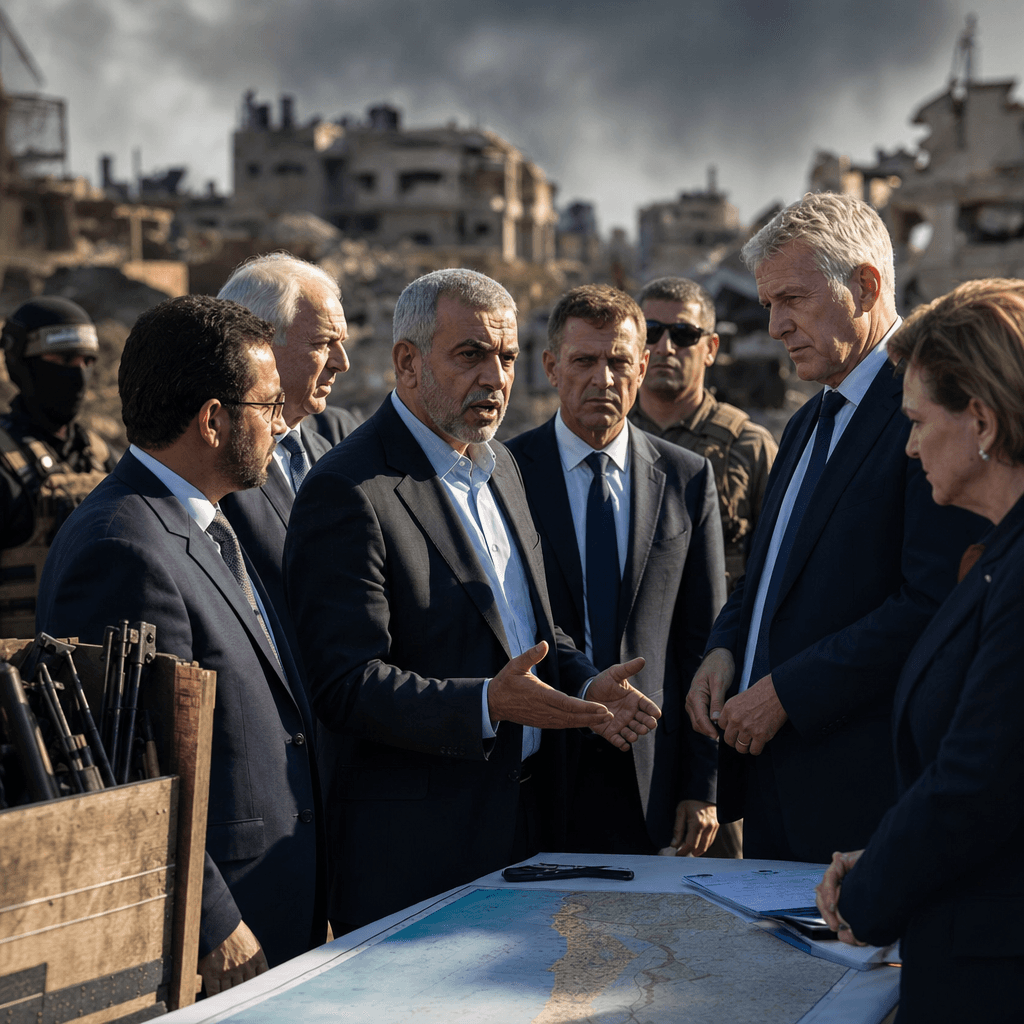
Gaza’s Board of Peace Is Betting on Hamas’ Weakness
Trump’s Gaza board wants disarmament before money and withdrawal; critics warn that sequencing could harden the truce into a partition — or a new war.
The US-backed Board of Peace is making Hamas disarmament the price of the next phase in Gaza, and that is exactly why critics say the plan can snap the ceasefire instead of saving it (The Guardian,
Reuters). Nickolay Mladenov told the UN Security Council that the current split in Gaza could become permanent if Hamas keeps military and administrative control, while Hamas spokesman Hazem Qassem accused him of repeating the Israeli line and creating cover for pressure on the enclave (
Reuters). That is the leverage contest now: Washington is trying to use reconstruction money and international recognition to force surrender of weapons; Hamas is trying to keep a political role without giving up coercive power.
Why the sequencing matters
Mladenov’s public message is that Gaza cannot move into reconstruction while armed control remains in place. Reuters reported him saying funding will not flow where weapons have not been laid down, and that a divided Gaza would trap more than 2 million people in rubble, aid dependency and indefinite displacement (Reuters). Al Jazeera reported the same basic architecture: Hamas can remain a political movement if it disarms, but the phased deal still requires an Israeli withdrawal and an international stabilizing force (
Al Jazeera).
That sequencing is the core problem. It asks Hamas to give up its only hard leverage before it sees the benefits of compliance. It also lets Israel argue that reconstruction and withdrawal are hostage to Hamas, while retaining control over more than half of Gaza, according to Reuters and Al Jazeera (Reuters,
Al Jazeera). For policymakers watching
Conflict and
Global Politics, the key point is not whether disarmament is necessary. It is whether the board can make it enforceable without turning the ceasefire into a one-way demand on Hamas.
Who gains from a stalled phase two
Israel benefits if the process freezes in place. It keeps battlefield freedom, can claim Hamas is the blocker, and avoids committing to a timebound withdrawal. Hamas loses if reconstruction is permanently tied to surrender; its military wing is the obvious loser, but its political leadership also risks being boxed out by technocratic alternatives. The Board of Peace, meanwhile, gains only if it can persuade Arab mediators, the UN and donors that the plan is still alive and not a diplomatic cover for indefinite occupation (The Guardian,
Reuters).
The political danger is obvious: once each side treats the other as the sole obstacle, every truce violation becomes evidence the deal is collapsing. That is how ceasefires turn into resumptions of war.
What to watch next
The next test is whether the board can publish a credible phase-two sequence: verified Hamas decommissioning, a monitored Israeli pullback, and a reconstruction channel that does not vanish at the first breach. Watch the next UN Security Council step, and whether Qatar and Egypt can keep Hamas inside the talks. If they cannot, the “Board of Peace” will start to look less like a transition mechanism than a holding pattern.
Discover more

International Relations
Pakistan's Key Role in US-Israel-Iran Meddle
Pakistan is seeking to mediate the US-Israel-Iran conflict, balancing high-stakes diplomacy against severe economic pressures and steep regional challenges.

Global Politics
US Seizes Iranian Ship, Tensions Surge
The US seizure of the Iranian ship Touska highlights a shift in control over the Strait of Hormuz, favoring Iran's strategic position.
Global Politics
Trump's Conflicting Messages on Iran War
Trump's mixed messages on Iran reflect a strategy of audience management, benefiting Tehran amid a complex geopolitical landscape.

Conflict & Security
Drone Warfare Killing Aid Workers at Unprec
Over 1,000 humanitarian workers killed in three years as cheap armed drones collapse legal protections. Gaza, Sudan, Ukraine, and DRC see deliberate targeting of aid convoys and hospitals with zero prosecutions.