G7's 60% Rule on Rare Earths Explained
How the G7 aims to reduce reliance on China by 2030
Model Diplomat7 min readGlobal

G7's 60% rule: how China's rare earth squeeze rewrote the West's playbook
The G7's June 2026 Évian target to cap dependence on any single non-member rare earth supplier at 60% by 2030 is dependency management, not decoupling — and the real winner is Western industrial policy itself.
The single most consequential line from the G7's June 17, 2026 summit in Évian-les-Bains was not about Ukraine or Iran. It was a number: leaders committed to reduce dependence on any single non-G7 supplier of rare earths and permanent magnets to below 60% by 2030, with a stretch goal of 50% thereafter. The number is aimed at China without naming it, and it quietly ratifies a decade-long argument the West kept losing — that critical minerals require state intervention. Beijing's April 2025 export shock has done what a shelf of policy papers could not: made industrial policy respectable from Washington to Berlin. The paradox, as Marina Yue Zhang argues in Pearls and Irritations, is that every turn of the Chinese screw hands the G7 the crisis narrative it needs to coordinate.
The leverage map: who holds what
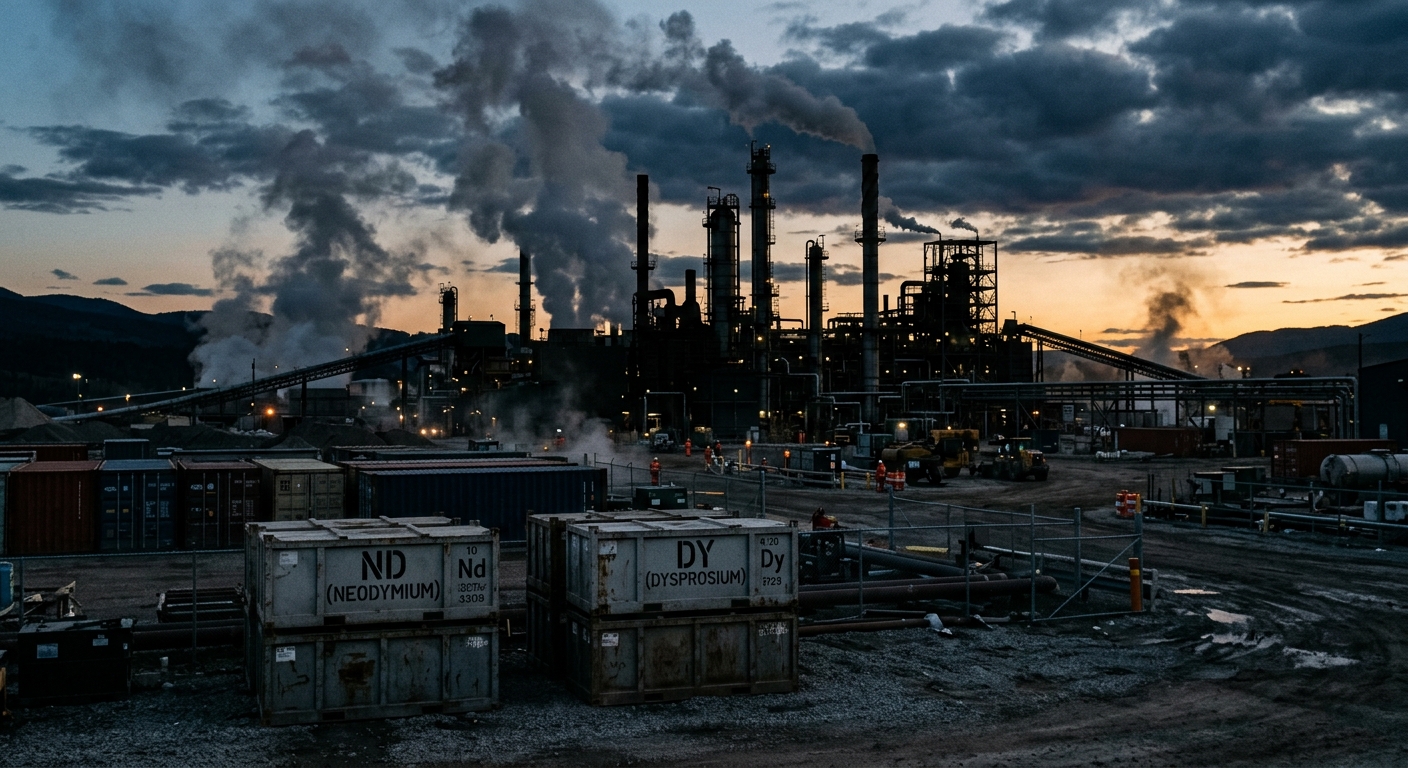
China controls roughly 90% of global rare earth refining and, per Center for Strategic and International Studies (CSIS) analysis of the Évian outcome, 93% of permanent magnet production. That is not an incumbency built on geology — reserves are spread across Australia, Brazil, Vietnam, the United States and Greenland — but on decades of cheap energy, patient capital and a full downstream ecosystem of separation chemistry, magnet-makers, solvents and waste handling.
The leverage flows from the middle of the chain, not the mine. The International Monetary Fund's April 2026 World Economic Outlook commodity feature documents what happened when Beijing pulled that lever on April 4, 2025: licensing on seven heavy rare earths (HREEs) and neodymium-iron-boron (NdFeB) magnets sent global magnet exports down roughly 70% year-on-year by May 2025, forcing production pauses at Suzuki and Nissan and rippling through F-35, EV and wind-turbine supply chains. Chinese exports rebounded once a US–China truce took hold in November, but the political damage was permanent.
Beijing then demonstrated the same tool could be pointed anywhere. On January 6, 2026, after Prime Minister Sanae Takaichi called a Taiwan contingency an "existential threat" to Japan, China's Ministry of Commerce banned dual-use exports to Japan; CSIS estimates Chinese exports of controlled products to Japan fell 43% in the first two months, with rare earths down 78%. A month later Beijing added another 40 Japanese entities — including Mitsubishi Heavy Industries and Subaru — to its watchlist,
Al Jazeera reported. The message: export controls are not just trade retaliation. They are foreign policy.
What Évian actually changed
The 60% target is not the whole architecture. It sits on top of the G7 Critical Minerals Action Plan adopted a year earlier at Kananaskis, which committed leaders to "diversifying the responsible production and supply of critical minerals, encouraging investments…and promoting innovation," per the European Council's record of the summit. The Évian statement bolted a measurable ceiling onto that framework — the first time a G7 group has put a number on a specific dependency — and tasked ministers with setting comparable dependency-reduction targets for every other critical mineral before year-end.
Backing it up is roughly €64 billion in announced projects, an expanded Critical Minerals Production Alliance under Canada's presidency, and the G7 Roadmap to promote standards-based markets endorsed at the G7 foreign ministers' meeting in Niagara. The European Commission's December 2025
RESourceEU Action Plan explicitly commits Brussels to "develop and deploy a robust policy approach, including trade instruments, that ensures the EU can act swiftly and decisively in case of non-market practices by third countries, such as price manipulation, in CRMs value chains."
That is a primary document worth reading in the original. The Commission is signalling that if China dumps rare earths to kill Western projects — as it did to Molycorp between 2011 and 2015 — the EU will treat that as a defensible trigger for tariffs, safeguards or price supports. The language is deliberately close to the Trump administration's own Section 232 investigation, which the Peterson Institute for International Economics notes concluded that imports of processed critical minerals "threaten to impair" US national security.
The instrument that used to be unthinkable
The most striking policy innovation is the price floor. In July 2025 the US Department of Defense took a 15% equity stake in MP Materials, the sole US rare-earth miner, and committed to a $110 per kilogram floor for its neodymium-praseodymium (NdPr) output for 10 years — roughly double the prevailing market price around $55/kg cited by the IMF. The Economist called it the largest such intervention
since the US nationalised the railroads in the First World War. A parallel $110/kg floor was extended to Australia's Lynas for oxide production, much of it destined to be refined in Malaysia — which in 2025 became
the first country outside China to produce dysprosium oxide, according to CSIS.
The G7 has not, however, agreed on a coordinated price floor. As CSIS notes, "governments have been reluctant to use public funds to support a price floor, particularly as countries such as the United Kingdom and Australia [face] growing fiscal pressures." Vice-President JD Vance previewed a workaround at the Washington critical minerals ministerial: the Forum on Resource Geostrategic Engagement (FORGE), a coalition of more than 50 countries which he described, per the Council on Foreign Relations, as a "preferential trade zone for critical minerals protected from external disruptions through enforceable price floors." That is quiet cartelisation dressed as security policy, and it is now the operative playbook.
The angle everyone is missing
The interesting question is not whether the West can hit 60% by 2030 — most veteran analysts think it cannot. Zhang's piece calls the target dependency-management, not a China-free pathway. The
rareearthexchanges.com audit notes that "no G7 country currently possesses a fully integrated, commercial-scale mine-to-magnet supply chain." Lynas's flagship US heavy rare-earth plant in Seadrift, Texas — funded under the Defense Production Act in 2021 — was effectively shelved in 2025 after permitting and cost problems, CSIS reports. Japan's 15-year head start on diversification still left Tokyo as the
world's largest importer of Chinese rare earth metals in 2024, per CFR's June 2026 report.
The angle worth watching is the credibility risk emanating from Washington. In a striking February 2026 note, the Peterson Institute warned that "for the first time in decades, US political stability and policy continuity are themselves part of [allies'] risk calculations." The Trump administration is asking European, Japanese, Canadian and Australian firms to build 20-year processing assets on the assumption that a coordinated Western price floor, an EXIM strategic reserve and preferential trade will hold across administrations. That is a big ask from an ally that in the past 18 months has feuded with NATO over Greenland, upended the Munich Security Conference and imposed tariffs on partners.
Ergo the hedging visible in Brussels, Tokyo and Ottawa: the EU–Australia critical minerals trade deal signed on March 24, 2026; the Quad's
$20 billion Critical Minerals Initiative Framework announced by foreign ministers on May 26, 2026; the ACITI (Australia-Canada-India) tripartite; and the India–Brazil framework agreement. The winner of Beijing's rare-earth coercion is not Washington — it is the diversification of Western diversification itself.
The chokepoint problem no one wants to discuss
Zhang's second, subtler point is that a supplier-share metric can mislead. Beijing controls not just mines and refineries but the boring middle: sulfuric acid, solvent-extraction reagents, magnet-making equipment, tungsten, antimony, germanium. As Noah Intelligence recently noted, China has been consolidating the "secondary" supply chain — inputs and by-products that no one notices until they are scarce. A G7 magnet plant sourcing its oxides from Lynas but its solvents from a single Chinese chemistry supplier is still exposed. The
BBC's tour of the Solvay plant at La Rochelle, the only facility outside China able to process all 17 rare earths, underscores that the West's chokepoint problem is one of chemistry and process know-how, not geology.
That is why heavy rare earths remain the bottleneck. Dysprosium and terbium are essential for the magnets that keep F-35s flying and 15-megawatt offshore turbines spinning. Japan's decade of light-rare-earth diversification has barely dented the HREE dependency, per CFR. Malaysia's Lynas Advanced Materials Plant and MP Materials' expanded Mountain Pass separation train are the only credible non-Chinese HREE processors coming online in the 2020s.
Diplomat View
The Évian target will not be met on schedule, but it will change facts on the ground. Expect the West to hit roughly 70–75% single-supplier dependence on China for rare earth magnets by 2030 — better than the 90%+ status quo, worse than the 60% target. The binding constraint is not capital or ore; it is midstream chemistry, permitting timelines that run 7–15 years, and the political durability of price floors across a US election cycle. The forecast changes if any of three conditions flip: Congress writes the $110/kg floor into permanent statute; a coordinated G7 floor is announced (watch the November 2026 ministerial); or China concludes that further escalation costs it more customers than it gains leverage — and quietly relaxes licensing, as it did briefly in November 2025. If none of those happen and Beijing weaponises antimony, tungsten or solvent-extraction reagents next, the 60% figure becomes a fiction and the G7 shifts openly to stockpile-and-ration mode. The tell will be whether the European Commission invokes its RESourceEU trade instrument against Chinese price manipulation before mid-2027. That is the decision that will separate declaratory diplomacy from actual industrial policy.
What to watch next
- September 2026: G7 ministers must publish dependency-reduction targets for critical minerals beyond rare earths and magnets — the test of whether the 60% rule generalises to lithium, graphite, cobalt and gallium.
- November 2026: Expiry window for the US–China rare earth truce that eased China's October 2025 controls; renewed tightening would reactivate the Évian consensus and could trigger the first coordinated G7 price-floor announcement.
- December 2026: European Commission is due to specify the trade instruments in the RESourceEU Action Plan — the moment Brussels either backs its rhetoric on non-market practices with enforceable law, or reveals it will not.
Discover more

US Politics
House Ethics Committee Pushes Sexual Miscond.
The House Ethics Committee has shifted responsibility for sexual harassment settlement records to the Office of Congressional Workplace Rights, complicating disclosure efforts.

India
Romanian Coalition Party Demands PM Resign
Romania's Social Democrats withdrew from coalition, joining far-right AUR to topple PM Bolojan, risking €10 billion in EU funds by August 2026.

US Politics
SNAP Food Assistance Faces Legal Challenges
In 2026, SNAP faces stricter eligibility rules and mounting legal challenges, threatening food assistance for the millions of Americans who rely on the program.

Conflict & Security
Drone Warfare Killing Aid Workers at Unprec
Over 1,000 humanitarian workers killed in three years as cheap armed drones collapse legal protections. Gaza, Sudan, Ukraine, and DRC see deliberate targeting of aid convoys and hospitals with zero prosecutions.