G7 Turns Latin American Lithium Into a Geop
G7's binding target turns lithium into a geopolitical chokepoint
Model Diplomat11 min readLatin America
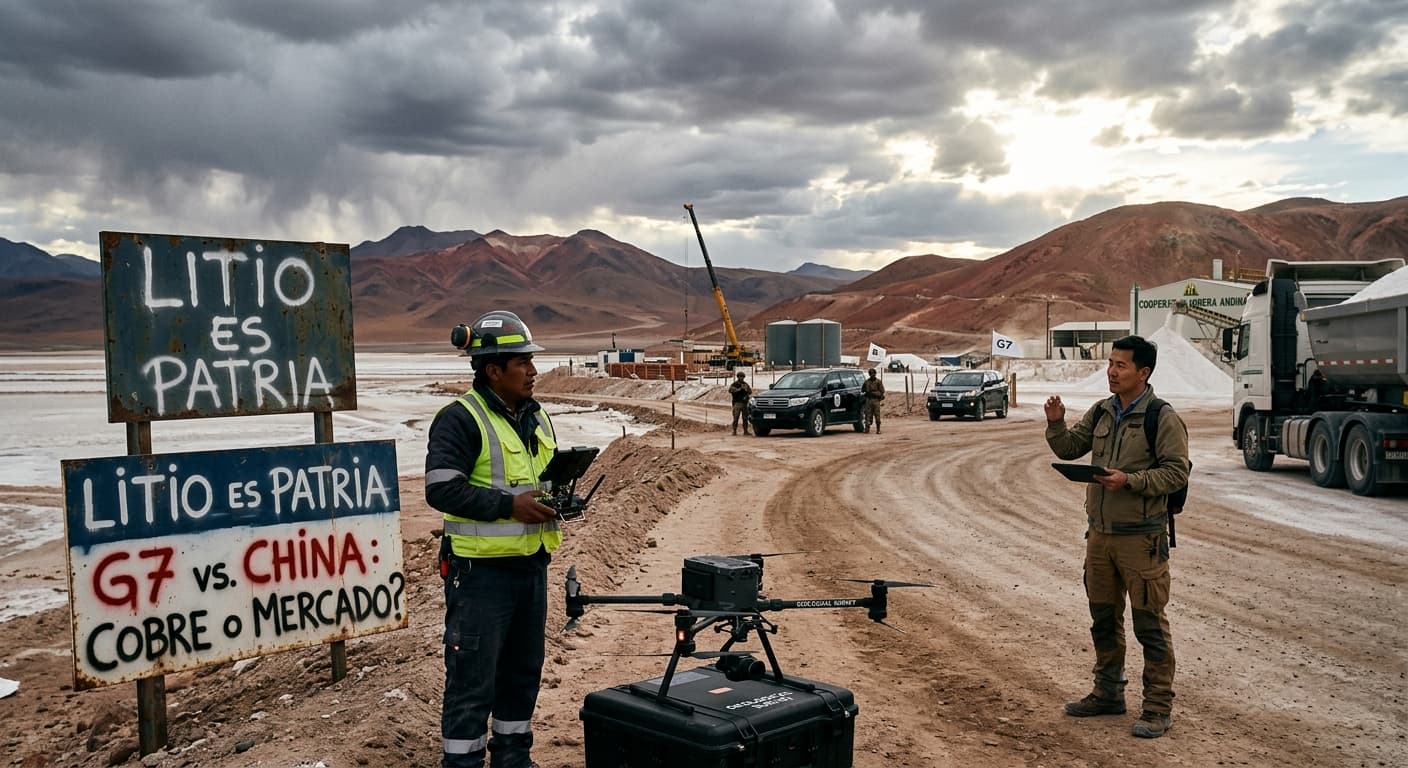
The G7 Just Turned Latin America's Lithium Into a Strategic Weapon — And the Region Isn't Ready
The G7's first-ever binding supply-chain target transforms Chile's Atacama, Argentina's salt flats, and Brazil's mineral basins from commercial deposits into geopolitical chokepoints. The price of Western market access is rising — and Beijing is still writing checks.
On June 17, 2026, in a lakeside resort in Évian-les-Bains, the Group of Seven leaders buried a revolution inside an otherwise predictable communiqué. Ukraine air-defense pledges. Iran framework-agreement diplomacy. Sanctions on Russia's shadow fleet. But the sentence that will redraw trade routes across the Southern Hemisphere was this: reduce dependence on any single non-G7 supplier of rare earths and permanent magnets to below 60 percent by 2030, with a longer-term objective of 50 percent. The Center for Strategic and International Studies reported from the summit's closed sessions that it was the first binding supply-chain resilience target in G7 history.
It is not a trade policy. It is a procurement war, and the battlefield is Latin America.
The region holds roughly 58 percent of the world's lithium reserves across the Lithium Triangle of Argentina, Bolivia, and Chile, produces about 40 percent of global copper, and sits on substantial deposits of nickel, rare earths, and niobium — the metal that makes jet engines possible. China understood this geography decades ago. Between 2014 and 2023, Beijing directed roughly $153 billion in financial assistance to the region, nearly three times the $50.7 billion Washington contributed over the same period, according to the research lab AidData, cited by the BBC. Since 2005, the China Development Bank and the Export-Import Bank of China have loaned more than $120 billion to Latin American and Caribbean countries, financing 138 infrastructure projects — from Brazil's Belo Monte transmission grid to Argentina's Kirchner-Cepernic hydroelectric dams, as
the Council on Foreign Relations documented.
Now the G7 is arriving with a different proposition: access to Western markets, but on Western terms. And those terms are about to become law.
The European Hammer: Mandatory Diversification
The most consequential piece of the G7 pivot is not the 60 percent target itself but the legislative machinery it triggers. The European Commission is advancing an amendment to the Critical Raw Materials Act that would make supply-chain diversification mandatory for large market operators — not merely incentivized, not voluntary, not "best-effort."
According to the EU's RESourceEU Action Plan published earlier this year, the Commission now seeks "the capacity to incentivise effective diversification measures that large companies should adopt in the event of significant vulnerabilities, and, in case of non-action, make diversification mandatory." The language is deliberately elastic on which countries qualify as acceptable alternative suppliers. The implication is not. If European automakers, battery manufacturers, and defense contractors are legally required to source lithium, cobalt, rare earths, and copper from non-Chinese suppliers, the line of supplicants forms in Santiago, Buenos Aires, and Brasília.
The numbers explain why Brussels is moving with uncharacteristic speed. The EU's trade deficit with China reached €360.6 billion in 2025 — equivalent to roughly €1 billion a day and up 15 percent from the previous year, as Al Jazeera reported in late June. EU Trade Commissioner Maros Sefcovic told reporters: "This trend is not sustainable. The status quo is not an option." Tariffs of up to 35.3 percent on Chinese electric vehicles have done little to slow BYD, Geely, and Chery's advance into European markets. BMW is cutting a quarter of its workforce by end-2026. Mercedes-Benz has paused employee bonuses. The next instrument is not tariffs — it is supply-chain law.
For Latin American producers, the prize is enormous. Battery-grade lithium demand is projected to triple by 2035, and Western automakers are desperate for non-Chinese supply. But the trap is equally substantial: access to European markets will almost certainly come with conditions — environmental standards, labor protections, limits on Chinese investment in extraction, and expectations of political alignment — that transform mineral trade from a commercial transaction into a strategic bargain.
The European Battery Regulation already requires verifiable low-carbon-footprint sourcing along the entire value chain, as World Bank research documented. The EU Carbon Border Adjustment Mechanism adds further cost for goods with carbon footprints exceeding European benchmarks. Together, these standards function as a regulatory filter: Latin American producers who clear it gain premium access. Those who cannot — often because their operations depend on Chinese processing, financing, or technology — are locked out before the first contract is signed.
The American Stick: A Hemisphere Under Pressure
If the EU approach is regulatory, the American approach under the Trump administration has been coercive — and occasionally effective.
The "Donroe Doctrine," as analysts at the Council on Foreign Relations have labeled it, proclaims that "the United States must be preeminent in the Western Hemisphere" and promises to deny foreign powers a strategic role there. The administration has muscled El Salvador, Guatemala, and Argentina to match US duties and import quotas on Chinese goods in their trade frameworks. It has pressed Latin American nations to "rip" out existing Chinese telecom and energy equipment. And in a display of hard power widely interpreted as a signal to the region, the US imposed visa restrictions on Chile's minister of transport and two other officials for evaluating an undersea fiber-optic cable connecting Valparaíso with Hong Kong — a project that was subsequently halted, according to
CFR's China in Latin America tracker.
The results have been mixed. Mexico, under pressure to stop serving as a "backdoor" for Chinese goods entering the US market, implemented tariffs of up to 50 percent on 1,463 Chinese product categories — including textiles, automotive parts, electric vehicles, and steel — that took effect January 1, 2026, as CFR reported. Colombia imposed a 35 percent levy on Chinese steel and metalworking products. Argentina signed a reciprocal trade and investment agreement with Washington that commits Buenos Aires to prioritizing US buyers for its copper, lithium, and critical minerals over "market-manipulating economies." But Argentine Foreign Minister Pablo Quirno then publicly clarified that the agreement does not prevent Chinese investment in the country's mining sector — a caveat that reveals the fundamental asymmetry in the US approach.
The problem is arithmetic. China overtook the United States as Brazil's largest export market in 2009 and has since become the top trading partner for most of South America. Bilateral China-Latin America trade hit $518.47 billion in 2024, a 6 percent year-on-year increase, according to Brookings. Trade between the two was barely $12 billion in 2000. Some economists expect the figure to reach $700 billion by 2035.
Washington's offer — conditional market access backed by the threat of tariffs — competes against a Chinese economic relationship that is tangible, immediate, and remarkably unconditional. "Whether it is the US, whether it is China, we do not reserve our minerals for one specific country," Celso Amorim, foreign policy adviser to Brazil's president, told the Financial Times. It is the clearest articulation yet of the Latin American position: we will take both calls.
The Chinese Counterweight: Beijing Is Not Retreating
If the G7 expected its Évian declaration to trigger a Chinese retrenchment from Latin America, the evidence of the past six months suggests the opposite.
In March 2026, China's state-owned Jiangxi Copper completed the acquisition of SolGold for approximately $1.2 billion, securing control of the Cascabel copper-gold porphyry project and an extensive exploration portfolio in Ecuador, according to CFR. Chinese automaker GAC announced a $1.3 billion investment plan in Brazil through 2030, including a factory set to open in 2027 with annual production capacity of 50,000 vehicles. China's Tianqi Lithium Corp. — which held a 21.9 percent stake in SQM, the world's largest lithium company — only began reducing its position after Chile's Supreme Court ruled against its attempt to block SQM's partnership with state-owned copper giant Codelco. And in Nicaragua, the government has granted mining concessions to 16 Chinese companies between 2021 and 2026, totaling over one million hectares — 8.5 percent of Nicaraguan territory.
Beijing's diplomatic response has been equally pointed. At a May 2025 China-CELAC ministerial forum, President Xi Jinping announced a 9 billion yuan credit line for the region, according to CFR's backgrounder. In December 2025, China published its third official policy paper on Latin America — a document that, without naming the United States, promises to "oppose unilateral bullying practices" and "reject attempts of 'decoupling' and 'reinventing the wheel.'" Twenty Latin American and Caribbean nations have now signed onto the Belt and Road Initiative. Chinese state media maintain at least 47 content-sharing agreements with Latin American news outlets, allowing Beijing to shape public discourse directly, as
Brookings documented.
The asymmetry is structural. China buys what Latin America sells — soybeans, copper, lithium, iron ore, beef — and sells what the region buys: manufactured goods, electric vehicles, solar panels, 5G equipment. The G7 is asking Latin American countries to redirect their commodity exports toward Western supply chains without offering a comparable market for their agricultural output, and to restrict Chinese technology imports without offering cost-competitive alternatives. As Enrique Dussel, a scholar of China-Latin America relations, told the BBC: "Gone are the days of development partnerships, free trade, multilateralism, and even basic reciprocity. China's presence has grown drastically, while the US response remains late and reactive."
The Region's Choice: No One Wants to Choose
The defining feature of the current moment is that Latin American governments are refusing to pick sides — and finding that both Washington and Beijing increasingly demand that they do.
Brazil is the fulcrum. It exports more to China than to the European Union and the United States combined. Its president, Luiz Inácio Lula da Silva, declared during a May 2025 state visit to Beijing that "China needs Brazil and Brazil needs China," as Al Jazeera reported. Yet two Brazilian government officials told the
Financial Times that the country is now considering a partial trade agreement between Mercosur and China — a proposal that would have been unthinkable a decade ago, driven in part by the unpredictability of US tariff policy. The US consul general in São Paulo has warned Brazilian port executives that Washington does not want the concession for Latin America's largest port terminal, in Santos, to fall into Chinese hands.
Argentina embodies the tension. President Javier Milei, an enthusiastic supporter of the Trump administration, has called the Chinese "fabulous" partners. His government signed a reciprocal trade agreement with Washington that includes language about prioritizing US buyers for critical minerals — while simultaneously accepting a $136 million Chinese loan to resume work on the Jorge Cepernic hydroelectric dam in Santa Cruz Province, as CFR tracked. Ecuador's President Daniel Noboa, aligned with Trump on combating organized crime, "ruled out distancing himself from China because he cannot pick a fight with his second-largest trading partner," CFR noted — a position that applies across the political spectrum from left to right.
The structural bind is this: China offers unconditional capital; the West offers conditional market access. The conditions — environmental traceability, labor standards, limits on Chinese co-investment — are defensible and even desirable on their own terms. But as a package, they represent demands that Beijing has never made and has no incentive to make. A lithium producer in Argentina's Salar del Hombre Muerto can sign a long-term offtake agreement with a Chinese state-owned processor in weeks, with financing attached. Securing a comparable contract from a European automaker requires navigating the EU Battery Regulation's carbon-footprint verification, the Corporate Sustainability Due Diligence Directive, and potentially new mandatory diversification rules — a process that can take years.
What to Watch
The next six months contain three decision points that will determine whether the G7's bet succeeds or collapses into competitive bidding between blocs.
October 2026: EU-China trade consultations. EU Trade Commissioner Sefcovic and Chinese Commerce Minister Wang Wentao agreed in late June to a joint trade monitoring mechanism and identified four "workstreams" for their next round of negotiations, according to Al Jazeera. If Beijing offers meaningful concessions on overcapacity — particularly in electric vehicles and green technology — the urgency behind mandatory diversification could ease. If talks collapse, the CRMA amendment accelerates.
End-2026: EU legislation deadline. The European Commission's proposal to make diversification mandatory for large market operators is expected to move through the legislative process before year-end. The final text will define which countries qualify as acceptable alternative suppliers and what standards apply — effectively writing the rulebook for who can sell strategic minerals to Europe.
Critical elections and leadership transitions. Brazil's October 2026 presidential election and Colombia's ongoing political realignment will determine whether the region's two largest economies move closer to or further from the G7's orbit. Chile's incoming president, José Antonio Kast, has already clashed with outgoing president Gabriel Boric over the Chile-China Express undersea cable project, leading to what CFR described as an "unexpected breakdown in the power transfer process."
Diplomat View
The G7's 60 percent target is not a supply-chain goal — it is a contest over Latin America's development model dressed as procurement policy. China's offer to the region has been straightforward for two decades: we will buy your commodities, build your infrastructure, and not ask questions about your domestic politics or environmental record. The G7's counteroffer — conditional market access, regulatory alignment, standards compliance — is more lucrative in the long run but electorally harder to sell in the short term.
The bet the G7 is making is that the premium Western buyers will pay for certified, traceable, low-carbon lithium and copper — combined with the stick of mandatory diversification — will overcome the speed and simplicity of Chinese deals. The bet Latin American governments are making is that they can maintain both relationships simultaneously.
One of those bets is wrong. The EU's legislative trajectory and the Trump administration's demonstrated willingness to use visa bans, tariff threats, and direct diplomatic pressure mean that the window for ambiguity is closing. The first country forced to choose — likely Chile, where the incoming Kast government faces immediate decisions on Chinese telecom infrastructure and lithium partnerships — will set the template.
If it chooses alignment with G7 standards, the Western bloc will have secured the most mineral-rich region on earth without firing a shot. If it refuses, the G7's entire critical-minerals architecture will be revealed as a demand without a customer — and Beijing will have won without lifting a finger.
The Bottom Line
The G7's binding target of reducing rare-earth dependence on China below 60 percent by 2030 is the formal opening of a procurement war whose primary theater is Latin America. The region's lithium, copper, and rare-earth deposits are now strategic assets in a contest between China's unconditional capital and the West's conditional market access. Latin American governments are betting they can accept both — but the legislation advancing through Brussels and the pressure emanating from Washington are designed to force a choice. The first government that must make it — likely Chile under its incoming administration — will determine whether the G7's minerals architecture succeeds or collapses into competitive bidding between blocs.
Discover more

US Politics
House Ethics Committee Pushes Sexual Miscond.
The House Ethics Committee has shifted responsibility for sexual harassment settlement records to the Office of Congressional Workplace Rights, complicating disclosure efforts.
India
700 Activists Accuse PM Modi of MCC Breach
Over 700 activists allege PM Modi breached election code with a televised address attacking opposition parties just before state elections.

International Relations
Pakistan's Key Role in US-Israel-Iran Meddle
Pakistan is seeking to mediate the US-Israel-Iran conflict, balancing high-stakes diplomacy against severe economic pressures and steep regional challenges.

Economics
Fed's Amex AML order puts correspondent banking on notice
Federal Reserve's Amex AML order requires board-level controls and a 90-day plan; OCC fined the bank $350 million over enterprise-wide deficiencies.