Fujairah Drone Attack
Iran's strike on Fujairah raises energy security concerns for India.
Model Diplomat8 min readMiddle East
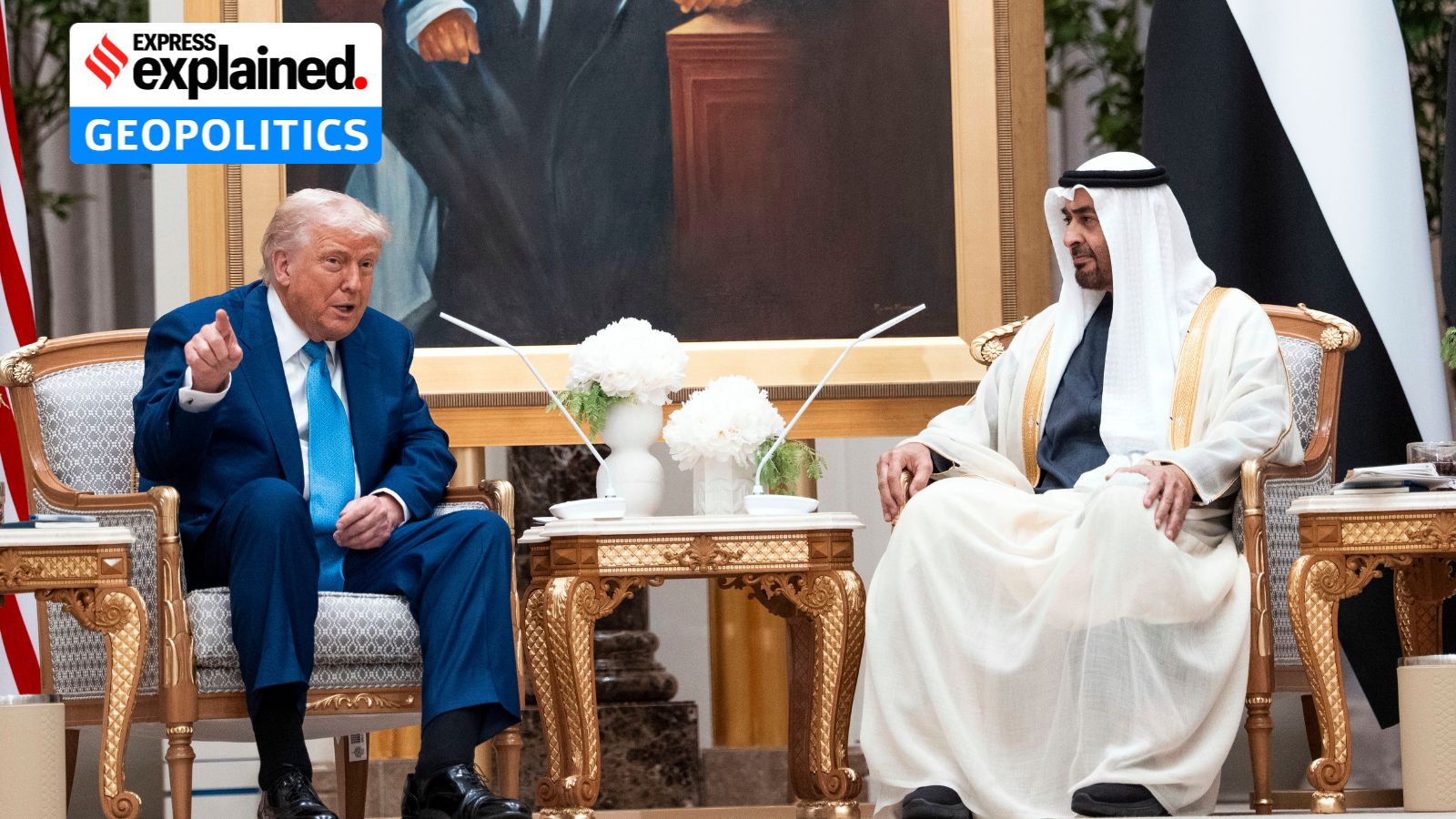
Fujairah Drone Attack: Why the Hormuz Bypass Became a Target
The May 4, 2026 Iranian drone strike on Fujairah's oil zone injured three Indians and broke a month-old ceasefire — but its real target was the pipeline India is now betting its energy security on.
On May 4, 2026, an Iranian drone slipped through UAE air defences and set the Fujairah Petroleum Industries Zone alight, moderately wounding three Indian workers in what Abu Dhabi called a "treacherous" ceasefire breach. The strike mattered less for the fire than for the geography: Fujairah is the one Emirati port that sits outside the Strait of Hormuz, the terminus of a 1.5-million-barrel-per-day pipeline that has quietly carried roughly half the UAE's wartime crude exports. By hitting Fujairah, Tehran was not attacking oil infrastructure — it was attacking the workaround. And the country most exposed to that workaround failing is not the UAE. It is India, which within eleven days had signed a deal to store its own strategic reserves inside the very facility that had just burned.
What happened on May 4
The UAE Ministry of Defence said its air defences "engaged" 12 ballistic missiles, three cruise missiles, and four drones launched from Iran that day, according to Al Jazeera. One drone got through. Fujairah's local government said the resulting blaze at the Petroleum Industries Zone injured three Indian nationals, who were moved to hospital in stable condition. Iran attacked an ADNOC-linked empty tanker in the Strait of Hormuz the same day; South Korea reported an explosion on one of its ships anchored off the UAE coast;
BBC News said US Central Command sank six Iranian fast boats trying to interdict tankers Washington was attempting to escort through the strait.
The strike was the first direct hit on UAE territory since a fragile US-Iran ceasefire took effect on April 8. It capped ten weeks in which Iran fired more than 2,800 missiles and drones at the UAE — more than at any other Gulf state or Israel — since the US-Israel war on Iran began on February 28, 2026. Fujairah alone had already been hit at least three times in March, according to
Al Jazeera's infrastructure tracker.
Iran denied involvement. The IRGC issued a statement, carried by state media, saying its forces "have not carried out any missile or drone operations against the UAE in recent days" and blaming "US military adventurism" for the fires. Neither the UAE nor Washington accepted the denial.
Why Fujairah, specifically
Fujairah is the only major UAE port on the Gulf of Oman rather than the Persian Gulf. Vessels loading there do not need to transit Hormuz. That is not decoration; it is the single most important piece of energy geography in the region.
The Abu Dhabi Crude Oil Pipeline runs 380 kilometres from the Habshan field in western Abu Dhabi to Fujairah's export terminal, with a nameplate capacity of roughly 1.5–1.8 million barrels per day. The UK Foreign Office describes Fujairah as the world's second-largest bunkering port behind Singapore, in a country brief on UAE ports. Once Iran began interdicting shipping inside Hormuz in early March, Fujairah loadings rose sharply: Kpler data cited by
Al Jazeera show exports through the port climbing from 1.17 million bpd in February to 1.62 million bpd in March. At the wartime peak, Fujairah handled about 1.7 million bpd — roughly half of UAE export capacity.
That is what Iran was targeting. Poland's OSW Centre for Eastern Studies noted in March that the combined spare capacity of the UAE's Fujairah bypass and Saudi Arabia's East-West pipeline could handle only about 30–40% of the crude normally shipped through the strait — and that Iran's attacks on Fujairah, plus force-majeure declarations by some bunker suppliers, were already eroding even that partial cushion.
Hitting Fujairah is Iran's asymmetric answer to a fundamental problem: it cannot indefinitely close Hormuz without inviting a war it has already partly lost. But it can raise the insurance premium and shipping cost of every barrel leaving the Gulf, including the barrels that transit its own alternative, by making the bypass unsafe too.
The Indian angle: why three injured workers matter more than they look
India has 4.3 million citizens living in the UAE — the country's largest expatriate community — and roughly 55% of India's crude oil supply and 38% of its inbound remittances come from the wider Middle East, according to Jefferies figures cited by the BBC. The three Indian nationals hurt at Fujairah were not incidental victims; they were an early data point in what Delhi's finance ministry has since called a "supply constraint" shock rippling through the domestic economy.
India's Ministry of External Affairs called the attack "unacceptable" in an X post on May 5, and demanded "immediate cessation of these hostilities and the targeting of civilian infrastructure and innocent civilians." That is unusually direct language from Delhi, which has historically avoided condemning Tehran by name over regional strikes. The Carnegie Endowment noted in April that Iran's new supreme leader, Ayatollah Mojtaba Khamenei, had told "friendly nations" including India that Hormuz would remain open for their tankers even as it stayed closed to others — a courtesy that survived until Fujairah's Indian casualties turned up on the front pages.
The BBC has documented the domestic cost. LPG shortages have shuttered restaurants and food processing plants; migrant workers are leaving Mumbai; Delhi has proposed a $6.2 billion economic stabilisation fund. Brokerages now expect the Gulf crisis to shave up to a full percentage point off India's FY2026-27 GDP growth.
The pivot: eleven days later, Modi signs a Fujairah storage pact
Prime Minister Narendra Modi flew to Abu Dhabi on May 15. The joint statement covered defence, shipping, and energy, but the operationally significant clause concerned strategic petroleum reserves. Both sides agreed, per an Al Jazeera report on the visit, to the "potential storage of crude oil in Fujairah, UAE, to form part of the Indian strategic petroleum reserve." Modi condemned the Fujairah strikes in a post on X and, during the meeting, "renewed my emphasis on our condemnation of the attacks that targeted the United Arab Emirates in the strongest terms."
Read against India's existing SPR architecture, the deal is a structural shift. India's Indian Strategic Petroleum Reserves Ltd, a Ministry of Petroleum entity, currently holds 5.33 million tonnes of crude in underground caverns at Visakhapatnam, Mangalore, and Padur — enough for roughly 9.5 days of consumption at recent levels, per
government filings. ADNOC has stored crude at the Mangalore cavern since 2018 under a commercial arrangement.
The Observer Research Foundation, in a detailed analysis of the May visit, described the new arrangement as scaling ADNOC's participation in Indian SPR to as much as 30 million barrels — a near-fivefold increase — and, more novel, exploring the reverse: Indian SPR crude physically stored at Fujairah, days from the wellhead rather than a fortnight down a shipping lane. If operationalised, ORF wrote, India would become "among the first major Asian crude importers to hold distributed strategic reserves on both ends of the supply chain."
The uncomfortable second-order question
Here is the tension the wire coverage has largely missed. India is now proposing to store sovereign strategic reserves at a facility Iran demonstrably knows how to hit, has hit repeatedly since early March, and hit again on May 4 despite a ceasefire. The Fujairah corridor is simultaneously India's most rational hedge against Hormuz and its most exposed one.
Two things make the bet less reckless than it looks. First, ADNOC has fast-tracked a second West-East pipeline — the announcement was made by Abu Dhabi's crown prince days after Modi's visit, per Al Jazeera — targeted for 2027, that would double Fujairah's throughput. Second, the June 12 Reuters scoop that Abu Dhabi had agreed to unlock roughly $20 billion in frozen Iranian funds in exchange for a halt to attacks appears, so far, to be holding: the
last direct Iran-UAE strike remains May 4.
But hedges built on cash payoffs to Tehran are not the same as hedges built on hardened infrastructure. And the June 27 tit-for-tat US-Iran strikes in and around Hormuz — the IRGC hit US Gulf positions after CENTCOM struck Iranian radar and missile sites in response to a drone attack on a Singapore-flagged tanker, according to Al Jazeera — show how thin the ceiling is over Fujairah's tanks.
What to watch next
Three concrete catalysts sit on the horizon:
- August 16, 2026: the 60-day US-Iran MoU deadline. The framework signed in Islamabad on June 17 expires without a follow-on agreement. Vice President JD Vance has already said he "cannot guarantee" Washington won't return to combat before then.
- The next Doha round. Qatari mediators
confirmed further technical talks after former Supreme Leader Khamenei's funeral processions conclude. Hormuz shipping rules are the central agenda item; Fujairah's fate is downstream of the outcome.
- The ISPRL-ADNOC contract text. The May 15 announcement was a framework. The operative document — governing "access priority and first right of refusal under emergency conditions" once Indian crude sits inside UAE territory, in ORF's phrasing — has not yet been signed.
Diplomat View
The Fujairah drone attack is being read wrong as a ceasefire violation and a tactical embarrassment for UAE air defence. Both are true, but the strategic story is that Iran picked the one target that would simultaneously punish Abu Dhabi, terrify Asian buyers, and expose the limits of every announced Hormuz "bypass." It worked — briefly. Within six weeks, the UAE agreed to pay Iran roughly $20 billion in unfrozen assets to stop shooting; within eleven days, India signed the deepest SPR deal in its history with the country whose infrastructure had just been proven vulnerable.
Our call: the May 4 strike will be remembered less for the fire than for accelerating the fragmentation of Asian oil security into two-ended, physically distributed reserves — and for making the Fujairah corridor the single most contested piece of non-military infrastructure in the Gulf. The forecast would change if the ISPRL-ADNOC contract stalls beyond Q4 2026, if the US-Iran MoU collapses at the August 16 deadline, or if a subsequent strike on Fujairah produces Indian fatalities rather than injuries — any of which would force Delhi to re-price the assumption that a UAE-sheltered reserve is meaningfully safer than an Indian one.
For now, India is quietly betting that Iran's leverage over Fujairah is transactional, not existential. That is a defensible bet. It is not a cheap one.
Discover more

Global Politics
US Seizes Iranian Ship, Tensions Surge
The US seizure of the Iranian ship Touska highlights a shift in control over the Strait of Hormuz, favoring Iran's strategic position.

International Relations
Pakistan's Key Role in US-Israel-Iran Meddle
Pakistan is seeking to mediate the US-Israel-Iran conflict, balancing high-stakes diplomacy against severe economic pressures and steep regional challenges.

Conflict & Security
Drone Warfare Killing Aid Workers at Unprec
Over 1,000 humanitarian workers killed in three years as cheap armed drones collapse legal protections. Gaza, Sudan, Ukraine, and DRC see deliberate targeting of aid convoys and hospitals with zero prosecutions.

Global
World Normalises Taliban as Afghan Women Eras
UN data shows Afghan women erased from public life as Russia recognises the Taliban, EU hosts officials in Brussels, and ICC warrants for gender persecution go unenforced.